Polish or Russian

BLOG HOOP 1l Eagle Lodge


THE DOUBLE-HEADED EAGLE, the symbol of Albania, has fascinated me ever since I first became interested in the country in about 1967. This much-employed imaginary creature, whose origins go back at least 3000 years before the birth of Christ, is not only the national symbol of tiny Albania but also of Imperial, and now modern, Russia. A year or so ago, I was walking along Golders Green Road in northwest London, one of my childhood haunts, when I saw something I had never noticed before. It was a block of flats on which I spotted a large sculpture of a double-headed eagle. The building is appropriately named ‘Eagle Lodge’.

According to Pam Fox, author of “The Jewish Community of Golders Green” a detailed and fascinating book published in 2016, Eagle Lodge was one of a number of mansion blocks built on the sites of former large villas with extensive grounds that used to line Golders Green Road. Next to the mention of ‘Eagle Lodge’, Ms Fox refers to her endnote number 1, which reads:

“It was designed by a Polish architect who carved the Polish eagle onto its façade, giving the block its name.”

Although I doubt that Ms Fox’s book attracts many Polish nationalist readers, this footnote would certainly upset them. The Polish eagle used heraldically or as a symbol has only one head. Having been subjected to domination by the Russians for many years, to confuse the single-headed eagle of Poland with the double headed version used by their Russian neighbours would not go down too well amongst the Polish fraternity.

As for the “Polish architect”, there is another problem. Eagle Lodge was, according to the architectural historian Nikolaus Pevsner, designed by MV Braikevitch and built 1935-37. Mikhail Vasilievich Braikevitch (1874-1940) was a Russian engineer and art collector born in the Ukraine. I found an interesting pamphlet published by the London Borough of Barnet, which contains the district of Golders Green. Titled “The 1917 Revolution & Barnet’s Russian Heritage”, it says:

“Possibly the most interesting Russian resident was Mikhail Vladimirovitch Braikevitch of Woodstock Avenue. He had been an important engineer in the construction of the Trans-Siberian Railway, was the mayor of Odessa before the war, and had been a member of the interim government, who ran Russia between February 1917 and the October Revolution. Remarkable as all these things are, it was his art collection which was most important. Having settled in England, he started to collect works of art smuggled out of Russia from fellow refugees – both in London and Paris – and amassed one of the best collections of Russian art outside of Russia itself. On his death in 1940, he left the collection to the Ashmolean Museum in Oxford, but we can imagine an ordinary house in Golders Green with some of the greatest works of Russian art on the walls.”

It was at Braikevitch’s suggestion and following a visit to his home in Golders Green that the undeservedly lesser known but remarkable Russian composer Nicolas Medtner (1880-1951), a contemporary of Rachmaninoff and Scriabin, shifted from Paris to London in 1935.  The composer and his family settled into a new home on Wentworth Road in Golders Green.

Braikevitch, like Medtner, was buried at Hendon Cemetery and Crematorium, not far from Golders Green.  The architect’s funeral was held at St Philip’s Russian church, Buckingham Palace Road, London. So, all things considered, it is highly likely that the architect of the rather unappealing looking Eagle Lodge with its double-headed eagle was not Polish, and that the bird with two heads has nothing to do with Poland as erroneously suggested by Ms Fox in her end note.  

Military disasters

IT IS ALWAYS PLEASING to read about a subject that is new to me. A friend gave me a copy of “Fall of the Double Eagle” by John Schindler. It deals with the conflict between Austria Hungary (‘AH’) and its enemies Russia and Serbia at the beginning of WW1.

BLOG book

Schindler’s book is clearly written and engaging. It reveals a tale of truly lethal incompetence, that of the military leaders of AH during their pointless attacks on Galicia and Serbia. These were confrontations whose aim appeared to be to satisfy the egos of the arrogant leaders of AH’s military.

With the exception of skilful use of radio interception of Russian signals, everything else that the leaders of AH’s military laid their hands on led to the unnecessary deaths and injuries of a horrendously large number of brave and loyal soldiers. These soldiers, drawn from all of the numerous ethnic groups in the AH Empire, were united in their loyalty to their Habsburg rulers and very brave in battle. However, the incompetence of their superiors rendered their bravery pointless and in most cases their actions resembled those of lemmings running towards a lethal ending.

Despite knowledge of recent examples of modern warfare, the Anglo-Boer War, the Russo-Japanese War, the Balkan Wars, the AH high command made little or no attempt to update military equipment and tactics/strategies. Schindler describes this well, and also the unwillingness of the AH government to invest money on bringing the military up to date. Consequently, when the AH armies came into conflict with the Russians and Serbians, courage and bravery were futile in the face of superior artillery and tactics.

What Schindler describes brilliantly in his book is a tragic epic of incompetence. The military leaders of AH should have had, but did not appear to have had, very bad consciences in the light of the number of fatalities caused by their negligence.

Reading Schindler’s fascinating compendium of official arrogance, refusing to learn from experience, and lack of foresight, during the first years of WW1, made me have worrying thoughts about what is going on around us today during the current pandemic.

I recommend Schindler’s book to anyone interested in WW1 and/or the importance of competent planning by governments.

PS: The inclusion of some maps might have been helpful to assist the reader in following the exciting descriptions of some of the campaigns described.

One body with two heads

HAPPY NEW YEAR

THE DOUBLE-HEADED EAGLE (‘DHE’) is a creature with a single body, two wings, and two heads each with its own neck. Of course it does not exist in nature but it is used quite widely as a symbol or emblem. I first became interested in the DHE after I became fascinated by Albania. The DHE has appeared as its national symbol for several centuries. It is also an emblem of Russia, Montenegro, Serbia, and the Indian state of Karnataka. In times past, the DHE was associated with the Hittites, several families in Cornwall, and the Byzantine Empire. It has also been used by some people in pre-Columbian America.

The DHE is an unusual symbol because it required considerable imagination to create it. Symbols like the cross, the crescent, the star, the swastika, and the circle are simple geometric emblems that could have easily arisen from thoughtless doodling. Likewise with emblematic animals like the lion, the eagle (with one head), and other creatures are based on observation of nature. The DHE, on the other hand, is neither an accident of geometry nor based on real life. It is, like the multi-limbed Hindu gods and the Egyptian sphinx, the result of human imagination.

The earliest archaeological evidence of the DHE is on rings used by the ancient Babylonians to mark ownership of containers of oils and other liquid goods. These seals have been dated as having been in existence between two and three millennia before the birth of Christ.

It is interesting to note that the DHE was not the only two headed creature conceive by the ancient Babylonians. There is plenty of archaeological evidence that shows that they created emblems depicting other creatures with a single body, two necks, each supporting a head.

In the future, I hope to explore the origins and the distribution of the DHE in far greater detail, maybe I will make this the subject of a book.

What is in a name?

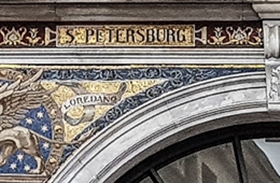
PETERSBURG


An old mosaic adorns the facade of the big Apple store on London’s Regent Street. It harks back to the time long ago when the building housing the store was a London Branch of a big insurance company. The mosaic was assembled and installed long before the great Russian Revolution of 1917. Various cities are named on the mosaic. One of these is St Petersburg. After the revolution , St Petersburg was renamed ‘Petrograd’ and then ‘Leningrad’, which remaine dits name until the 1990s when the city reverted to being ‘St Petersburg’. During my childhood and early adulthood, St Petersburg was ‘Leningrad’. Whenever I passed that mosaic, I used to marvel that the city’s old name remained unchanged on the facade of the building. It was a memory of historic times. Now, by chance, it is up to date.

Many of the readers of this blog will have realised that I visit India regularly. Most people know that Bombay is now known as ‘Mumbai’. Actually, speakers of Marathi and Gujarati have always called it that, but often still call it Bombay when speaking in English.

Madras has become Chennai. So what should one ask for when ordering Chicken Madras, which appears on many menus in Britain’s Indian restaurants?

In Karnataka, Bangalore has become Bengaluru, Mysore is now Mysuru, and Halebid is Halebidu. When I bought a bus ticket to Gulbarga in northern Karnataka, I was puzzled to see I had been issued with a ticket to Kalaburgi. This turns out to be the new name for Gulbarga.

Allahabad is now Prayagraj, a name that removes the Islamic flavour of its former name. There are moves afoot to de-islmamicise the name of Ahmedabad in Gujarat. The proposed name for the city founded by Ahmed is ‘Karnavati’, but the change has not yet been enforced.

Whether these changes of Indian place names will stick remains to be seen. Who can say whether they will revert like Leningrad that became St Petersburg again?

Scene in a ticket office

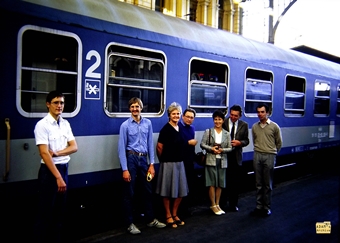
BUDAPEST KEL PU 83 Farewell 2

I used to visit Budapest in Hungary frequently in the 1980s during the Communist era. I had many good Hungarian friends there. They were very hospitable to me.

One day, I happened to visit the advanced booking office at Budapest’s grand Keleti (Eastern) Station. I have no recollection of where I was planning to go, but that is not relevant to the true story that follows. The smallish rectangular room was lined with about ten (or more) counters at each of which there was a booking office official. 

A young Soviet Russian soldier entered the room. He was in an immaculately smart uniform and looked proud. He went up to the first counter and spoke to the person behind it. After about a minute, he was instructed to go to the next counter. Once again, he spoke to the official behind the window at the counter. And, after a few minutes, he was directed to the next counter. This went on until he had visited each counter in the room and reached the last one. At the last one, the official indicated that he should leave the room as he was in the wrong room for obtaining tickets for Soviet military personnel.

You might have thought that the official at the first counter he visited would have directed him to the correct place, but no. So great was the average Hungarian’s disdain for the Soviet soldiery that was keeping their country under the thumb of the Soviet Union that the officials in the booking office conspired together to waste the young Soviet soldier’s time and humiliate him. It was a beautiful example of passive resistance.

Gandhi, Lenin, Stalin

gandhi

Non-violent Gandhi 

Beside three leading men

Who faced fate with force


This mantle-piece at Shaw Corner, the home of George Bernard Shaw at Ayot St Lawence in Hertfordshire, bears the portraits of (from left to right) Mahatma Gandhi, Felix Dzerzhinsky, Vladimir Lenin, and Josef Stalin. Shaw met all of these men.