THE GWALIOR MONUMENT stands on the bank of the Hooghly River in Kolkata (Calcutta). The monument commemorates British officers and their men, who died in the Gwalior War of 1843. Constructed in 1847 by the then Governor General of India, Lord Ellenborough, its roof is made of metal.
Several thousand miles away near London’s Hyde Park Corner and the towering Hilton hotel, there is a statue of the ancient hero Achilles. It commemorates the victories of Arthur Wellesley, 1st Duke of Wellington, and his men who helped achieve them. Standing on a granite plinth, Achilles is made of metal.
These two distantly spaced British memorials both contain metal in their construction. They have one more thing in common. The metal on the roof of the Gwalior Monument and that used to make Achilles is recycled. In each case, the metal was obtained by melting down the canons of the defeated armies. In the case of the Gwalior Monument, the metal was derived from the cannons of the defeated Marath army, and in the Achilles statue, it was derived from the enemy’s cannons captured at the battles of Salamanca, Vittoria, Toulouse, and Waterloo.
I wonder how the defeated armies would have felt if they had known that their weapons were being melted down to celebrate their opponents’ victories.
AFTER MY DAD’S father died, his mother remarried Isaac, a merchant, who lived and worked in Port Elizabeth (South Africa).
In his holidays, both school and then later university, Dad, whose father had owned a general store (in Tulbagh, South Africa), helped his stepfather in his shop in Port Elizabeth. Once again, he was in an environment where he was acquiring first-hand experience of the workings of commerce, one of the foundations on which the study of economics is based. By all accounts, including the fact that Isaac could afford regular holidays in Europe, the business prospered. Dad told me that during his vacations, he used to help Isaac compile annual inventories of his stock.
The shop owned by my father’s father in Tulbagh
One day, Dad came across many large glass bottles filled with boiled sweets that had become unsaleable because the candies had fused together to form huge masses. My father asked Isaac whether these bottles should be thrown out. He was told that they were to be retained. A few years later, WW2 broke out and there was a shortage of glass. Isaac sold the bottles filled with inedible sweets because the glass, now valuable, could be sold (for recycling) during the glass ‘famine’.
Was it experiences in his father’s and stepfather’s shops that might have led him to eventually become a professor of economics, and helped him to understand the concept of futures markets? I wonder.
THE VICTORIA EMBANKMENT was constructed along the River Thames in the 1860s. It was built to enclose a newly constructed sewer: the Main Low Level Sewer, which was part of the grand sewage system improvement project designed by Sir Joseph William Bazalgette (1819-1891). The wall of the embankment facing the river was constructed from large brick-shaped, carved granite stones, each weighing about 1 tonne. Several of these have had to be removed to construct a new sewage conduit – the Thames Tideway Tunnel.
58 of the granite stones have been repurposed to become a series of open-air public art installations. This series was created by Matthew Barnett Howland, Oliver Wilton, and CSK Architects. Small groups of these have been placed in seven locations: St Peter’s Hill, Carter Lane Gardens, St Paul’s Cathedral, Christchurch Greyfriars Church Garden, King Edward St, Little Britain and Smithfield Rotunda. Today, the 31st of July 2024, we came across the group placed in Little Britain, which is not far from Barbican Underground Station. What we saw were 3 of the huge locks of granite arranged in a straight line. A gentleman was using one of them as a bench while he looked at his mobile telephone. Next to them, a wooden sign explained what is going on. This was useful because if there had been no sign next to them, we might not have given them a moment’s notice.
You might well be wondering why this series of stones were placed at seven places in London. I will leave it to someone else to explain:
A FEW WEEKS AGO, we viewed a wonderful exhibition of contemporary quilt making at Swiss Cottage Library (see: https://adam-yamey-writes.com/2023/07/15/quilts-in-a-wonderfully-designed-library/ ). These quilts were made with both recycled bits of material and/or textiles specially bought for use in their manufacture. Although some of the works on display could be used as rugs or coverings, many of them were designed as non-functional artworks for display. Today (1st of August 2023), we visited the Brunei Gallery in London’s Bloomsbury. Our intention was to see an exhibition of paintings and drawings from the south of India. However, when we entered the place, we discovered that in addition to what we had come to see, there was another exhibition, which we did not know about. This is the rather intriguingly named “Japanese Aesthetics of Recycling”, which is on until the 23rd of September 2023. With a name like that, we could not resist taking a look at what was on show.
The exhibition has a fine collection of exhibits demonstrating the Japanese tradition of recycling old materials to create new objects. In a country where raw materials were highly valued, it made a lot of sense not to waste them, but to re-use them. We saw many examples of ‘Boro’ textiles. These are items made by fashioning worn clothing and waste fabrics to create another usable textile. Often, a large piece of used material with damage (e.g., holes) was made usable by patching it with scraps of waste material. Both quilting and Boro involve sewing pieces of material together. Unlike quilting, which uses scraps of material to create a brand-new entity, Boro uses scraps to restore worn textiles to make them usable again. There were also examples of ‘Washi’ on display. This is handmade paper concocted from already used sheets of paper (for example from discarded account books). The Washi was made waterproof by painting it with persimmon paste. Washi paper was used for many purposes including wrapping valuable clothing, floor coverings, room dividers, making bags, and more. For example, there was a conical hat made in leather and lined with waxed recycled Washi paper. In addition to these recycling techniques, there were several others. One which caught my attention was ‘Sakiori’, which in many ways resembles the North American and European rag weaving technique.
The exhibition was not only fascinating because of the range of recycling techniques exemplified, but also because many of the items made from the recycled materials were aesthetically pleasing. The exhibits are beautifully displayed, and the accompanying labels are interesting and informative. Whether you are interested in Japan or recycling or both, it is well worth visiting the Brunei Gallery to see this show.
TOLLESBURY IN ESSEX on the Blackwater River estuary is a village just over 5 miles southeast of Tiptree, a small town close to the Wilkinson jam factory and museum. This charming village, where a good friend of ours lives, has a venerable parish church, St Mary the Virgin.
Roman bricks used to construct the arch above the south entrance of St Mary’s in Tollesbury, Essex.
In common with most of the parish churches we have visited during our extensive roamings around the English countryside, this church, whose construction had begun by the 11th century, contains a rich selection of interesting features. These are well described in a copiously illustrated booklet about the edifice published by the Friends of St Mary’s Tollesbury in early 2020. Amongst the interesting things we saw within St Mary’s, one of them particularly intrigued me: the incorporation of Roman bricks in the fabric of the church.
Archaeologists have uncovered the remains of a Romano-British cemetery near the village. They have concluded from their findings that in about 200 AD, there was a significant rural settlement located near Tollesbury at that time. Other remains are evidence that the district around the estuarine village has been the site of human activity since the Neolithic era (4000-2000 BC).
As if to prove that recycling is not simply a recent trend, the church of St Mary incorporates bricks made whilst the Romans occupied England. These can be seen clearly above the south doorway within the church. The 11th century arch above this portal is made entirely of recycled Roman bricks. Some more brickwork made with Roman bricks can be seen exposed above the gothic archway in the western wall of the nave, which is also part of the late 11th century bell tower.
Although the re-used Roman bricks have been ‘highlighted’ in St Mary’s, the structure of the parish church in the nearby village of Goldhanger also contains recycled Roman bricks. Making bricks at the time when these churches were built would have been far more laborious than making bricks using today’s industrial techniques. So, re-using bricks that had already been made would have been very sensible.
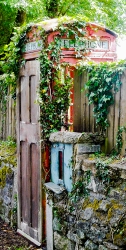
RURAL TELEPHONE BOXES (kiosks) are often used (re-purposed) to house AED defibrillators and small book libraries. Occasionally, they still contain coin-operated telephones. We were driving through rural Cornwall between Bodmin and Luxulyan, when we took a wrong turn and drove along a small lane. After making a three-point turn, I spotted an old telephone box partly covered with vegetation. Its original glazed door had been replaced by a wooden one that was quite out of keeping with the box’s elegant design. The present owner of the telephone box has been using this as the entrance to his or her garden. I was pleased to make find this quirky modification of an old telephone kiosk.
Here is a subject that might not appeal to the squeamish.
Currently in the UK, toilet paper is in very high demand. So great is the desire of people not to run out of this commodity that the supermarket shelves are empty of toilet rools. Or, if they are available, they are priced much higher than usual.
The panic buying of toilet paper is quite ridiculous. Alternative methods of posterior hygiene are widely available, and often used. Years ago, I visited a monastery in Greece. The toilet was not supplied with toilet paper. Instead, there were properly sized pieces of newspaper threaded on a string. There is plenty of newspaper about – no shortage. So, why not use it instead of the scarce once used toilet paper. Using newspaper will not only wipe away what is not desired, but also by being used, the newspaper is being uemployed more than once – recycled. A word of advice if you plan to move to newsprint, most of which is more suitable for wiping posteriors than for reading. The advice is do not flush newspaper down the toilet. Instead, put the used pieces in a bucket with a lid, and dispose of it hygienically.
If you are not keen on using newspaper, then do as millions of people do in the Middle East and Asia. Just use water and your left hand. Many toilets in Asia are supplied with small showers that can be used to purify your posterior. Some toilet seats have a conveniently and appropriately located spray attached. A jet of water from this device cleans your bottom like a car wash.
After reading this, you might stop panicking about buying ‘loo’ paper, BUT remember to always wash your hands frequently.
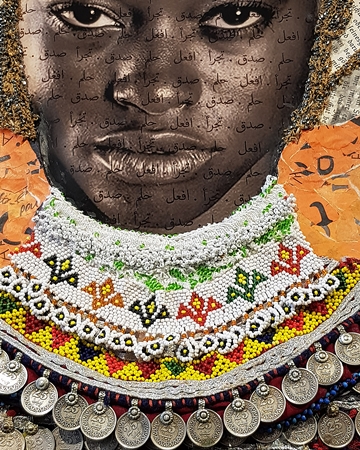
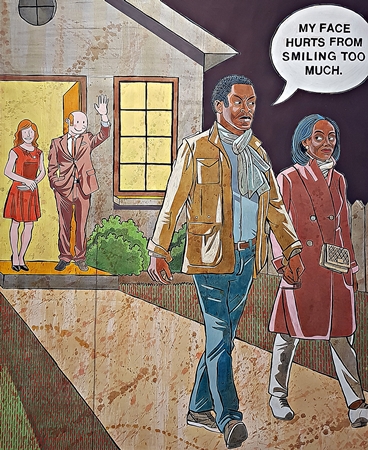
“The Contemporary African Art Fair (1 – 54)” is held annually at London’s Somerset House. This year it was a very exciting show full of vibrant, creative artworks mainly, but not exclusively, created by Africans with little or no European ancestry.
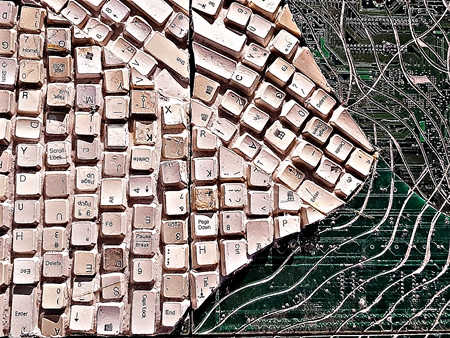
Many of the works use recycled waste materials such as bits of paper, engine parts, spent bullets and retired armaments, electronic components, and so on. Almost every art work is a fine aesthetic object when seen as a whole. Looking into any of these works in detail is like beginning to explore Africa, its troubled past and challenging present.
Africa is beginning to emerge from its colonial past. Africans are taking control of their destinies. Yet, at this exhibition, which is where a series of galleries display thier wares, mot of the dealers, who earn considerable commissions are ‘White’ Europeans. Maybe colonialism is not quite dead yet!





 yamey
yamey 