PHOTOGRAPHY HAS LONG been an artistic medium for expressing protest. This is well exemplified by photographic images on display at the excellent “Women in Revolt” exhibition, which is on at London’s Tate Britain until the 7th of April 2024, and is well worth seeing. Running concurrently with this. is an exhibition at the South London Gallery (in Peckham) – “Acts of resistance: photography, feminisms and the art of protest”, which is on until the 9th of June 2024.
As its title suggests, the show at Peckham consists mainly of exhibits that make use of photography. There are also several digital items. The subject matter deals with matters that concern feminists (and ought to concern everyone) including rape, abortion, genital mutilation, other forms of violence against women, and so on. Unlike the exhibition at Tate Britain, which deals mainly with feminist activities in Britain during the 1960s to 1980s, this show was to coin a phrase ‘art sans frontières”, and bang up to date. The exhibition has as its inspiration the words that the artist Barbara Kruger used in 1989:
“Your body is a battleground”.
Incidentally, there is an exciting exhibition of Kruger’s work at the Serpentine South Gallery (in Kensington Gardens) until the 17th of March.
The exhibition at Peckham (to quote the gallery’s website):
“… explores feminism and activism from an international and contemporary perspective. Looking at different approaches to feminism from the past 10 years, the show highlights shared concerns including intersectionality, transnational solidarity, and the use of social media and digital technology as a tool for change.”
It includes works by at least 20 artists, some of them working as collaborators. Their creations are displayed well both in the gallery and its annexe nearby in a disused fire station. Put simply, the works on display at Peckham have a far more visceral impact than those being shown at Tate Britain, which in many cases appeal more to the brain than to the heart. Even if you ignore the messaging conveyed by the artists in the works at Peckham – and this is not easy to do – their visual impact is magnificent. They are works of art as well as being tools of protest. This is an exhibition well worth making the trek out to Peckham!
I DO NOT KNOW whether it was deliberate or accidental that currently (until the 7th of April 2024) there are two contrasting (or, maybe, complementary) exhibitions on in the galleries of London’s Tate Britain.
On the first floor, there is an exhibition called “Sargent and Fashion”. It is a collection of paintings by the American-born artist John Singer Sargent (1856-1925), who was born in Florence (Italy) and died in London (UK). The aim of the show is, according to the Tate’s website, to show:
“… how this remarkable painter used fashion to create portraits of the time, which still captivate today.”
The exhibition includes some of Sargent’s portraits alongside a few of the items of clothing that his subjects wore whilst he was creating their portraits. In this well laid out show, the viewer gets to see that Sargent was an excellent painter, whose portraits manage to radiate the natures of the sitters’ personalities. I doubt that most of Sargent’s subjects would have been disappointed with the pictures he produced for them. Many of the paintings are portraits of women. Almost all of them were depicted wearing elegant clothes, and are superbly executed conventional portraits. They celebrate aspects of the ‘respectable’ (i.e., wealthy) society of his times.
Beneath the Sargent exhibition, on the ground floor of Tate Britain, there is an exhibition showing how women in Britain broke out of their conventional male-dominated lifestyle during the 1970s and 1980s. Called “WOMEN IN REVOLT Art, Activism and the Women’s movement in the UK 1970–1990”, it is according to the Tate’s website, it is:
“… a wide-ranging exploration of feminist art by over 100 women artists working in the UK. It shines a spotlight on how networks of women used radical ideas and rebellious methods to make an invaluable contribution to British culture. Their art helped fuel the women’s liberation movement during a period of significant social, economic and political change.”
During a long part of the period covered by the show, Britain had its first female Prime Minister, Margaret Thatcher (in office from 1979-1990). Although she fought her way through hitherto male bastions to emerge as the country’s first lady Prime Minister and showed what women were capable of doing in the world of politics, she was not a feminist icon, as Natasha Walter wrote in The Guardian (online 5th of January 2012):
“Obviously Thatcher was no feminist: she had no interest in social equality, she knew nothing of female solidarity … We should never forget her destructive policies or sanitise her corrosive legacy. But nor should we deny the fact that as the outsider who pushed her way inside, as the woman in a man’s world, she was a towering rebuke to those who believe women are unsuited to the pursuit and enjoyment of power. Girls who grew up when she was running the country were able to imagine leadership as a female quality in a way that girls today struggle to do. And for that reason she is still a figure that feminists would be unwise to dismiss.”
However, as Baroness Burt of Solihull said in the House of Lords on the 5th of February 2018:
“… my next figure is 1979, which, of course, was the date when we got our first female Prime Minister. Personally, I would feel more inclined to celebrate this milestone if she had encouraged other women to come forward, to use some of the talented women that she had at her disposal. But, sadly, she got to the top and pulled the ladder up behind her, which is a great shame, because the whole point of having representation from all parts of society is to make for better government.”
As several exhibits on display at the Tate (until the show ends on the 7th of April 2024), Mrs Thatcher was intensely disliked by artists encouraging ‘female liberation’.
Before entering the exhibition, I was a little worried that all I would see was propaganda and other polemic material. Well, there was plenty of that kind of thing, and much of it was both interesting and often visually intriguing – sometimes quite witty. The exhibition, which is excellently curated, also includes many paintings, sculptures, videos, and other artistic items. These have mostly been created by female artists with whom I am not familiar. And all of them are both visually engaging and satisfying. Several of these were of Indian heritage, and others have ‘black’ African heritage. There are also cases containing printed material that propagated feminist ideas. Included amongst these were a few copies of the magazine Spare Rib, which I remember seeing at friends’ houses many years ago. My future wife was one its readers. Published between 1973 and 1993, its aim was to challenge the traditional roles of females (of all ages) and to explore new ways in which they could engage in society. In fact, this was the aim of many – if not all – of the works in the exhibition.
We visited both exhibitions today (the 28th of February 2024), to experience the contrast between them. Both are excellent in their own ways and achieve what the curators intended. They are both well worth visiting. However, to my taste, the exhibition on the ground floor was far more exhilarating and inspiring, that the more conventional show on the floor above it.
KANNADA IS THE language spoken by the indigenous people of the Indian State of Karnataka. It is a Dravidian language spoken by about 44 million ‘natives’ of Karnataka and a 2nd or 3rd language for about 15 million ‘non-natives’.
The city of Bangalore is home to many people who either know no Kannada or for whom the language is not their ‘mother tongue’. Consequently many shop signs in the city either have no Kannada or have both English and Kannada lettering.
At the end of February 2024, it will be a legal obligation for all shop signs in Karnataka to have at least 60% of their coverage in Kannada script (currently, the requirement is 50%). However, for some fanatic Kannada nationalists this is not soon enough. On the 27th of December 2023, a few lorries loaded with men toured Bangalore. They stopped outside shops and attempted, often successfully, to damage or destroy the English lettering on shop signs. They did this not only to those signs which were entirely in the English script, but also to some bilingual signs (I.e., signs with both English and Kannada script). Not only did they damage or disfigure the English script, but in some cases, they also smashed windows.
Defaced shop sign
The police attempted to restrain these pro-Kannada activists. A few of them have been arrested. However, two days later I read that further unrest in Bangalore is threatened if those who have been arrested are not released.
While I sympathise with locals being upset that many of those who have come to Karnataka from elsewhere have little or no knowledge of Kannada, vandalism is no way to promote usage of the language and its script.
LADY GODIVA WHO died sometime in the second half of the 11th century (AD), has often been depicted by artists as riding nude through the city of Coventry. She was an Anglo-Saxon aristocrat, who was married to Leofric Earl of Mercia.
According to legend, she made her famous horse ride through Coventry to protest against excessive taxation that her husband had imposed on the people.
Most artists have portrayed her as being totally nude, thus producing images or sculptures with some pornographic content.
The Herbert Art Gallery in Coventry has a small gallery dedicated to Godiva. Most of the artworks on display show her without any clothing. However, one painting shows her on her horse but wearing plain, unrevealing simple garments. This is most likely how Lady Godiva was dressed on her ride. The reason is that penitents used to wear unadorned undergarments when processing in public. It is most likely that Godiva, who would have normally worn fancy clothing and jewellery, rode through the city devoid of these trappings of wealth and position – this would have been described as ‘naked’.
Our short visit to the Godiva exhibit was most interesting because it opened our eyes to another interpretation of Lady Godiva and her protest.
The Madras Gymkhana Club library was not devoid of interest. To enter it, one has to climb over a tall step. This is designed to protect the library when rainfall causes flooding of the Club’s grounds which are on low lying land close to the Adyar River estuary.
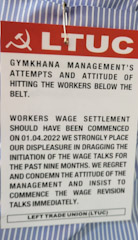
Another interesting feature was pinned to the shirt of one of the library staff. It was a rectangular plastic badge with a hammer and sickle on both of its sides. One side had words in Tamil, and the other in English. These words explain to the reader that there was a grievance between the staff and their employers, The Club. The problem about which the employees were protesting concerned pay. Seeing these badges of protest reminded me of a visit to Nizam’s restaurant in Kolkata a few years ago. There, the waiters were wearing similar badges, some in Bengali, some in Hindi, and others in English.
As for the library, it seemed well stocked with books and journals. Several old books were being sold, and there were three that I could not resist!
AT THE TICKET desk of the Barbican Gallery we were hesitantly asked if we knew about the exhibition of Carolee Schneemann (1939-2019) because it contains some sexually explicit exhibits. We said we knew roughly what we were heading for.
The exhibition is laid out on two floors and visitors are given a suggested route that allows one to see the gradual development of Schneemann’s work from abstract and semi-abstract painting through to highly adventurous installations and happenings (to use a word that assumed a special meaning in the 1960s).
The artist’s earlier works are on the upper floor. Dissatisfied with the relative flatness of painting on canvas, she began adding a third dimension to her paintings. Soon she was producing collections of objects in boxes, rather like the kind of things produced by Joseph Cornell. Unlike Cornell, who filled his boxes and frames with intact objects, Schneemann filled hers with damaged objects, such as rusty musical boxes and fragments of broken glass.
Much of Schneemann’s work became involved with the human body and sexual experiences, as depicted from the female point of view. In many of her creations, she used her own body as a prop. For example, there is a film recording of a ‘happening’ during which she painted glue on her naked body and then applied scraps of paper to herself, creating a human collage. Many of her other works either defy description or if described might disturb the squeamish or prudish reader.
Later in her career, she moved from depicting the body and sexual matters to political comment and protest. Most of these often powerful works are in the form of videos and installations.
I much preferred the earlier works on the upper floor. They were created as timeless artworks that could be looked at whenever. The more adventurous and innovative works on the lower floor are mostly almost static records of events that would have been seen to full and maximum effect when they took place in real life so many years ago. That said, this exhibition was both exciting and interesting.
POLITICAL PROTEST AND CONFLICT can be expressed in a wide variety of ways. Defacement of commonplace items is one of these. It forms the basis of a temporary exhibition, “Defaced!”, being held at the Fitzwilliam Museum in Cambridge (Cambridgeshire) until the 8th of January 2023.
Many of the exhibits on display are banknotes that have been defaced or altered in design to express a political message or protest. One example of this is a five-dollar US banknote with the words “All Lives Can’t Matter until Black Lives Matter” embossed on its portrait of Abraham Lincoln. Another is a five hundred Indian rupee note with a coloured picture of an endangered rare bird printed over it. Yet another banknote is designed to look like a British £20 note at first sight, but it soon becomes apparent that it is not what it seems: it has been modified to include a portrait of ex-Prime Minister Boris Johnson and the words “The ruling class. We own you.” It also includes the words “We were born to lead, you were born to follow.” Other banknotes have been redesigned so that they appear to be valueless: e.g. zero Japanese Yen and zero US Dollars. The diversity of altered banknotes and parodies of actual banknotes on display is staggering.
Occasionally banknotes lose their value during periods of hyperinflation. The exhibition includes several examples of objects, such as wallets, made using trashed valueless notes. Particularly striking is a life-size sculpture of a hand grenade made using shredded PRC ten Yuan banknotes.
There are also many coins on show. They have all been altered to express protest and/or political sentiments. One dramatic example of this is a coin issued in France during the reign of Napoleon III. This was altered by carefully cutting around and removing the portrait of Napoleon III from the coin, leaving the rest of the coin intact. There are several coins and medals on display that depict political events such as the American Revolution and the Peterloo Massacre. A few coins relate to the unrest in Northern Ireland. One of them is a 1970 Republic of Ireland fifty pence coin with the words “Ulster is British” stamped on it.
The show at the Fitzwilliam does not confine itself to the defacement and parody of currency for political and protest purposes. It also includes currency either modified or specially created for special purposes. Simple examples of these are overprinting of low value notes during hyperinflation and modification of currency for use by the military or in POW camps. There are also coins, notes, and certificates created for specific purposes, for example for use in the Siege of Mafeking and for use by Boer prisoners imprisoned by the British in India.
Although most of the exhibits are related to currency (coins and notes), one room is dedicated to a spectacular sculptural exhibit, an installation called “Big Bang 2. Debt in transit”. A video is projected onto a wall. It shows a Ford Transit van being blown up by explosives. As it flies into pieces, bits of paper all marked with the word ‘debt’ float down like snowflakes. The film is projected in a room in which the fragments of the van are suspended from the ceiling so that the viewer appears to be seeing a still from the video but in three dimensions. The installation, which is a protest on the exorbitant interest on payday loans, makes a very powerful visual impact. (SEE my video of this posted on YouTube: https://youtu.be/7MgdDTfBivw)
DESPITE THE RAIN, we decided to walk along the path by the River Thames, proceeding upstream from Hammersmith. I had done this before, but never ventured beyond (i.e., upstream) the attractive church of St Nicholas, Chiswick, in whose graveyard you can find the funerary monument to the painter, William Hogarth (1697-1764), whose former home is nearby, and another to the Italian patriot, Ugo Foscolo (1778-1827). After walking along a riverside pathway that passes several recent, moderately attractive, but probably immoderately priced, housing estates, we reached Chiswick Pier at Corney Reach, whose name commemorates the now demolished Corney House, where Queen Elizabeth I was once entertained by the Earl of Bedford, who owned the place (www.chiswickw4.com/default.asp?section=info&page=conhistory29.htm).
Several lovely old houseboats are moored next to the pier. Near the jetty there is a noticeboard explaining the history of each of these vessels. Soon after this, the riverside path enters Dukes Meadow. Up to Barnes Bridge, which is a combined rail and pedestrian crossing over the river, the meadows form a grassy promenade running parallel to the Thames. Beyond the bridge, the meadows widen out and extend to Great Chertsey Road that crosses Chiswick Bridge.
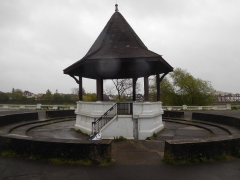
The bandstand at Dukes Meadow
The history of Dukes Meadow is recorded in a detailed essay by Gillian Clegg (https://brentfordandchiswicklhs.org.uk/dukes-meadows-the-threats-to-its-rural-survival/), from which I have extracted most of the following. In the past, the Meadow were low lying farmland and orchards prone to occasional flooding. The land was owned by the Dukes of Devonshire and cultivated by the Jessop family, then later farmed by John Smith of Grove Farm. Incidentally, one of the Dukes, William, the 5th Duke of Devonshire (1748-1811), who had owned nearby Chiswick House in the 18th century. He had both enlarged the house (in 1788) and extended its grounds. At one time, the grounds of Chiswick House must have neighboured the Dukes Meadow. Ms Clegg noted that it was miraculous that the meadows survived as such considering the plans that were proposed for making use of it during the early 20th century.
Two plans were conceived for the ‘development’ of Dukes Meadow. The first was a housing scheme that was to be named ‘Burlingwick’. Clegg wrote:
“On 19 April 1902 The Times newspaper reported that ‘an influential body of capitalists’ had negotiated successfully with the Duke of Devonshire for 330 acres of land for a building plan to be called Burlingwick. The promoter, manager and developer of this scheme was Jonathan Carr, the developer of Bedford Park.”
Had this gone ahead, it would have created housing for up to 400,000 people and 330 acres of green land would have been lost to bricks and mortar. Fortunately, for reasons that are not now too clear the scheme was abandoned in about 1906.
1914 saw the next threat to the Meadows. The Brentford Gas Company planned to cover 80 acres of the Meadow with a huge gasworks. The people of Chiswick and other areas raised strong objections. The London “Times” of 6th February 1914 published its doubts about the scheme, which it said went against all the principles of good town planning, suggesting:
“…that land ripe for building – such as the Chiswick orchard farm – near the heart of the metropolis should be utilized for parks and garden settlement.”
The plan was scrapped, but what the “Times” had alluded to was later realised, but in a then novel way.
In 1923, the local council bought 200 acres of land from the then Duke of Devonshire. The land was to be used as a public recreation area complete with a riverside promenade, a bandstand, and a children’s area with paddling pools. All of this cost the council much money. To recoup some of what they had spent, they made an agreement with the Riverside Sand and Ballast Group. As Ms Clegg explained, the company:
“…was allowed to extract at least five acres every year in exchange for £1,500 an acre.”
The extraction of gravel proceeded from 1924 until 1937 and caused considerable damage to the area. Ms Clegg explained that when the land was finally returned to the council in 1948:
“The gravel pits were filled in, mainly with rubbish brought from inner London, and the area re-landscaped. Dukes Meadows has been described as one of the earliest and most impressive examples of restoration.”
Today, the promenade remains but I saw neither a children’s play area nor paddling pools, which still exist. The bandstand, which stands within a sunken circle lined with steps on which the audience can sit has a hexagonal tiled roof supported by six plain pillars. It is flanked on two sides by spacious shelters, also with tiled roofs. All their roofs are designed so that the angle (or degree) of pitch reduces noticeably about two thirds of the way from the top. Judging by their appearance, I would guess that these structures were built back in the early 1920s. This is confirmed by their appearance in a photograph taken during those years. Also visible in this picture are the unusual, twisted railings, looking like sugar-candy, running alongside the water, and supported by concrete posts with rounded tops. These are still in place today as are their concrete supports which bear simple decorative patterns. Some balustrading can be seen lining the waterfront near the bandstand (see quote below).
Part of the promenade leading towards Barnes Bridge from the Chiswick end of the Meadow is arranged in the form of two long steps. I have no idea why, but maybe they were once used by spectators watching boat races on the river. An article written in 1924 describes the popularity the Meadow with people watching the annual university boat race (http://dmtrust.dukesmeadowspark.com/newriversidepleasaunce.html):
“…in fact so many thousands of people availed themselves of this vantage point last Saturday week at the small admission fee charged by the Council, that over £1,000 net was raised towards the promenade project.”
However, currently a line of bushes obscures sight of the river and the suburb of Barnes across it from these steps. A planning document produced in November 1923 (http://dmtrust.dukesmeadowspark.com/ariversideboulevard.html) sheds a little light on these steps:
“The Scheme, which received the first prize and was submitted by MR A. V. Elliot, of Chiswick, is reproduced on this page. It shows a series of terraces with a plateau of turf, showing seats and rustic shrubberies at intervals, and with a central feature of a bandstand and stone balustrading including a flight of steps and a causeway admitting to the river at all states of the tide.”
We enjoyed our stroll along the Dukes Meadow promenade even though the sky was grey, trees were dripping, and raindrops were falling intermittently. On our way back along the Thames Path to Hammersmith, we stopped at a charming Italian eatery and delicatessen on Chiswick Mall. The place, which is run by Sicilians, is called Mari Deli & Dining, and merits a visit to enjoy a good espresso, at the very least.
COPENHAGEN FIELDS WAS an open space north of the Barnsbury district of London’s Islington. In the 17th century, the place was beyond the northern edge of London. As with other open spaces in 17th century Islington, it was an area where people whose homes had been destroyed in the Great Fire of 1666 congregated with what belongings they managed to salvage. By the 18th century, Copenhagen Fields had become a place where large numbers of Londoners used to gather for political meetings.
Animals being led to Caledonian Market
According to William Howitt writing in his “The Northern Heights of London” (published in 1869), the fields acquired its name following a visit of the King of Denmark to his relative King James I (reigned over England, Scotland and Ireland from 1603 to 1625). A Dane built a house on the open space, Copenhagen House. The name ‘Copenhagen’ appears on a map published in 1695. Howitt reveals that Copenhagen Fields and its house became a place of recreation for Londoners:
“It became a great tea house and resort of the Londoners to play skittles and Dutch-pins. It commanded a splendid view over the metropolis, the heights of Highgate and Hampstead …”
As mentioned, Copenhagen Fields was connected with political activity; it was a place of mass protests. Not long after the French Revolution, there was a meeting in the open space:
“On the 12th of November 1795 a public meeting was summoned by the London Corresponding Society in Copenhagen Fields which was attended by more than a hundred thousand persons. Five rostra or tribunes were erected, and Mr. Ashley, the secretary, informed the meeting that it at each of them petitions to the King, Lords and Commons against the Bill for preventing seditious meetings would be offered to their consideration.” (www.historyhome.co.uk/c-eight/france/copenhagen.htm).
The best remembered protest that occurred in Copenhagen Fields was on the 21st of April 1834. Thousands of people commenced marching from there to central London in support of the Tolpuddle Martyrs, who lived in Dorset:
“In 1834, farm workers in west Dorset formed a trade union. Unions were lawful and growing fast but six leaders of the union were arrested and sentenced to seven years’ transportation for taking an oath of secrecy. A massive protest swept across the country. Thousands of people marched through London and many more organised petitions and protest meetings to demand their freedom.” (www.tolpuddlemartyrs.org.uk/).
Many of those marchers began their procession from Copenhagen Fields:
“Up to 100,000 people assembled in Copenhagen Fields near King’s Cross. Fearing disorder, the Government took extraordinary precautions. Lifeguards, the Household Cavalry, detachments of Lancers, two troops of Dragoons, eight battalions of infantry and 29 pieces of ordnance or cannon were mustered. More than 5,000 special constables were sworn in. The city looked like an armed camp.
By 7am the protesters began to gather marshalled by trade union stewards on horseback. Robert Owen, the leader of the Grand Consolidated Union and the father of the Co-operative Movement arrived.
The grand procession with banners flying marched to Parliament in strict discipline. Loud cheers came from spectators lining the streets and crowding the roof tops. At Whitehall the petition, borne on the shoulders of twelve unionists, was taken to the office of the Home Secretary, Lord Melbourne. He hid behind his curtains and refused to accept the massive petition.” (www.tolpuddlemartyrs.org.uk/story/mounting-protest)
In June 1855, Queen Victoria’s Consort, Prince Albert, opened the Metropolitan Cattle Market (later known as ‘Caledonian Market’). This market occupied most of the area of Copenhagen Fields. It was built to ease the congestion caused by driving live animals into the more centrally located Smithfield Market. Although at first many animals walked to the market from the fields where they were raised, the market was built close to the goods yards of the recently built Great Northern and North London railways (https://en.wikipedia.org/wiki/Metropolitan_Cattle_Market).
Cattle travelled (under their own ‘steam’) two hundred miles from Devon at two miles per hour, walking twelve hours a day. Sheep from Wales, also two hundred miles from Copenhagen Fields, would be trotting across England to London for twenty days. Some cattle travelled even further: over five hundred miles from Scotland. These fascinating figures can be seen on a sign located in the park that stands where the cattle market stood between 1855 and the early 20th century, when trade in live animals began to decrease. Later, the market area was used for selling antiques and bric-a-brac. The Caledonian Market finally closed in 1963.
Much of the old market area is now used for recreation. On the south side of Market Road, there are enclosed sporting areas. The northern side is an attractive little park. All that remains of the market are the Victorian cast-iron railings, which are in various states of decay, and the market’s clock tower, which has been beautifully restored. The tower is 151 feet tall. It used to stand amidst the now-demolished dealers’ offices and close to the also demolished abattoirs.
Just north of the tower, there is a small café which is named in honour of the Tolpuddle Martyrs. Within it, there is a wall facing the serving counter. This has two murals commemorating mass protest. One of them, painted in a style reminiscent of social realism depicts people of many different ethnicities marching beneath a banner of The Islington Trades Union Council. This bears the words:
“Reclaim our past. Organise our future”.
The other mural commemorates the Tolpuddle Martyrs.
Panels on the walls of the café and around the north entrance to the park are decorated with scenes from the history of the area in the form of silhouettes. Some of them show animals being driven through the countryside. Others depict market scenes and the shops in which the meat was sold. Circular panels mounted on the walls of the tower show old photographs of the market in its heyday.
Although the park is not as spectacular as many other London parks, it is worth visiting to see the magnificently restored market clock tower and the several plaques and illustrations that provide clear explanations of the area’s historical importance. In addition, the small café and surrounding buildings within the park are good examples of contemporary architecture. The Caledonian Park, the former Copenhagen Fields, is yet another fascinating feature that contributes to what is wonderful about London.
INDIAN INGENUITY KNOWS NO BOUNDS. Recently in many Indian cities, there have been public protests against unpopular new legislation. Bangalore is one of these cities.
To counter the protestors there have been temporary bans on large groups assembling to protest. In some places the police have arrested and even attacked some protestors, causing injuries and deaths.
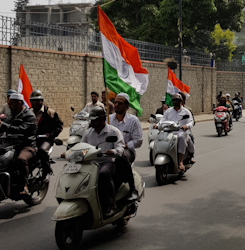
On the 23rd December, I was walking along Museum Road in central Bangalore. Suddenly, I saw swarms of motorcycles streaming past. Many of the people on the cycles were carrying the Indian tricolour, the national flag. The flags flew behind the bikes. Some of the passengers on the motorcycles were carrying paper banners with words expressing dislike of the new legislation.
The motorcycles were most probably heading towards a planned public protest. But, they might also have been carrying out a mobile protest, which being at a high speed made it difficult for the police to control. Even if they were only travelling towards the site of a protest gathering, it struck me that this high velocity and noisy protest on wheels was an ingenious way of attracting public attention whilst minimising the risk of police interference.






 yamey
yamey 