ALTHOUGH LONDON’S IMPERIAL War Museum contains a rich collection of objects related to warfare, it also has a fine art gallery in which there are many paintings inspired by, and recording, wars from WW1 onwards. The artworks, mostly paintings, are to be found in the rooms in the Blavatnik Art, Film and Photography Galleries on the museum’s third floor.
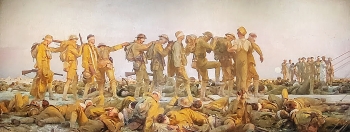
“Gassed” by John Singer Sargent
The paintings and other artworks are mostly by artists, who are now well-known, such as, to mention only a few: Joan Miro, Paul Nash, Eileen Agar, Laura Knight, Percy Wyndham-Lewis, John Piper, Eric Ravilious, John Singer Sargent, David Bomberg, and Steve McQueen. Others are by less well-known artists, and many of them have created images inspired by outbreaks of warfare that have occurred since the end of WW2. One of these, made by Steve McQueen, is a collection of postage stamps with faces of military personnel who died during the relatively recent Iraq conflict. These postage stamps, all of which bear a soldier’s portrait and the head of Queen Elizabeth II, are kept in a special wooden cabinet with sliding panels that can be pulled out to see the stamps. Like all the other artworks, this is both dramatic and moving. And seeing them during a period of warfare in the Middle East made them seem even more poignant.
There are several paintings by artists who joined British Colonial Artists Scheme, which encouraged ‘native-born’ artists to depict aspects of activities connected with warfare in the colonies. One of these artists was an African called Katongole. Another artist of interest is an Iraqi refugee called Walid Siti, who was born in Iraqi Kurdistan in 1984, and his etching was inspired by warfare.
Of all the wonderful paintings on display, two particularly attracted my attention. One showing Indian soldiers, who were recovering from injuries during WW1, lying in beds under a large, amazingly decorative dome in Brighton Pavilion, This was painted by Douglas Fox-Pitt in 1919. The other, which is the biggest picture in the galleries, is by John Singer Sargent. Called “Gassed”, it shows a long line of blindfolded soldiers, injured by poisonous gas, being led by an officer wearing a white overcoat. As they walk along, they are passing the corpses of their fellow soldiers.
The artworks in the Blavatnik Galleries at the Imperial War Museum easily rival what can be seen in the permanent collection of Tate Modern, and are a ‘must-see’ for anyone who has an interest in twentieth century artists, especially those who worked in Britain.
WHEN A FRIEND invited us to join him at London’s Kenwood House to view an exhibition of portraits by the artist John Singer Sargent (1856-1925), I had some misgivings. In the not-too-distant past I saw an exhibition of his portraits at the Tate Britain, and I left it unimpressed. In that show, the portraits were displayed alongside the dresses that the sitters had worn for their pictures. In contrast, the show, which is on at Kenwood until 5 October 2025, was very satisfying.
Between 1870 and 1914, 102 American women married men in the British peerage, and more than this married into the British upper class. Put bluntly, the men were enriched by their American brides’ money, and the ladies acquired social positions that were highly regarded in British society. Regarding these marriages, Theodore Rooseveldt said:
“I thoroughly dislike … these international marriages … which are not even matches of esteem and liking, but which are based upon the sale of the girl for her money and the purchase of the man for his title.”
Sargent, the artist, made portraits of more than thirty of these brides, and it is a selection of these that are on display at Kenwood in an exhibition appropriately named “Heiress. Sargent’s American Portraits”. Each picture is accompanied by an information panel that gives interesting biographical details about the ladies.
Undoubtedly, Sargent’s grand portraits made with oil paints on canvas are superb. However, even better than these, and there are several on display at Kenwood, are his charcoal sketches. Unlike the paintings that required the subject to attend 6 or more sittings, the charcoal portraits were completed in one sitting. Despite or maybe because of the rapidity of completing the charcoal images, these portraits seem to be even more expressive than the oil paintings upon which he had spent far more time. During a period of 20 years, he completed almost 700 charcoal portraits. Although there might have been one or two of his charcoal portraits at the Tate exhibition, a great proportion of the exhibits at Kenwood were examples of Sargent’s superb charcoal technique. For me, the highlights of this small exhibition were the works executed in charcoal.
I left the show at Kenwood feeling pleased that I had been, and with a greater appreciation of Sargent’s talent than I had before.
I DO NOT KNOW whether it was deliberate or accidental that currently (until the 7th of April 2024) there are two contrasting (or, maybe, complementary) exhibitions on in the galleries of London’s Tate Britain.
On the first floor, there is an exhibition called “Sargent and Fashion”. It is a collection of paintings by the American-born artist John Singer Sargent (1856-1925), who was born in Florence (Italy) and died in London (UK). The aim of the show is, according to the Tate’s website, to show:
“… how this remarkable painter used fashion to create portraits of the time, which still captivate today.”
The exhibition includes some of Sargent’s portraits alongside a few of the items of clothing that his subjects wore whilst he was creating their portraits. In this well laid out show, the viewer gets to see that Sargent was an excellent painter, whose portraits manage to radiate the natures of the sitters’ personalities. I doubt that most of Sargent’s subjects would have been disappointed with the pictures he produced for them. Many of the paintings are portraits of women. Almost all of them were depicted wearing elegant clothes, and are superbly executed conventional portraits. They celebrate aspects of the ‘respectable’ (i.e., wealthy) society of his times.
Beneath the Sargent exhibition, on the ground floor of Tate Britain, there is an exhibition showing how women in Britain broke out of their conventional male-dominated lifestyle during the 1970s and 1980s. Called “WOMEN IN REVOLT Art, Activism and the Women’s movement in the UK 1970–1990”, it is according to the Tate’s website, it is:
“… a wide-ranging exploration of feminist art by over 100 women artists working in the UK. It shines a spotlight on how networks of women used radical ideas and rebellious methods to make an invaluable contribution to British culture. Their art helped fuel the women’s liberation movement during a period of significant social, economic and political change.”
During a long part of the period covered by the show, Britain had its first female Prime Minister, Margaret Thatcher (in office from 1979-1990). Although she fought her way through hitherto male bastions to emerge as the country’s first lady Prime Minister and showed what women were capable of doing in the world of politics, she was not a feminist icon, as Natasha Walter wrote in The Guardian (online 5th of January 2012):
“Obviously Thatcher was no feminist: she had no interest in social equality, she knew nothing of female solidarity … We should never forget her destructive policies or sanitise her corrosive legacy. But nor should we deny the fact that as the outsider who pushed her way inside, as the woman in a man’s world, she was a towering rebuke to those who believe women are unsuited to the pursuit and enjoyment of power. Girls who grew up when she was running the country were able to imagine leadership as a female quality in a way that girls today struggle to do. And for that reason she is still a figure that feminists would be unwise to dismiss.”
However, as Baroness Burt of Solihull said in the House of Lords on the 5th of February 2018:
“… my next figure is 1979, which, of course, was the date when we got our first female Prime Minister. Personally, I would feel more inclined to celebrate this milestone if she had encouraged other women to come forward, to use some of the talented women that she had at her disposal. But, sadly, she got to the top and pulled the ladder up behind her, which is a great shame, because the whole point of having representation from all parts of society is to make for better government.”
As several exhibits on display at the Tate (until the show ends on the 7th of April 2024), Mrs Thatcher was intensely disliked by artists encouraging ‘female liberation’.
Before entering the exhibition, I was a little worried that all I would see was propaganda and other polemic material. Well, there was plenty of that kind of thing, and much of it was both interesting and often visually intriguing – sometimes quite witty. The exhibition, which is excellently curated, also includes many paintings, sculptures, videos, and other artistic items. These have mostly been created by female artists with whom I am not familiar. And all of them are both visually engaging and satisfying. Several of these were of Indian heritage, and others have ‘black’ African heritage. There are also cases containing printed material that propagated feminist ideas. Included amongst these were a few copies of the magazine Spare Rib, which I remember seeing at friends’ houses many years ago. My future wife was one its readers. Published between 1973 and 1993, its aim was to challenge the traditional roles of females (of all ages) and to explore new ways in which they could engage in society. In fact, this was the aim of many – if not all – of the works in the exhibition.
We visited both exhibitions today (the 28th of February 2024), to experience the contrast between them. Both are excellent in their own ways and achieve what the curators intended. They are both well worth visiting. However, to my taste, the exhibition on the ground floor was far more exhilarating and inspiring, that the more conventional show on the floor above it.