EVERY NOW AND then, when touring around England, we have spotted village lock-ups. These were small places with barred doors where prisoners could be held briefly in a cell until more suitable accommodation could be found for them. These miniature jails were:
“… used in the eighteenth and nineteenth centuries to house criminals who were apprehended on suspicion of committing petty crime … Lock-ups were only temporary forms of imprisonment, usually for one or two people, before the local authorities of the day decided how to deal with the offender. Criminals could be released or sent to the closest large town for trial.” (www.essexlive.news/news/essex-news/historic-jails-essex-you-can-3227277).
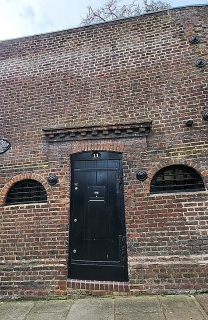
There were probably quite a few parish lock-ups in London, but now most of them have disappeared. However, if you walk along Cannon Lane in Hampstead, you will find one that has been preserved to some extent. It is within the garden wall of the grounds of Cannon Hall, which is where local magistrates held court, A plaque next to its entrance informs that the lock-up was established about 1730. Soon after the creation of the police force in 1829, the lock-house became disused, and prisoners were locked up in the Watch House that stands in Hampstead’s Holly Walk. Today, it seems as if the entrance to the former lock-house, flanked by two barred windows, is now the front door of some kind of residential accommodation.
MANY ART WORKS are ‘imprisoned’ in museums, galleries, and private collections. Today, 25 January 2026, we visited a collection of art ‘incarcerated’ in a prison.
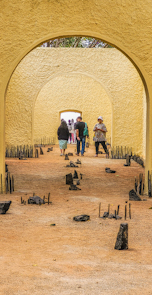
The prison is, in fact, a former prison. It is what was once the grounds of Bangalore’s Central Jail. After it became disused, it was converted into a public park in 2008: Freedom Park. This contains many of the former prison’s buildings, which have been restored to create a fascinating museum within a leafy park.
Freedom Park was the site of the 2026 BLR Hubba, which we visited today. The Hubba is a 10-day annual art festival held in Bangalore. Each year it is held at one of the city’s historic landmarks. This year at the former jail.
Encompassing many kinds of art including for example, sculpture, painting, music, theatre, and poetry, this festival is well-attended and vibrant.
At Freedom Park, the Hubba’s artwork and events were scattered all over the site of the former jail including within the cell blocks and at the place where hangings were carried out.
On the Sunday that we visited the Hubba, there was a competent jazz band playing and a crowd of visitors. Everyone seemed to be enjoying the art and themselves.
In comparison with the rather disappointing 2025/26 Kochi Muziris Biennale, which we attended in early January, the Hubba was wonderful: a well curated, excitingly appealing festival of art. Although the Hubba contained far fewer things than the much larger biennale, it produced a far more impressive impact on us than what we saw in Kochi
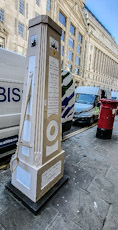
LONG BEFORE LONDONERS began the current fashion of carrying bottle of water wherever they go, the city’s inhabitants had to rely on water sources such as hand-operated street pumps. Although there are still a few functioning public drinking fountains in London, there are no usable pumps to be found. However, a few of them have been kept as historic monuments. One of these is located on the north pavement of Cornhill, a few yards east of the Royal Exchange building.
The pump, which is now kept looking like new – except that it no longer works – was set-up in 1799. On one of its four sides, the manufacturers, Phillips & Hopwood (“Engine Makers”), have included the information that the pump was paid for by the Bank of England, the East India Company, Fire Offices (i.e., insurance companies), and the “bankers and traders of the Ward of Cornhill”. The inscription on this side of the pump also mentions that the it was erected above a well that had been discovered and enlarged.
On another side of the pump, that facing south, there is a brief history of the well. It was first dug before 1282 when Henry Wallis (aka Henry le Walleis; died 1302), thrice Mayor of London, built a “House of Correction” on the spot. This was a prison for “night walkers” and was known as “The Tun”. Stow writing his “Survey of London” in 1598, noted that the prison was built of stone and (preserving Stow’s spelling) we learn: “In the yeare 1298. certaine principall Citizens of London, brake vp this prison called the Tunne, and tooke out certain prisoners for the which they were sharply punished by long imprisonment, & great fines, as in another place I haue shewed. In the yeare 1401. this prison house called the Tunne was made a Cesterne for sweete water conueyed by pipes of Leade frõ the towne of Tyborne, and was from thence forth called the conduite vpon Cornhill: Conduite vpõ Cornhill.Then was the wall planked ouer, and a strong prison made of Timber, called a Cage, with a payre of stockes set vpon it, on the top of which Cage was placed a Pillory for the punishment of Bakers offending in the Assise of Breade: for Millers stealeing of Corne at the Mill: and for baudes Cage, stockes and pillorie vpon Cornhill.and scolds &c.”
By the time the pump was set-up, the prison had long since gone (? demolished). How and why the well was rediscovered, I cannot say, but it was, and its water became accessible by using the pump. The top of the pump serves as an advertisement. At the top of each of the four sides of the pump, there are symbols, which people would have recognised as being the trademarks of four insurance companies in existence at the time that it was established. Back in the 18th and early 19th centuries, firefighting services were provided by the insurance companies. The trademarks of insurance companies were placed on buildings so that firefighters of each insurance company could recognise which houses had paid for policies that made them eligible to be saved by the firemen.
Today, firefighting is no longer provided by insurance companies, and water is no longer available from public pumps. So, it is not surprising to see many people wandering around London with their own supplies of drinking water – in plastic bottles and other containers. What does surprise me is that when I was younger, in the 1960s and 1970s, one hardly ever saw people carrying their own drinking water. Now, it is quite common to see people sipping from their personal water carriers. Have people become thirstier recently, or what is it that makes them feel that they should never be without a portable supply of potable water?
FORT KOCHI IN Kerala was occupied by three European powers: first by Portugal, then ny the Netherlands, and then by the British until 1947. It was whilst the British were in charge that a small jail was built on what is now Tower Road. Next to a police station and close to a string of roadside seafood restaurants, there is a gate that leads into the Jail of the Freedom Struggle. This prison was built by the British at a forgotten date during the 19th century. One clue to its age is that some of its roof tiles can be dated to 1865. The prison has a row of eight cells, each equipped with a 6 foot long concrete bed.
The prison, which might have been used as a transit establishment for prisoners waiting to be taken elsewhere, is said to have held leading freedom fighters such as Mohammed Rehman, Accamma Cherian, and K J Herschel, A K Gopalan, E M S Namboothiripad, and Abdurahiman Sahib. However, this is not known for certain. The prison, which had become disused and dilapidated, was restored in 2009, and opened as a museum.
In February 2023, we visited Fort Kochi to explore the 2022 Kochi Muziris Art Biennale. Unconnected with this major event, we visited an exhibition of artworks being displayed in the former prison. This included both paintings and sculptures. What made it an usual exhibition is that the exhibits are all contained within the cells behind strong iron doors with vertical bars. The doors that once prevented the prisoners from leaving the cells now prevent visitors from entering them.
I FIRST MET THE GIRL who is now my wife at University College London (‘UC’). The college was founded in 1826 for Jews, atheists, dissenters, and women. Its principal founder was the philosopher Jeremy Bentham (1748-1832). His mummified body is on display in one the college’s buildings.
Several thousand miles from UC in the city of Kolkata is the now disused Alipore Jail, which was opened in 1864. It was within its walls that many Indian freedom fighters were interred and some executed, by the British when they were ruling India.
Today, the prison has been highly restored and is open to the public as a museum. Here one can see the cells in which, for example, Jawaharlal Nehru, Sri Aurobindo, and Subhas Chandra Bose, were incarcerated. Visitors flock to se the gallows and the autopsy room nearby. Other attractions include the prison hospital and the centrally located ‘watch tower’. As one explores the vast prison, the air is filled with patriotic songs, including “Vande Mataram” blasting out of loudspeakers.
The watch tower is an octagonal building with windows on each of its eight sides. It is an example of a panopticon, a structure invented by Jeremy Bentham in 1787. The panopticon was an institutional structure from which guards (of a prison or a mental asylum) could survey the whole institution. It was to be positioned so that the inmates/prisoners could all see the panopticon. It was designed so that the custodians could look out but the inmates could not see within it. Bentham’s idea was that if the inmates could not see into it, they could not know whether or not they were being watched. Thus, as few as one custodian could keep an eye on the whole institution and the inmates had to behave all the time as they had no idea whether they were under observation. I suppose the system worked because panopticons were constructed in many prisons including that at Alipore.
The panopticon was invented long before cctv and traffic speed cameras were even thought of. Like the panopticon, from which inmates could never be sure that they were not being observed, cctv and speed cameras can employ the ‘panopticon effect’. As you can never tell whether a cctv camera or a speed camera is switched on, when you spot one, it is wise not to do anything wrong, which can be detected by these devices.
When we visited the former prison, now museum, we had no idea that it had a connection with our alma mater, UC. Information panels on the walk of the watch tower include a portrait of Jeremy Bentham alongside some information about his invention. A visit to the jail is worthwhile but do not go on a Saturday afternoon when it is swarming with visitors. It is ironic that the sturdy bolts of the doors of the cells have to be kept locked, not to keep the inmates confined but to prevent the eager visitors from entering them.
HAMPSTEAD IN NORTH London is full of interesting nooks and crannies.
At the west end of Well Walk in Hampstead, near the lower end of Flask Walk, there is a corner building with a Georgian shop front. It is now a small theatre but was once the Well Walk Pottery, which occupied this place for many years. The pottery was started by the potter Christopher Magarshack in 1959. According to Bohm and Norrie, writing in their “Hampstead: London Hill Town”, published in 1980, Elsie, the widow of the Russian Jewish translator and writer David Magarshack (1899-1977), lived there. She bought this corner building, which had formerly been Sidney Spall’s grocery shop in 1957, for Christopher to use as his pottery. His father, David, left his birthplace Riga, then in Russia in 1918 and later lived above the shop. Elsie died in 1999, aged 100. In addition to selling pottery there, the pottery also held classes for ceramicists, some of whom now have good reputations. David’s daughter Stella, a fine artist, was the Head Art Teacher at King Alfred’s, a ‘progressive’ school situated between Hampstead and Golders Green. In 2016, aged 87, she was brutally attacked in the street close to her home. Now, the premises is to be home to a theatrical enterprise, The Wells Theatre. Its present owners have decorated one of its windows has been decorated with a pictorial history of the premises.
Before returning uphill along Flask Walk towards the pub, you will pass a pair of doors covered in metal studs arranged neatly in geometric patterns. According to an article in the January 2018 issue of “Heath and Hampstead Society Newsletter”, this pair of studded doors:
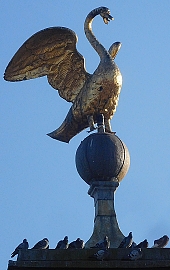
A LARGE GOLDEN SWAN with wings outstretched towers over the small town of Buckingham, once the county town of Buckinghamshire (until the 18th century, when Aylesbury took over this role) and now home to a respected private university, with whose founding my late father was to some extent involved. The gold-coloured copper swan surmounts a clock above the roof of an elegant late 18th century building on Market Square. Built in about 1783, this is The Old Town Hall, but not the oldest that the town has known.
The Old Town Hall was built to replace an even older one constructed in 1685 at the instigation of a local Member of Parliament, Sir Ralph Verney (1613-1696), during whose life the Civil War occurred. Initially on the side of the Parliamentarians, he fell out with them and fled abroad for a few years. After King Charles II gained the Throne, Verney returned to England where he served his people and the monarch.
In 1882, the clock was added above the Old Town Hall and upon this was placed the Swan of Buckingham, the borough’s crest. The wrought iron canopy over the main entrance was added early in the 20th century. The façade of the Old Town Hall faces another building, a well-known landmark and tourist attraction in the town, The Old Gaol, built in 1748 with its façade added in 1839.
The Old Town Hall was used for municipal administration until the 1960s when the local government headquarters were established elsewhere in the town. Now, the building is home to a firm of solicitors and the large metal swan high above their offices provides a nice perch for groups of the town’s pigeons.
TOLLESBURY IS A TINY village on the estuary of the River Blackwater in the English county of Essex, famed for its oysters, nature reserve, and sailing facilities. It is not far from Colchester and the smaller Tiptree famed for its jam manufacture. Tiny though it is, Tollesbury appears in the Domesday Book, with the name ‘Tolesberia’ and in 1218 as ‘Tolesbir’. It is possible that the ‘Toll’ part of the name refers to a person who lived many centuries ago. The Church of St Mary the Virgin that stands at one end of the central village square was built in about 1090, possibly incorporating material from an earlier Saxon Church.
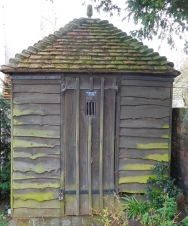
At the southern edge of the square, close to the northern boundary of the churchyard there stands a small wooden hut with a pyramidical tiled roof and one door with a small, barred window. It looks a bit like a garden shed but it was not built for storing tools and so on. For, this was the village lockup or ‘cage’. Built in 1700, it seems in remarkably good condition. The lockup, as its name suggests, was where local miscreants were locked up. It was a tiny prison. The reason that it is in a good state despite its age is that it has:
Essex is home to plenty of village lockups. Apart the lockup from at Tollesbury, you can see village lockups at, for example, Great Bardfield, Thaxted, Canewdon, Great Dunmow, Orsett, Braintree, Roydon, and Steeple Bumpstead (hwww.essex.police.uk/SysSiteAssets/media/downloads/essex/about-us/museum/research/history-notebooks/66.pdf).
These miniature jails were:
“… used in the eighteenth and nineteenth centuries to house criminals who were apprehended on suspicion of committing petty crime … Lock-ups were only temporary forms of imprisonment, usually for one or two people, before the local authorities of the day decided how to deal with the offender. Criminals could be released or sent to the closest large town for trial.” (www.essexlive.news/news/essex-news/historic-jails-essex-you-can-3227277)
Our friend, who lives in Tollesbury, suggested that probably the lockup was often used to house people who had drunk too much and needed to sober up. This not an unreasonable idea considering that at one time the village had six pubs.
Although there is much more that could be written about Tollesbury, I hope to do this after a future visit to this charming little place.
I ENJOY THE OBSCURE, or, at least, what is new and unknown to me. I am also interested in Hungary and the Hungarians. So, recently, when we were walking along Branch Hill, a road beneath and west of Hampstead’s Whitestone Pond, I spotted a circular blue commemorative plaque that I had not noticed before. Close to a house where the singer Paul Robeson lived for one year, it commemorates a celebrated Hungarian, whom I had never come across before. The plaque reads: “Alfred Reynolds, Hungarian poet and philosopher lived here 1980-1993”
Sadly, the two most knowledgeable Hungarians I knew, who could have told me something about him, the philosopher Imre Lakatos (1922-1974) and one of my father’s co-authors, the economist Peter Bauer (1915-2002), are no longer in the land of the living. So, I have had to resort to that font of all knowledge, Wikipedia, for information about Reynolds, a name that hardly sounds Hungarian to me. Searches of the internet reveal little other biographical information in English apart from what is noted on Wikipedia.
Alfred Reynolds (1907-1993) was born Reinhold Alfréd in Budapest, Hungary (the Hungarians put their surnames before their first names). His mother was Jewish and his father Roman Catholic. After graduating from the University of Leipzig in 1931, he founded a magazine called ‘Haladás’ (‘Progress’), which published the works of various Hungarian poets and was closed by the police soon after it began. Next, he founded another journal, a monthly with leftish tendencies called ‘Névtelen Jegyző’ (‘Anonymous Chronicler’), which was also soon closed by the police. After a brief spell as a member of the Communist Party of Hungary and a spell of imprisonment in Hungary, Alfred moved to the UK, to London, in 1936.
During WW2, Alfred served in the British Army, joining the Intelligence Corps in 1944. When the war was over, he became a leading light in the Bridge Circle, a group of libertarians. The group produced a journal called “London Letter”, some of whose articles were published in a book called “Pilate’s question: Articles from ‘The London Letter’,1948-1963”, which was released in 1964 and contains articles by Reynolds. In 1988, he published another book in English, “Jesus Versus Christianity”. The aim of this book was:
“…to redefine the prevailing image of Jesus of Nazareth. The author considers that Jesus remains a living figure reminding us of our humanity – the kingdom of Heaven within us. He argues that we should free the image of doctrinal encumbrance.” (https://www.goodreads.com/book/show/4932942-jesus-versus-christianity).
Prior to his arrival in England, Reynolds published his writings in Hungarian and those of other Hungarian poets, mostly in the journals he founded. Many of his papers, publications, and other memorabilia are currently on display at the Petőfi Literary Museum in Budapest.
And that is about all I can tell you about Reynolds who spent the last years of his life in a fine house that affords good views over Hampstead Heath. I wonder whether he ever frequented Louis on Hampstead’s Heath Street. Louis was opened as a Hungarian patisserie and café in 1963 by the Hungarian Louis Permayer (died 2017), who fled from Communist Hungary during the Uprising in 1956 (http://budapesttimes-archiv.bzt.hu/2014/10/04/louis-patisserie-a-hungarian-tea-temple-in-the-heart-of-north-london/). Louis still exists and has maintained its original wood-panelled interior décor that owes a lot to traditional Central European taste. It was where my wife and I had our first ‘date’. Today, the café is under different management from what it was when Reynolds moved to Hampstead.
Yet again, whilst walking for pleasure and exercise, I have spotted something that intrigued me because it seemed so unfamiliar and made me want to investigate it. Having discovered that there is not much information easily available about Alfred Reynolds, I am not surprised that I had never heard of him. The plaque commemorating his residence is unusual in that it does not state the name of the organisation or whoever it was that placed it. That adds to the mystery that partially shrouds this Hungarian refugee’s life and his relative obscurity that appeals to me.
When I worked in a dental practice near Portobello Road in west London, I met a lot of ‘colourful’ characters, many of whom I might have avoided had I saw them approaching me by chance in the street. One fellow, Ted, a large patient whose nose had been broken at least once and been badly fixed, said to me once: “If anyone ever causes you trouble in the street, just say you’re a friend of Ted. That’ll warn them.”
One day while I was standing in a queue at a takeaway counter waiting to order lunch, someone standing near me, a patient of mine, said: “Need a motor, doc?” I answered that I did not need a car at that point of time. “No problem, Doc,” he replied, “when you need one, just tell me what you want, whatever colour and make, and I’ll get it for you.” Not willing to sound ungrateful, I thought that when he said “get”, he really meant “steal.”
I had many patients who had been in and out of trouble with the law. Often, I would be told: “Look what the prison dentist did to this tooth, doc. Bleeding butcher, he was. Ought to be put behind bars.” I never asked why my patients had spent time ‘inside’. I felt it would be better not to know.
The last patient before one lunchtime was an aggressive young man. He was accompanied by his friend, a slightly older man. Before I had time to ask the young fellow what was wrong, he told me. Pointing to a lower left premolar tooth, he said: “Get it out. It’s f…..g killing me.” I looked at the chap. His mouth did not seem to close properly. “Don’t just stand there. Get it out, man”. I looked at the tooth. It looked alright. It was neither decayed, nor wobbly, nor tender. That strange mandibular posture bothered me.
“You’ve broken your jaw,” I said. “Don’t give me that crap. Just take it out.” I said: “If I take it out, you will still be in pain. You need to go to a hospital to fix your jaw.” This only angered the patient more, and I began to fear for the integrity of my jaw. “I’m not leaving until you take it out.” “Then,” I replied, “I’ll ring for an ambulance.” The patient’s friend said: “Come on, mate, let’s go.” Reluctantly, the patient allowed his friend to drag him out into the street. I locked the practice for the lunch break, relieved to see them leave.
Some days later, I met the patient’s friend in the street. I asked him whether the young man had been to hospital. He did not answer my question. Instead he said: “He’s gone away.” “On holiday?” I queried innocently. “Yes, on holiday.” “Long holiday?” I asked, beginning to understand what he meant by ‘holiday’. “Yes, very long holiday”.





 yamey
yamey 