Fountains of memory in London and Paris

THE FIRST TIME I visited Paris (France) was with my parents in 1968. We travelled there and back on the Silver Arrow (sleeper) train, which was loaded on to a ferry that plied between Dover and Dunkirk. We tried to sleep in our berths while the train was on board the ship, but I found that difficult mainly because I wanted to watch our train being loaded and unloaded at the channel ports. After returning from Paris, we disembarked from the train at London’s Victoria Station. Immediately after stepping on to the platform, my mother pointed excitedly at a lady exiting the carriage next to ours – our fellow passenger was Sir Winston Churchill’s wife.

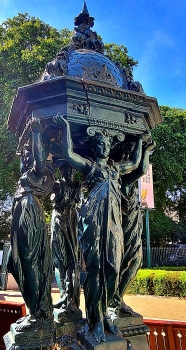
During that first visit to Paris, my father pointed out something that sparked my interest. Painted dark green, it was a drinking fountain covered with a decorative dome, which was supported by four sculptures of ladies (caryatids) with bare arms. It was a Wallace Fountain, and after having it pointed out to me, I began spotting them in many parts of Paris,

In 1872 following the Siege of Paris (1870). Sir Richard Wallace paid for 50 of the so-called Wallace Fountains (as described above) to be installed in the city. Each of the drinking fountains is of the same design They were designed by Charles-Auguste Lebourg (1829-1906).

In 1959, a late cast of the of the Wallace Fountain was presented by the London Borough of Shoreditch to Hertford House in London’s Manchester Square. Hertford House is the home of the huge art collection that was established by Sir Richard Wallace, and is now a public art museum – The Wallace Collection.  So, it is appropriate that a cast of one of Wallace’s fountains stands close to the Collection’s main entrance.

A website (www.londonremembers.com/memorials/wallace-drinking-fountain)  revealed something of the history of London’s Wallace Fountain:

c. 1904 four ornate fountains were installed in Shoreditch. This was done through the Metropolitan Drinking Fountain and Cattle Trough Association … Artistically designed water fountains were required and Dudley Fortescue found four designs that he liked, including this Wallace design, which he had seen and liked in Paris. The fountain was made and installed at The Oval, Windsor Terrace, EC1, on 19 July 1904. A newspaper report named an anonymous donor, ‘E. F. F.’.  Philanthropic men would sometimes give the name of a close female relative, rather than their own but, still, we cannot find an E. F. F. for Dudley Francis Fortescue, his wife being Lady Camilla Eleanor Fortescue, and the marriage having no issue. Perhaps the ‘E.’ was a misprint for ‘D.’? In 1959, when the fountain had ceased to function, the Wallace Collection asked Shoreditch Council if they could have it for Hertford House and it was installed in its current location in 1960.”

The fountain in Manchester Square bears the place name “Val d’Osne”. Another website (https://wallacefountains.org/fabrication-of-the-fountains/) explained:

During the past 150 years there have been few changes to the methods used to manufacture Wallace Fountains. The decorative cast iron process was invented in France by Jean Pierre Victor André who established a successful, award-winning art foundry in 1835 and set up Val d’Osne, a workshop foundry in the Haute Marne region. The Val d’Osne foundry manufactured the first Wallace Fountains in 1872 and Val d’Osne markings can be found on the oldest fountains still operating in Paris.”

Today, the London’s Wallace Fountain is no longer functional, but every time I see it at Manchester Square, it brings back memories of my first of many visits to “The City of Light”.

Before we began carrying personal water supplies

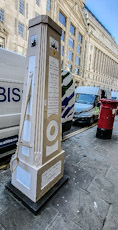
LONG BEFORE LONDONERS began the current fashion of carrying bottle of water wherever they go, the city’s inhabitants had to rely on water sources such as hand-operated street pumps. Although there are still a few functioning public drinking fountains in London, there are no usable pumps to be found. However, a few of them have been kept as historic monuments. One of these is located on the north pavement of Cornhill, a few yards east of the Royal Exchange building.

The pump, which is now kept looking like new – except that it no longer works – was set-up in 1799. On one of its four sides, the manufacturers, Phillips & Hopwood (“Engine Makers”), have included the information that the pump was paid for by the Bank of England, the East India Company, Fire Offices (i.e., insurance companies), and the “bankers and traders of the Ward of Cornhill”. The inscription on this side of the pump also mentions that the it was erected above a well that had been discovered and enlarged.

On another side of the pump, that facing south, there is a brief history of the well. It was first dug before 1282 when Henry Wallis (aka Henry le Walleis; died 1302), thrice Mayor of London, built a “House of Correction” on the spot. This was a prison for “night walkers” and was known as “The Tun”. Stow writing his “Survey of London” in 1598, noted that the prison was built of stone and (preserving Stow’s spelling) we learn:
“In the yeare 1298. certaine principall Citizens of London, brake vp this prison called the Tunne, and tooke out certain prisoners for the which they were sharply punished by long imprisonment, & great fines, as in another place I haue shewed.
In the yeare 1401. this prison house called the Tunne was made a Cesterne for sweete water conueyed by pipes of Leade frõ the towne of Tyborne, and was from thence forth called the conduite vpon Cornhill: Conduite vpõ Cornhill.Then was the wall planked ouer, and a strong prison made of Timber, called a Cage, with a payre of stockes set vpon it, on the top of which Cage was placed a Pillory for the punishment of Bakers offending in the Assise of Breade: for Millers stealeing of Corne at the Mill: and for baudes Cage, stockes and pillorie vpon Cornhill.and scolds &c.”

By the time the pump was set-up, the prison had long since gone (? demolished). How and why the well was rediscovered, I cannot say, but it was, and its water became accessible by using the pump. The top of the pump serves as an advertisement. At the top of each of the four sides of the pump, there are symbols, which people would have recognised as being the trademarks of four insurance companies in existence at the time that it was established. Back in the 18th and early 19th centuries, firefighting services were provided by the insurance companies. The trademarks of insurance companies were placed on buildings so that firefighters of each insurance company could recognise which houses had paid for policies that made them eligible to be saved by the firemen.

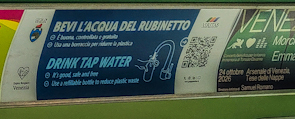
Today, firefighting is no longer provided by insurance companies, and water is no longer available from public pumps. So, it is not surprising to see many people wandering around London with their own supplies of drinking water – in plastic bottles and other containers. What does surprise me is that when I was younger, in the 1960s and 1970s, one hardly ever saw people carrying their own drinking water. Now, it is quite common to see people sipping from their personal water carriers. Have people become thirstier recently, or what is it that makes them feel that they should never be without a portable supply of potable water?