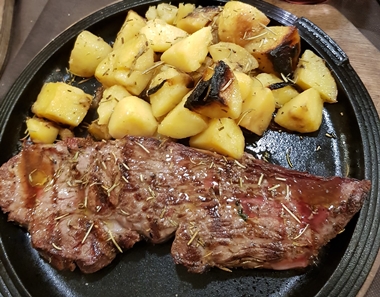
Claim your steak

STEAK

When I was much younger, my parents often took my sister and me to eat dinner in restaurants.

Before we looked at the menu, my late mother used to examine the plates and cutlery on our table. If there was a blemish on the cutlery or a crack or chip in the porcelain, the waiter would be summoned to replace the defective item(s). Often this delayed the arrival of any food. If we looked reproachfully at my mother, she would say:

“You can eat off cracked plates if you like, but I am not paying good money to eat off bad plates.”

She said this in such a way that meant that really there was no way that any of us could eat off damaged crockery, even if we wanted to.

As the years went by, I used to look at my plate and cutlery carefully as soon as we sat down. If I spotted a defect, I used to casually lay my hand on it so that my mother would not see it. I was always hungry before a meal and wanted to get on with it rather than having to wait for perfect eating utensils to be fetched. Once any defective cutlery/crockery was replaced, the meal could be ordered.

My mother was fond of beef steak. Rather unfashionably for London in the 1960s, she preferred her steak rare, almost what the French call ‘bleu’. This simple request was the real test for a restaurant. Frequently, the rare steak would arrive cold. My mother would then summon the waiter or maitre d’hote.

“My steak is cold.”

“Madame, I will ask the kitchen to heat it for you.”

The steak would then be returned, and my mother would begin cutting it. Soon the waiter would be called again.

“My steak is no longer rare; it is overcooked. Take it away and bring me another one cooked rare and warm.”

Any restaurant that could get this right without fuss, won my mother’s custom. She would then return there frequently.

Today, rare steak is the ‘in thing’. Most good chefs and discerning diners prefer the insides of steaks to be red, if not bloody.

Writing of steaks reminded me of Monty Modlyn (1921-94), a radio presenter and journalist. Occasionally he would speak on the early morning Today programme on the BBC Home Service (now ‘Radio 4’). He would report on steaks and other meat he had eaten. He had a metal ball that he would drop onto pieces of meat. The depth of the indentation made by the ball’s impact was his measure of the meat’s quality. It all sounded a bit mad to me when I listened to him when I was a young boy. Apparently, what he was doing was quite sound. The quality of raw meat can be judged by indenting it with a finger tip and then watching how quickly the indentation disappears. If the meat recovers quickly, then the quality is likely to be lower than if it recovers slowly.

Harrods department store

POLO


In the early 1960s, my parents installed a Permutit water softening unit in our family home. I have no idea why they did this. Maybe it was to save soap and the furring up of pipework. I am not sure that they would have done it had they known of the research that shows that heart disease is reduced as the hardness of drinking water increases.

The apparatus consisted of two cream coloured cylinders, each about five feet high, which stood next to each other in our garage by the side of the house. One of the cylinders was sealed shut and surmounted by a circular metal control wheel. Its neighbour could be opened by lifting a lid. Once a week, my father had to refresh the ion-exchange resin in the sealed container. This was done by adding salt in large quantities to the other cylinder, having removed its lid. By turning the control wheel at intervals dictated by an instruction manual, the refreshing cycle was completed over a period of about two hours. When the procedure was completed, my father used to test the softness of the water in our taps by mixing it with a soap solution supplied by Permutit. If a stable foam was produced, this indicated that the refreshment cycle had been completed successfully.

A special salt, called dendritic salt, was required for the weekly process described already. There was only one store that would both supply sacks of dendritic salt and, also, deliver it to our home. That store was the world-renowned Harrods in Knightsbridge, which brought us the salt in their silent electrically-powered delivery vehicles.  In order to get these regular deliveries, my parents had to open a Harrod’s account.

Harrods has never been a store that one would enter hoping to find a bargain. In the sixties, they provided their customers with very attractive carrier bags. My late mother liked these, but she was not particularly interested in buying anything from the store in Knightsbridge. So, she used to enter Harrods and buy a packet of Polo mints, one of the least costly things on sale, and have the payment of them put on the family account. This low-cost purchase allowed her to get what she really wanted: a Harrods’ carrier bag.

Delivered to your door

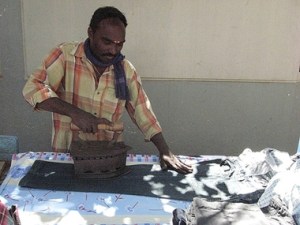
After we married in 1994, we used to visit my in-laws in Bangalore (India) regularly. During the first few visits, we stayed in their home in Koramangala, a suburb to the south of the city’s diffuse central area. Although they lived close to shops, some within easy walking distance, their street was visited by itinerant sellers. For example, there were (and still are) people wheeling barrows from which they sell fruit and vegetables. These sellers announce their arrival with shouts in the Kannada language, which I cannot understand.  Other vendors come to the door selling bags of nuts and deep-fried and other snacks. Every street or street corner has a stall that is visited daily by the dhobi, who collects washed clothes to be ironed from your front door. All of this occurred in 1994 and continues today.

When I was a child during the 1950s and ‘60s, I lived with my family in Hampstead Garden Suburb (‘HGS’) near to Golders Green in north-west London. The HGS is a housing project, which was conceived by the social reformer and general ‘do-gooder’ Henrietta Barnett (1851-1936). The Suburb, whose construction began around 1904, is a mixture of residences of varying sizes built in different styles of architecture. Her idea was to provide homes for all classes of society, so that people from all these social classes could live harmoniously side-by-side. As with all the best-laid plans, this social mixing was never achieved. The very pleasant green suburb became a haven for the middle classes, the bourgeoisie. In his autobiography “A Little Learning”, Evelyn Waugh wrote of HGS (in its early years) that it was inhabited:

“… not exactly by cranks, nor by Bohemians, but mainly by a community of unconventional bourgeois of artistic interests.”

Today, this kind of people cannot afford to live there; it is now a highly desired residential area for the sector of middle class with plenty of money at hand.

Henrietta Barnett included three churches, a community hall (the so-called ‘Tea Room’), a school, an Institute, and two areas of woodland in her utopian suburb, but rejected the idea of including anything so ungodly as shops. So, HGS had, and still has, no shops within its boundaries. The nearest shopping centres are Golders Green, Temple Fortune, and the Market Place that is located on an arterial road that divides HGS into two separate parts. Unless one lived near to any of these shopping areas, the nearest shops could be up to a mile away from your front door. Because of this, HGS used to be visited by various roving services in my day.

The milkman made deliveries of dairy products every day. These were loaded on small electrically powered vehicles (‘milk floats’) that moved almost silently along the streets. The only sound they made was the tinkling of glass milk bottles as they rattled in the wagon. The milkman collected his stock from the Express Dairy Depot at Hoop Lane on the edge of the boundary of HGS. It was at this depot that the electric vehicle’s batteries were charged overnight. Newspapers were delivered to the door by a delivery boy employed by a local newsagent. A man with a French accent wearing a beret used to cycle around HGS selling strings of onions. For some reason unknown to me my mother never bought onions from him, but her sister, who lived close by, always did. Several times a week a tatty lorry used to cruise slowly along our streets. His vehicle contained a vegetable shop.

In summer, vans selling ice-cream would occasionally cruise along our street. When they stopped, they played a pre-recorded musical (well, not very musical) jingle to attract customers’ attention.

Every now and then, a knife grinder would arrive on his bicycle. He had a pedal-operated grinding wheel that spat out a shower of sparks when a knife was being sharpened. My mother never employed the grinder, claiming that he would ruin her kitchen knives. Being a sculptress, she was used to sharpening her chisels on a stone, and probably sharpened her own knives as well. Cries of what sounded to me like “old iron and echo” heralded the arrival of the scrap metal collector. When I was very young, he arrived with a horse-drawn wagon. This was later replaced by a battered motor driven lorry.

Twice a week, a mobile public library visited HGS. I never used it, preferring to walk to the better stocked library in Golders Green. The only commercial establishment, the nearest approximation to a shop, within HGS was Mendels Garage, which sold petrol and repaired cars. This has long since disappeared as did some of the other services mentioned above.

A dhobi ironing in Bangalore

Moving fast forward to today’s world, there is little need to leave your home if you do not feel like doing so. With the advent of the Internet, everything can be brought to your front door: from cooked meals to rare books, clothes, and almost anything you might want to buy. Even fast-food joints like McDonald’s will deliver your favourite snacks. Recently, a friend in Bombay needed a new rubber stamp costing a very few rupees. He rang the manufacturer to order it and was told that it would be delivered to his home within a very short time.

The convenience of home delivery is obvious, but this may jeopardise the future of shops that rely on people entering their stores to buy things.  Such is life, as so many people say, rather irritatingly I feel!

All ‘aggro’ : my Allegro

I passed my Driving Test in 1982. Naturally, I wanted a car after that. A good friend, a dental colleague who was keen on motor cars, suggested quite sensibly that it would be best if my first car was not brand new. He felt that as I was an inexperienced driver, I was more likely to damage it. With his assistance, I chose a second-hand Austin Allegro, which looked in good condition and had not done a huge mileage. Neither he nor I would have guessed what a challenge this vehicle would prove to be.


allegro 1

Austin Allegro [source: Wikipedia]

All went well at first. After a few weeks, I was driving along a motorway between the Medway Towns, where I worked, and London when suddenly the car lost power. I managed to steer the Allegro to the hard shoulder. The engine was not working. I turned the ignition key and the engine sprung back into life. I continued to London uneventfully.

The problem, the engine’s spontaneous and unexpected switching off, occurred on a number of other motorways and main roads, sometimes at night. I returned to the garage where I had bought the car, and their mechanics checked the car thoroughly (so they said). They could find nothing wrong. Reassured, I continued using it, but the same problem recurred regularly. I got to a point where I used to drive along the motorway with my hand holding the ignition key in the start position, so that the motor could not turn off.

After a few months in rented accommodation, I decided to buy a house when I discovered that the monthly mortgage repayments were the same as my monthly rental payments. After looking at about nine properties, I chose one. Before moving in, I used to visit its soon to be former owners in order to settle details of the house sale. On one visit, I parked my Allegro in front of the driveway where two of the occupants’ cars were parked. When I was ready to leave, the Allegro would not start. The owner’s son, a man in his twenties, came out to look at the car. Within minutes, he discovered what the garage mechanics had missed. The lock into which the ignition key fitted was loose: it did not engage firmly in the ‘on’ position. So, when the car vibrated, the key could be thrown out of the ‘on’ position into an ‘off’ position.

When the boy’s father, who was taking an interest in the proceedings, saw what his son had discovered, he fetched a wire, and touched its two ends to a couple of places in the engine. Suddenly, there was a blue flash followed by a strange smell and some white smoke.

“Aw, now look what you’ve gawn and done, Dad,” said the son, “I reckon you’ve blown a fuse.”

Almost as quick as a flash, the young man said that he would run up the road to buy a new fuse, which he did. He inserted it, and then carefully started my car.

I continued using the car for a while. Soon after the fuse incident, the car began belching black smoke instead of the normal exhaust. Once again, I returned to the dealer, who had sold me the car. After I told him what was wrong, he said:

“Sounds like you’ll need a new engine, my friend.”

“But,” I protested, “I’ve only had the car for four months.”

“Such is life, young man.”


I took the car to another repair shop. This was run by a wizened old man. He looked at the engine, and said:

“I can do something about that smoke, but it won’t last long. My advice to you is to sell it as soon as I’ve mended it and before the problem returns and the engine burns out.”

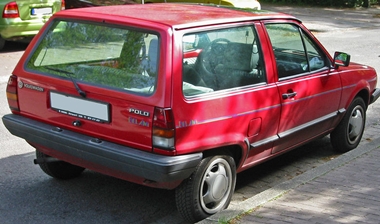
I took this wise man’s advice. The local Volkswagen dealership were happy to take my Allegro as part payment for my brand-new Polo vehicle.
 

allegro 2

Volkswagen Polo [source: Wikipedia]

Soon after taking possession of the Polo, I visited my aunt and uncle in London. Their reaction to my new car gave away something of what they had secretly thought about me in the thirty years they had known me. After spending a few hours with them, they accompanied me to the road. I had not told them about my purchase. When they saw me unlocking my pristine Polo, my aunt said:

“Is that yours, Adam?”

“Yes.”

Then my uncle said:

“I never imagined you would have ever bought a new car. It’s the first normal thing you have ever done.”

Not really…

American and English

similar lingos

sometimes different  

USA

Some years ago, I practised dentistry in a surgery near Ladbroke Grove in West London. One day while I was waiting for the next patient to arrive, I found myself alone at the reception desk, the receptionists having gone off somewhere briefly. The telephone rang. Being a helpful sort of person, I picked it up.

“Hello, this is the dental surgery,” I said.

A man with an American accent said to me:

“I want to speak with June Courtney.”

June was a dentist, who used to work in the practice.

“I am afraid she does not work here anymore,” I replied.

“Well, maybe you’re her husband?”

“No, I am not.”

“Well, maybe I can interest you in buying some bonds,” continued the trans-Atlantic caller.

“I’m not really interested,” I replied.

“Well, that means you might be a little bit interested,” the caller replied.

“let me explain something to you,” I began, “if someone English says that they are not really interested, it does not mean that they are ‘slightly interested. It is a polite way of saying that they are not at all interested; they are totally uninterested.”

“Well, thank you for explaining that, sir,” the caller said before ending the call.

I guess that sometimes it pays to speak bluntly.

A bit too far

Drill a bit,  not too far.

In the tooth is a nerve:

do not disturb it


DRILL 1


It would not have been fair to my patients if I had written what follows before I had retired from practising dentistry. If I had been one of my patients, I might have lost confidence in my dentist after reading this.

Before dental students are allowed to drill teeth on living patients, much training is required. A great deal of this is done using plastic teeth mounted in the jaws of the heads of a mannequin, known as a ‘phantom head’. The plastic teeth are held in the artificial jaws with metal screws. The screws fit into holes on the undersides of the teeth so that the crowns of the teeth appear intact. As a dental student, I spent many hours each week practicing cutting standardised cavities. The cavities had to be cut to very precise dimensions, which were neither to be exceeded nor the opposite. I recall that certain parts of the plastic teeth had to be cut to exactly two millimetres deep and much the same width. At first, I found this extremely difficult. Not only was I not yet used to using dental drills, but also the plastic cuts in an awkward way.

Eventually, the time arrived for a practical test. Unsupervised, we were required to cut one of the several cavities that we had been learning to prepare. Disaster struck. Within a few seconds of starting my tooth, I had cut too deep. The metal of the screw retaining the plastic tooth in the phantom head was staring me in the face. I called over the examiners. They studied the tooth carefully, and then one of them said to me:

“I think you have exposed the nerve, Mr Yamey.”

“We might be looking at a root treatment, here, don’t you think?” asked the other examiner.

I could not believe what I was hearing.

“I think we’re looking at a failure here,” I replied.

They agreed.

I spent another few weeks in the phantom head room, and retook the exam, which I passed with flying colours, you will be relieved to learn. Now, I was deemed ready to treat dental cavities on real teeth in real patients – under supervision, of course.

The first tooth that I had to work on had only a little decay. Nevertheless, after the intense training, which emphasised cutting teeth should be done as conservatively as possible, cutting only as little of healthy tooth tissue as was strictly necessary to retain the restoration (‘filling’), I approached my first ‘real’ tooth with much trepidation. After boring down to the two-millimetre depth that was ingrained in my mind, I could see nothing but healthy tooth – no sign of decay. I summoned the clinical teacher (the ‘demonstrator’). He looked at the tiny hole I had created with great care and laughed.

“You have not yet cut through the enamel. Keep going,” he said.

The enamel, for those who are uncertain about dental anatomy, is the outer covering of the part of the tooth that is visible in the mouth. Beneath it, is the dentine, and below that the dental pulp chamber, which contains nerves and blood vessels. Decay spreads much more rapidly through dentine than through enamel.

I looked at the demonstrator, and said:

“But in the phantom head room we were told never to go deeper than two millimetres.”

“Those were just plastic teeth,” the demonstrator replied, “forget all that.”


[Picture from “Der Zahnarzt in der Karikatur” by E Henrich]

Thank you, Queen Victoria

From worlds far apart,

Two folk come together:

Cupid’s bow does its job


When our daughter was a little girl in junior school, the members of her class were asked to name the greatest Briton in history. She nominated Queen Victoria. Her choice was based on the following facts: her mother’s parents were born in India and my parents were born in South Africa. When Queen Victoria reigned, she argued, both countries were part of the British Empire. This, she felt, made it more likely that both her parents would study in England and meet. Without Victoria, she concluded, my wife Lopa and I might never have met, and she would not have existed. Well, maybe she was right. I believe that the reason we met was due to two men who gave us career’s advice: Professor Lewis Wolpert in London and Major General SL Bhatia in Bangalore.

As I approached the time when I had to choose a university undergraduate course, I had no idea which subject to select. I was interested in biology, physics, and chemistry, but had no interest in studying medicine, or even dentistry, which I studied many years later. Careers advice at my secondary school was not helpful.

My South African-born parents knew many South Africans living in London. One of these was my father’s close friend, the late Cyril Sofer, a sociologist. It was through the Sofer family that we met Lewis Wolpert, who was born in South Africa. First, he trained to become a civil engineer. By the time I first met him, he had become an eminent biologist, specialising in cell and developmental biology.

Wolpert, on learning that I was having difficulties choosing a course of study, kindly invited me to his office in Middlesex Hospital in central London. He spent about an hour with me, listening to what I had found interesting in the science subjects I had studied at school. Having heard me out, he suggested that I study physiology at university. This subject would, he thought, encompass all that interested me so far. He told me that the best places to study physiology were Cambridge and University College London (‘UCL’). Of these, he considered the physiology department at UCL to be the best. I was pleased to hear this.

About five years before meeting Wolpert, my father and I had visited UCL because a friend of the family, the art-historian Leopold Ettlinger, worked there. All that I can remember of this visit was walking across the lawns in UCL’s elegant Front Quadrangle and thinking how beautiful it seemed. So, when Lewis Wolpert suggested that I apply for admission to UCL, I was happy about that.

At about the time I was discussing my academic future with Wolpert in London, a young lady, my future wife Lopa, was discussing the same thing with another eminent scientist 5000 miles away in Bangalore. The scientist, Major General SL Bhatia (1891-1982), had known Lopa’s mother’s father from when he studied medicine in Bombay. The two medics became close friends. When Lopa’s mother Chandra was born, Bhatia became the equivalent of Chandra’s god-father.

Chandra’s father died young having succumbed to blood poisoning while treating one of his patients. His friend Bhatia had a glittering career in science, medicine and the Indian Army. It was during his retirement that Lopa met him at his beautiful old-fashioned bungalow in Bangalore. Bhatia had studied medicine not only in India but also at St Thomas’s Hospital in London during the second decade of the 20th century. While in London, he had conducted research with leading physiologists. Like Wolpert had done for me in London, Bhatia recommended that Lopa, who was not keen on studying medicine at that time, pursue a course of physiology at UCL, because he knew it to have a fine reputation in that subject.

One morning in October 1970, I arrived at the Physiology Department at UCL, having travelled from my home in north-west London. I was one of nine students who had been accepted for the course. Lopa was one of the others. She had travelled over 5000 miles to join the department. We were greeted by the department in the Starling Room, named after a famous physiologist who had worked at UCL. This common room is where I met the young lady who was eventually to marry me.

SL BHATIA 3

In the bar at the Bangalore Club

Our wedding reception in Bangalore was held in 1994 at the Bangalore Club, a prestigious ex-colonial institution in the heart of Bangalore. Although he could not attend, Major SL Bhatia was the first Indian President of that elite club. Before that, all the Presidents had been British. Bhatia’s widow was at the wedding. She claimed, not without some reason, that it was she and her late husband, who were responsible for getting Lopa and me together.

The late queen_800

Just as our daughter is eternally grateful to Queen Victoria for bringing Lopa and me together, I am equally thankful to Professor Wolpert and Major General Bhatia for getting our paths to cross. I cannot acknowledge them for what was to follow; Cupid and his arrows are to be thanked for that.

Picture sources: semanticscholar.org (Bhatia) & retractionwatch.com (Wolpert)

Shaped by nature, not by man

The word GOGOTTE is pronounced ‘go-got’

gogotte 1


Quartz and chalk were fused

millions of years ago

to create  gogottes


gogotte 2


These two gogottes were from Fontainbleu. They were on sale at Christies auction house in London