A hotbed of demoralisation and crime in north London

A WINDING LANE leads from Hampstead’s East Heath Road into the picturesque Vale of Health. I wrote about this isolated, small settlement surrounded by Hampstead Heath in the summer of 2017 (https://hampsteadadam.travellerspoint.com/2/) and have not revisited the place until today, the 2nd of January 2021. Little appears to have changed since then, but I have learnt a little more about the place.
As for its name, the place was not always as healthy as its name suggests. I wrote:

The land on which the Vale is situated is mentioned in the Domesday Book (1086 AD). It was then owned by the Abbots and monks of Westminster. By the 18th century this swampland in the middle of the part of the Heath, then known as part of ‘Gangmoor’, was inhabited by impoverished people and was malarial. In the 1770s, the area was known as ‘Hatches’ or ‘Hatchett’s’ Bottom, because Samuel Hatch, a harness-maker, had owned a cottage there before 1770. This unsavoury hollow was described in about 1817 as a “stagnate bottom, a pit in the heath” by the sculptor Joseph Nolleken’s wife (see: http://www.british-history.ac.uk/vch/middx/vol9/pp71-73). It was a vale, but not a healthy one.”

However, by 1801 when the land had been drained and property developers began building houses in the area, it gained the salubrious-sounding name by which it is known today.

Apart from the famous Indian artistic genius Rabindranath Tagore (1861-1941), who stayed in the Vale in 1912, the settlement was home to many other well-known people including the author Compton Mackenzie; the barrister Alfred Harmsworth; DH Lawrence; the philosopher Cyril Joad; and Stella Gibbons. Earlier notable residents included the law reformer Sir Samuel Romilly (1757-1818); the poet and essayist James Leigh Hunt (1784-1859), who entertained leading literary figures such as Hazlitt, Keats, Lord Byron and Shelley in his house in the Vale; the publisher Charles Knight (1791-1873); and, also, a Prince Eszterhazy.

During the 19th century, not only were the literati and wealthy attracted to the Vale but also it was a popular place for hoards of trippers, whose names never made it into the annals of history. The author of “The Northern Heights of London” published in 1869, William Howitt (1792-1879), describes these pleasure-seekers and what they did in some detail. He wrote that:

“This Vale of Health used, till of late years, to present a sight at once picturesque and pleasant. In front of a row of cottages, and under the shade of willows, were set out long tables for tea, where many hundreds, at a trifling cost, partook of a homely and exhilarating refreshment. There families could take their own tea and bread and butter, and have water boiled for them, and table accommodation found for them, for a few pence…”

And then, everything changed for the worse according to the puritanical-sounding Howitt:

“Recent times have seen Sunday dissipation reasserting itself, by the erection of a monster public house with a lofty tower and flag, to attract the attention of Sunday strollers on the Heath. Of all places, this raised its Tower of Babel in that formerly quiet and favourite spot, the Vale of Health … that taps and gin palaces on a Titan scale should be licensed, where people resort ostensibly for fresh air, relaxation, and exercise, is the certain mode of turning all such advantages into popular curses and converting the very bosom of nature into a hotbed of demoralisation and crime…”

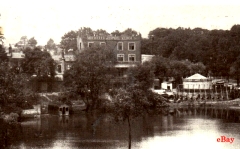
This demoniacal-sounding establishment is marked as ‘Suburban & Hampstead Heath Hotel’ on a map surveyed a year before Howitt’s book was published. On a map surveyed in 1912, it is marked simply as ‘Hotel’. Just a few houses away southwest of it, another building is marked ‘Hall’, to which I will refer shortly. According to both maps, the hotel stood where today there is a twentieth century block of flats called Spencer House. Opposite this edifice, there is a caravan park, which has been in the possession of the Abbotts family for over 160 years. Since the late 19th century, this patch of land has been fairground land. About ten members of the family live on the site in caravans, and other travelling fair workers can camp there free of charge. In exchange, members of the Abbott family, who operate travelling fairs, are allowed camp for nothing on other fairground owners’ sites when they travel around the country.

Returning to the building that upset Howitt, “A History of the County of Middlesex: Volume 9” (https://www.british-history.ac.uk/vch/middx/vol9/pp71-73) notes:

“… the Suburban hotel (also called the Vale of Health tavern) with towers and battlements and accommodation for 2,000 was built in 1863 …”

This source also notes another establishment, which was being built whilst Howitt was writing or just about to publish. This was the ‘Hampstead Heath Hotel’, which was built in 1868. This stood between two groups of ‘villas’, that is between 1-6 Heath Villas and 7-12 Heath Villas. It was the building marked as ‘Hall’ on the 1912 map. It is now occupied by a mid-twentieth century block of flats, smaller than Spencer House, named ‘Athenaeum’.

The Hampstead Heath Hotel closed in 1877, when it passed into the ownership of Henry Braun. His great grandson, Frances Francis wrote (www.francisfrith.com/uk/hampstead/vale-of-health-hotel_memory-7431):

“My great grandfather Henry Braun owned the Vale of Health Hotel … overlooking the lake, from 1877 until the early 1900’s. The hotel was used as an Anglo German club called the Athenaeum and by 1908 had 1200 members – 500 English, 700 German, including many political radicals. The hotel became a factory during World War I and then remained derelict for some years. The hotel was eventually pulled down in 1958, when I was 15 and I remember with sadness watching ‘luxury’ flats being erected in its place.”

The club closed in 1914 and then became used as a factory until it was demolished and replaced by the present building in 1958.

According to the County History to which I have already referred, The Athenaeum club’s larger neighbour, the hostelry that Howitt detested was:

“The large Vale of Health tavern, originally intended as a hotel and sanatorium, was sold in 1876, became associated with the fair, was let as flats, and c. 1900 became a hotel again on a smaller scale, with the upper rooms let as studios … Spencer House (flats) replaced the Vale of Health hotel in 1964.”

Howitt would have been even more dismayed to have learnt that there was a third hotel built in the Vale of Health in the 1880s. It stood next to the Athenaeum on the site now occupied by Byron Villas. It was at number 1 Byron Villas that the writer DH Lawrence lived in 1915.

Today, Howitt would most probably be happier with the Vale of Health than he was in 1869. The hotels have gone, and there is not even the tiniest of stalls where refreshments may be obtained. He might disapprove of the parked cars and the caravan site opposite Spencer House, but there would be hardly anything that he could find to decry.  By the edge of its large pond, one of the sources of the River Fleet, the Vale of Health remains a quiet oasis in the heart of north London.

Friday the 13th is unlucky for some

MUCH OF MOTCOMB Street in London’s Belgravia is now pedestrianised. It is lined with nineteenth century buildings that house shops and food outlets, mostly aimed at wealthy customers. Here, you can find the shops of Christian Loubertin, Ottolenghi, Nicola Donati, Marie Chantal, Maison Corthay, to mention but a few you might know. It is probably safe to say that this is not much of a street for bargain hunters, but to be fair, it does boast a newsagent and a large branch of the Waitrose supermarket chain.

Motcomb Street first appears on a map in 1830, when it was briefly known as ‘Kinnerton Mews’. By 1854, many of the houses along it became shops and places where cows were kept. A publication (http://www.grosvenorlondon.com/GrosvenorLondon/media/GrosvenorLondon/WALKING-IN-BELGRAVIA.pdf) produced by the Grosvenor Estate details the shops:

“… a cow-keeper, a saddler, two tailors, a plumber, a wheelwright, a grocer and two sellers of asses’ milk (thought to be beneficial to health and used in nearby hospitals).”

The ‘Alfred Tennyson’ pub stands on the corner of Motcomb and Kinnerton Streets. It was formerly known as ‘The Pantechnicon’. The reason for its earlier name becomes obvious if you walk away from it westwards along Motcomb Street. Opposite Waitrose and by far the most imposing building in the street is a neo-classical façade supported by ten sturdy pillars with Doric capitals. As impressive as many of the great neoclassical façades in central London,  such as that of the National Gallery, these pillars support a slab on which the word ‘PANTECHNICON’ is boldly displayed.

The Pantechnicon was built as commercial premises in about 1830-34 (https://historicengland.org.uk/listing/the-list/list-entry/1223569) for the property developer Seth Smith (1791-1860), most probably designed by the architect and civil engineer Joseph Jopling (1788-1867; http://farnham.attfield.de/fam1012.html). The Pantechnicon was enormous. Covering two acres, it stretched backwards (north) from Motcomb street and was surrounded by the backs of many of the houses lining the east side of Lowndes Square and the west side of Kinnerton Street. When it was completed, it was originally:

“… a bazaar, and was established principally for the sale of carriages and household furniture. There was also a ‘wine department’, consisting of a range of dry vaults for the reception and display of wines; and the bazaar contained likewise a ‘toy department.’” (www.british-history.ac.uk/old-new-london/vol5/pp1-14).

By 1850, when Peter Cunningham published his “Handbook of London”, things had changed. It had become a repository, where you:

“… may send the whole contents of an extensive house – furniture, wine, pictures, even jewellery; and the utmost care will be taken of them, at a comparatively reasonable charge …”

Cunningham lists these charges in detail and later added reassuringly:

“The building is well ventilated, and considered fireproof; but the risk (if any) of accidents by fire, civil commotion, or otherwise, will attach to the owners of the property sent to the Pantechnicon to be warehoused.”

Incidentally, the owners of the Pantechnicon designed a new form of removal van. Its innovation was a movable rear ramp that aided the loading of heavy or bulky objects. Originally, horse-drawn, these became known as ‘Pantechnicons’, a word often applied to motorised removal trucks in use today. And just in case you are wondering, the word ‘pantechnicon’ is derived from two Greek words, ‘pan’ and ‘techne’, meaning ‘all arts’, and was coined to describe wide range of goods that were available to buy in the bazaar in Motcomb Street.

Disaster struck on Friday, the 13th of February 1874 at about 4 pm. The fireproof Pantechnicon burst into flames. By 7 pm, the roof had collapsed. Karen Odden, who has written an interesting article about this conflagration (https://englishhistoryauthors.blogspot.com/2020/01/the-pantechnicon-fire-of-1874.html), noted:

“ …the event was perhaps the single largest episode of destruction of art and furnishings in the Victorian era … It is difficult to assess the value of the objects lost. Because people had such faith in the Pantechnicon, they under-insured their valuables—or found ways to avoid insuring them altogether. For example, one family hid their jewels in their furniture. The cost of insuring a headboard was significantly less than insuring jewels—but jewels hidden inside were (ostensibly) safe all the same. (Tricky!) However, it is known for certain that the fire destroyed the MP Sir Richard Wallace’s painting collection, worth £150,000; and the MP Sir Seymour Fitzgerald’s art collection, worth £200,000, which included many portraits by Sir Joshua Reynolds and paintings by other masters including J.M.W. Turner. Contemporary accounts estimated the total value upon the destroyed items at £2,000,000 (approximately £220,000,000 or $280,000,000 today).”

Luckily for us, many of Wallace’s works were not involved in the fire as can be seen by visiting the Wallace Collection in his former home in Manchester Square.

Today, only the façade of the Pantechnicon remains standing. Located opposite a modern ‘bazaar’, Waitrose, it conceals a lovely public space behind it, which contains benches and a few artworks, and is lined by Halkins Arcade. A modern building attached to the old façade houses restaurants, bars and other businesses, some of which can be entered from the Arcade.

It worth making a visit to Motcomb Street not only to see the impressive remnant of the Pantechnicon but also because the short pedestrian-friendly street has become a particularly pleasant place to linger.

Organs and archaeology

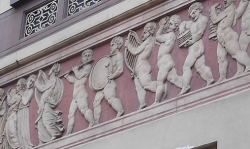
THE EYES OF MOST VISITORS to Kensington Gore are attracted to the spectacular Royal Albert Hall and, opposite it, the monument to Albert, Queen Victoria’s consort. Immediately to the west of the Royal Albert Hall, there stands the comparatively less impressive twentieth century building housing the Royal College of Art (‘RCA’), designed by H T Cadbury Brown and opened in 1962. Next to this geometric structure of concrete and glass and on its south side, there is an edifice whose appearance is a dramatic contrast to it. The walls of the RCA’s southern neighbour are covered with figurative illustrations, created in the ‘sgraffito’ technique.  Bands of ‘putti’ carrying musical instruments, scrolls of paper, or singing, appear to be scurrying across the walls of the building. Maybe this is not surprising because once this place housed The Royal College of Organists (‘RCO’).

Founded in 1864 by the organist Richard Limpus (1824-1875) to promote advanced organ playing, it received its Royal Charter in 1893. The building next to the present RCA and facing the Royal Albert Hall was designed by Lieutenant Henry Hardy Cole (1843-1916) of the Royal Engineers, and the ‘sgraffiti’ decorating it was created by Francis Wallaston Moody (1824-1886).

Lieutenant Cole was a son of Sir Henry Cole (1808-1882), a civil servant who had an extremely important role in organising the Great Exhibition of 1851. His building, erected 1874-75, was originally constructed to house The National Training School for Music. It was paid for by Sir Henry Cole’s friend, music lover, and a fellow member of the Society of the Arts, the developer Charles James Freake (1818-1884), who lived in Cromwell Road (www.londonremembers.com/memorials/sir-c-j-freake).

The architect, Lieutenant Cole had little practical architectural experience as is revealed in “The Survey of London Vol.38” (www.british-history.ac.uk/survey-london/vol38/pp217-219):

“Lieutenant Cole had returned in 1871 from India, where he had been Superintendent of the Archaeological Survey, North-West Provinces, and his previous architectural work seems to have been confined mainly to publications on ancient Indian architecture and archaeology, and the preparation of casts for the Indian section of the South Kensington Museum, which he catalogued.”

Consequently:

“He was not left to design the school on his own. It was evolved in consultation with his father and was subjected to criticism by members of the Science and Art Department. A committee of management was appointed in July 1873 …”

Moody was a protégé of Sir Henry and a teacher at the National Art Training School, a forerunner of the RCA.

Between 1883 and 1896, the building was used by the newly founded Royal College of Music, which moved into its new premises south of the Royal Albert Hall in about 1896. The large variety of musical instruments that have been depicted on the building’s walls reflect the place’s first occupants.  Between 1896 and 1903, it stood empty. Then it was leased to the RCO for 100 years at a ‘peppercorn’ rent. When it was learnt that after expiry of the lease the rent would be increased considerably, the RCO moved into new accommodation in 1991. Currently, at least in 2018, it is owned by an entrepreneur, Robert Tchenguiz.

The Lieutenant, who designed the RCO building, became the Curator of Ancient Monuments in India. His “First Report Of The Curator Of Ancient Monuments In India” was published in 1882 in Simla. This contains some of his views on dealing with archaeological items and sites. For example, he wrote:

“Experience has shown that the keenest investigators have not always had the greatest respect for the maintenance of monuments. Archaeological research has for its object the elucidation of history, and to an enthusiast the temptation to carry off a proof of an unravelled mystery is undoubtedly great. If there were no such things as photographs, casts, and other means of reproducing archaeological evidence, the removal of original stone records might perhaps be justified …”,

and, regarding the now controversial British possession of some famous sculptures in the British Museum:

“Sometimes, indeed, the removal of ancient remains is necessary for safe custody; and in the case of a foreign country, we are not responsible for the preservation in situ of important buildings. We are not answerable for keeping Grecian marbles in Greece; neither were we concerned for the rights of Egypt when Cleopatra’s Needle left Alexandria for the Thames embankment.”

However, regarding India, the Lieutenant wrote:

“In the case, however, of India—a country which is a British possession—the arguments are different. We are, I submit, responsible for Indian monuments, and that they are preserved in situ, when possible. Moreover, as Mr. Eergusson remarks, Indian sculpture is so essentially a part of the architecture with which it is bound, that it is impossible to appreciate it properly without being able to realise correctly the position for which it was originally designed …”

In order to satisfy the needs of museums in Europe, the lieutenant suggested that perfect replicas of artefacts can be made as is well demonstrated by the superb life-like plaster casts that can be seen in the Cast Courts of the Victoria and Albert Museum, which were opened in 1873 and established by Sir Henry Cole and the art collector John Charles Robinson (1824-1913). In general, Sir Henry’s son was against moving historical remains from British possessions. To make his point, he wrote:

“The removal, for instance, of Stonehenge to London would, I imagine, provoke considerable excitement in England, and be condemned by a majority in the scientific and artistic world.”

I am not sure that Lieutenant Cole’s views were shared by the American sculptor and collector of antiques George Grey Barnard (1863-1938), who bought and whole cloisters and other architectural items in France and then had them shipped to New York City. There, they were reassembled and displayed in the superb Cloisters Museum at the northern tip of Manhattan.

Looking at the outside of the former RCO building, I could not detect anything that reflected its architect’s experiences in India except, if I stretch my imagination, for the upper storey windows that faintly recall the projecting windows that can be found on ‘havelis’, for example, in Gujarat and Rajasthan. But maybe I am letting my imagination run a little wild.

Lamb or mutton

IT WAS ONE DEGREE Celsius and a bright sunny December day when we made our third visit to Bushy Park. When we arrived at about 9.30 am, the car park near the Pheasantry Café was almost empty. On this trip, we decided to walk along the long waterway that leads from the Diana Statue to the Leg of Mutton Pond. The stream flows through several ponds, which were partly covered with a thin layer of ice. Gulls and other waterfowl stood on the ice, there bodies being reflected in its mirror-like surface.

The watercourse is part of the man-made Longford River, which I described recently (https://adam-yamey-writes.com/2020/09/20/diana-and-the-deer/) as follows:

“… King Charles I (reigned 1625-1649) ordered the building of a canal, the Longford River, which carries water for 12 miles from the River Colne (a tributary of the Thames) to the grounds of Hampton Court Palace. The man-made waterway, designed by Nicholas Lane (1585-1644) and dug by hand in only 9 months in 1638-39, flows through Bushy Park, supplying water to its numerous water features. The water is drawn from the river Colne at a point (Longford near Slough) whose altitude (72 feet above sea level) was great enough to ensure a fast flow to Hampton Court Palace, which is only about 13 feet above sea level.”

On an 1867 map of Bushy Park, the river is named ‘Queen’s or Cardinal’s River’. In the past, the Longford River has been known by these names as well as the ‘New River’ (not to be confused with the canal with the same name that carries river water from Hertfordshire to Islington) and the ‘Hampton Court River’ (https://freejournal.org/4020246/1/longford-river.html).  The river enters Bushy Park and divides into two main streams about 1.3 miles west of the Diana Statue that stands in the midst of a circular pond. One of the streams flows south into the grounds of Hampton Court Palace and the other flows east to the pond containing the statue. Some of its water is diverted to flow through the park’s attractive woodland gardens, which are separated from the rest of the park by a fence erected to prevent entry by the deer that roam around Bushy Park. From the statue, it flows eastwards through the Boating Pool, the Heron Pond and then to the Leg of Mutton Pond. From there, it flows under Sandy Lane and enters the Thames east of it, having travelled the last stretch beneath the ground.

The Boating Pool does not appear on the 1867 map. When we saw it today, people were propelling noisy radio-controlled toy boats across it, much to the dismay of the waterfowl bathing in the water. I did not spot a heron at the Heron Pool, but I did see cormorants perching on the Statue of Diana to which some Christmas hats and tinsel had been added. On my first visit to Bushy Park back in about September, I did see a heron on the edge of the round pond in the middle of which the statue stands. Although I saw no herons during my latest visit, there were plenty of gulls, geese, ducks, swans, coots, and moorhen on all three ponds that punctuate the Longford River.

The Leg of Mutton Pond, when seen on a map or from the air resembles the conical lump of meat, which rotates in front of a grill and from which shavings are sliced and put into ‘pita’ bread when ordering a Turkish döner kebab, rather than a leg of mutton. The pond tapers far less than most legs of mutton. Bushy Park is not the only place in London with a Leg of Mutton Pond. Other examples can be found on Hampstead Heath; near the Dollis River in Totteridge; in Barnes; in Richmond Park; and in Wanstead Park, there is even a Shoulder of Mutton pond.  

Mutton is not frequently eaten by people of European heritage living in the UK today. It is not so easy as lamb to find in shops. The consumption of mutton in the UK declined many decades ago. Tracy Carrol wrote (https://localfoodbritain.com/surrey/articles/forgotten-mutton-slow-food-worth-the-wait/):

“In Victorian times, mutton was the food of kings and paupers alike, yet things started to change when New Zealand and Australia found themselves with too many sheep as a by-product of the thriving wool industry. Once refrigeration came into being in the late 19th century, the solution was obvious – ship the meat to Britain to feed its hungry and growing population. This was the beginning of the end for British mutton and by 1925 lamb was beginning to appear more and more on our menu. It may not have had the depth of flavour of mutton, but this younger meat was more reliable, even in the hands of the careless cook.”

It is the depth of flavour of mutton that makes it a far better ingredient of curries. Providing one cooks it slowly and for much longer than lamb, it becomes a tender flavoursome meat, and the curry gains a rich flavour, rarely attained by using lamb. Given that mutton prevailed over lamb when long ago ponds were named, it is not surprising to find ponds named after mutton, rather than lamb. In fact, a search of Google or its maps for a ‘Leg of Lamb’ pond or other body of water yielded no results.

Given the ‘way back’ position of regular mutton-eating in the timeline of British food history, seeing the ‘Leg of Mutton Pond’ on the map of Bushy Park made me keen to see this venerable pond. Our walk from the car park to it was truly worthwhile. When we returned to our vehicle, the car park was almost full, as was another one close to the Diana Statue. So, if you wish to enjoy Bushy Park at its best, try to get there early in the morning, well before 10 am.

Gray’s Anatomy

ON OUR WAY FROM Hyde Park Corner to Lowndes Square (in London’s Belgravia), we wandered along a thoroughfare that was new to us, Kinnerton Street. This gently winding road is lined with mainly picturesque buildings and is punctuated by narrow cul-de-sacs, such as Capeners Close and Ann’s Close. At its southern end, the buildings along Kinnerton Street look newer than the others.

The street was originally built for dwellings of those who serviced the far grander buildings that line Wilton Crescent and Wilton Street on the Grosvenor Estate, that began to be built on in earnest during the 18th and early 19th centuries.  Kinnerton is the name of a village in Cheshire associated with the Grosvenor family who developed the Estate that includes large parts of Belgravia and Mayfair. Until well after the middle of the 19th century, the street, which was occupied by servants, shopkeepers, tradesmen, and animals, was rather a slum. In more recent years, the street, once the home of the poorer classes, has become gentrified.

Although we were unaware of it when we visited Kinnerton Street, it occupies an important place in the history of medicine. St George’s Hospital was founded in 1733 and later located in a building designed by the architect of London’s National Gallery, William Wilkins (1778-1839). It now houses the upmarket Lanesborough Hotel, which is a few yards from Kinnerton Street.

From the start of 19th century, medical education in England became more structured than before. Pupils at St George’s Hospital were:

“… required to learn anatomy at either Hunter’s, Lane’s, Carpue’s or Brookes’ schools of anatomy, which were private academies set up for this purpose.” (https://archiveshub.jisc.ac.uk/search/archives/4c9f3048-475c-3201-9c0b-8a593ec59dc6).

After a dispute between the surgeon and anatomist Samuel Armstrong Lane (1802-1892), who had graduated at St George’s and ran one of the anatomy schools (at 1, Grosvenor place; https://livesonline.rcseng.ac.uk/), and the authorities at St George’s Hospital, the latter decided to set up its own dedicated school of anatomy, whose activities it could control.  This led to the physiologist and surgeon Sir Benjamin Brodie (1783-1862) buying a house on Kinnerton Street.

Brodie leased the house to St George’s Hospital for use as an anatomy school. It housed an anatomy theatre, a lecture room, and a museum. Until Lane’s school closed in 1863, it was one of two rival anatomy schools serving the students of St George’s. Even though students were taught medicine at St Georges from its inception, a medical school was not formally established until 1834. It was housed in the house on Kinnerton Street and inaugurated in 1835. During the opening ceremony, an Ancient Egyptian mummy was dissected. The school remained in Kinnerton Street until it was moved nearer to Hyde Park Corner in 1868.

Where exactly was the school? Ruth Richardson wrote in her “The Making of Mr Gray’s Anatomy” (published in 2008):

“In addition to its unostentatious frontage on Kinnerton Street, the medical school seems to have had its own discreet rear entrance. Old maps show there to have been an access way bridging the Serpentine River at the back of the building, by which deliveries and collections could unobtrusively be made. It connected to Williams Mews which still joins William Street via an alley … Today, though, this way across the old river has disappeared, entirely blocked by a high wall … The Kinnerton Street Medical School was a large, austere, functional place. Renamed, it still stands, dark and private, enclosed within its own solid walls.”

Based on this information, I looked at a map surveyed in 1869 and found College Place, which was located between Kinnerton Street and the short William Street. It does not appear on current detailed maps. The northern end of William Mews lay close to College Place. A modern description of Kinnerton Street (https://issuu.com/chestertonhumberts/docs/low_res_grosvenor/66) includes the following:

“Studio Place, renamed in 1931, was built as College Place in 1844. It contains Bradbrook House, which until the 1890s, was a series of schools of anatomy.”

In case you were wondering, the Serpentine River, mentioned above, was another name for the now subterranean River Westbourne, a tributary of the Thames. From the eastern end of the Serpentine Lake in Hyde Park, it flows south between William Street and William Mews.

All of this, interesting as it is, becomes more interesting to the general reader, who, even if not connected with medical science, will likely be aware of  the book, “Gray’s Anatomy”, whose title inspired that of a TV series. Written by Henry Gray (1827-1861), this famous textbook of anatomy, which is still used, was first published in 1858. The first edition was dedicated to Brodie, who established the anatomy school in Kinnerton Street. In 1842, Gray enrolled as a student at St George’s Hospital and it is highly likely that he honed his knowledge of anatomy at Kinnerton Street. By 1853, Gray had been appointed a lecturer of anatomy.

In a review of a book about Gray, Caroline Rance wrote that:

“Gray worked with Henry Vandyke Carter on ‘Anatomy Descriptive and Surgical’ for twenty months in 1855-7, dissecting cadavers at St George’s Dissecting Rooms in Kinnerton Street. Carter, struggling to finance his medical studies, was a talented artist who relied on commissions such as this to keep his own body and soul together.” (https://vulpeslibris.wordpress.com/2009/03/12/the-making-of-mr-grays-anatomy-bodies-books-fortune-fame-by-ruth-richardson/).

By walking down Kinnerton Street, as we did recently, maybe we were walking where once the famous anatomist, Henry Gray, used to enjoy a spot of fresh air after hours of dissecting corpses or whilst walking to his home on nearby Wilton Street.

Henry the Eighth and Chelsea

CHEYNE WALK RUNS along the left bank of the River Thames from midway between the Battersea and Albert Bridges to 245 yards downstream of the Albert Bridge. Before 1866, Cheyne Walk ran along the shoreline, but after the construction of Chelsea Embankment it became separated from the waterfront. Today, while walking along this lane east from the Albert Bridge, we spotted the narrow Cheyne Mews. A sign at its entrance intrigued me. It reads:

“King Henry VIII’s manor house stood here until 1753 when it was demolished after the death of its last occupant, Sir Hans Sloane. Nos. 19 to 26 Cheyne Walk were built on its site in 1759-65. The old manor house garden still lies beyond the end wall of Cheyne Mews and contains some mulberry trees said to have been planted by Queen Elizabeth I.”

The manor and village of Chelsea was already in existence in the Anglo-Saxon era (between the departure of the Romans and 1066), when a document records it as ‘Cealchylle’. The 11th century Domesday book names it ‘Cercehede’ and ‘Chelched’. The manor was owned by the Abbey at Westminster until the reign of King Henry VII, when it was in the hands of Sir Reginald Bray (c1440-1503), a highly influential figure during the king’s reign. Next, it changed hands a couple of times before being possessed by William, Lord Sandys (1470-1540), a diplomat, Lord Chamberlain, and a favourite of King Henry VIII (ruled 1509-1547). Sandys, who disapproved of Henry’s marriage to Anne Boleyn (c 1501/07 – 1536), accompanied the unfortunate Anne to the Tower of London, where she was imprisoned.

In 1536, Sandys gave the manor to King Henry VIII. The much-married king gave it to his last spouse, Katherine Parr (1512-1548) as part of her dowry.  She lived in the manor house after the coronation of King Edward VI in January 1547 until she died. After her death, the manor was owned by the soldier and politician John Dudley, Duke of Northumberland (1504-1553). Then the manor passed through many owners until the physician and founder of the British Museum Sir Hans Sloane (1660-1753) bought it in 1712 from the Tory politician Lord William Cheyne (1657-1728).

There were two manor houses in Chelsea, an old one and a new one. The old one, which was given to the Lawrence family by Henry VIII was close to Chelsea Old Church that stands to the west of the Albert Bridge. The New Manor House stood on Cheyne Walk where we saw the sign. It stood near a coffee house that was flourishing when Sloane bought the manor, Don Saltero’s Coffee House, founded in 1695 by James Salter. Saltero’s was originally a barber’s shop until Sloane began donating unwanted specimens to his former servant and travelling companion, the owner of Saltero’s. Salter displayed these specimens (botanical, zoological, and other), collected on Sloane’s travels, in cabinets and gradually the barber shop was transformed into ‘Don Saltero’s Coffee House and Curiosity Museum’. This establishment attracted local men to become its customers, including Sir Isaac Newton.

Sloane’s purchase was a shrewd investment because at the time London was expanding westwards. His biographer James Delbourgo wrote:

“The manor cost the considerable sum of £17,800 and included a total of eleven houses and the Manor House itself … As a suburban equivalent of a country seat, the manor grounded Sloane’s gentlemanly identity. It also bought him about 90 acres of land … as a freeholder, and an unknown number of tenements, on which he began to collect his own rents.”

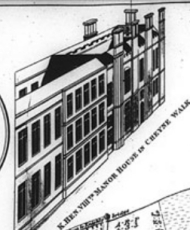
I have found an engraving of the appearance of the Chelsea manor house that stood on Cheyne Walk in a book published in the 1880s. The image resembles that included on a map of Chelsea surveyed in 1664 by James Hamilton and redrawn in 1717 (www.britishmuseum.org/collection/object/P_1880-1113-1221), but the exact location of the house is not marked on the map.

Apart from the commemorative sign at Cheyne Mews and the garden, to which we were unable to gain access, King Henry VIII’s manor house has completely disappeared. I wondered whether Chelsea’s Kings Road had any links to Henry VIII’s ownership of the manor, but it does not. It began as a private road used by King Charles II, who came to the throne long after Henry VIII, when travelling from London to Kew, and was only made a public thoroughfare in 1830. The site of the former manor house owned by Sloane is but a few minutes’ walk from the Chelsea Physic Garden, some of whose land was leased to the Society of Apothecaries for a small amount by Sloane when he acquired the manor.

Finding small things of great interest like the sign on Cheyne Mews is one of many things that increases my ever-growing fascination with London.

An almost secret garden

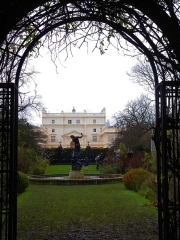
ONE COULD EASILY MISS it whilst walking around the Inner Circle at London’s Regent’s Park. Had I not noticed a couple of people emerging from the discreet gap in a fence, I would have dismissed this as one of the numerous private entrances on the outer circumference of the Inner Circle. The gap in the fencing is near the northernmost point on the circular road. A small notice, framed by vegetation, within the gap in the fencing gives a short history of The Garden of St John’s Lodge. Follow the pathway away from the road, take a left turn and walk between two manicured hedges and then turn right, and you enter a lovely formal garden replete with a pond, several sculptures, and a lawn that gives a fine view of one side of St John’s Lodge. Brave the slippery mud and explore the various separate parts of this almost secret garden. You will not be disappointed.

St John’s Lodge was the first ‘villa’ to be built in Regent’s Park. Completed between 1817 and 1818 (https://historicengland.org.uk/listing/the-list/list-entry/1277478), it was designed by John Raffield (1749-1828), who had worked for the Adam brothers before setting up his own architectural practice. It was later modified and enlarged both by Decimus Burton and Charles Barry. The house was built for the politician Charles Augustus Tulk (1786-1849).  Subsequent owners of the private residence have included Lord Arthur Wellesley, Duke of Wellington (1769-1852) who served in India; John Crichton-Stuart, 3rd Marquess of Bute (‘Bute’;1847-1900), whose heart was buried at The Mount of Olives in Jerusalem; and Baron Sir Isaac Lyon Goldsmid (1778-1859). It was Wellesley who employed Decimus Burton to enlarge the house in 1831-32.

Goldsmid was a philanthropist and one of the leading personalities in the emancipation of British Jews. He made his fortune as a partner in the bullion brokers firm of Mocatta & Goldsmid (founded as ‘Mocatta Bullion’ in 1684), brokers for both The Bank of England and The East India Company. It was due partly to Goldsmid that my alma-mater, University College (London), was able to come into existence. Albert Hyamson, author of “A History of the Jews in England” wrote that:

“University College, London … was established in 1826, largely by the efforts and through the munificence of Isaac Lyon Goldsmid …”

Goldsmid paid for the land on which the university was later built.

In connection with Jewish emancipation, the online Jewish Encyclopaedia (www.jewishencyclopedia.com/articles/6765-goldsmid) writes of Goldsmid:

“The main effort of his life was made in the cause of Jewish emancipation. He was the first English Jew who took up the question, and he enlisted in its advocacy the leading Whig statesmen of the time. Soon after the passing of the Act of 1829, which removed the civil disabilities of the Roman Catholics, he secured the powerful aid of Lord Holland, the Marquis of Lansdowne, the Duke of Sussex, and other eminent members of the Liberal party, and then induced Robert Grant to introduce in the House of Commons a similar measure for the Jews. During more than two years from the time when Jewish emancipation was first debated in Parliament, Goldsmid gave little heed to his ordinary business, devoting himself almost exclusively to the advancement of the cause.”

In 1841, Goldsmid became the first Jewish person, who had not converted to Christianity, to become a Jewish baronet.  His son, Sir Francis Henry Goldsmid (1808-1878), worked with him for Jewish emancipation and was the first Jewish barrister in England, having been called to the Bar at Lincolns Inn.

Clearly, St John’s Lodge has had some noteworthy residents. Of these, it was Bute who commissioned the Scottish Arts and Crafts architect and landscape designer Robert Weir Schultz (1860-1951) create a garden “… fit for meditation”. Bute at St John’s Lodge, which he acquired in 1888, was one of Schultz’s first major clients (http://www.scottisharchitects.org.uk/architect_full.php?id=200199). Bute had taken an interest in Schultz’s studies, having financed his visit to the British School at Athens in the late 1880s. The garden was created in the early 1890s. It was refurbished and some of its original features restored in 1994, but it has been open to the public since 1928 (https://londongardenstrust.org/conservation/inventory/site-record/?ID=WST108).

Apart from its vegetation, the garden features sculptures, a pond, and a giant urn. The sculptures include “Goatherds daughter” by Charles L Hartwell (1873-1951); “Hylas and the Nymph” by Henry Pegram (1862-1937); an “Awakening” by Unus Safardiar (born 1968), commemorating Anne Lydia Evans (1929-99), a local medical practitioner. There are two stone piers, one on each side of a lawn, bordered by scalloped hedges,  leading up to the house. Each of these is topped with a stone cherub holding a fading painted stone shield, the coat-of-arms of Crichton-Stuart. These were made by William Goscombe John (1860-1952).

St John’s Lodge remained in private ownership until World War I, when it became a hospital for disabled officers and then became the HQ of St Dunstans (now known as ‘Blind Veterans UK’) with its workshops from 1921 to 1937. Then, it became the headquarters of the Institute of Archaeology from 1937 to 1959. In 1959 it was occupied by Bedford College (now ‘Regent’s University’).  It was vacated and since 1994, it has been leased for private residence to the Royal Family of Brunei.

Had I walked past the small passage leading off the Inner Circle,  I would have missed experiencing the almost hidden, delightful garden of St John’s Lodge, which is a building that has housed persons who have influenced the history of Britain significantly. We visited the garden in late December when few plants were in flower. We hope to return a few months later when not only the garden will be filled with blooms as will the nearby Queen Mary’s Rose Gardens within the Inner Circle.

Amy and origami

OUR FRIENDS INTRODUCED us to a square in north London, which we had never visited before despite the fact it is near the pub where we meet them regularly, when covid19 regulations permit. The square, Camden Square, is about 1000 yards northeast of Camden Town Underground Station. The rectangular open space that comprises the ‘square’ was developed between 1830 and 1850 and formed the centrepiece of Marquis of Camden’s New Town development (https://londongardenstrust.org/). The square and Camden Town take their names from John Pratt (1759-1840), the First Marquis of Camden (https://en.wikisource.org/wiki/Dictionary_of_National_Biography,_1885-1900/Pratt,_John_Jeffreys). In 1736, he was called to the Middle Temple, where many years later my wife became a barrister. In 1795, he was appointed Lord Lieutenant of Ireland, and was not popular with the Irish. He was opposed to emancipation of the Catholics and to parliamentary reform. His attitude towards the Irish was repressive and he developed an intrusive intelligence network. In May 1798, insurrection broke out in Ireland and he appealed for more military personnel to be sent from England. Later that year, he was replaced by Lord Cornwallis (1738-1805). A remarkable soldier, Cornwallis was involved in attacking the formidable Tipu Sultan (1750-1799) and forcing him into signing an unfavourable treaty in 1792 at Seringapatnam near Bangalore and Mysore in India.

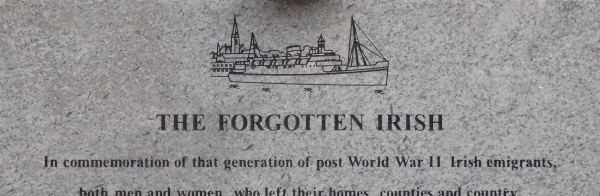
Given the Irish antipathy towards the Marquis of Camden when he was Lord Lieutenant of Ireland, it is ironic that at the southeast corner of the square, we find the building that houses the London Irish Centre (https://www.londonirishcentre.org/). It was founded in 1954 to provide assistance to Irish migrants arriving in London after WW2, often quite unprepared. Its present home, 50 Camden Square was bought in 1955. Its location was chosen because it is close to Euston Station, where many of the Irish arrived by train from Holyhead. A plaque placed on the outside of the Centre’s elegant neoclassical Victorian façade commemorates the ‘Forgotten Irish’. It reads:

“In commemoration of that generation of post-WW2 Irish emigrants, both men and women, who left their homes, counties, and country. They came to work and rebuild this city and country, ravaged and destroyed by war. Sometimes called ‘The Forgotten Irish’, many would never return to Ireland. This plaque recalls their contribution and their loss…”

The Centre contains many facilities including a good library, a bar, and a community café.

The Irish centre and almost all the houses on the eastern and southern sides of the square date back to long before WW2. However, some of the buildings on the western side of the square are post-WW2, most likely built on the sites of houses destroyed by bombing during the war.

Number 57 on the southern side of the square was home to the Indian politician Krishna Menon (1896-1974) between 1924 and 1947, when, after India won independence, he became Indian High Commissioner to the UK. Menon received much of his education in London, at the London School of Economics and University College. He was also admitted to the Middle Temple. Menon worked with the publisher Allen Lane at the time when Penguin Books was established and might have been the inspirer of the idea of producing cheap editions of quality titles, which was the principle adopted by Penguin.

As a member of the Labour Party, Menon was elected borough councillor of St Pancras, and was later given the Freedom of the Borough, an honour which had only one other recipient, George Bernard Shaw. A close friend of Jawaharlal Nehru, the Indian patriot and future Prime Minister of India,  Menon was President of the India League between 1928 and 1947. The League fought for the complete independence of India from the British. Once Menon was asked whether India would prefer to be ruled by the British Empire or the Nazis. He is supposed to have replied that one:

“ …might as well ask a fish if it prefers to be fried in butter or margarine.”

At Camden Square, Menon:

“… had a room and the use of the bath. His furnished room had a bed, a table, a couple of chairs, a wardrobe and a sideboard. Come hell or high water, he had to have his morning bath, and hell often broke loose when the Luftwaffe set out to put the torch to London. Krishna Menon’s landlady is still puzzled about this. Did he, she wonders, insist on his morning bath because of his religion? He paid a pound per week for rent, including the price of his breakfast tea and toast. The rent was modest even for Camden Town.

Krishna Menon used his room only for sleeping. He never gave any parties nor did he entertain guests. In the evening he returned at irregular hours, and if it was not late, he asked Mrs. Rouse for tea. While Krishna Menon was meticulous about his clothing, he left his room in Bohemian disarray. It is with some amusement that Mrs. Rouse recalls that his discarded clothing was scattered all over the room and that he seemed to be unable to fold his towels ‘neat-like’.”

(quoted from “Krishna Menon” by Emil Lengyel).

Almost across the road from Menon’s home, is number 1 Camden Square, home to Robert Harbin (1909-1978) in 1928. ‘Who he?’, I hear you ask. Born Edward Richard Charles Williams in Balfour (near Johannesburg in South Africa), he came to London, aged 20, and began working in the magic department of Gamages toy shop. An accomplished magician, he performed in music halls and later in television and in films. He became interested in Japanese paper folding and became the first President of the British Origami Society, founded in 1967.

Other famous persons have lived in Camden square, many of them artists. They include the Dutch-born painter Lawrence Alma-Tadema (1836-1912), who lived briefly at number 4, when he first arrived in London from Belgium. The sculptor William Turnbull (1922-2012) lived in the square nearer the end of his life. During the 1960s, my mother worked alongside him in the sculpture studios of St Martins School of Art, then in Charing Cross Road next door to the famous Foyles bookshop.

Before I mention the currently most famous resident of the square, I should record the fact that there are no houses along the space’s northern edge. The northern edge is the southern boundary of the grounds of St Paul’s church, Camden Square. The church is a non-descript structure completely devoid of architectural merit. It was built as a temporary replacement of an older church that was designed by Frederick Ordish and John Johnson and built in 1849, and then severely damaged by bombing during WW2.

Number 30 at the north east corner of the square faces three trees whose trunks are surrounded by screens made of bamboo rods, some of which have padlocks attached to them. For, number 30 was the home of the popular singer Amy Winehouse (1983-2011). Some of the padlocks have her name inscribed on them by the mourning fans, who attached them to the trees.

Now that the covid19 pandemic is forcing us to meet others outdoors, the weather has become of even more interest than in healthier times. This brings us to George James Symons (1838-1900), who lived at number 62 Camden square between 1868 and 1900. At the age of 17, he became a member of the Royal Meteorological Society, becoming elected its President twice. He was a pioneer in the scientific study of rainfall and founded The British Rainfall Organization as well as establishing a Climatological Station in the square.

Fortunately for us, there was no rainfall whilst we walked around the square and through the peaceful, well-maintained garden in its centre. I am grateful to our friends for introducing us to this square full of diverse historical associations, some of which were new to all of us.

Rule Britannia!

HAPPY CHRISTMAS !

NOW THAT THE GRAND FINALE of Brexit is nail-bitingly close, maybe our thoughts will turn to patriotism as it is hoped by many, but certainly not all, that Britannia will once again rule the waves, or, at least, the fish that surround our ‘sceptred isle’. Some hope, if you ask me!

James Thomson

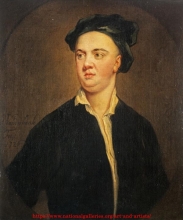
Yesterday, the 16th of December 2020, we joined our friends on a walk from their home in Richmond to Kew Gardens. On the way, we walked along a quiet back street, Kew Foot Road, and passed a former, now disused, hospital, ‘The Royal Hospital’, which opened in 1868 (https://ezitis.myzen.co.uk/royalrichmond.html)  and closed recently. In its last reincarnation, it served as a psychiatric day hospital and a mental health resource centre. A plaque on one of its buildings facing Kew Foot Road commemorates that James Thomson (1700-1748) lived and died here. Observant readers will note that his residence in this location antedates the establishment of the former hospital. The hospital was opened as ‘The Richmond Infirmary’ in the pre-existing Rosedale House on Kew Foot Road. According to James Thorne in “Handbook to the Environs of London” published in 1876, this was the building in which Thomson lived.

Thorne wrote of Rosedale House:

“The present house is a large brick house of three floors, – a centre with a small portico reached by a flight of steps, and two irregular wings. The house Thomson occupied was a mere cottage of two rooms on the ground floor, which now, united by an arch, form a sort of entrance hall… It has since suffered many changes, and is by now (1876) the Richmond Infirmary. The garden has suffered as much as the house. Thomson was fond of his garden, added largely to it, and spent as much time in improving it as his indolent temperament allowed.”

Thomson’s cottage became incorporated into the building that served as the first part of what was to become the Royal Hospital.

One room was where Thomson died on the 22nd of August 1748. The other room was where he wrote  his last published poem, “The Castle of Indolence” (text available at : http://spenserians.cath.vt.edu/TextRecord.php?textsid=34286)  during the last year of his life. This poem, written in Spencerian stanzas, had a great influence on the poetry written by Byron, William Wordsworth, and John Keats.  This kind of stanza, employed by Edmund Spencer (1552-1599) in his poem  “Faerie Queen”, consists of nine lines, eight of which are iambic pentameters and the remaining an iambic hexameter, with the ABABBCBCC rhyming scheme (https://en.wikipedia.org/wiki/Spenserian_stanza).

Thomson was, as you might begin to realise, a poet. Born in Scotland, and educated at The College Edinburgh, he was planning to become a Presbyterian cleric. At Edinburgh, he joined the Grotesque Club, a literary group. He made friends with a fellow member, the Scottish poet and dramatist David Mallett (c1705-1765) and followed him to London in early 1725.  Thomson had a busy life in London, tutoring, teaching in a school, and writing.

In 1740, Thomson collaborated with Mallett on the masque “Alfred”, which was first performed that year at Cliveden, the country home of Frederick, Prince of Wales (1707-1751), father of King George III. Five years later, the British composer Thomas Arne (1710-1778) modified their work to create an oratorio and then a few years later an opera. The finale of this work by Arne uses Thomson’s words in the now well-known patriotic song “Rule Britannia”.

Thomson wrote the words to “Rule Britannia” whilst living at Rosedale in Kew Foot Road. He moved to the area from his room above the Lancaster Coffee House at Lancaster Court in London’s Strand in 1836, but not immediately to Rosedale. It was in 1839 that he moved along the road to Rosedale (www.richmond.gov.uk/james_thomson).

In August 1748, Thomson took a boat trip from Hammersmith to Kew. During that excursion, he caught a chill. The great Samuel Johnson (1709-1784) describes Thomson’s this excursion in his “Lives of the English Poets” as follows (http://spenserians.cath.vt.edu/BiographyRecord.php?action=GET&bioid=33843):

“The last piece that he lived to publish was The Castle of Indolence, which was many years under his hand, but was at last finished with great accuracy. The first canto opens a scene of lazy luxury, that fills the imagination.

He was now at ease, but was not long to enjoy it; for, by taking cold on the water between London and Kew, he caught a disorder, which, with some careless exasperation, ended in a fever that put an end to his life.”

Thomson was buried in St Mary Magdalene, Richmond, near the font.

I had no idea when we set out for our walk that I would walk past the former home of the creator of the patriotic song, “Rule Britannia” on our way to Kew Gardens, which we entered via the Lion Gate and enjoyed greatly. Each time I visit these fine botanical gardens, my enjoyment of this place increases.

A joyous façade on the Tate Gallery

HERE IS SOMETHING WORTH seeing if you can. It is on display at the Tate Britain until the 31st of January 2021 and you need not enter the gallery building to see it. Originally created to celebrate Diwali, the Hindu Festival of Light, in late 2020, this is a wonderfully joyous celebration of both Indian and British culture in light and colour.

The artist Chila Kumari Singh Burman was born in Bootle, near Liverpool, daughter of Punjabi Hindu parents. She graduated at the Slade School of Fine Art in 1982 after having also studied at Southport College of Art and Leeds Polytechnic.

Burman has temporarily transformed the main (Thames facing) entrance of the Tate Britain, its staircase and pillared portico into a pleasing and often humorous riot of colour that makes many references to her upbringing and India’s culture and mythology. To do this, she has made use of coloured lights, neon tubing lights, coloured photographs, and decorative printed coloured paper. The Tate’s website (https://www.tate.org.uk/whats-on/tate-britain/exhibition/chila-kumari-singh-burman) describes Burman’s installation, “Remembering a Brave New World” as follows:

“This magnificent installation, remembering a brave new world, combines Hindu mythology, Bollywood imagery, colonial history and personal memories. Inspired by the artist’s childhood visits to the Blackpool illuminations and her family’s ice-cream van, Burman covers the façade of Tate Britain with vinyl, bling and lights. She changes the figure of Britannia, a symbol of British imperialism, into Kali, the Hindu goddess of liberation and power. The many illuminated deities, shapes and words are joined by Lakshmibai, the Rani (queen) of Jhansi. Lakshmibai was a fierce female warrior in India’s resistance to British colonial rule in the 19th century.”

This description provides a fair summary of what is to be seen. It does not mention the entertainingly decorated autorickshaw (three-wheeler) that was on display in the vestibule of the gallery when we visited. The doorways are also worth examining because they are lined with images taken from the Amar Chitra Katha’s comic books that are published in India to teach Indian children about both Hindu mythology and Indian history. Our daughter, whose background, is both Indian and European, used to enjoy reading these.  Despite what the Tate has written, the artwork does not come across as polemical or anti-British, at least not to me. On the contrary, the artist appears to be enjoying her joint cultural heritage: both British and Indian. My wife said of the installation:

“If this is multi-culturalism, let’s have more and more of it!”

However, words are quite insufficient to describe the visual impact of this wonderful spectacle. It has to be seen to be believed and enjoyed. We saw it during daylight when it can be enjoyed in fine detail, but I imagine that seeing it after dark would also be quite magical.