Revolution in north London

65 ca


Between 1965 and 1970, I studied at Highgate School (founded 1565). Its main Victorian gothic building perches on the summit of Highgate Hill. About two fifths of a mile south east of the school, an architecturally unexceptional late Victorian residential building stands on Cromwell Avenue (number 65). Although this brick edifice may not look special, it harbours the ghosts of a lesser-known episode in the history of India’s struggle for independence from the British Empire. The only thing that hints at the interesting history of number 65 is a blue plaque commemorating the fact that the Indian patriot and philosopher Vinayak Damodar Savarkar, a father of Hindu nationalism, lived there once.

In 1905, a wealthy barrister and scholar of Sanskrit, Shyamji Krishnavarma, bought number 65 Cromwell Avenue and named it ‘India House’. He intended it to be a home away from home for Indian students studying in England. However, it became more than that. It became a centre where Indian politics was discussed and acted upon.

Very soon, India House became the nucleus for Indians who wanted India to break free from the British Empire by any means possible. These included: sending propaganda and literature (including bomb-making manuals) regarded as ‘subversive’ and ‘treasonable’ by the British to India; smuggling weapons and ammunition into India; and political assassinations both in England and India. Valentine Chirol, the Foreign Editor of the Times newspaper wrote that India House was “…the most dangerous organisation outside India…”. As such, India House was under the constant vigilance of Scotland Yard, but despite this, its members were able to carry out real-life exploits that rivalled the derring-do of characters in John Buchan’s fiction.

Apart from Krishnavarma, those who congregated or lived at India House included well-known Indian patriots and freedom fighters, such as Madame Bhikaiji Cama, VVS Aiyar, VD Savarkar, Lala Lajpat Rai, Madan Lal Dhingra, and Har Dayal. The place was also visited by MK Gandhi (the future ‘Mahatma’), Charlotte Despard, David Garnett, Dadabhai Naoroji, and VI Lenin.

India House thrived until late 1909. During that year, one of its members carried out an assassination in London. After that deadly deed, activities at India House declined rapidly, and it was closed for ever by the beginning of 1910.

My new book, “Ideas, Bombs, and Bullets”, describes the history of Highgate’s India House and the activities that originated there. In addition, it explores the ideas that led Krishnavarma to ‘create’ India House and the lives led by people who lived in, or congregated, at the place. Also, it contains the background to the replica of 65 Cromwell Road that can now be viewed and entered by visitors to Kutch, an arid part of the western Indian state of Gujarat.

Until I visited Kutch in 2018, forty-eight years after leaving Highgate School, I had not known that my alma-mater is situated so close to the site of such an exciting short episode in the history of anti-colonialism. Boldly, I suggest that this story is also unknown to most pupils, who have attended Highgate School since 1905. Furthermore, Highgate’s India House and Shyamji Krishnavarma are practically unknown amongst many educated Indians, with whom I have spoken. I hope that “Ideas, Bombs, and Bullets” will help to make the exploits and aspirations of the members of India House more widely known.


BUY a paperback version of IDEAS, BOMBS, and BULLETS here:

http://www.lulu.com/shop/adam-yamey/ideas-bombs-and-bullets/paperback/product-24198568.html

BUY an e-book version of IDEAS, BOMBS, and BULLETS here:

https://www.amazon.com/dp/B07W7CYKPG/ 

The Patient Assassin

Assass


I love browsing in second-hand bookshops. Occasionally, I come across really good books that I had not previously known about. The Patient Assassin by Anita Anand (published 2019) was one such discovery.

The Patient Assassin is about the life and exploits of  Udham Singh (1899-1940), a pro-independence, anti-British activist. Some of his friends were killed in the notorious Jallianwalla Bagh massacre  in mid-April 1919. Under the command of General ‘Rex’ Dyer, several hundred innocent men, women, and children, were shot dead within the closed space of Jallianwalla Bagh, a walled public garden in Amritsar. Many others were injured in this cruel attack whose supposed purpose was to subdue the people of the Punjab so that they would not rise against British rule. 

Dyer died of illness in England, having been proclaimed a hero for his malevolent deed. Michael O’ Dwyer, the Lieutenant Governor of the Punjab, who thoroughly approved of what was done at Jallianwalla Bagh and other horrific treatment of Indians, retired to London.

Udham Singh had friends who were killed at Jallianwallah Bagh. He made it his mission to kill O’ Dwyer. The author of Patient Assassin, Anita Anand, traces Udham’s complex and mysterious life from the Punjab to London, where he shot dead O’ Dwyer at a meeting at London’s Caxton Hall in 1940. Ms Anand weaves an exciting tale based on her researches of Udham’s colourful and exciting life. Her book about a real person makes far more engaging reading than most fictional thrillers. 

I was very pleased to stumble across Anand’s book for two reasons. One is that it turned out to be an un-put-downable read. The other is that it chimes with something that I have been working on.

In mid 1909, Madan Lal Dhingra, who like Udham Singh came from the Punjab, shot dead Sir William H Curzon Wyllie, a retired important British administrator in India, at the Imperial Institute in South Kensington. This assassination horrified the British nation and many in India. 

Dhingra had come to England study engineering at University College London several years before shooting Curzon Wyllie. He had become involved in the freedom fighting activities that were centred on India House in Highgate between 1905 and early 1910. It was Dhingra’s fatal shots that hastened the demise of India House, a student hostel and meeting place which was regared by the British as a ‘centre of sedition’.  I have almost completed writing a book about India House and its members, including Dhingra, and it should be available for sale soon. Its title will be “Ideas, Bombs, and Bullets”.

Finding Ms Anand’s book quite by chance was a great delight for me. Unintentionally, it might almost be considered a kind of sequel to what I have just written.

Indian patriots in Edwardian London: against the British Empire


Here is something to whet your appetite!

IDEAS,BOMBS, and BULLETS

Indian freedom fighters in Edwardian London

Inside a house on a quiet tree-lined residential street in north London’s Highgate, a young Indian held a revolver in one hand and repeated a solemn oath promising to give liberating India from the British greater importance than his own life…

Pandit Shyamji Krishnavarma (1857-1930) was born in Mandvi in Kutch. He earned his title of ‘Pandit’ because of his very great knowledge of Sanskrit. In the 1880s, he travelled to England where he became an assistant to Professor Monier Williams at the University of Oxford. Krishnavarma’s studies of Sanskrit at Oxford earned him great fame amongst the Indologists all over the world. He also became a barrister. On hisreturn to India, Krishnavarma served as ‘Diwan’ in various princely states, before returning to England in 1897.

FACE

By 1905, Krishnavarma had become deeply involved in the movement to free India from the grips of the British Empire. That year, he purchased a house in the north London suburb of Highgate. He named it ‘India House’ and it served as both a hostel for Indian students and a centre for plotting the liberation of India from the British.

Between 1905 and 1910, when India House was closed and sold, this place became known as a ‘centre of sedition’ and the ‘most dangerous organisation in the British Empire’. I have almost finished writing a book, to be called “IDEAS, BOMBS, and BULLETS” about Highgate’s India House and the people associated with it. 

Here is a brief introduction to my forthcoming book:

This is about a little known part of the history of India’s struggle for independence. It concerns events centred on a house in Edwardian London. It is a tale of bombs, guns, lawyers, patriots, philosophers, revolutionaries, and scholars.

A large Victorian house stands in a residential street in the north London suburb of Highgate. Between 1905 and 1910, it was known as ‘India House’, and was a meeting place and hostel for Indian students, many of whom wished to help liberate India from centuries of British domination.

In the 19th and 20th centuries before India’s independence, many young Indians came to England to be educated. This is the story of  a few of them, who came to Britain in the early 20th century, and then risked sacrificing their freedom, prospects, and lives by becoming involved in India’s freedom struggle. 

This book describes the true adventurous exploits of members of Highgate’s India House (including VD Savarkar, Madan Lal Dhingra, and VVS Aiyar) and its history.

I will give you more news about my book soon, I hope!


English abroad: Globes, robots and bogies

Stop light_240


I must have been about eleven years old when the headmaster of my preparatory school, the Hall School in Hampstead, interviewed all of us individually in preparation for our applications to secondary school. When I had answered several questions using the word ja (pronounced ‘yah’), the headmaster said that it was wrong to say ja when I should be saying ‘yes’. 

The reason that I said, and often still say, ja instead of yes is that my parents were born and brought up in South Africa where ja is often used to express the affirmative.

In my childhood, I heard my parents using words that form part of South African English. At table, I always wiped my hands and mouth with a serviette, rather than a ‘napkin’. And, when we relaxed we usually sat in the lounge, rather than in the ‘sitting room’ or ‘drawing room’.

If I wanted to see a film, my father would enquire at which bioscope it was being shown. And, if a light bulb needed changing, he would insert a new globe

When we were in the car we used to stop at a robot, if the traffic light was showing a red light and then proceeed when it changed through amber to green.

By now, you can see that I was raised in England, but acquiring vocabulary that was only used many thousands of miles away below the Equator in South Africa. So, it was not surprising that I answered the headmaster with ja instead of ‘yes’. But, he probably had no idea about my parents’ background.

Many years after leaving home, I began visiting India and encountered another local English vocabulary. For example, when the car needs more fuel, you fill up at the petrol bunk. And, if you have baggage, you put it in the car’s (or bus’s) dickie, rather than the ‘boot’. And en-route you drive round a circle, rather than the ’roundabout’. When you board a train, you do not enter a carriage. Instead you board a bogie. If you want your coffee without sugar, do not say ‘without sugar’ but do ask for sugar less.  And, so it goes on…


English might well be one of the world’s most used languages, but it abounds with regional variations. American English is a prime example of this. As Oscar Wilde wrote:

“… we have really everything in common with America nowadays, except, of course, language

A vulgar audience

music


I enjoy attending events at the Nehru Centre, the Indian High Commission’s cultural centre in London. However, the audience can become quite unruly occasionally. 

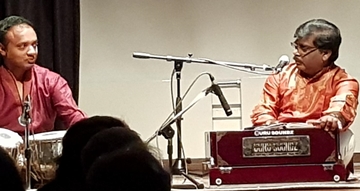
Only afew days ago, I attended a concert of Bengali and Hindi songs pertformed by an excellent Bengali male vocalist, Soumyen Adhikari who accompanied himself on a harmonium. He was also accompanied by a superb tabla player. 

The audience was, as is often the case, restless. People arrived late throughout the performance. Others kept moving from one seat to another or leaving the auditorium only to return a few minutes later. All around us people in the audience were chatting to each other loudly whilst the musicians performed. They would not be silent even after having been asked repeatedly. All of these disturbances are quite normal amongst Indian audiences and are more or less tolerable.

What really upset me at this particular concert was the ignorant comments shouted by some members of the audience. After the singer had sung several beautiful songs in Bengali, some people began shouting things like “Sing something in Hindi”, “we can’t understand Bengali”, and “enough of Bengali songs”. 

I cannot understand either Hindi or Bengali, but that does not detract from my enjoyment of songs sung in these languages. What is important to me is that the singer has a good voice and that the musicians play well. Just the lovely sounds of the songs and the music is a great pleasure for me. It upset me that so many of those around me lacked the  ability to appreciate the beauty of what was being played. Their approach was so parochial that all they wanted was something familiar, which they had heard over and over many times before. I felt sorry for the singer, who is clearly a masterful performer whom I would happily hear again.

A keen salesman

Elephant_240

Many years ago when we vere on holiday in India, we visited a historic Hindu temple complex in the State of Karnataka.

When we left the enclosure containing the amazing temples with thier intricate stone carvings, we were approached by a little boy, who could have been no more than ten years old. He wanted to sell us some quite attractive miniature elephants carved in stone. Out of politeness, rather than curiosity, we asked the price.

“200 rupees,” he said.

We told him that we did not want the carvings.

“100 rupees,” he said, hopefully.

“We don’t want them, thanks,” we said.

“50 rupees?”

“Really, no thanks”

“25 rupees?”

“Really, no”

“10 rupees?”

We tried to make it clear that we did not want the carvings at any price.

“Have them for nothing,” the little boy offered.

We still did not take them. I often wonder what would have happened next, had we accepted his three elephants as a free gift.

Directions

directions


I travel a great deal and sometimes get lost. It is then that I might ask a passer-by for directions. Generalising a bit, the kind of answer you get tends to vary from country to country.

During trips to the USA, I have either been told that the person I asked has absolutely no idea at all or I have been given very precise, accurate directions. 

In the UK, if you ask directions from the average person you meet by chance, several things might happen. First of all, you might be given accurate directions. More likely, you will recieve a vaguer reply like:

“I think it’s somewhere in that direction. Follow that road, and then ask again.”

Because most British people want to be helpful, you might be told:

“I think I’ve heard of it. You could try going that way, but I’m not sure.”

But, it is very rare that you will be told:

“I’ve absolutely no idea.”

In India, asking directions can result in a small conference taking place. People within earshot of the person you first asked will join in the discussion. Often each person will point in a different diection in an attempt to be helpful and also to have the chance to meet a stranger. Like the Americans, who will happily admit ignorance of places that do not have any importance in their lives , many Indians also only know how to reach places where they need to be but not others. But, unlike the Americans, Indians do not want to disappoint visitors to their country by not supplying some kind of answer.

Of course, all of the above is highly generalised. But, here is one specific example, which occurred in Istanbul, Turkey. We were looking for some place of interest, but could not find it. We entered a shop. Without having any knowledge of Turkish, we managed to make it clear what we were looking for. Without hesitation, the shop keeper abandoned what he was doing, becckoned us to follow him, and then walked with us through the area until we reached our desired destination.


No outside food


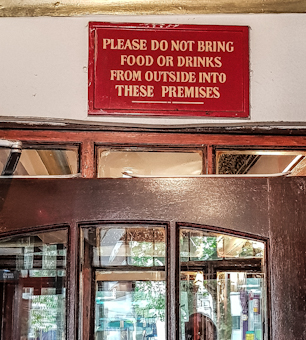
The Coffee Cup café in London’s Hampstead has been in business since 1953, and has been very popular since I first remembered it in the early 1960s. I have visited it several times, but never before noticed the sign at its entrance, which reads: “Please do not bring food or drinks from outside into these premises.” This instruction is not seen frequently in restaurants and cafés in the UK. Seeing this sign reminded me of what is very common in eateries in India, namely, signs reading: “Outside food not allowed.” Customers are forbidden to bring into the estblishment food or drink they have obtained elsewhere. That is fair enough, I suppose.

Cinemas in India, like in many other countries, try to sell food and drink to their customers, often at outrageously high prices. Apparently, watching a film is for many people more enjoyable if you are stuffing popcorn into your mouth at the same time as spilling it on the floor in the dark.

Back in 2001, my family, my in-laws, and my wife’s brothers family went to watch the recently released Bollywood blockbuster Kabhi Khushi Kabhie Gham at a large cinema in Bangalore (India). After purchasing the tickets, we had to wait in a queue before all of our baggage, shopping baskets, handbags etc., were searched by uniformed security personnel. I wondered what these officials were looking for. Was it guns or explosives, I asked my sister-in-law after we had reached the auditorium. No, it was not that, she replied. They were looking for food and drinks brought from outside the cinema. She told me that outside food was not allowed into the cinema, and then showed me inside her shopping basket, All I could see was a shawl (some cinemas are too cool because of air-conditioning). She moved the shawl aside to reveal that her bag was filled with sufficient drinks and snacks to easily satisfy all eight of us during the three and a half hour film. So much for the security check! Had we been carrying anything more dangerous than ‘outside food’, this would have also been missed by the not so vigilant security people.

It is odd how a chance sighting of something like the sign in the Coffee Cup can bring back distant memories.

Chopsticks


My earliest recollection of eating Chinese food was in a restaurant called ‘Tung Hsing’ in Golders Green almost opposite the old Hippodrome Theatre. It opened in the 1960s and was one of the first restaurants in London to serve Pekinese food, rather than the then usual Cantonese cuisine. The restaurant was owned by a retired ambassador from Chiang Kai-shek’s nationalist China and his wife, whom I believe was responsible for the very excellent food served. 

Although I am sure they were available, I am not sure whether I used chopsticks when eating at the Tung Hsing. Maybe, I learned to use them there, but I really cannot remember. Whatever the case, I have been eating Chinese food with chopsticks for many decades. I would not say that I am 100 percent proficient with them, but I feel that using them to eat Chinese food satisfies me.

Chinese-style food is very popular in India. Most Indians eat in Chinese restaurants using western utensils such as plate, fork and spoon. If you ask for chopsticks, they are usually available, but they are not supplied as default table settings.

Some years ago, early this century, a new Chinese restaurant opened in Museum Road in Bangalore. We visited soon after its inauguration. It was a lovely restaurant and the food was good by Indian Chinese restaurant standards. As usual, we asked for bowls and chopsticks. The waiter disappeared for a while, and then returned empty-handed.

“There are no chopsticks,” he told us.

“Why not?” we asked.

“I will ask the manager.”

The Manager came over, and explained:

“We have been so busy since we opened, and many of the guests have taken them home as souvenirs. So, we have run out of them”