If you are there, you must try…

TAHARI blogg

I had always wanted to visit Gulbarga (now ‘Kalaburgi’) in northern Karnataka (India), not far from Hyderabad, because of the richness of its medieval Islamic architectural heritage.

When my friend in Bangalore, Mansour, a great gastronome and connoisseur of fine foods, knew we were in Gulbarga, he said:

If you’re there, you must try tahari

Well, we had no idea what this dish comprised, but if Mansour reccomended it, it must be worth trying. A search on Google revealed that the Limra Tahari was highly rated. We rang to make a reservation and were told that was unnecessary. Also, we learnt that the place only took cash payments.

One evening, we hired an autorickshaw to take us to Limra. However, the driver had no idea how to find it, and eventually dropped us near a different restaurant, saying;

This is a restaurant. You can eat here.

It was a totally unsatisfactory eatery.

Next evening, we were fortunate. A rickshaw driver knew where to find the Limra. When we arrived, he told us that he would wait for us as we would not be long and, also, it was difficult to find autorickshaws in the area in the evening. We wondered why, but soon found out.

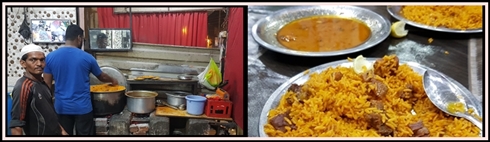
The front of the restaurant was unprepossessing, to put it mildly. The place was separated from the street by a pair of ageing red curtains, rather like that found at a theatre stage. The steps leading up to it from the street were littered with old newspaper and other rubbish. I looked at my wife questioningly. She seemed happy to enter, so we parted the curtains and stepped inside. The interior was spotlessly clean.

To the left of the entrance, an old man sat behind a small cash desk. To the right, there were a couple of men preparing food in huge metal post heated by smouldering charcoals. Limra’s dining area was simple. There were several long narrow rectangular metal tables, which were probably screwed to the floor. All of the diners were men, except my wife.

Before we had time to ask for a menu or what was on offer, a boy slid two metal plates across our table towards us. Each plate was laden with tahari. He added a third plate that contained an unappetising looking greasy sauce. We ordered a couple of bottles of mineral water and began our exploration of tahari.

The tahari consisted of spicy yellow rice which contained a few lumps of well-cooked tender meat. The sauce turned out to be delicious and not at all greasy. The tahari was very tasty and delicately spiced – a real treat. Tahari is, I later discovered, an Awadhi dish from the region of India where Lucknow is located. It is typical of a certain style of Mughal cooking. It is, as we saw when we entered Limra, slow-cooked.

When we finished our tahari, we noticed the menu on the wall behind us. It consisted of two items: tahari: full plate, and tahari: half plate. No wonder, we were served our food immediately. There was nothing to choose from here! Our bill for two full plates and two bottles of water came to only 80 Indian Rupees (about £0.90 sterling). It took us no more than 10 minutes to finish our scrumptious meal. We understood why our driver decided to wait for us, and we understood why the restaurant did not accept anything but cash as payment. So, if you are ever in Gulbarga, you must try tahari!

One book, two titles

COVER GUJ a blog

The prices of books varies greatly from one country to another. In India, many books cost far less than their equivalents sold, for example, in Europe. Readers in India buying books that have to be imported from ‘the West’ often face high charges due to delivery from afar. I have tried to address this problem with a couple of books, which I have written. My solution is outlined after the following introduction to one of my books about India:

My wife, who is a fluent Gujarati speaker, was born in Bombay. Her father’s family originated in Gujarat and her mother’s in the former Princely State of Kutch, which became part of the State of Gujarat after India became independent.

Both my wife and I have visited India regularly from our home in the UK, yet neither of us had ever been to Gujarat until early in 2018. We felt that it was high time that we visited the parts of India connected with her heritage. I have published a book that describes that first trip. We did not visit everywhere in Gujarat, but the places we saw, our experiences, and the people we met ranging from autorickshaw drivers to former royalty, and our experiences, are described my book. All of these have made us want to visit the region again and to explore it further.

I have long been fascinated with tiny enclaves. I have visited places such as Andorra, San Marino, Mahe (in Kerala), Pondicherry, and Llivia (a part of Spain surrounded by France). Gujarat contains two such places, the former Portuguese colonies of Daman and Diu, territories surrounded by Gujarat but separated from it by borders. We included them on our journey and discovered that though small in area, they are filled with interest.

Gujarat was the birthplace of many celebrated persons, including Narsinh Mehta (poet), Dayanand Saraswati (philosopher), Shyamji Krishnavarma (Sanskrit scholar and freedom fighter), and politicians such as: Mahatma Gandhi, Dadabhai Naoroji, Vallabhai Patel, Morarji Desai, and Narendra Modi. Yet, undeservedly, it is a part of India less frequented by tourists than many other places in India (e.g. Goa, Kerala, Rajasthan, and the ‘Golden Triangle’). I hope that what you will read in this travelogue will whet your appetite and encourage you to make plans to visit Gujarat.

The idea of my book is to unwrap the attractions of Gujarat to make them better known to those who have not yet visited this region of India.

What I have written above is to introduce you to a book I published in 2018 with the title “TRAVELS THROUGH GUJARAT, DAMAN, and DIU”. This book is available from on-line booksellers such as lulu.com, Amazon, and bookdepository.com. When you buy my books from these suppliers, they are produced in Europe or the USA and then shipped to the buyer. If they are bought by people living in India, their prices become very large (in comparison with average Indian book costs) because of additional postal charges. For example, TRAVELS THROUGH GUJARAT, DAMAN, and DIU can cost up to 1500 Indian Rupees (‘INR’) and another book, which I have recently published, “IDEAS, BOMBS, and BULLETS” can cost purchasers in India over 800 INR.

To make my books more affordable in India and priced at a rate closer to comparably sized books in the Indian market, I have re-published the two books mentioned above with an Indian print on demand outfit called pothi.com. The travel book has been revised and I hope improved. I have renamed it “GUJARAT UNWRAPPED”. My book about Indian patriots in early twentieth century London, “IDEAS, BOMBS, and BULLETS” retains its original name.

When ordered through pothi.com and delivered in India, GUJARAT UNWRAPPED is priced at 296 INR (plus minimal postage) and IDEAS, BOMBS, and BULLETS comes to 395 INR (plus minimal postage).

To order GUJARAT UNWRAPPED FROM POTHI.COM,

click: https://pothi.com/pothi/book/adam-yamey-gujarat-unwrapped

To order IDEAS, BOMBS, and BULLETS FROM POTHI.COM,

click: https://pothi.com/pothi/book/adam-yamey-ideas-bombs-and-bullets

IMPORTANT:

It is worth nothing that purchasers ordering the books from pothi.com BUT not having their books delivered in India, face huge postage charges.


Captured by the British

COVER blog


This true story in this recently published book covers three contintents:

* It concerns the adventures of an educated South African, who was captured by the British during the Boer war (1899-1902)

* The prisoner of war (POW) was held in prison camps in what was then British India.

*Whilst in Captivity, he visited Indian localities such as Madras, Trichinopoly, Kolar, Amritsar, and Bangalore. Being observant, he made notes on what he experienced. His observations form the centrepiece of this book, which is also rich in South African history.

* The POW’s descriptions of Bangalore in 1901 are particularly detailed, and will fascinate anyone who knows the city today

* This book will appeal to anyone interested in the histories of South Africa and/or India 


IMPRISONED IN INDIA” by Adam Yamey

is available as a paperback (ISBN: 9780244826161) at:

http://www.lulu.com/shop/adam-yamey/imprisoned-in-india/paperback/product-24280162.html

For readers in India: https://pothi.com/pothi/book/adam-yamey-imprisoned-india

and on Kindle

Veggie burgers and other creatures

veggie

The popularity of vegetarianism and its relative veganism has greatly increased in the western world in recent years, and is still increasing. Popular reasons for abandoning the consumption of meat and/or products derived from animals (e.g. milk and eggs) include seemingly virtuous reasons such as love of animals and a desire to protect the world’s climate.

On the 23rd of July 1939, one world-famous vegetarian wrote a letter to another equally well-known vegetarian. Mahatma Gandhi wrote to Adolf Hitler. Here it is in a much abbreviated form (from: https://www.mkgandhi.org/letters/hitler_ltr1.htm):

DEAR FRIEND,
That I address you as a friend is no formality. I own no foes.

… We have no doubt about your bravery or devotion to your fatherland, nor do we believe that you are the monster described by your opponents. But your own writings and pronouncements and those of your friends and admirers leave no room for doubt that many of your acts are monstrous and unbecoming of human dignity, especially in the estimation of men like me who believe in universal friendliness

… I, therefore, appeal to you in the name of humanity to stop the war. You will lose nothing by referring all the matters of dispute between you and Great Britain to an international tribunal of your joint choice

You know that not long ago I made an appeal to every Briton to accept my method of non-violent resistance.

During this season when the hearts of the peoples of Europe yearn for peace, we have suspended even our own peaceful struggle. Is it too much to ask you to make an effort for peace during a time which may mean nothing to you personally but which must mean much to the millions of Europeans whose dumb cry for peace I hear, for my ears are attended to hearing the dumb millions? …

I am,
Your sincere friend,
M. K. GANDHI
The letter never reached Hitler; it was intercepted by the British in India.

I have no idea what the monster Adolf Hitler had to say about vegetarianism, but the saintly and peace-loving Gandhi wrote much about his abstinence from meat. For example, in 1932 he wrote:

I do feel that spiritual progress does demand at some stage that we should cease to
kill our fellow creatures for the satisfaction of our bodily wants. The beautiful lines
of Goldsmith occurs to me as I tell you of my vegetarian fad:

‘No flocks that range the valley free
To slaughter I condemn;
Taught by the Power that pities me
I learn to pity them’

(see: https://www.mkgandhi.org/ebks/moralbasis_vegetarianism.pdf)

And at another time:

“It is very significant that some of the most thoughtful and cultured men are partisans of a pure vegetable diet.”“.

Maybe, he was thinking of the man of culture, Bernard Shaw, rather than Adolf Hitler!

Returning to the present day and the increasing appetite for meatless and dairy-free food, let us consider the current desire for vegetarian products to resemble meat products. Supermarket shelves are filling up with veggie burgers, meatless steaks, meatless meat balls, meatless shawarma, and many other products made to resemble meat without containing it. Recently, I was in a Chinese restaurant, which offered diners vegetarian chicken and vegetarian duck dishes. This yearning for vegetarian products to be named like and to look like meat products is absurd,

There are plenty of delicious vegetarian dishes that are not made to resemble foods that usually contain meat. Middle-Eastern and Turkish cuisine, for example, offer vegetarian eaters delights such as: humous, fattoush, Imam Bayildi, Mutabbel (an aubergine dish), falaffel, stuffed peppers,etc. Even the French, who until recently have not been overly attracted to vegetarianism, have a traditional dish perfect for vegetarians: ratatouille. As for Indian cuisine, there is a plethora of dishes that are vegetarian and do not try to appear like meat. In India, the land where Gandhi was born, vegetarianism is a way of life, rather than a changed lifestyle, for hundreds of millions of people. This has been the case in India for many millennia.

To conclude, what I am trying to say is that if you wish to abandon eating meat for whatever reason, then you might as well abandon the desire to eat things that look like meat, but are not. If you are adopting vegetarianism, then enjoy meatless dishes for their own sake, not because they remind you of meat! Bon apetit!

Picture source: tesco.com

Urban animals

Romulus

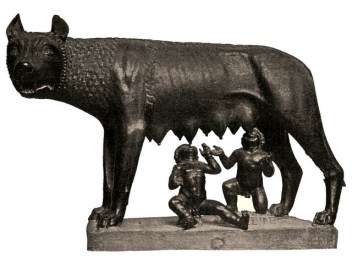
Exactly when great cities were founded is often unclear. However, sometimes there is a myth involving the animal world that is associated with the genesis of a great city. In the case of Rome (Italy), the story of Romulus and Remus and the wolf that suckled them is too well-known to be repeated here. If you do not know it, read about it HERE .

The great city of Ahmedabad in Gujarat (India) was founded in the 15th century AD by Ahmed Shah, who governed the Sultanate of Gujarat  from 1411 until  1442. According to the writers Achyut Yagnik and Suchitra Sheth in their book Ahmedabad: From Royal City to Megacity:

One popular myth says that Ahmed Shah went hunting one day on the banks of the Sabarmati and saw a hare chasing a dog. Amazed by the the unusual role reversal and interpreting it as an auspicious omen, Ahmed Shah decided to found a city at that spot by the river“.

This kind of myth in which a predator is chased by its prey is shared by several other cities including Malacca (now in Malaysia), Chandrapur (in Maharashtra), and the ancient city of Vijaynagara (in Karnataka). In the case of Malacca, a mouse deer being chased by a dog managed to push its pursuer into a river (see: https://en.wikipedia.org/wiki/Chandrapur) . As for Chandrapur, there was a hare chasing a dog. In each case, a city was founded on the spot where these unusual occurrences were reported.

Vijanagara on the banks of the River Tungabadra thrived from the 14th century until the 16th century and was during its heyday one of the largest and richest cities of its time.  Today, its extensive, impressive, and attractive ruins can be explored by visitors to Hampi (near the city of Hospet). According to Robert Sewell (1845-1925) in his A Forgotten Empire (first published 1900), a chieftain Deva Raya (aka ‘Deorao’) was:

“… one day hunting amongst the mountains south of the river when a hare, instead of fleeing from his dogs, flew at them and bit them…”

When Deva Raya told the sage Vidyaranya about this incident, the wise man told him to build a city on this spot. That was in 1336 AD, and the city became Vijaynagara. In another version of  this story, as related by Ratnakar Sadasyula in his recently published book City of Victory says that the hare attacking the dogs (at the place Vijaynagara was started) was seen by the brothers Harihara and Bukka, who were the first two rulers of the Empire of Vijaynagara (see: https://en.wikipedia.org/wiki/Harihara_I). It matters not who actually witnessed this extraordinary attack of the dogs by a hare. What is interesting  is that the locations of several cities has been ascribed to the siting of  prey pursuing its predator(s). 


Picture source: wikipedia

An automobile in Albania

KRUJA small

This is an extract from my book “REDISCOVERING ALBANIA” (ISBN: 978-1326807108). The extract describes a visit to a historic town and problems with a rented car.

“When we have hired cars in the past, we have been presented with a car which is almost new and totally flawless. This was not the case with Enterprise at Tirana’s airport. We had ordered a Tata Indica car – I had chosen it because of the price and also because I had not driven an Indian car since 1994, the first and only time that I ever drove in India. Our Tata was distinctly tatty in appearance. It was covered in scratches and dents, all of which were carefully noted and photographed by the Enterprise representative and me. The upholstery was clean but looked well worn. He told us that the car was “quite new”; it had “…only done about 32,000 kilometres”. Dubious at first, I realised later that this unprepossessing vehicle was just the job for the terrain that we were going to traverse.

I had not driven for two years, the last time being when we hired a car in Palermo (Sicily) in 2014. However, I soon got into the swing of driving. I was pleased that we had not hired the car from an office in Tirana, where traffic is heavy, but from the airport where traffic is light. Soon, we left the main Tirana to Shkodër ‘highway’, and then began winding our way uphill to the small town of Krujë, which is where Albania’s hero Skanderbeg had his headquarters while he was combatting the invasion of the Ottomans.

Skanderbeg, the son of a noble-man called Kastrioti, was taken forcibly by the Turks to Turkey as a young boy (as many Christian youths were in that time). He was converted to Islam, educated as a soldier, and became a good fighter in the Ottoman Army. In 1443, aged 38, Skanderbeg along with several other Albanian soldiers abandoned the Turks. Soon, he took command of the Castle at Krujë, which became his headquarters from where he harassed the Ottomans, who were trying to invade what is now Albania. After many military exploits both in Italy and in Albania, Skanderbeg finally succumbed to malaria in 1468. This is a very brief account of the career of a man who saved Western Europe from becoming part of the Ottoman Empire. Albania did become part of the Empire, but in the words of a guidebook published in 1969 by Albturist, the state tourist agency of Albania:

Although their heroic efforts were not crowned with final victory, the Albanian people did not kneel down. Throughout the centuries that followed, our people continued their resistance against the Ottoman feudal regime.”  

The road became steeper and steeper until we entered the town in which level ground is a rarity. We parked the car on a steeply sloping street and made our way to a café, whose terrace provided a great view of the town’s castle, which overlooked us, and the old bazaar, which was several metres below us. From where we were sitting we saw one or two elderly people wearing what looked to us like traditional costumes, but most people were dressed in modern clothing.

We made our way along the shiny cobbled street that runs between the two lines of shops that make up the old bazaar. This has been extended since I saw it in 1984, but the extension has been made to look as if it were original. As in 1984, all of the shops in the bazaar are selling goods aimed at tourists: everything from tasteless ‘tat’ to some very lovely antiques. One particular shop contained superb examples of traditional Albanian handicrafts, some pieces including some wooden cradles for babies were quite old. Some weeks later in Tirana, we met, quite by chance, the shop owner’s cousin, the daughter-in-law of one of Albania’s foremost artists. Although the bazaar resembles what I remembered from my first visit in 1984, the town is filled with new buildings, including mosques and churches, which might have existed before Enver Hoxha destroyed them, but are now reconstructed or entirely new. Many but not all of the old Ottoman era buildings that made Krujë so attractive to me in 1984 have been demolished to make way for newer mostly less-attractive constructions. Nevertheless, Krujë, nestling in the wooded hills that surround it, is still a lovely place to visit.

After stumbling through the cobbled market, we began climbing the path that leads to the castle complex. On our way we passed an old (Ottoman?) structure that housed what must have once been the outlet for a spring. It was filled with fragments of old carvings including an eight-pointed star, and just above the outlet for the water two animals (lions?) facing each other.  Nearby, two young boys selling small round green plums asked where we were from, and then tried to sell us some of their fruit. Just before we reached the entrance to the castle, we came across a man sitting on a wall selling books. He was the author of the various volumes that he had set out for sale. We said hello to him, and told him that we would have a look at his books after we had visited the castle.

Parts of the vast area of the interior of the castle walls are still inhabited. Much of the space is covered with ruins of what had originally been Skanderbeg’s castle and then later the Ottomans’. These ruins include a solitary watchtower and the base of a large minaret. We had read that there was a Bektashi mosque, the Tekke (‘teqe’ in Albanian) of Dollma, in the grounds. A young man offered to guide us to it. Because the way to it was extremely rough and Lopa had a bad ankle, she decided to wait for me while I went to see the mosque. The young man explained to me (in good English) that he is a Bektashi, a member of a ‘sect’ of Muslims (although many Muslims disclaim them) that is halfway between Shia and Sufi. It is particularly popular in Albania, Bulgaria, and Anatolia. Unemployed as so many Albanian graduates are, he spends his time looking after the tekke and its surroundings. On our way along the path to the tekke, we met a woman, aged about 30, with her small child. She spoke some English, but mainly gossiped in Albanian with my new acquaintance. We stood next to what looked to me like an Ottoman hammam or bathhouse. It was, but it has been heavily restored with bright new roof tiles that detract from its character and beauty. After the woman left, he explained that when she had been orphaned, his family had informally adopted her and brought her up as a daughter.

The 18th century tekke is in good state of preservation. By the way, a tekke is a gathering place for Sufi and Bektashi believers. Its interior walls and ceilings are covered with delicately painted frescos and lines of Arabic or Turkish calligraphy. There are several tombs of dervishes within the mosque, and also some outside it in its grounds. Near the tekke, I saw some old stone fragments that looked as if once they had been part of an earlier structure, maybe a church. My guide introduced me to an elder man who lives in a recently built circular meeting place next to the mosque. The old man, I was told, had spent 12 years in prison during the Communist era simply because he was a Bektashi adherent. Some years ago I showed my friend Bejtulla Destani, an academic from Kosovo, pictures in a book by Albert Mahuzier who visited Albania in the early 1960s, in the years before Enver Hoxha outlawed religion. The book included a photograph of the imam or priest of the tekke in Gjirokastër. Without hesitating, Bejtulla said that it was most likely that that man would have been killed by Hoxha’s people soon after 1967.

The visit to the tekke took rather longer than I had anticipated. As we were making our way back to where I had left Lopa, a security man came rushing towards me shouting: “Mister Adam?” I nodded, and he led me not to where I had left my wife, but instead to the Ethnographic Museum, where Lopa was passing the time and also becoming concerned that I might have been kidnapped or worse. After being reunited, I took a look around the museum which was not only interesting on account of its exhibits, but also because it was housed in a very old Ottoman era building.

Our way back to the castle entrance took us past the impressive but incongruous fortress-like building, built in 1982 by the Communists to house a museum or mausoleum to honour Skanderbeg. I did not enter it in 1984, and not on this visit (because it is closed on Mondays). When we emerged from the castle, we stopped by the man selling books. He introduced himself as Professor Baki Dollma (he was related to the Dollma family after whom the tekke is named), a professor of history. Most of his books are in Albanian. We bought a couple that contained some English and were related to the history of Krujë. When he learnt that I also write books, the professor became very friendly, and kept addressing me as ‘Professor’.

We left the amiable professor, and returned to our car. I turned the ignition key, and nothing happened. I tried several times, and then assumed that we had been given a dud hire car. I rang Enterprise, and explained the situation, and was told that someone would ring me back in a few minutes. When this happened, I was asked if I had used the remote control. I told the person on the ‘phone that I had not the remotest idea of what she was talking about. I was told to look under the driver’s seat where I would find a little box on a cable, and that I should always press a blue button on it before starting the car. It worked. However, it would have been helpful to have known about this security feature when we took possession of the vehicle.”


Enjoyed the extract? Then read more!  Buy a copy ofREDISCOVERING ALBANIAby Adam Yamey. It is available from on-line bookstores such as Amazon, bookdepository.com, lulu.com, and as an e-book on Kindle

What is in a name?

PETERSBURG


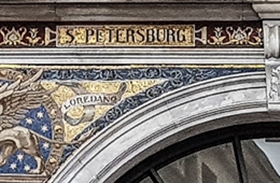
An old mosaic adorns the facade of the big Apple store on London’s Regent Street. It harks back to the time long ago when the building housing the store was a London Branch of a big insurance company. The mosaic was assembled and installed long before the great Russian Revolution of 1917. Various cities are named on the mosaic. One of these is St Petersburg. After the revolution , St Petersburg was renamed ‘Petrograd’ and then ‘Leningrad’, which remaine dits name until the 1990s when the city reverted to being ‘St Petersburg’. During my childhood and early adulthood, St Petersburg was ‘Leningrad’. Whenever I passed that mosaic, I used to marvel that the city’s old name remained unchanged on the facade of the building. It was a memory of historic times. Now, by chance, it is up to date.

Many of the readers of this blog will have realised that I visit India regularly. Most people know that Bombay is now known as ‘Mumbai’. Actually, speakers of Marathi and Gujarati have always called it that, but often still call it Bombay when speaking in English.

Madras has become Chennai. So what should one ask for when ordering Chicken Madras, which appears on many menus in Britain’s Indian restaurants?

In Karnataka, Bangalore has become Bengaluru, Mysore is now Mysuru, and Halebid is Halebidu. When I bought a bus ticket to Gulbarga in northern Karnataka, I was puzzled to see I had been issued with a ticket to Kalaburgi. This turns out to be the new name for Gulbarga.

Allahabad is now Prayagraj, a name that removes the Islamic flavour of its former name. There are moves afoot to de-islmamicise the name of Ahmedabad in Gujarat. The proposed name for the city founded by Ahmed is ‘Karnavati’, but the change has not yet been enforced.

Whether these changes of Indian place names will stick remains to be seen. Who can say whether they will revert like Leningrad that became St Petersburg again?

Hall of fame

CAXTON blog

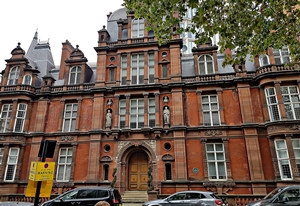
Caxton Hall is close to major London landmarks such as Westminster Abbey, the Houses of Parliament, St James Park, and Buckingham Palace. Yet, it is hidden away in Caxton Street, not only from the casual visitor but also from the attention of contemporary London life. However, this has not always been the case.

Built as Westminster’s Town Hall in 1878-82, it was designed by the architects W Lee and FJ Smith. Its architectural style has been described as an “Ambitious but coarse essay in Francois I style”.[1] It is distinctive looking building that attracts the eye.

The Town Hall contained two large public spaces known as the Great and York Halls[2]. Prior to the 1930s, these halls were used for a variety of gatherings including political meetings. Between 1933 and 1979, Caxton Hall became a registry office where weddings (often of celebrities) were held.

In 1900, the first Pan African Conference was held in Caxton Hall. From February 1906, it was the venue for meetings of The Women’s Social and Political Union, which was founded in 1903 by Emmeline Pankhurst, a fighter for women’s suffrage. Being close to the Houses of Parliament, Caxton Hall was a convenient place for the women to gather before their regular marches to the home of Parliament.

On the 1st of July 1909, Sir William Hutt Curzon Wyllie was shot dead at the Imperial Institute in South Kensington by an Indian nationalist, Madan Lal Dhinghra, from the Punjab. On the 5th of July[3], four days after the assassination, many Indians gathered at Caxton Hall to condemn the actions of Madan Lal Dhingra. Although most of those attending supported the motion “ that those present at the meeting and all the communities of Indians both in India and Great Britain express horror and condemnation of the murders of Curzon Wyllie …”, there was at least one person who opposed it as this extract from my book “Ideas, Bombs, and Bullets” describes:

“When the Chairman announced that the resolution had been passed unanimously, Veer Savarkar, who was in the audience, shouted:

No, not all!

Thereupon, mayhem broke out. People were filled with fear as many of them knew Veer’s connections with revolution and bomb-making . Many shouted that he should be thrown out and a few chairs were brandished angrily. A Mr Edward Palmer[4], of mixed British and Indian ancestry, took it upon himself to:

“… plant a truly British blow between the eyes of Savarkar who had raised a chair to fell me… ”

Tirumal Acharya, who helped to defend Veer from further attacks by Palmer, first thrashed Palmer and then began helping his friend get away from the hall .  Before this, VVS Aiyar had threatened Palmer with a gun, but Veer winked at him to restrain him . A few days later, Virendranath Chattopadhyaya, who was unable to attend the meeting, wrote to the London Times, saying that if he had been present, he would have supported Veer’s objection even at the risk of being thrown out . He added that although he objected to the resolution and believed in the right to express one’s own opinion, he did not consider that assassination and anarchism was the right way to achieve the independence of his country.”

For those who do not know, Veer Savarkar (VD Savarkar: 1883-1966) has assumed great importance in today’s India. He was a prolific writer, an Indian nationalist and freedom fighter, and helped formulate the concept/philosophy of Hindutva, which is part of the foundation of Hindu Nationalism.

Although Savarkar did not remain in the UK for much longer after this meeting, seeing Caxton House, now converted to luxury dwellings, and knowing its connections with those people I have researched in some detail sends a shiver down my spine.

“IDEAS, BOMBS, and BULLETS”

by Adam YAMEY

is available from:

Amazon, bookdepository.com, lulu.com, and Kindle

Notes to the text of the blog:

[1] https://historicengland.org.uk/listing/the-list/list-entry/1357266

[2] https://en.wikipedia.org/wiki/Caxton_Hall

[3] Much detail from Times (London) 6 July 1909

[4] Edward Palmer was of mixed Indian and British descent. Maybe, it was he who founded Veeraswamy’s Restaurant in London in the 1920s (see: https://erenow.net/biographies/white-mughals-love-and-betrayal-in-eighteenth-century-india/1.php, and https://www.historic-uk.com/CultureUK/The-British-Curry/, both accessed 15 June 2019)

Hitler for children

hitler


In a previous blog (see: https://adam-yamey-writes.com/2019/01/15/hitler-on-the-shelf/ ), I have written about the prevalence of copies of Hitler’s Mein Kampf in bookshops all over India. Here is an article I wrote a few years ago about a book about Hitler aimed at Indian children.

I was browsing the shelves in Gangaram’s Bookshop in Bangalore (India) when I found a book about Hitler, which was published in 2007 (ISBN: 9788131002520). It is part of a series called “Biographies of Great Personalities”, aimed at younger Indian readers . The garishly covered book caught my eye in that large well-known bookshop in Bangalore. When I flicked through it, I noticed that it was illustrated with line drawings, many of which showed Adolf Hitler in Indian settings with palm trees. At 40 Rupees (less than half a Pound Sterling), I could not resist buying the 93 page book.

 The author, Igen B, is a prolific writer. He has published well over 70 short books including biographies of personalities as diverse as Jesus Christ, Bhagat Singh, Mother Teresa, Ashoka the Great, Chhatrapati Shivaji, Shakuntala, and Netaji Chandra Bose. As well as these he has written versions of great Indian classics such as the Vedas, the incarnations of Lord Vishnu, and the Mahabharata. That these books are probably aimed at children is evident from the format and appearance of the books and also the fact that one of his titles is “Illustrated Model Book of School Essay etc.” Therefore, his potential audience is the innocent and impressionable younger mind. This should be remembered whilst paging through his children’s biography of Adolf Hitler.

More than half of the text is dedicated to Hitler’s childhood about which not much is known in detail, his career as an artist, and his rise to power. The author of this book, Igen B, blames a disturbed childhood in a dysfunctional family for much of what Hitler was to become.  The future dictator’s disillusionment with the lack of German national pride and his disappointment with the country’s leadership during WW1 were, according to this book, also important formative factors. As, are also the Jews: unquestioningly, Igen B repeats the kind of dangerous nonsense about the Jews that Hitler and many Germans believed.

Having gained power, we learn of Hitler’s campaign to relieve the Jews of any role in public life, and his hatred of the communists. We also learn of his desire to tear up the Treaty of Versailles, and how he went about doing so. So far, the reader is presented with something that faintly resembles what is now common knowledge about the history of Germany just before and during the brief, but long enough, era of Nazi rule. The penultimate 4 pages of the book describe some aspects of WW2. The last page of text is dedicated the last days of Hitler and his new bride Eva Braun.

Nowhere in the book are the mass murders perpetrated by the Nazis even hinted at, let alone mentioned. This worries me greatly considering that the book is sold in bookshops in India, and most of these also sell Hitler’s pernicious ‘autobiography’ “Mein Kampf”.

Igen B’s book is aimed at an Indian audience. It is appropriate in a way that the illustrations are drawn with an Indian ‘flavour’, as many readers are unlikely to have visited Europe or are ever likely to do so. The spelling of many German words and names is peculiar. For example we read of ‘Hebzburg’ (Habsburg), ‘Strum Abtiling’ (Sturmabteilung), ‘fonn’ (von), ‘Versai’ (Versailles), and ‘Hoffbraha’ (Hofbrauhaus). Whilst these original spellings are used more than once and are thus unlikely to be typographic errors, they may also be purposeful. It is possible that the author, realising that most of his readers are likely to be unfamiliar with German pronunciation, has transliterated them so as to make them pronounceable by readers of English.

I picked up this book as a curio, and read it. The author appears to have done some research, but his or her interpretation and presentation of the facts is somewhat unusual. His lack of emphasis of Hitler’s evil influences and deeds in a book aimed at impressionable youngsters is worrying to say the least.  The impression I had after reading it was that Hitler was portrayed as an unfortunate child, who grew up with the aim of making Germany a great nation. I was not given the impression that he was even a fraction of the monster that he was in reality. I had rather the same impression after watching the end of the film Downfall made in 2004. Hitler’s final moments during that film were almost heart-rending; the power of film and literature cannot be underrated. This is why Igen B’s book on Hitler might well be considered malevolent, even if the author’s intention was otherwise, to be purely informative.


Identity crisis

Don’t worry! This is not really a crisis. I used the word ‘crisis’ in the title to catch your attention! And, now that I have caught your attention, you might as well read on for a fewminutes because what I am about to tell you has a good chance of being interesting for you.

ALDWYCH

Since marrying a lady born in India, I have had many opportunities to visit India House on the western arm of the Aldwych in central London. Built 1928-30 and designed by Herbert Baker (1862-1946) with AT Scott, this stone building is profusely decorated with Ashoka lions and many circular, coloured emblems, which were those of the pre-Independence (and pre-Partition) colonial provinces (e.g. ‘Baluchistan’, ‘United Provinces’, ‘Burma’, ‘Madras’ and ‘North West Frontier’).

ALDWYCH 2

Looking upwards, there are two elaborate crests each topped with heraldic lions and including the mottos: “Honi soit qui mal y pense” and “Dieu et mon droit”. These are ‘souvenirs’ of the era when India was a British colony. Just as in post-Independence India there are still some statues of Queen Victoria standing– there is a fine example in Bangalore, these reminders of British imperialism remain attached to the building.

One side of India House faces India Place, which contains a bust of the Indian leader Jawaharlal Nehru (1889-1964), who became a barrister at the nearby Inner Temple. Close to a side entrance of India House, there is a monument to an off-duty policeman Jim Morrison, who was stabbed in December 1991 whilst chasing a handbag thief, who has never been caught. A ‘Friendship Tree’ was planted nearby in 1994 to commemorate the 125th anniversary of the birth of Mahatma Gandhi.

The India House, which now stands in the Aldwych, was NOT the first ‘India House’ in London. It had a predecessor in the north London suburb of Highgate. The earlier India House  stood at 65 Cromwell Avenue was a Victorian house that still exists. The Victorian house was named India House between 1905 and 1910 when it  was owned by Shyamji Krishnavarma who made it a hostel for Indian students and other Indians staying in London. The north London India House had a brief existence because it was under constant police surveillance on account of the anti-imperialist activities that went on within its walls (including producing anti-British propaganda, anti-British meetings, bomb-making, and arms smuggling).

Many Indian patriots, who wanted to force Britain to give its then colony India freedom, lived and congregated in Highgate’s India House. Their activities and often daring deeds are described in my new book about a lesser-known period in the history of India’s independence struggle: “Ideas, Bombs, and Bullets”.


“IDEAS, BOMBS, and BULLETS”

by Adam Yamey is available from on-line stores including:

Amazon, Bookfinder.com, Bookdepository.com, Kindle, and Lulu.com