Misunderstood

The coffee lounge at Calcutta’s Grand Hotel on Chowringee was closed for cleaning. So, we were advised that we could get coffee at the nearby ‘P.L.S’ café.

We walked in the direction of P.L.S but could not find it. We asked someone, who pointed at a large hotel called ‘Peerless Inn’. This, the locals pronounce ‘P.L.S’!

Pilots

I associate the word ‘pilot’ mainly with aeroplanes. Also, I think of small boats that help larger ones enter and leave ports. There is also, I believe, a creature called a ‘pilot fish’.

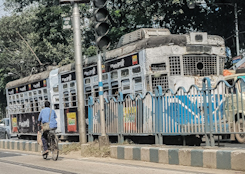
On arrival in Calcutta (now ‘Kolkata’) in West Bengal (India), I noticed that the local city buses have the word ‘pilot’ written on the doors that the bus drivers (i.e. pilots) use to enter their buses.

I am certain that I have never seen the word pilot used to describe a bus driver anywhere else I have visited.

I wonder if you know…

I do not know how many millions of people live in Calcutta, but I know it is well in excess of 14 million.

One day, a friend, M, met us in London. He told us that a mutual friend, D, was married to a woman born in Calcutta. As my wife went to school in that city, M said to her: ” You might know D’s wife.”

My wife replied: “Do you realise how many people live in Calcutta, M?”

Then after a moment, she asked; “What is her name?”

M mentioned a name. Hearing this, my wife answered: “She was a year junior to me at school.”

I thought it was amazing how small the world can seem even when a city as huge as Calcutta is being discussed.

DisCONCERTing

I have attended concerts at BBC recording studios. Before the performance begins, the audience, members of the public, are asked to be very still and silent, so as not to spoil the recording or live broadcast. The audience is politely requested to be so silent that one feels that even the sound of breathing might disturb the event.

With the exception of one western classical music concert in Bombay, audience disturbance is well tolerated at concerts I have attended in India. Pepole arrive and leave the auditorium whenever they feel like. They chat and take photos and often mover from one part of the auditorium to another.

Once, I attended a musical performance that was being relayed ‘live’ on All India Radio. Unlike the BBC recordings and live broadcasts, the audience was far from placid. Throughout the event, there were disturbances as described above, but no one seemed in the slightest disconcerted .

But, all is no longer well with British audiences. Recently, I have been to a few classical music performances in London, at which there has been applause at inappropriate places in the music. An example of this is clapping at the end of a movement of a symphony, rather than at its ending. Maybe, orchestras are getting used to this, but I find it a bit disconcerting.

Triumph of the ego

jinnah

Mohammed Ali Jinnah (1876-1948) saw the realisation of his ambition, the formation  of a sovereign nation for Indian Muslims: Pakistan, a year before he died as its supreme leader. Jinnah was a brilliant barrister and orator. His brilliance is described by Rafiq Zakaria in his book “The Man who divided India“. The author, clearly recognising his subject’s skills, does not rate him highly as an individual. His lucid, well-reasoned text makes this very clear.

At first, Jinnah, who was always attracted to politics, strove for Hindu-Muslim unity/harmony in pre-independence India. Various factors, including his disapproval of the anti-British Khilafat uprisings of India’s Muslims following WW1, led to him being sidelined by both the Indian National Congress and the main Indian Muslim political groupings. This led to him leaving India and establishing a legal practice in London and also attempting (in vain) to become involved in British parliamentary politics. 

Returning to India after a few years in London, Jinnah recommenced his struggle to become prominent in the Indian polical scene. To do this, he abandoned the idea of working for Hindu-Muslim unity for the opposite – the alienation of India’s Muslims. This proved successful. Under his leadership of the Muslim League, he promoted the idea of a separate sovereign state for India’s Muslims by indoctrinating his followers to believe that as the Congress became more powerful and when the British left India, Muslims would be at the very least dominated by the Hindus. By 1947, when the British gave up their hold on India, the formation of Pakistan, a sovereign state for Indian Muslims, was guaranteed.

The formation of Pakistan was associated with mass movements of people: Muslims into Pakistan, Hindus and Sikhs out of the newly created country. During this ‘Partition’, there was massive loss of life and much irreversible misery both in Pakistan and India. Furthermore, Pakistan was not one contiguous territory, but two widely separated portions: West Pakistan and East Pakistan (now Bangladesh).

Zakaria describes how Jinnah, the great leader of the  Muslims, was really a very unobservant Muslim. Throughout his life, Jinnah ate pork, enjoyed alcohol, hardly knew the Koran, and never learnt Urdu, the language of the Muslims of the Indian subcontinent. According to Zakaria, Jinnah did not hold his fellow Muslims in high regard, to put it mildly. It appeared to me while reading the book that Jinnah took advantage of Muslim fears of possible domination by the Hindus to further his ambitions of achieving political prominence, which were indeed successful.

Zakaria uses the last few chapters of his fascinating book to discuss the legacy of Jinnah’s creation, Pakistan. He paints a gloomy picture. Having espoused the idea of the separateness of the Muslims, and promoted the idea that the Indian Muslims were a ‘race’ or ‘nation’ separate from their non-Muslim Indian neighbours, Jinnah, like his hero the Turkish leader Kemal Ataturk in Turkey, decided that Pakistan should become a ‘modern’ secular state rather than some kind of Islamic entity. He wanted to govern Pakistan using the model of British imperialism, which the Indian subcontinent had just freed itself. This has not happened in Pakistan; it is now an Islamic state.

Zakaria emphasises that far from unifying India’s Muslims, Jinnah’s creation of Pakistan has achieved the very opposite. The Muslims of the subcontinent are now divided between Pakistan, India, and Bangladesh. Many families have members now separated by international borders. Many Muslims in India continue to live with the fear that they are somehow threatened by the Hindu majority in the country.  In addition, within Pakistan itself, different factions of Muslims (Sunnis, Shias, and others) are in permanent conflict with each other. In Bangladesh, there are also problems. And, if that were not bad enough, the political situation in modern Pakistan is extremely unstable and life there is far from peaceful. From what I have read in Zakaria’s interesting and highly readable book, Jinnah’s dream of unifying India’s Muslims has turned into a nightmare.

To conclude, it should be mentioned that Zakaria, an Indian Muslim, has served the Indian Congress Party, which opposed Jinnah in the years before independence,  as a high-ranking official. Despite that, I felt that his book attempts quite successfully to give a balanced view of Jinnah and his politics without concealing his own views.

Beneath a roof

65 CW blog mini

Beneath this roof

Indian patriots conspir’d

To end an empire 


The picture shows the roof of a house in London’s Highgate district where, between 1905 and 1910, Indian patriots (including Shyamji Krishnavarma, VD Savarkar, Madanlal Dhingra, and VVS Aiyar) plotted the downfall of the British Empire in India. You cand discover much meore about this fascinating, but relatively unknown episode in the history of India’s struggle for independence in the book “IDEAS, BOMBS, and BULLETS” by Adam Yamey.

The book is available here: 

https://www.bookdepository.com/IDEAS-BOMBS-BULLETS-Adam-YAMEY/9780244203870

and at a special low price in India here:

https://pothi.com/pothi/book/adam-yamey-ideas-bombs-and-bullets

and on Kindle

Biography of an idealist

gandhi blog

I have just finished reading a 660 page biography of Mahatma Gandhi. Its author, Rajmohan Gandhi, is one of his grandsons, a noted historian.

Gandhi was an idealist with a highly original mind. After a childhood in Gujarat (part of western India), he studied in London and became a barrister. After a brief return to India, Gandhi set off for South Africa to dwork as a barrister. He remained in South Africa for many years, managing his legal practice and fighting for the rights of Indians living in the country – actually, countries as South Africa was only unified in 1910. His struggles for the rights of the Indians was the proving ground for methods of non-violent revolution which he brought to India when he returned there for good in 1915.

It is no exaggeration to claim that Gandhi’s activities and his saintly persona, more than anything else, prepared the Indian masses for a desire to become liberated from the yoke of British imperial rule. Rajmohan Gandhi describes and explains this lucidly. So great was the respect for Gandhi all over India, that he was able to resolve numerous problems with the government or between different communities simply by fasting. He was willing to starve himself to death, but neither the British authorities nor most Indians were prepared to lose him. So, they gave in to his not unreasonable demands. His mass non-violent protests that were joined by thousands of ordinary people, who were prepared to be imprisoned or to be beaten by the police without offering resistance, often achieved their aims.

By the mid-1940s, the situation in India was such that the British began planning to leave it. During the lead up to Independence in August 1947 and after the Partition of India and the formation of the new state of Pakistan, India was plagued by excessively violent inter-communal conflicts: Hindus vs Muslims and Sikhs vs Muslims. Despite numerous fasts, Gandhi was unable to keep the peoples of India unified.

Gandhi’s ideals included seeing India achieve its independence. He was also keen to maintain harmony between members of India’s different religions. He did witness India’s freedom from the British, but had to suffer in the knowledge that despite his efforts, Independence was achieved whilst inter-communal violence kept increasing.

There were many in India who did not share Gandhi’s desire for inter-religious harmony. Amongst these were the so-called ‘Hindu nationalists’. It was a group of them who assasinated the Mahatma in 1948 at one of his prayer meetings in New Delhi.

Rajmohan Gandhi’s account of his famous grandfather is thorough. It gives a good idea of the Mahatma’s personality and his brilliance with dealing with everyone from the humblest harijan (‘untouchable’ or ‘dalit’) to the most pompous of politicians both Indian and British.

In brief, this book is first class and I can strongly reccommend it.


Postscript:

The book described above deals with the Mahatma’s rather eccentric, to put it mildly, relationship with women. However, it avoids mentioning his prejudices aagainst black Africans during the first few years of his sojourn in South Africa. No one is perfect! As he grew older, he could no longer be accused of holding racist views.