A WALK IN THE PARK

BANGALORE IS RAPIDLY BECOMING AN URBAN DESERT, but luckily there are some green oases. One of these is Cubbon Park, named in honour of Sir Mark Cubbon (1775-1861). When it was first laid out in 1870 it was called ‘Meades Park’. Now, its official name is ‘Sri Chamarajendra Park’, although few Bangaloreans would recognize that name as being Cubbon Park.

Although a few roads traverse the park, they do not detract from ots pleasant sylvan nature. And, on Sundays many of these roads are closed to make them free of traffic.

Most of the park is not laid out in an obviously planned way and much of it is pleasantly in the shade of the leafy branches of huge old trees. Wherever you go, you will encounter dogs with their owners, wild dogs, people sitting or sleeping on benches or logs, people exercising, and picnickers. During a recent visit, I saw groups of young art students sitting in circles on the ground. They were cutting up old newspapers and magazines to gather materials for collages they were preparing.

Cubbon Park has its own metro station. One of its entrances is close to both a statue of King Edward VII of Great Britain and also a disused fighter jet, advertising the products of HAL, whose offices face the park.

After passing through the security check, which is present at all metro stations, I descended to the subterranean concourse. This and other parts of the station has been decorated by artworks created, with varying degrees of skill, by students of the Shristi school of design, which is located at Yelahanka, in between Bangalore and its Kempe Gowda Airport.

I was escorted by one of the Shristi students through the metro ticket barrier to another concourse that can be entered via a station entrance near the Chinnaswamy Cricket Stadium. This particular concourse had a temporary exhibition of photos of Indians who served in British armed forces during WW2. Sadly, this exhibition looked hastily conceived and did not make much of an impact either visually or historically. The involvement of Indian troops and officers during WW2 is undoubtedly of great interest, but this exhibition did not really explore this even superficially. While I was looking at the show, a Sikh gentleman spoke with me and pointed to one of the photos on display. It showed his father, who had fought during the War.

The exhibition ends on the 22nd December, but the delights of Cubbon Park remain … at least for the foreseeable future, but for how long it is impossible to say in a city that gives more importance to real estate investments than to preservation of heritage.

AN INDIAN HERO: Savarkar

WHILE I WAS WRITING my book about Indian freedom fighters in Edwardian London, “Ideas, Bombs, and Bullets”, I was aware that Vikram Sampath was preparing to publish a book about one of those freedom fighters, Vinayak Damodar Savarkar (1883-1966). Until I attended the Bangalore Litfest in November 2019, I had no idea that Vaibhav Purandare had also recently published a biography of Savarkar. I have just finished reading this interesting survey of the life of Savarkar, a controversial figure in the history of twentieth century India. What made Savarkar controversial is well elucidated in the very readable book by Purandare.

Savarkar, a father, or maybe THE father, of Hindu Nationalism and the author of an influential book on the concept of ‘Hindutva’, led a vividly colourful life, much of it behind prison bars.

Purandare describes Savarkar’s life as a law student and ‘revolutionary’ in London between 1906 and 1910 in some detail. I must take issue on one fact, namely that the house in London where he carried out much anti-British activity was number 65, not 63, Cromwell Avenue. This is only a minor criticism of an otherwise good book. Whether or not Savarkar was involved in various bombings and assassinations in India and the murder of Sir Curzon Wyllie in London was never proved, yet suspicions that he was led to his arrest in London and subsequent imprisonment in the horrendous Cellular Jail in the Andaman Islands.

Mr Purandare details Savarkar’s years of incarceration interestingly at some length. That a barrister trained in London could endure the torments that Savarkar underwent is a measure of his impressive character. The author deals with the prisoner’s appeals for clemency fairly. Many of Savarkar’s critics still accuse him of cowardice, but Purandare makes it clear, over and over again, that many other well known and obscure political prisoners made attempts to gain early release from the living hell that was the Cellular Jail.

After being released from the Cellular Jail, Savarkar, by now an Indian national hero, was confined to the district of Ratnagiri on condition that he did not carry out any political activity. To some extent, he conformed to this condition, but not as much as the British would have preferred.

By the time his period of confinement to Ratnagiri was over, much had changed in India and Europe. The Muslims, who were gradually adopting Jinnah as their leader, were demanding ever more political representation and then political autonomy within or separate from the rest of India. The Indian National Congress was far from free of internal conflict. Other forces including the Hindu Mahasabha, which Savarkar led for some years, all had their own ideas on how India’s future should be. Purandare skilfully guides his readers through this tangled time.

As India approached independence and Savarkar aged and became increasingly unhealthy, his influence on India’s political struggles decreased.

Savarkar was associated with exciting developments both during his student days in both India and then London and also in his old age. Following the assassination of Gandhi in 1948, Savarkar, who was very unhappy with the Partition of India in 1947, was arrested, being charged with conspiracy to kill the Mahatma. Purandare deals fairly and quite objectively with the controversy about Savarkar’s possible involvement in a plot to assassinate Gandhi. In connection with this, he mentions Vallabhai Patel, who suggested that although Savarkar might have been morally culpable, he was not necessarily criminally culpable.

Purandare presents Savarkar as an honourable and brave man but does not hesitate to point out his failings and weaknesses. His biography is a worthwhile and compelling introduction to the life of one of India’s most intriguing freedom fighters.

Now I am looking forward to reading how Vikram Sampath deals with the life of Savarkar in the first volume of his large biography, which deals with Savarkar’s life only up to 1924.

Buying a postage stamp in Bangalore

MERRY CHRISTMAS!

ALL I NEEDED WAS A POSTAGE STAMP. I could have walked around the corner to the post office in nearby Museum Road, but I chose to do otherwise. I found that there is a post office in Shivajinagar, a busy district in central Bangalore that contains many places of interest with ‘local colour’.

I asked directions to the post office from a couple of men standing in their tiny silver shops on the corner of Jewellery Street and Ebrahim Saheb Street. One of the men pointed in one direction and the other at the opposite. After some discussion, these kind gentlemen decided that I should head towards the large mosque at the top end of Commercial Street.

The Jumma Masjid stands at one end of Commercial Street on a traffic filled lane. A wider street lined with shops and market stalls leads from this centre of Muslim worship to St Mary’s Basilica whose tall spire dominates the skyline. The church and its grounds were exuberantly decorated with Christmas decorations. A portrait of Mother Teresa overlooks the busy courtyard in front of the church. A stall was selling gawdy decorations including a model of Father Christmas playing a brass coloured saxophone.

One side of the square outside of the church compound was lined with stalls selling decorative Christmas items, ranging from paper stars to models of Nativity cribs.

A building with indo-arabesque domes lines part of another side of the square. This is Russell Market, an indoor food bazaar. The picturesque building was built by the British in 1927.

Russell is not the only market in Shivajinagar. On my rambles today, I came across a couple of other food markets. These are not housed in buildings like the Russell Market, but in simple shacks. Years ago while wandering in Shivajinagar, I came across an open air bazaar specialising in spare parts for automobiles. I have not been able to find this chaotic jumble of motoring spares again, but I have been told it still exists.

HKP Road leads away from the Square that contains Russell Market. I had never been along this road before. The first thing that caught my eye was the covered Beef Market, which bears the date 1932. Near its entrance I saw butchers working on huge pieces of unrefrigerated beef. There is another beef market, which I have visited before, at Johnson Market at the south of the city centre.

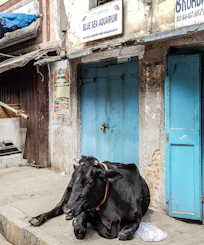
Outside the Beef Market, there were numerous cages containing birds for sale as pets. Proceeding a few yards away from the Beef Market, I had to step aside to avoid bumping into a live cow occupying most of the pavement outside a shop called “Blue Sea Aquarium”. This was close to a shop specialising in repairing sewing machines, both electrical and pedal operated.

After crossing a canal, or maybe, judging by its smell, an open sewer, I spotted an old house with ornate shades over its windows. I photographed it.

The old house is opposite a tiny post office, which I entered. Three men were sitting behind the counter in a disordered office space. Eventually, one of them attended to me. After weighing my letter and scrutinising the address on its envelope, I was handed a 5 Rupee stamp. Using glue from a pot on the counter I affixed the stamp.

I had already handed over twenty Rupees, but received no change. When I had stuck on the stamp, I asked for my change. The post office employee who had sold me the stamp seemed surprised. One of his colleagues rummaged around in a drawer, and handed me ten Rupees. Neither I nor the post office had five Rupees to give the correct change. I felt it was worth losing 5 Rupees at this transaction because my journey to reach it had been far more interesting than had I walked to the post office nearest to where I was staying.

After leaving the post office, I began walking back along HKP Road. A motor scooter pulled up alongside me. It was being driven by a man. Behind him sat his child and his wife in full burqa. He said that he had seen me taking a picture of his old house. I told him that I am interested in the old buildings of Bangalore. He told me that his house was over 100 years old and that I should visit his clothing shop in Commercial Street.

A town in the Himalayas

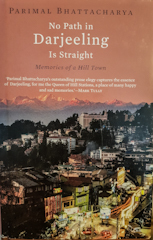
“NO PATH IN DARJEELING IS STRAIGHT” is the title of an excellent small book about Darjeeling and its environs. I bought a copy shortly after spending an enjoyable week in the Himalayan hill town close to Nepal and Sikkim and not too far from Tibet. Being so near to these places on the fringe of Central Asia, the area in which Darjeeling is located is populated by a large number of different ethnic groups. The book describes some of these and their histories.

Written by someone who lived and worked (as an academic) in Darjeeling for several years, the author Parimal Bhattacharya, provides an evocative series of observations about the town and around it. He imparts much fascinating information about the place and its people and their problems in almost poetic prose. He also manages to convey his feelings of delight and excitement with the reader.

If I have any criticism of this wonderful book, it is that he does not provide any reference to further reading about the Hungarian explorer and orientalist Sandor Csoma Koros (1784-1843), who died in Darjeeling on his way to the Silk Road. But, this is only a minor criticism.

This book, which I loved reading, gives a great sense of place. It will delight readers who have visited Darjeeling, and will intrigue those who have yet to do so.

DINNER WITH THE NIZAM

During a recent visit to the Chowmahalla Palace in Hyderabad (India), I saw a sepia photograph taken at a dinner party held by the ruling Nizam during the era when India was part of the British Empire.

Some of diners were Indian and others sitting beside them at the table were Europeans, most probably British. All of them have their faces turned towards the camera, but what was going through their minds?

The British at the table, who were probably high ranking colonial officials, and their wives probably believed, as many Europeans did in the past, that they were superior to the Indians. They were most probably outwardly polite to their Indian hosts and fellow diners, but inwardly contemptuous.

The Indians at the table were probably also outwardly civil to their fellow European diners because not only are Indians hospitable by nature but also they knew that the high positions they held in the State of Hyderabad were dependent on being respectful and loyal to the British. However, inwardly I am sure that they regarded the British as inferiors, worthy only of contempt. They felt, I imagine, an innate sense of superiority over their European guests, who unlike them were not members of a royal house.

I wonder whether, apart from the superior British military ability, it was this mutual contempt that ensured an albeit uneasy harmony between the British imperialists and the royal families that ruled the princely states that made up a sizeable portion of the British Indian Empire.

An Indian hero

SUBHAS CHANDRA BOSE (1897-1945) was, along with Gandhi, one of the most important fighters for the independence of India. Without doubt, the activities of Bose and their consequences were one of the main reasons that the British left India in 1947. A one time president of the Indian National Congress, he later parted ways with it.

Before 1940, Bose was placed under house arrest in Calcutta by the British. In 1940, he escaped and made his way to Nazi Germany, where he arrived in 1941. The German authorities were prepared to cooperate with him to bring about the downfall of the British Empire in India.

After the surrender of Singapore to the Japanese, Bose and his colleague Abid Hassan Saffrani (1911-84), who was studying engineeringin Germany and anti-British, were placed on a German submarine in early 1943. It took them to Madagascar, where they boarded a Japanese submarine that took them to Japanese occupied Sumatra. Then, they proceeded to Singapore, where Bose persuaded captured Indian troops to fight the British to gain independence for India. It was during this time that Abid Hassan Saffrani coined the salutation ‘Jai Hind’.

Bose led his Indian National Army on an ill fated military expedition to enter India via Burma. In 1945, Bose was killed in an air accident in Japanese held Taiwan. Abid Hassan Saffrani returned to India and after Independence served his country as a diplomat.

The photograph shows Bose with Abid during their journey on the German submarine in 1943. (Bose is on the left with spectacles)The print I saw is in the possession of a nephew of Abid, who lives in Hyderabad.

Some days before I met Abid’s nephew, we met a lady in Calcutta. After spending an evening with her, I expressed my interest in the anti-British activists, who lived in Calcutta. Hearing this, she revealed that she is related to one of them. We asked which one. She told us that her grandfather was Sarat Chandra Bose, the brother of Subhas Chandra Bose who helped Subhas to escape from Calcutta in 1940. We were amazed to hear this.

A royal palace

IT IS COSTLY PAYING A VISIT to the Faluknuma Palace in Hyderabad, but is it worth the expense?

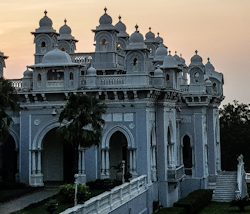
The Faluknuma Palace, which is located on a hill, is high above the rest of Hyderabad. It was built in a neo Palladian style to the designs of an Italian architect between 1884 and 1890 as a residence for Sir Viqar al Umra, a Prime Minister of Hyderabad. To settle a debt, in 1897 Viqar handed his palace to his creditor, the 6th Nizam of Hyderabad.

The palace is now used as a luxury hotel. One night at this place will set you back by at least £440 excluding taxes. The most economical way to see the palace is by booking afternoon tea, which is not at all cheap. However, such a booking includes a guided tour around the palace. After much difficulty and numerous telephone calls to the hotel, we managed to book a couple of places for the afternoon tea experience.

The guided tour was fairly uninformative but gave us a chance to see several rooms that were used by the former Nizams and their guests.
Unfortunately, the guide was uninspired and his English was poor. It would have been better if the guide had been better informed as well as more interested in history and culture.

One thing the guide told us impressed me. He said that the palace was wired up for telephony and was supplied with electricity in the 1890s whilst the Nizam’s subjects lived without electricity until the late 1930s.

Each of the rooms and hallways of the palace look spectacular at first sight. However, after closer examination they are not so impressive. The rooms which were designed to amaze are actually rather dowdy and unrefined. The interior has a Victorian heaviness. In contrast, the Marble Palace in Calcutta, also built to mimic European tastes, is spectacular both macroscopically and in minute detail. Unlike the Faluknuma, the Marble Palace is an example of exquisite taste.

I find it sad that Indians such as the builders of the Faluknuma (and the Marble Palace) found it necessary to mimic, not always successfully, the styles favoured by their imperialist rulers rather than building in styles that have evolved from the rich legacy of pre-colonial architecture. One palace that I have visited, that at Bhavnagar, The Neelambagh, was designed by a European architect who paid tribute to India’s rich cultural heritage by successfully incorporating elements of India’s historical architectural styles. The so-called Indo-Saracenic style sometimes melds European and Indian elements successfully.

The afternoon tea was elegantly presented. The serving staff outnumbered the guests. There was a great deal of bustling about, but our requests were eventually fulfilled. Every member of staff we encountered at the palace was kind and caring. I felt that everyone wanted us to enjoy our visit, which we did.

Was our visit worth what we paid? I would say ‘yes’ cautiously, but I would have preferred to have been charged a little less. It would have been really good value at two thirds of the price. Is the palace worth seeing? I would recommend it not because it is either an aesthetic gem or an architectural marvel, but it is a great example of how the wealthy and powerful spent their money to impress their subjects and the British Colonial Officials, who guaranteed the continuing existence of their vassals, the rulers of the Princely States, of which Hyderabad was the largest, richest, and most powerful.

While we were sitting waiting for our taxi to take us away from the palace, we watched horse drawn cartiages passing by. They carry guests up the long winding drive to the hotel. We also saw staff feeding some of the more than one hundred peacocks which live in the extensive grounds of the palace, which provide a peaceful refuge from the city that sprawls all around the Faluknuma.

Some cafés and an Ottoman princess

WE WERE ADVISED TO PAY a visit to the “new Niloufer café” in Hyderabad to try its Irani Chai. We hired an Uber taxi to take us there.

The New Niloufer Café turned out to be a rather scruffy place across the road from a newer looking place called “The Niloufer Café”.

Irani chai is prepared by boiling tea leaves continuously in a large kettle. This produces a strong decoction, which is poured through a muslin filter and then added to boiling milk before being served in cups.

As the New Niloufer did not serve milk without sugar, we crossed the road to the Niloufer Café, which did. This café was very crowded. In addition to tea, it sold a wide range of biscuits, cakes, and breads. One of the breads looked like an oversized bagel or an obese Turkish simit.

After taking tea at this café, we walked past several Hindu temples, mostly dedicated to Hanuman, and many medical clinics until we spotted yet another Niloufer Café. This one is newer and more luxurious than the previous café but belongs to the same company. It described itself as the “Niloufer Café Premier Lounge”.

On reflection, we realised that it was the new Premier Lounge, rather than the unrelated New Niloufer Café, that had been recommended to us.

By the way, Princess Niloufer (1916-89) was one of the princesses of the Ottoman Empire. She married the second son of the last Nizam of Hyderabad, Moazam Jah. He died in 1952 and then she married an American, Edward Julius Pope in 1963.

Photo shows kettle for boiling tea to prepare decoction