ONE YEAR DURING THE 1980s, I was in Belgrade, then the capital of Yugoslavia, on New Year’s Eve. I was staying with my good friend Raša Raićevič. He suggested that we should see in the new year at a friend’s flat I New Belgrade.
Before we set off from his flat in the older part of the city, Raša warned me to keep away from windows and off the terrace as the midnight hour approached. In the 1980s, many retired military people resided in New Belgrade, and quite a few of them possessed firearms. It was customary in those days to fire the guns at the moment a new year commenced. The risk was that ricocheting bullets might break windows or hit people out on their terraces and balconies. Fortunately, we survived the evening without mishaps, and spent the first few hours of the new year at another friend’s home, a long taxi ride away from New Belgrade.
Many years later, sometime after 2006, we were in Bangalore over New Year. My wife and I stayed at home with my recently widowed mother-in-law, who was too frail to attend a party. Everyone else in the family went out to celebratory parties.
The three of us, who remained at home, decided that we would sit together until midnight. However, by about 10 pm on the 31st of December, we all fell asleep. It was only when our daughter phoned us at 3 am that we realised we had slept through the transition from one year to the next.
My New Year’s Eve spent in Belgrade was a complete contrast to that which we slept through in Bangalore. This evening, we plan to have a slap-up dinner followed by drinks under the stars high above the city of Bangalore. I hope that all of you, dear readers, will have a great 2024.
I KNOW OF TWO Avenue Roads. One is in London. Lined with the homes of the wealthy, it runs between Swiss Cottage and Regents Park. The other one is in Bangalore. It runs between KR Market (aka City Market) and a large Hindu temple (mandir) where Kempe Gowda Road becomes District Office Road. Both the road in London and its namesake in Bangalore carry much traffic, but there the similarity ends.
Avenue Road in Bangalore (‘AR’) is mainly lined with all kinds of shops, especially those dealing in paper goods (stationery as well as printed books). It runs through one of the oldest parts of the city: Chickpet. The lines of shops are punctuated by small lanes and alleys that lead away from AR.
Old pillars in a mandir on Avenue Road in Bangalore
As you stroll along the thoroughfare, you will pass mandirs and one church. And near the KR Market end of the road, a short lane leads to a Muslim shrine, the Dargah-e-Hazrath Manik Mastan Sha Saherwadi. It is well worth removing your footwear to enter this peaceful place. The grave it contains is in a small room with a mirrored, domed ceiling.
Some of the mandirs on or near AR are also worth looking into. Although some of their facades look fairly recent, the carved stone columns within the buildings look quite old. Near the street entrance of one of the mandirs on AR, I saw two intricate stone carvings of Hindu subjects. Both looked as if they might have been carved several centuries ago.
The Rice Memorial Church stands in its own small grounds, separated more from its neighbours than the mandirs on AR. Named after the British missionary, the Rev Benjamin Holt Rice, this Church of South India place of worship was built between 1913 and 1916 on the site of an earlier chapel first constructed in 1834, and then later rebuilt before being demolished. Although I have passed it often, I have not yet been able to enter it.
Not far from the church and a couple of picturesque mandirs, there is a branch of the Kamat chain of eateries. You can stop there for snacks and a variety of beverages. This place is in the midst of the numerous bookshops on AR. Proclaiming discounted books, these stores mainly stock textbooks and computer programming instruction manuals. Incidentally, AR is a good place to find a wide variety of diaries and calendars.
Bustling Avenue Road in Bangalore is a far more colourful and interesting thoroughfare than its rather elegant but staid namesake more than 5000 miles away in London. The street in Bangalore and the lanes leading off it give one a good idea of the ‘flavour’ of the parts of the city which existed before the arrival of the British imperialists. It makes a fascinating contrast to the newer Cantonment areas that became established after the British began settling in Bangalore.
ONE OF THE THINGS that struck me when I first visited India in January 1994 was how everyone was wearing clothing far more colourful than anywhere else I had been before. Wherever I have been in the country, there is a feast of colourful clothing to be seen. Whether the colourful garments are worn purely for aesthetic reasons and/or for ceremonial or group identity reasons, everywhere there is much to please the eye.
I am not alone in noticing the Indian penchant for wearing bright colours. In 1956, the famous style ‘diva’ Diana Vreeland noted in British Vogue magazine: “… pink is the navy blue of India …”. Following from this, an article in India’s “Economic Times” of January 2022, pointed out that “Red is the Indian beige and yellow is the Indian grey…”. In other words, that the exuberant colours worn by Indians contrast dramatically with the much more drab colours currently worn in the West. Actually, as my wife pointed out, long ago in Europe (eg the 18th century and before) clothes – especially those worn by the wealthy and the aristocracy – were far more colourful than now.
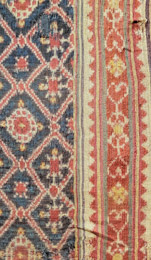
On the 23rd of December 2023, we were fortunate to get admission to an exhibition of sarees on its last day. Intriguingly entitled “Red Lilies, Water Birds”, the show was hosted by The Registry of Sarees in a house on Hayes Road in Bangalore. The Registry (established in 2016) is a trust set up by the Mysore Saree Udyog (founded in 1932). Its purpose is to promote the study, design, and conservation of handspun and handwoven textiles.
The nine rooms of the exhibition contained about 84 examples from the Registry’s much larger collection. Each room concentrated on either a particular region of India, or a specific method of creating the textiles. Every room was filled with sarees, which filled the viewer’s eyes with richly coloured, intricately patterned delights.
Many of the visitors to the exhibition, and the staff looking after, and explaining, the show were wearing clothing that demonstrated what I mentioned at the outset – namely, the preference of many Indians to dress colourfully.
WHEN I FIRST visited India – that was in January 1994 – I carried my British and International driving licences with me. Boldly, I drove in the heavy traffic and densely crowded streets of the busy City Market area of Bangalore and also all the way to Ootacamund (‘Ooty’) – over 270 Km, and that was before the highway was constructed. You can share in these experiences by reading my book about travels in India, “The Hitler Lock & Other Tales of India”. This book/kindle is available from Amazon (https://www.amazon.co.uk/HITLER-LOCK-OTHER-TALES-INDIA/dp/B0CFM5JNX5/ ), and IF you live in India, from: https://store.pothi.com/book/adam-yamey-hitler-lock-and-other-tales-india/ .
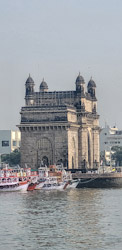
WE HAVE BEEN VERY fortunate to get a booking at the Royal Bombay Yacht Club, located next door to the world famous luxurious Taj Mahal Hotel. Our bedroom is directly opposite the front of the Gateway of India – Bombay’s best known landmark.
The Gateway was built to celebrate the arrival in India of the British King George V – Emperor of India. However, as it was only completed in 1924, the king only got to see a cardboard model of the archway. Construction of this edifice only began in 1915, when the land on which it now stands was first prepared. The Gateway’s foundations only began to be built in 1920.
The magnificent archway was designed by George Wittet (1878-1926), an architect who worked mainly in Bombay. The Gateway was designed in an Indo-Saracenic style with many features borrowed from 16TH mosques found in Gujarat.
The Gateway is a brilliant piece of architecture. In its position next to the sea, it ‘works’ successfully. It has become not only an icon of Bombay but also, I believe, of India. I find it ironic that like that other icon of India, the Taj Mahal in Agra, its construction was inspired not by Indians but by invaders of the Indian Subcontinent. Despite that, Indians love it and flock to see it.
PROFESSOR ROBERT HARKNESS was my PhD supervisor between 1973 and 1977. He and his wife remained my close friends for the rest of their lives. Robert was interested in everything. His was not a fleeting interest, but a deep, enquiring passion. He was fascinated by the contents of hardware shops, especially when making his annual overland trips between the UK and the North of Greece.
During his explorations of these shops, he noticed that the designs of traps for rodents varied from place to place. Many of them were constructed so that the rat or other pest was not killed when caught in the trap. Over the years Robert collected a wide variety of differently designed traps.
The rat trap and the man who made it
Today (the 8th of December 2023) when wandering through one of the many bazaars in Surat (Gujarat), we spotted a metal worker’s shop. On a table outside it, there were a pile of rat traps for sale. They looked like little sheds or garages. At one end of each of them, there was a sliding door. Bait is placed in the far end of the trap. When a creature touches this, the trap door drops down and imprisons it. I do not know what the owner of such a device does with the victim enclosed within it. I suspect that the animal might be killed by drowning.
The owner of the shop said that most of the traps on display were made elsewhere, but he showed us one he had made. As we examined the traps and other ironmongery on offer, I thought how much Robert would have enjoyed visiting this shop.
THE HAZIRA MAQBARA is an impressive octagonal structure in Baroda (Gujarat). It was built in about 1586 in the Mughal style of architecture, such as can be found in Delhi. This beautiful mausoleum houses the graves of Qutb-ud-din Muhammad Khan who was the tutor of Salim, son and successor of Akbar, and also that of his son Naurang Khan who held important posts in Gujarat under Akbar. There are other graves within the building and also nearby on land near it.
The various graves are covered with colourful cloths upon which red rose heads are placed. The roses are replaced daily, and the cloths every Thursday. This we were told by an elderly man who had been praying loudly within the main central chamber of the mausoleum.
Apart from the beauty of the building and its wonderful jaalis (latticework window screens), I was impressed by some things that I have noticed in many other Muslim mausoleums in India.
Incense stick near some gravestones
Within the mausoleum and close to the graves outside it, there were incense sticks (agarbatti) burning, releasing small clouds of fragrant smelling smoke. Within the mausoleum, I spotted at least two oil lamps (diyas), each with small flickering flames.
Agarbatti and diyas are commonly found in Hindu temples, and often at the beginning of the day in shops, restaurants, etc. I first noticed them being used in Islamic settings in India in Sufi dargahs (shrines containing graves) in Bangalore when going on excellent guided walks led by my friend Mansour Ali. Later I begun noticing these things, which I had initially assumed were only associated with Hinduism, in places associated with Islam. I have discussed this commonality of Hindu and Muslim practices in one chapter of my new book about travels in India, which is available from Amazon (eg https://www.amazon.co.uk/HITLER-LOCK-OTHER-TALES-INDIA/dp/B0CFM5JNX5/ ) AND if you live in India, from https://store.pothi.com/book/adam-yamey-hitler-lock-and-other-tales-india/ .
Other chapters in my book about my experiences of visiting India cover a wide variety of subjects. The book, which is aimed both at those who ‘know’ India and those who do not, is both informative and entertaining.
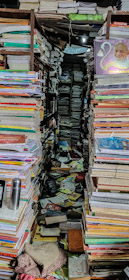
A FEW MINUTES WALK from our hotel in BARODA (Gujarat) brings you to Patel Bookstore. The owner of this small bookshop stocks ‘pre-loved’ (not ‘secondhand’) books. Some of them are arranged on surfaces under the verandah in front of his shop and on its counter. The rest of them are on shelves and on the floor of the part of his store behind the counter. The shop has a chaotic appearance, but I am sure Mr Patel knows what he has in stock.
Mr Patel, a friendly gentleman, has a huge stock of books in English – much fiction and slightly less nonfiction. He also sells books printed in Gujarati.
The owner of the shop is happy to buy back books you have bought from him. When you make a purchase, he writes the price you paid in the book, and how much he would be prepared to buy it back when you have read it. He is also happy to buy other volumes that you wish to dispose of.
Even though I could not see many books that appealed to me, I love visiting idiosyncratic bookstores like that run by Mr Patel.
THE PUARESHWAR MAHADEV Shiv temple is about 24 miles west of Bhuj. Built about 1200 years ago, it is possibly the oldest surviving Hindu temple in the Kutch region of Gujarat. Partially restored, this attractive small mandir is still in use but has lost most of its roof.
At Puareshwar
As we approached the temple, I noticed that near it, there were numerous small piles of stones. Each of the precarious looking piles consisted of several rock’s or fragments of masonry piled carefully, one on top of another. I asked our driver, who had suggested we visit this temple on our way to Narayan Sarovar, about these small piles. He said that they were constructed by people, praying to obtain or build a home of their own.
After visiting, Narayan Sarovar, its lake and mandir, we stopped to see the mandir at Koteshwar, which is on a spit of land near India’s border with Pakistan. Outside this temple, there were many piles of stones just like we had seen at Puareshwar.
Although I have visited many Hindu temples in India during 30 years of travelling to the country, it was only yesterday, the 27th of November 2023, that I first became aware of these small stone offerings. According to one online article I found (https://medium.com/six-word-photo-story-challenge/prayer-stone-stacks-a-belief-b7fc0edc5d9a), stones are piled outside temples all over India by people hoping to build their own homes. I will now look out for them whenever I visit a mandir.
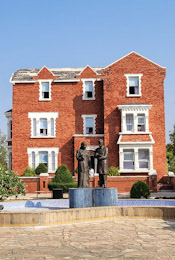
A NARROW ROAD LEADS away from the town of Mandvi (in Kachchh, a part of Gujarat) into an arid sandy area close to the seacoast. Scrubby bushes populate most of this flat terrain. After a few miles, a red building can be seen on the horizon. As you approach it, you can see that it resembles no other in the surrounding area, or, for that manner, in any other part of India. However, if you are a Londoner, it would seem familiar, although quite incongruous.
Replica of India House near Mandvi, Kachchh
The house in the desert is an accurate replica of a typical Victorian house, such as can be found in North London. In fact, it is a full-size copy of number 65 Cromwell Avenue in London’s Highgate area. The reproduction near Mandvi was built as part of a complex to commemorate Shyamji Krishnavarma (1857-1930), who was born in the centre of Mandvi.
Krishnavarma, who became a barrister and worked in various Princely States, moved to London, where he lived until about 1907. He moved to Paris, and then to Geneva, where he and his wife lived until they died.
In London, Krishnavarma lived opposite Highgate Woods. He invested wisely, and became interested in the works of English men, who had their doubts about Britain’s domination of India. He became an opponent of British rule in the Indian subcontinent. At first, his interest was mainly intellectual. However, in 1905, following the partition of Bengal, he became an activist.
One of his several activities was to purchase number 65 Cromwell Avenue. He had it adapted to become a ‘home away from home’ for Indians studying in London – they frequently had to endure the racist attitudes of English people. He named the building ‘India House’ (which should not be confused with the present Indian High Commission in London).
Apart from providing Indian food, some accommodation, and some leisure facilities, India House also hosted meetings that discussed the injustice of British rule in India. Soon, India House attracted the attention of the British police. This was because India House was becoming a nucleus or hotbed of anti-British activism. For example, some of the people who frequented the House experimented with bomb making and smuggling firearms to freedom fighters in India.
Krishnavarma left London in 1907, when he feared that he might be arrested. India House continued to be active until mid-1909 when one of its visitors assassinated an important colonial official.
Krishnavarma wrote in his will that after he was cremated, his ashes should be returned to India only after it had become independent of the British.
In the early part of this cemetery, the Chief Minister of Gujarat, then Narendra Modi, decided to bring Krishnavarma’s ashes to India – to Mandvi. Some years later, a complex to commemorate Krishnavarma was built outside Mandvi. Part if this is the replica of Highate’s former India House. The ashes of Krishnavarma and his wife are stored in urns on display in a building next to the replica.
If this story interests you and you want to know much more about India House, its replica, Krishnavarma and his fellow freedom fighters, including the currently influential VD Savarkar, you should read my, dare I say it, very informative book. I have produced two versions of it. One, the latest edition is “Indian Freedom Fighters in London 1905-1910), and is available here: https://www.amazon.co.uk/gp/aw/d/0244270716/ . The other “Ideas, Bombs, and Bullets”, which can only be delivered to addresses in India in available here: https://store.pothi.com/book/adam-yamey-ideas-bombs-and-bullets/.






 yamey
yamey 