This artist shines lights on life in modern India

BORN IN MYSORE (Mysuru) in 1969, the Indian artist NS Harsha lives and works in that city. He studied art first at Mysore’s Chamarajendra Academy of Visual Arts, and then at Maharaja Sayajirao University in Baroda (Vadodara). Until 31 July 2026, there is a wonderful exhibition of his large paintings at the Victoria Miro Gallery in London.
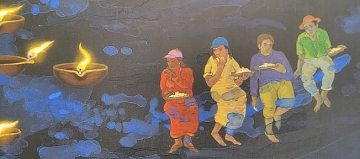
Almost all of Harsha’s beautifully executed paintings in the show contain depictions of lighted oil lamps (diyas), often many in a single work. In some paintings, the oil lamps are arranged to form regular patterns. In others, they are interspersed with images of people, animals, food, and items used in daily life. The numerous people who appear in these works are frequently workers in their overalls and hard hats (helmets), animals, and people planting crops. From a visual point of view, the paintings are very pleasing even if one has no idea what, if any, message the artist is attempting to convey. Although they depict contemporary subjects and far from being miniature, they hark back to the historical traditions of Indian Miniature paintings.

In a web page produced by the Chemould (Prescott Road) Gallery in Bombay, I read that:

Like a chronicler, often drawing from popular stories and local perceptions of international news events, Harsha depicts in his canvasses small town/city Indian life in our increasingly globalized times. His intricately detailed canvasses juxtapose seemingly disassociated images of scenes of small town and village India with those of more recognizably international ones. Harsha’s multi-layered narratives strongly suggest that the global is always already located within the local imagination.”

Regarding the lamps in the paintings, the Victoria Miro website explained:

The works, which elaborate on the artist’s celebrated, ongoing ‘lamp grid’ series, feature diyas – lamps traditionally made from clay that are lit during rituals, prayers, ceremonies, celebrations and during power cuts – with flames and trails of smoke together creating patterns that guide the eye around each canvas …  In Harsha’s work they represent energy, forces perhaps unseen.”

This interesting interpretation is useful enough, but the paintings alone speak for themselves, and throw an intriguing light on contemporary life in India.

I enjoyed viewing this exhibition, and becoming aware of a fascinating artist, whom I had not come across before.

Towers of light at a water tank in Mumbai

HAPPY CHRISTMAS

A DEEPSTHAMBH IS a Hindu architectural feature found near temples or temple compounds. It is a tower with many small niches into which small oil lamps (diyas) are placed and lit to celebrate special Hindu occasions. A good place to see a number of these is at Bombay’s Banganga Tank in the Walkeshwar area.

Two deepsthambhs next to Banganga Tank

The tank is a rectangular pool surrounded by steps that lead into the water contained within it. At one corner of the tank water flows from a spring vigorously into the pool. The tank is full of large fish, which the locals feed. Being in a strictly vegetarian neighbourhood, these fish are safe from being caught and eaten. The tank is surrounded by houses and many smallish temples. The Tank is a few yards from the rock strewn seashore.

The tank was first built in 1127 AD by Lakshman Prabhu, a minister in the Sihara Court of Thane. This makes the Tank one of the oldest surviving features of what is now Mumbai. It was rebuilt in 1715. According to legend, the spring that now feeds the Tank appeared suddenly when Rama stopped at this spot during his search for Sita.

Banganga Tank is a pleasant spot at which to linger. So near to the hustle and bustle of Mumbai, here is a place that us both beautiful and relatively peaceful. It gives me a good feeling.

Smoke and flames in a Muslim mausoleum in Baroda (Gujarat)

THE HAZIRA MAQBARA is an impressive octagonal structure in Baroda (Gujarat). It was built in about 1586 in the Mughal style of architecture, such as can be found in Delhi. This beautiful mausoleum houses the graves of Qutb-ud-din Muhammad Khan who was the tutor of Salim, son and successor of Akbar, and also that of his son Naurang Khan who held important posts in Gujarat under Akbar. There are other graves within the building and also nearby on land near it.

The various graves are covered with colourful cloths upon which red rose heads are placed. The roses are replaced daily, and the cloths every Thursday. This we were told by an elderly man who had been praying loudly within the main central chamber of the mausoleum.

Apart from the beauty of the building and its wonderful jaalis (latticework window screens), I was impressed by some things that I have noticed in many other Muslim mausoleums in India.

Incense stick near some gravestones

Within the mausoleum and close to the graves outside it, there were incense sticks (agarbatti) burning, releasing small clouds of fragrant smelling smoke. Within the mausoleum, I spotted at least two oil lamps (diyas), each with small flickering flames.

Agarbatti and diyas are commonly found in Hindu temples, and often at the beginning of the day in shops, restaurants, etc. I first noticed them being used in Islamic settings in India in Sufi dargahs (shrines containing graves) in Bangalore when going on excellent guided walks led by my friend Mansour Ali. Later I begun noticing these things, which I had initially assumed were only associated with Hinduism, in places associated with Islam. I have discussed this commonality of Hindu and Muslim practices in one chapter of my new book about travels in India, which is available from Amazon (eg https://www.amazon.co.uk/HITLER-LOCK-OTHER-TALES-INDIA/dp/B0CFM5JNX5/ ) AND if you live in India, from https://store.pothi.com/book/adam-yamey-hitler-lock-and-other-tales-india/ .

Other chapters in my book about my experiences of visiting India cover a wide variety of subjects. The book, which is aimed both at those who ‘know’ India and those who do not, is both informative and entertaining.