THE BRITISH MUSEUM contains many objects that were obtained when much of the world was part of the British Empire. Over the past couple of years, the artist Hew Locke (born 1959) has been selecting items in the museum’s collections and putting them together in a special exhibition called “What have we here?”. The exhibition will continue until the 9th of February 2025.
The items he has chosen are exhibited alongside sculptures and other artworks he has created in recent years. Each of the museum objects that Locke has chosen is accompanied by a short text that places the exhibit in the context of British imperialist exploits and exploitation. This has been done sensitively and gives the viewer an idea of what the objects meant to their original owners and why British collectors deemed them worthy of bringing home to England as ‘souvenirs’ of their activities in far off lands.
Interspersed amongst the exhibits chosen from the British Museum’s collection there are artworks by Hew Locke. Each of these beautiful things has been created to illustrate aspects of colonialism. For example, the model boats he has made symbolise exploration, trade, and the transport of goods and people (often against their will). There are also several historic companies share certificates on which Locke has added paintings. The shares were issued by companies that used slave labour. Perched above the display cabinets are a series of well-crafted but grotesque models of people, often dressed in clothes made from fragments of company documents. They represent the people who were downtrodden by their imperialist rulers.
In this exhibition, Locke neither seeks revenge nor condemns the activities of the colonialists. Instead, he tries to improve our understanding of what happened, hoping that history will not repeat itself. As with many other of Locke’s creations, this exhibition at the British Museum is both imaginative and eye-catching. It is well worth a visit.
THE ARTIST YINKA SHONIBARE was awarded the prestigious CBE in 2019. In case you do not know what these three letters stand for, it is ‘Commander of the British Empire’ – not that Britain has much of, if any, empire left to boast of. For much of its long existence, places in the British Empire witnessed many injustices and inhumanities. This was especially true before the abolition of the slave trade in the early 19th century. Yinka Shonibare, who was born in London in 1962 and brought up between that city and Lagos in Nigeria, uses his artistic skills to explore Britain’s lengthy history of imperialism imaginatively and creatively. Even without knowing that he does this, his art works are in themselves visually exciting and fascinating to the viewer. The pieces on display until the 1st of September 2024 at the Serpentine South gallery in Kensington Gardens are well worth seeing both for their inherent beauty and for the way that Shonibare expresses his interpretation of Britain’s colonial past and its legacy.
THERE IS A LOVELY walled garden, open to the public, in Sunbury-on-Thames. We were introduced to it today (20th August 2023) by our friends, Sue and Imtiaz, who live in Richmond. The large garden is well-tended and awash with flowers including a wonderful crop of late flowering roses. In the centre of the square garden, there is a carved stone lion on a plinth.
The lion commemorates the deaths of Captain Charles Frederick Lendy on the 15th of January 1894, aged 30. And his brother Edward August William Lendy on the 23rd of December 1893, aged 25. Charles died in Bulawayo (now in Zimbabwe) during the Matabele Campaign. And Edward, who was a captain in the Sherwood Foresters and Inspector General of the Sierra Leone Frontier Police, died in Warina (in Sierra Leone). According to a website (https://victorianweb.org/sculpture/warmonuments/9.html), he died as a result of ‘friendly fire’, and Charles died “from the effect of the Matabele campaign”, whatever that might mean. According to another website (www.photosunbury.com/lendymemorial4.htm), Charles
“… collapsed and died of peritonitis on 15th January 1894. Elsewhere, another interpretation places him at the Tati Hotel (in Botswana) where his illness was attributed to a heavy bout of drinking and eating.”
The brothers were the only sons of French born Major Auguste Frederic Lendy (1826-1889), a Royalist, who came from France as an exile, and settled in Sunbury-on-Thames. He ran his Practical Military College in nearby Twickenham, which prepared young men for entry into the major British military academies. He also wrote some books about warfare, and encouraged the British to be well prepared for military encounters. His sons’ military careers, though prematurely ended, were a credit to his teaching and philosophy.
Both brothers were in Africa to assist in the preservation and growth of Queen Victoria’s British Empire. One of them died because of friendly fire, and it seems that the other died of illness rather than during fighting. I doubt that their father would have been too pleased to know that neither of them had died whilst attempting something demanding bravery.
Apart from the Lendy memorial, there is a café in the walled garden, and next to that there is a small gallery. The gallery contains a fascinating embroidery on which most of the old houses in Sunbury-on-Thames are depicted beautifully and in great detail.
In addition to the walled garden and its contents, Sunbury-on-Thames has many old houses and a magnificent church (St Marys), which was designed by the Victorian architect Samuel Sanders Teulon (1812-1873), son of a French Huguenot, and built in 1857. I am very grateful that our friends introduced us to this charming place on the Thames.
NOW FILLED WITH TOURISTS and pigeons, the area which is currently Trafalgar Square was where Royalty kept their hawks between the 13th century and 1534. In that year the Royal Mews, where the hawks were kept, burnt down, and were replaced by stables for the royal horses. The stabling was moved to Buckingham Palace in the reign (1820-1830) of King George IV. In 1826, the clearance of the stables from the area began, and following the plans of John Nash, a new square began to be laid out. Initially named in honour of King William IV, it was later named Trafalgar Square to commemorate Nelson’s victory at the Battle of Trafalgar in 1805. Nelson’s Column (145 feet tall) was erected in May 1854.
At each of the four corners of the Square there is a stone plinth designed to support a sculpture. At the northeast corner, the plinth supports a statue of King George IV. Major-General Henry Havelock (1795-1857), who was involved in suppressing the First Indian War of Independence, is perched on the southeast plinth. He died of dysentery in Lucknow after relieving Kanpur from a siege. General Sir Charles James Napier (1782-1853) is portrayed sculpturally on the southwest plinth. His mother was the great-granddaughter of King Charles II. As a Major-General in the Bombay Army, he led the British conquest (1843) of the Indian province of Sindh. It is said that on achieving this, Napier reported in Latin “Peccavi”, which means ‘I have sinned.’
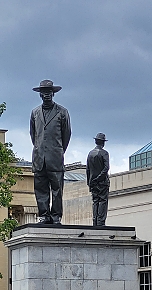
The fourth plinth on the northwest corner of the Square was destined to have a statue of King William IV. Because of insufficient funds, the king’s statue was never made, and the plinth remained empty until 1999 when the Royal Society of Arts (‘RSA’) conceived the idea of using the plinth to display a series of artworks by contemporary artists. Three artists displayed works between 1999 and 2001 on what is now known as The Fourth Plinth. Since 2005, under the supervision of London’s Lord mayors, a series of artworks by different creators have been displayed on the Fourth Plinth. Currently (since September 2022), the plinth (see photograph) displays a sculpture, “Antelope”, by Samson Kambalu. Recently, I heard this highly intelligent artist speak at a conference. His work on the plinth, based on a photograph taken in 1914, portrays the Baptist preacher and pan-Africanist John Chilembwe and the European missionary John Chorley. As the website www.london.gov.uk explained:
“The photograph was taken in 1914 at the opening of Chilembwe’s new church in Nyasaland, now Malawi. Chilembwe has his hat on, defying the colonial rule that forbade Africans from wearing hats in front of white people. A year later, he led an uprising against colonial rule. Chilembwe was killed and his church was destroyed by the colonial police.
On the plinth, Chilembwe is larger than life, while Chorley is life-size. By increasing his scale, the artist elevates Chilembwe and his story, revealing the hidden narratives of underrepresented peoples in the history of the British Empire in Africa, and beyond.”
Kambalu’s piece is a powerful work of art, and its message of resisting colonialism, makes stark contrast to the exploits of the other people portrayed on the Square’s plinths.
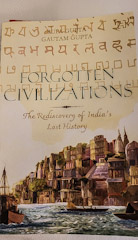
RUPA GUPTA AND Gautam Gupta have written a fascinating book with an intriguing title: “Forgotten Civilisations. The Rediscovery of India’s Lost History”. It describes 15 British men, who came to India during the British colonial era, which ended on the 15th of August 1947 and explored the Subcontinent’s early history.
The authors have written short biographies of these interesting men, highlighting the contributions they made to documenting India’s long history. The book seems to be making the case that before the arrival of these men, filled with a great enthusiasm for unearthing the past, India’s history prior to the Mughals had been largely forgotten.
Now, I am not qualified to comment on whether or not Indians had forgotten about their early ancestors, but wonder whether this history had really been lost before the arrival of the men described in the book. In many cases, these men were reliant on help from pandits who could read ancient scripts such as Sanskrit. Understanding these texts was the key to many of the ‘discoveries’ made by the subjects of the book. The existence of these texts suggests that long before the arrival of the British, early Indian history had been preserved, but maybe not as systematically as modern European historians would have preferred.
Despite my reservations about whether India had really lost or forgotten its ancient past, the book by the Guptas is fascinating (even though I have some reservations about its rather repetitive formulaic style).
Suggesting that a country had forgotten its own history might pander to readers who still harbour patronising or colonialist ideas about India. Although I have not yet seen this book on sale in British bookshops, I suspect it would might well appeal to readers, who seem to have forgotten that Britannia no longer rules the waves. I doubt that it was the Gupta’s intention that their interesting text might possibly appeal to readers who still believe that Britain is superior to other nations.
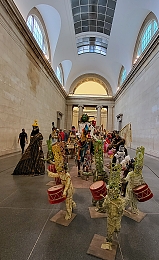
IN 1899, RUDYARD Kipling (1865-1936), who was born in Bombay (when India was under British rule), wrote a poem called “The White Man’s Burden”. The content of this piece was in harmony with the then current idea that the ‘white race’ was morally obliged to ‘civilise’ the non-white races of the earth, and through colonisation to encourage their economic development and ‘progress’. Well, this was an illusion happily believed by most of the colonisers. The reality was that colonisation was not designed to benefit the colonised but to increase the prosperity of the colonisers. The white man’s burden was in truth much more the burden which had to be borne by the non-white races, which were colonised. This is beautifully characterised in an art installation, “The Procession”, on display in London’s Tate Britain until the 22nd of January 2023. Conceived and created by the Guyanese-British artist Hew Locke (born 1959 in Edinburgh), I have seen it twice so far, and loved it each time.
“The Procession” consists of a large number of models of people dressed in colourful and fantastical costumes. They are arranged as if they are taking part in a carnival or parade. Many of the models appear slightly grotesque or even menacing. If these models were real people, they would inspire awe and maybe fear. Some of them carry banners, others carry skulls, and there are some supporting poles from which objects are either suspended, or on which objects are supported.
There are banners in the procession. Some of these depict colonial dwellings and institutions. Others show enlarged photographs of company share certificates and financial bonds. Some of the characters in the parade wear clothes on which these old-fashioned records of financial investment are printed. Thus, the artist has portrayed the fact that success of the investments of the European and American colonists and their backers rested on the shoulders of the hard-working black colonial subjects, who derived few if any benefits from their labour.
“The Procession” is not only a highly original way of conveying the unfortunate history of colonization, but also a feast for the eyes. It is both a reminder of Britain’s not always too glorious colonial past, as well as a celebration of the cultural diversity, which this country enjoys. The installation is housed in the magnificent neo-classical Duveen Galleries (opened in 1937), whose design is derived from architecture characteristic of the ancient imperialist regimes, which dominated the Mediterranean many centuries ago. Was it accidental or deliberate to place an essentially anti-imperialist exhibit in rooms that evoke an imperial past and by their immensity dwarf the exhibits? Whatever the answer, this is an exhibition for which it is well-worth making a detour.
IN WARWICK, I chanced upon a fascinating book in a charity shop. It is Part 2 of “Stanley Gibbons Priced Catalogue of Stamps of Foreign Countries 1912”. When it was published, it could be purchased for as little as half a crown (2/6, which is 12.5 pence). I paid a lot more for it, but not an excessive amount.
I felt compelled to buy it because of its date and my interest in Albania. For, on the 28th of November 1912, the independence of Albania was proclaimed in the seaside town of Vlorë. Albania’s independence was formally recognised when the Treaty of London was signed in July 1913. The catalogue I bought in Warwick was published some time in 1912 and most likely before independence was proclaimed. As far as the publishers and the compilers were concerned, what is now Albania was still part of the Ottoman Empire.
The index of the catalogue contains an entry for “Albania (Italian P.O.)”. This needs some explanation. Throughout the Ottoman Empire, there were postal services operated by foreign (i.e., not Ottoman) countries. A website (www.levantineheritage.com/foreign-post-offices.html) reveals:
“In the 18th century, foreign countries maintained courier services through their official missions in the Empire, to permit transportation of mail between those countries and Constantinople [sic] the Empire capital. Nine countries had negotiated Capitulations or treaties with the Ottomans, which granted various extraterritorial rights in exchange for trade opportunities. Such agreements permitted Russia (1720 & 1783), Austria (1739), France (1812), Great Britain (1832) and Greece (1834), as well as Germany, Italy, Poland, and Romania, to maintain post offices in the Ottoman Empire. Some of these developed into public mail services, used to transmit mail to Europe. The Ottoman Empire itself did not maintain a regular public mail service until 1840, when a service was established between Constantinople and other major cities in the country and this was slow to develop and expand. The gap in this capacity was very much filled with the various foreign post offices which continued functioning right till the beginning of WWI in 1914 …”
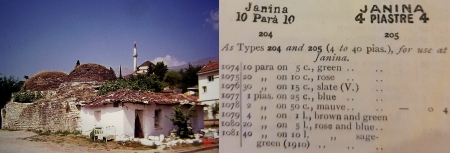
Left: Ioannina in the 1970s. Right: examples of over-printing texts
Hence, the entry in the catalogue’s table of contents. I turned to the page listed and found the section on Albania. The Italian Post Offices in the Turkish (Ottoman) Empire issued stamps, to quote the catalogue, which:
“…surcharged or over-printed for use in Italian post offices abroad.”
These stamps were the regular issues but, to quote the catalogue:
“… distinguished by the removal of some details of the design, over-printed with Type…”
Different Italian stamps were overprinted with names of places and a Type number. For example, Italian stamps were over-printed with: “ALBANIA. 10 Para 10. 201” (where ‘10 Para’ is a monetary denomination and ‘201’ is the Type number), or “Durazzo. 4 PIASTRE 4. 205”, or “Valona, or other place names. 10 Para 10. 208”. Durazzo and Valona being the Italian for the Albanian names Durres and Vlore.
Within the Albanian section of the catalogue there is also an illustration of the over-printing “JANINA. 4 Piastre 4. 205”. Janina is the name of a town now in Greece, Ioannina (Ιωάννινα). In 1912, this town was not in what was then Greece, but in the Pashalik of Janina, part of the Turkish Empire. In February 1913, following the battle of Bizani in the First Balkan War, the town was absorbed into Greece. Many Albanians still consider that by rights Ioannina should be a part of a Greater Albania. The large Albanian population in the town was forcibly reduced by population exchanges in the early 1920s and also the pre-WW2 Greek government’s policy of strongly encouraging people of Albanian ethnicity to regard themselves as Greeks. When I visited Ioannina in the 1970s, there were the remains of Turkish buildings but many of them were in a sad condition. I do not know whether they have been restored since then.
My purchase in Warwick has proved to be of interest. It records the state of postage stamps on the eve of great changes that were about to happen in the Balkan peninsular as well as illustrating aspects of European colonialism, both political and economic.
THAXTED IS A PICTURESQUE small town in Essex, about six and a half miles northeast of Stansted Airport. Apart from its numerous quaint old buildings, the town has three notable landmarks: an old windmill, a 15th century guildhall, and a large parish church, which was built between 1340 and 1510 during the time when Thaxted was an important centre for the manufacturing cutlery. Also, Thaxted is home to an annual music festival, whose existence derives from the discovery of the town by a composer, Gustav Holst (1874-1934), creator of “The Planets” and many other musical compositions, who was on a walking tour in Essex during the winter of 1913.
Gustav Holst in Thaxted
Holst, who was born in Cheltenham, was living in London by 1913 and teaching music at St Pauls School for Girls in Hammersmith, James Allen’s Girls School in Dulwich, and Morley College for adults in Lambeth. At the same time, he was busy composing.
Holst had come to study at The Royal College of Music in London in 1893. Soon after arriving in London, he became acquainted with William Morris (1834-1896) and attended meetings at the latter’s house in Hammersmith, where he would have heard lectures on socialism given by George Bernard Shaw (1856-1950) and others. Holst joined the Hammersmith Socialist Society (‘HSS’), which was led by Morris. Many of the socialists he met including Shaw were vegetarians, as was the composer Wagner, whom Holst greatly admired. As a student and a regular attender of meetings of the HSS, he became a vegetarian and at the same time developed a great interest in Hinduism (www.ivu.org/people/music/holst.html). He began studying Sanskrit at The School of Oriental and African Studies (https://www.bl.uk/20th-century-music/articles/holst-and-india) and several of his compositions bear Indian-sounding titles, such as “Savitri” and another opera called “Sita”, and songs based on the Rig Veda.
According to Nalini Ghuman:
“In contrast to the vague musical orientalism in vogue during the height of the British Empire, Holst’s hymns, with their bona fide Indian texts, subjects, and musical elements, have often seemed decidedly ‘un-Indian’ to the uninformed ear: ‘Sound firm impressions of the East from a sane Western perspective’ declared The Musical Times; ‘They do not suggest a point further East than Leicester-square’ (Daily Telegraph); after all, explained the Manchester Guardian ‘many real Eastern musical ideas are frankly ugly and uninteresting’. Their Indian musical roots have long been denied by the composer’s biographers.” (https://www.bl.uk/20th-century-music/articles/holst-and-india).
However, Ghuman points out in her article that Holst did incorporate elements of Indian music, including emulating Vedic chanting and a South Indian mode, the namanarayani. You would need to be a serious musician with specialist interest in Indian music to be aware of these features whilst listening to Holst’s Indian inspired compositions.
Returning to his political leanings, major biographies of Holst tend not to focus much on his connections with socialism, but an informative article, “Gustav HoIst, William Morris and the Socialist Movement” by Andrew Heywood (Journal of the William Morris Society, vol 11, no. 4: 1996), shows that his involvement was far from inconsiderable. In addition to attending meetings of the HSS, Holst conducted its socialist choir, played the harmonium on the ‘official socialist’ cart, and was involved in the administration of the society. Heywood wrote that:
“In the light of his clear commitment to the socialist movement through 1896 it would seem likely that his involvement with the musical activity of the society did not stem from a lack of political commitment; rather it was an opportunity to serve the movement in a way which utilised his musical talents and interest.”
It was through the HSS that Gustav met his wife Isobel, who not only sang in the socialist choir but also, according to Heywood, was politically active in the society.
So, it was with a background of involvement with socialism that Holst walked into Thaxted in late 1913 and took such a great liking to the place that he rented a 17th century cottage there (actually, in Monk Street, 1 ½ miles from Thaxted) from its owner, the Jewish author Samuel Levy Bensusan (1872-1958). Thus began Holst’s several year’s association with the town. It was not long before he made the acquaintance of Thaxted’s vicar, Conrad le Despenser Roden Noel (1869-1942). After the cottage in Monk Street burnt down, Holst and his family lived in a house, The Manse (formerly known as ‘The Steps’), in the centre of Thaxted. Today, this is marked by a commemorative plaque.
Noel was not a run-of-the-mill country cleric. He was a Christian Socialist and a member of Social Democratic Federation, a founder member of the British Socialist Party, and for some time the Chairman of the Anti-Imperialist League, supporting the struggle for independence both in Ireland and India. Deeply committed to Christian socialism, social justice, and egalitarianism, Noel made sure that what went on in his parish church promoted these ideals. Noel’s biographer, Reg Groves, wrote that Conrad:
“…emphasised always that there was much more to making a new society than the acquisition of political power and the transfer of some property from the rich to the state, from one set of rulers to another. In this as in so many things, he was at one with the wisest of English socialists, William Morris, and much of what Morris said in prose and poetry and in the work of his hand, Noel tried to say in the group life he had developed at Thaxted”.
Noel and Holst shared socialist sympathies and more.
During Holst’s sojourn’s in Thaxted in between his heavy teaching and other musical commitments, he attended services led by Noel. It was after one of these held at Whitsun in 1915, that Holst, having heard the great potential of singers in the church, approached Noel and offered to give the choir the benefit of his professional skills as a trainer of vocalists. Noel, recognizing the splendid opportunity, soon had Holst become his church’s ‘master of music.’
Heywood explains that Holst’s:
“…first job was to train the choir for the church. Its members were drawn from the local population, and they achieved high standards with Holst. One member, Lily Harvey from the local sweet factory, was sent to London for professional training because of her exceptional vocal talents. In addition to his activities with the choir and playing the organ, Holst organised three major music festivals in Thaxted between 1916 and 1918.”
Lily was not the only person sent to London for musical training. The then young curate Jack Putterill, who was politically turbulent and played the organ, became one of Holst’s students at Morley College. Jack, who married Noel’s daughter, succeeded Noel as Vicar in 1942.
The festivals organised by Holst involved not only performers from Thaxted but also some of his students from Morley College and St Pauls as well as other musicians from outside the town. Each festival lasted several days, on each of which there were many hours of music making, both rehearsed concert pieces and much spontaneous music.
Holst not only helped make music in Thaxted but also composed there. The plaque on the The Manse, where he lived, is positioned on the outside of the wall of the room in which he composed. While living at Monk Street, he composed much of what was to become the well-known piece, “The Planets”. The “Jupiter” section of “The Planets” contains a tune or theme that Holst named “Thaxted” (you can listen to this familiar tune here: https://youtu.be/GdTpBSg7_8E). In 1921, “Thaxted” was used as the tune for the patriotic song “I vow to Thee, My Country”, whose words were written by the British diplomat Cecil Spring Rice (1859-1918). Holst also composed pieces specially for Thaxted and its people. These works include a special version of Byrd’s “Mass for Three Voices”, “Three Hymns for Thaxted” (later known as “Three Festival Choruses”), and a setting of the Cornish carol “Tomorrow shall be My Dancing Day” (hear it on https://youtu.be/Cz_0j__FDuc).
Although the last festival in Thaxted with which Holst was intimately involved was in 1918, he never lost touch with music making in the town, even after he moved from it to nearby Little Easton in 1925. Holst’s pupil Jack Putterill, an accomplished musician who was Thaxted’s assistant curate from 1925 to 1937 and its vicar from 1942 until 1973, helped keep the town’s musical life alive and vibrant. In the 1950s and 1960s, concerts with great orchestras such as The London Philharmonic and audiences in excess of 1000 were held in the parish church. In 1974, the hundredth anniversary of Holst’s birth, the first of what was eventually to become an annual music festival was held in Thaxted. By the 1980s, the Thaxted Festival had become a regular and respected part of the British musical calendar (www.thaxtedfestival.co.uk/).
Apart from the Festival and the house with the plaque in Thaxted, most souvenirs of Holst’s time in the town can be found within the cathedral-like parish church, which, incidentally, was once a candidate for becoming Essex’s cathedral (this honour was granted to the parish church in the centre of much larger Chelmsford). The church in Thaxted contains a photograph of Holst with singers and musicians at the Whitsuntide Festival held in 1916. Near this, there is some calligraphy with the words of “Tomorrow shall be My Dancing Day”. The church’s Lincoln organ built in 1821 by Henry Cephas Lincoln (who worked between c1810 and c1855) was played by Gustav Holst and has been recently restored. Not far from the organ is a cloth banner, sewn by Conrad Noel’s wife, which was used in the 1917 Whitsuntide Festival. It bears the words “The aim of music is the glory of God and pleasant recreation”. These words were written by the composer JS Bach (1685-1750) and were chosen for use on the banner by Holst. Near this banner, there is a bust of Holst’s friend and collaborator, Conrad Noel.
Both Holst and his student Putterill fell in love with Thaxted at first sight and were so strongly drawn to it that the town came to occupy important places in their hearts and minds. We first visited Thaxted in the early summer of 2020 soon after covid19 restrictions began to be relaxed sufficiently to permit travelling out of one’s immediate neighbourhood. Like Holst and Putterill, Thaxted made a special impression on us, so much so that we have visited it at least twice since our first encounter with it. Next year, we hope to be able to attend concert(s) at the Thaxted Festival inside a church that we have grown to love.
NOBODY IS PERFECT, and that includes all of those ‘great’ men and women whose lives are remembered with statues. Let me state at the outset that I am against both idolatry and iconoclasm. I do not believe that anyone should be worshipped without questioning (or even after questioning) nor that statues should be destroyed. Everyone has good and bad points, and that should be remembered always when looking at a statue.
Let me state at the outset that I am against both idolatry and iconoclasm. I do not believe that anyone should be worshipped without or with questioning nor that statues should be destroyed. Everyone has good and bad points, and that should be remembered always when looking at a statue.
Consider Cecil Rhodes (1853-1902). He was not a person that I would have enjoyed meeting, even for a brief drink in a pub. From what I know of him, he was power hungry and greedy and would stop at nothing to achieve his goals.
Undoubtedly, money derived from his endeavours has been spent on good works including the famous Rhodes Scholarships, which began funding bright young scholars from 1902 onwards. Many academic and other fine accomplishments have been achieved by the recipients of these awards. However, some of them are now criticising the way that Rhodes exploited/plundered Africa to produce his wealth. Given that these scholarships, funded by what some might describe as ‘dirty money’, are awarded to people with above-average intellectual abilities who could easily have examined Rhodes’ history, I find it strange that the recipients did not question the morality of the origins of what was being offered to them before receiving and spending it. Some recipients justify accepting the scholarships by saying it is a way that Rhodes’ debt to Africa can be partially repaid. Maybe, but would you feel comfortable if, say, the infamous Kray Twins or Al Capone offered to use some of their ill-gotten gains to fund your education? Would you justify accepting their money by saying that although they killed people and committed crimes like theft, it was good that they were using someone else’s wealth to repay their debt to society? Few people would justify erecting statues to either the Kray Twins or Al Capone.
Unlike Capone and the Krays, Rhodes was not breaking any British law when he was plundering Africa to glorify the British Empire and line his own pockets. From the viewpoint of the great majority of ‘white’ British people, his contemporaries, Rhodes was doing a good job during his lifetime for the Empire and his native land, Great Britain. Statues were erected in his memory by those who had benefitted from his life’s work. Those people were mostly, if not all, ‘white’ people. The monuments were put up during an era when racial prejudice went unquestioned and people ‘of colour’ lacked any public influence.
Times have changed. The racial situation, the rights of ‘people of colour’, is also changing, albeit too slowly. Recent and not so recent events across the Atlantic in the “land of the free and the home of the brave” have justifiably heightened popular consciousness and questioning of the worthiness of those, like Rhodes, whose statues adorn our lands.
So as Vladimir Ilych Lenin, discredited by some, and many of whose statues have been toppled, asked in 1902: “What is to be done?” What is to be done with the statues of celebrated people with flaws in their personalities? One could pull them down as has been the case with many statues of Stalin, Enver Hoxha, Saddam Hussein, and more recently a slave owner in Bristol. Apart from temporarily assuaging the temper of an assembly of aggrieved folk, the toppling or destruction of a statue might have few or no lasting beneficial effects.
It would be far better to remove the statues from positions of great public prominence to more discreet locations (maybe to museums) and to label their plinths with inscriptions that summarise the subjects’ both good and bad actions. Also, it would be a good idea to educate children and other students to understand that just as there are two competing teams in a football match, there are two sides to a person’s personality: a good one and a bad one. It is the balance of these that needs to be judged. In the case of Rhodes, the bad wins, but in the case of, say Edward Jenner (of smallpox vaccination fame), whose statue can be found in Hyde Park, his good features easily predominate.
Finally, destruction of statues and monuments worries me because they are part of remembering. If we know that a monument commemorates something that should not be repeated, such as slavery, let it remain, suitably labelled, so that we do not run the risk of unpleasant aspects of history repeating themselves. For as the philosopher George Santana (1863-1952) wrote in 1906: “Those who cannot remember the past are condemned to repeat it.”
HAVING PARENTS WHO WERE BROUGHT UP IN RACIALLY conscious South Africa, I feel easier calling the two parts of old Pondicherry by their French names, ‘Ville noire’ and ‘Ville blanche’, rather than their English names, ‘Black Town’ and ‘White Town’. The English names are redolent of the sad days of racial segregation in apartheid South Africa.
While Pondicherry was a French colony, most Europeans lived in White Town, and people of local Indian origin lived in Black Town. This kind of racial separation was not unique to the French in India. The British were also keen to keep races separate. Bangalore, for example, was divided into the Cantonment (European area) and the City (local Indian area).
A rather malodorous partially covered canal or drain separates White Town from Black Town (now called ‘Heritage Town’). White Town lies between Black Town and the shore of the Bay of Bengal.
Today, more than 60 years after the French ceased to Govern Pondicherry, the White Town continues to retain its appearance as a French colonial town. Many of the buildings were built by the French and are distinctly European in architectural style. The streets are neatly laid out, tree lined, and wide. There is none of the hustle and bustle associated with most Indian towns and villages. This might be because there is little commercial activity apart from tourist related facilities (accommodation and eateries). You can enjoy a good but costly meal in White Town, but buying a newspaper or fruit and vegetables is hardly, if at all, possible.
Since our last visit to Pondicherry five years ago (just before the great storm that flooded Chennai in late 2015), the city’s authorities have placed plaques along the streets of White Town. Written both in Tamil and English (not French!), they provide short informative histories of the streets’ names.
Cross the covered drain into what used to be called ‘Black Town’, and familiar Indian urban life is flourishing. The streets are crowded; there are shops aplenty; the area is full of traffic: two, three ,four (and more) wheeled vehicles; and there are Hindu temples (as well as churches). Apart from tiny roadside Hindu shrines, the only places of worship in White Town are churches.
In contrast to White Town, the architecture in the old Black Town is not so fine. There are a few traditional Tamil style buildings, but much of the architecture is relatively new and generally lacking in visual appeal.
Apart from being a very pleasant place to visit, Pondicherry and its well preserved historical layout offer an interesting reminder of colonial life and its less savoury racist aspects. That said, the place and its beautiful seaside promenade is a joy for all visitors whether or not they have any interest in history.






 yamey
yamey 