Abolishing slavery and an obelisk

BLACK LIVES MATTERED MUCH to young Thomas Clarkson (1760-1846), who was born in Wisbech, Cambridgeshire. One day when he was walking with his horse from Cambridge to London, he stopped on a slope that was above and in sight of the Feathers Inn at Wadesmill (Hertfordshire) next to a bridge crossing the River Rib on a stretch of the old Roman road known as Ermine Street.
A student at St Johns College in Cambridge, he had just won a prize for his essay (in Latin) that addressed the subject “Is it right to make slaves of others against their will?” Soon after writing his piece, he published an English translation of it. Clarkson, who had done much research into slavery past and in his time, was thoroughly disapproving of the slave trade. The concluding paragraph of his long and well-reasoned essay, rich in factual material, summarises the young man’s objection to slavery:

“For if liberty is only an adventitious right; if men are by no means superiour to brutes; if every social duty is a curse; if cruelty is highly to be esteemed; if murder is strictly honourable, and Christianity is a lye; then it is evident, that the African slavery may be pursued, without either the remorse of conscience, or the imputation of a crime. But if the contrary of this is true, which reason must immediately evince, it is evident that no custom established among men was ever more impious; since it is contrary to reason, justice, nature, the principles of law and government, the whole doctrine, in short, of natural religion, and the revealed voice of God.”

With the Feathers inn ahead of him, he had a revelation. In his own words:

“Coming in sight of Wades Mill in Hertfordshire, I sat down disconsolate on the turf by the roadside and held my horse. Here a thought came into my mind, that if the contents of the Essay were true, it was time some person should see these calamities to their end. Agitated in this manner I reached home. This was in the summer of 1785”

That revelation, like a Dick Whittington moment or the apple falling on Isaac Newton’s head, set Thomas on his life’s mission to abolish slavery. His essay inspired the formation of a small group of Quakers, whose aim was to lobby the British Parliament to campaign against slavery. Soon, this led to the formation of a non-denominational ‘Committee for the Abolition of the Slave Trade’ (in 1787).  Clarkson was a member of this committee. It was he who encouraged the young (and now well-known) William Wilberforce (1759-1833), a Member of Parliament, to join the group.

Although it was Wilberforce who introduced the first Bill to abolish the slave trade in 1791, it was Clarkson, who worked tirelessly to persuade the British public of the desirability to bring an end to the trade in human cargoes. Clarkson travelled about 35,000 miles throughout Britain, amassing information about the slave trade and persuading people of its evil nature. He collected evidence of the cruelties and injustices of slavery from 20,000 sailors who had worked or were working on slave carrying ships. He wrote several pamphlets about the slave trade and its impropriety and assembled visual aids with which he could dramatically purvey its horrors and cruelties to the British public, whom he encountered during his extensive travels.

When, finally in 1807, the Act for Abolition of the Slave Trade was passed by the British Parliament, the poet William Wordsworth (1770-1850) wrote a sonnet in honour of Clarkson’s immense efforts to defeat the slave trade. Called “To Thomas Clarkson On the final passing of the Bill for the Abolition of the Slave Trade, March, 1807.”, it goes like this:

“Clarkson! it was an obstinate Hill to climb:

How toilsome, nay how dire it was, by Thee

Is known,—by none, perhaps, so feelingly;

But Thou, who, starting in thy fervent prime,

Didst first lead forth this pilgrimage sublime,

Hast heard the constant Voice its charge repeat,

Which, out of thy young heart’s oracular seat,

First roused thee.—O true yoke-fellow of Time

With unabating effort, see, the palm

Is won, and by all Nations shall be worn!

The bloody Writing is for ever torn,

And Thou henceforth shalt have a good Man’s calm,

A great Man’s happiness; thy zeal shall find

Repose at length, firm Friend of human kind!”

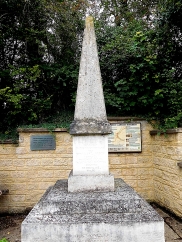
It was descending the hill to Wadesmill that set Clarkson, the real initiator of the abolition of the slave trade, that set him to “… climb that obstinate Hill…” And his halt near Wademill, in sight of the Feathers inn has not been forgotten. An obelisk by the roadside commemorates Clarkson’s ‘light bulb moment’. The base of the obelisk bears the words:

“On the spot where stands this monument in the month of June 1775 Thomas Clarkson resolved to devote his life to bringing about the abolition of the slave trade.”

The monument was erected in 1879 for a chess playing barrister, Arthur Giles Puller (1833-1885) of Youngsbury, which is close to Wadesmill. According to a web page , http://abolition.e2bn.org/source_27.html:

“In 1833, Basil Montague asked Thomas Clarkson to show a party of abolitionists, the exact spot where he decided to dedicate his life to ending slavery. A young Charles Merivale went with them. Years later he became Dean of Ely and told his story to Arthur Giles Puller, of Youngsbury, who offered to help him fulfil his promise to mark the spot. Charles Merivale unveiled the monument on 8th October, 1879.”

Charles Merivale (1808-1893), apart from becoming the Dean of Ely, was one of the founders of the annual Oxford and Cambridge boat race, which was first held in 1829. Destined for a career in India (which he decided against), he studied both at Haileybury College and St Johns College Cambridge, where Clarkson had also studied.

Clarkson’s monument was restored by members of the US Airforce in the 1950s. in June 1972, it was moved 9 yards up the road to allow some road widening. Finally, in November 2007, a very thorough restoration and repair of the monument was completed. Now in 2020, part of the base looks as if it could benefit from some more repair work.

The monument, unlike many of those that commemorate slave-owners, is a modest memorial to a man whose efforts and achievements have been overshadowed by those of his fellow abolitionist, William Wilberforce. I am very grateful to our dear friends who live in Hatfield (Hertfordshire) for showing me this monument after we had enjoyed a large lunch at the Feathers Inn that Clarkson was able to see when he resolved to bring the slave trade to an end.
All that remains is …

OUR GOOD FRIENDS IN HERTFORDSHIRE always take us out into the countryside for a walk with their two friendly dogs. Invariably, we visit countryside that is both beautiful and contains something of interest. This time, we parked in the small hamlet of Thundridge (in Hertfordshire), which is located on what was once the Roman road, Ermine Street (from the Old English ‘Earninga Straete’). This thoroughfare linked London with York. We set off by walking along a small road named Old Church Lane. This soon becomes a footpath that runs alongside the River Rib, a tributary of the River Lea, which in turn is a tributary of the River Thames. The Rib merges with the Lea in the town of Hertford.

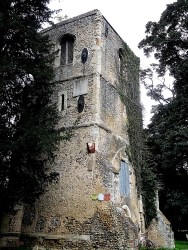
We walked past a vast field in which some grassy crop was growing. Far across the field there was a small wood. A church tower could be seen rising from amongst the trees. We followed another path towards the clump of trees and soon arrived at the tower. This tower and a graveyard is all that remains of the church of St Mary and All Saints (some call it ‘All Hallows and Little St. Mary’ and others ‘Thundridge Old Church’), which was demolished (apart from the tower) in 1853, when a new church was built in Wadesmill. The tower was constructed of flint and mortar in the 15th century. The rest of the church, now demolished, was built in the 11th to 12th centuries. A Romanesque archway now set into the eastern wall of the tower is the only visible remains of that former church.  Although this ruined tower might well appeal to those who find ruins romantic, it is in a bad condition with some of the structure covered with corrugated iron sheeting and other parts with graffiti. There are some plans to conserve it and others to demolish it to make room for new housing.

The reason that the old church was demolished was that the old manor house, which was close to the old church, was demolished in the 19th century. Consequently, the population of Thundridge moved nearer to the new manor house that was built where the church built in 1853 now stands.

Just before we reached the old church tower, we passed a field which had a long grass-covered trench running along it. This is the remains of a moat built long ago when Thundridge village was located near to the the old, now demolished church. The banks of the moat were liberally studded with mole hills. This moat is believed to have been dug in mediaeval times. What remains of it is ‘D’ shaped and encloses an area bounded by sides of approximately 660 feet north to south and by the same east to west. The moat enclosed the site of the former manor house.

Having seen all that remains of Thudridge Old Church, we retraced our steps to Ermine Street, crossed the fast-flowing River Rib, and then ate an enormous roast lunch in the garden of the nearby Feathers pub in Wadesmill, which is about two minutes’ walk from Thundridge.

A river and a canal

THE GREAT BED of Ware is eleven feet long and ten feet wide. Constructed at the end of the 16th century, this four-poster bed dwarfs the modern king size bed (six and a half feet by five feet). The Great Bed was housed in various inns in the town of Ware in Hertfordshire until the early 1930s when it was acquired by the Victoria and Albert Museum in London. A few days ago, we visited Ware, not expecting to see its Great Bed but for other reasons. One of these was that it is a small town not far from Perry Green where the Henry Moore Foundation is located. Another was to see the upper reaches of the River Lea and the point along it where water enters the New River.


BLOG W 10

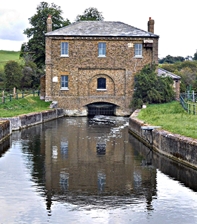
The Gauge House and the New River emerging from underneath it

The 42 mile long River Lea, a tributary of the River Thames, rises near Luton in the Chiltern Hills in Bedfordshire, flows through Hertfordshire, and then makes its way south through parts of  northeast then eastern Greater London, reaching the Thames at Bow Creek. The river flows through the centre of Ware. A short walk (1.3 miles) along the bank of the river westwards from Ware, brings one to the start of the New River, which is not actually a river. It a canal built to bring fresh water from the clean upper reaches of the Lea into London.

The history of the New River involves the London district of Islington, where the reservoir that used to collect water from the New River was located. To quote from something I wrote a couple of years ago (https://londonadam.travellerspoint.com/44/):

“At the triangular Islington Green, Essex Road branches off from Upper Street at an acute angle. At the apex of the triangle, there is a statue of Sir Hugh Myddelton (1560-1631) sculpted by John Thomas (1813–1862). He stands bare-footed, wearing a ruff and breeches, which stop short of his uncovered knees and lower legs. Below his plinth, two carved children sit or kneel with pitchers between their legs. Once, they issued water, but no longer. Myddelton, a Welsh entrepreneur, was the driving force behind the creation of the New River water supply project. The 38-mile-long canal, which he helped to finance, was constructed between 1608 and 1613 …”

Roseberry Avenue in London’s Islington is now best-known for the Saddlers Wells Theatre. However, one of its near neighbours was of great importance in connection with the New River. Quoting from my piece again:

“Across Roseberry Avenue, which flanks Spa Fields, there is a large brick building with white stone trimmings, now a block of flats. Completed in 1920, New River Head House was designed by Herbert Austen Hall (1881-1968) as the headquarters of the Metropolitan Water Board. Above two of its windows, there are carved inscriptions. One reads “Erected MDCXIII”, and the other “MDCCLXXXII”. These dates are 1623 and 1782 respectively, which are carved in archaic lettering. The inscribed stones must have been saved from an earlier building. The land on which the house stands was formerly the ‘New River Head’.

The New River, a canal constructed to bring fresh water from Hertfordshire into London ended at the reservoir called ‘New River Head’. It was high enough above what was the city of London in the 17th century to allow the flow of water from it to be ‘powered’ by gravity alone (see: http://www.british-history.ac.uk/survey-london/vol47/pp165-184). The brick-lined reservoir was constructed in 1623, when the first building at the reservoir, the ‘Water House’, was also built. The architect Robert Mylne (1733-1811), surveyor to the New River Company, repaired, enlarged, and refaced it in the 18th century. The refacing was done in 1782 … The old building, which had been enlarged many times, was demolished by 1915.”

Having seen the site of the destination of water carried by the New River, I was keen to see the point of its origin. Hence, our visit to Ware.

We parked near the centre of Ware in a car park (Burgage Lane) next to a footbridge that crosses the Lea. Then, we followed the riverside path after traversing the river. At first the path runs sinuously beneath trees that line both banks the stream. Their different coloured leaves are reflected in the water that ripples as waterfowl swim past. We met many other people enjoying their morning walks, but the path was never crowded.

After a short distance, the river flows around and between a network of islands and the path loses its lining of trees. Soon, there is open country on one side and on the other a series of modern industrial buildings partially hidden from view by occasional trees including lovely weeping willows. We reached the impressive weir of Ware. To enable boats to pass this hazardous waterfall, a lock exists. Ware Lock was first built in 1855 but looks as if it has been modernised since then.  Continuing west from the weir, we became aware of traffic noise as we approached the concrete bridge that carries the busy A10 dual-carriageway road over the river.

A third of a mile upstream from the road bridge, there is a tall brick house. It is not attractive and can be seen from afar in the flat landscape surrounding it. This building, The Gauge House, was built in 1856 to the design of William Chadwell Mylne (1781-1863), a son of Robert Mylne, who was involved with the terminal reservoir at New River Head in Islington (see above).  The building is constructed on an arch, a bridge that straddles the start of the New River at the point where water enters the canal from the River Lea. The ground floor of the building houses a mechanism for regulating the flow of water from the Lea into the New River. This is explained on the historicengland.org.uk website as follows:

“… [The] ground floor contains the gauge which measures the intake of water from the River Lee; it consists of 2 iron boats 5m long floating at Lee level which are joined by a chordal segmental iron beam 9m long, and the rise and fall with the level of the Lee controls the flow of water over the sluice which can be further adjusted by weights hung from the gate, the daily intake from the Lee being 22 1/2 million gallons.”

Another website, engineering-timelines.com, gives details of the predecessors of the Gauge House:

“At first, the flow from the river was monitored by a wooden ‘balance engine’ – a rocking beam-and-float device. It was later replaced with the Marble Gauge, built by Robert Mylne inside a Portland stone chest. Though now empty, this is still visible a little downstream.”

We were able to see the exterior of the Gauge House including the grille through which water leaves the Lea to flow under the building and that from which it flows from the House into the first stretch of the New River. The canal flows about 300 yards south before making a right angle beyond which it begins flowing east.  Having visited the London terminus of the New River and walked along attractive stretches of the canal lined by parkland in Canonbury, near Islington, I was very satisfied seeing where this historic waterway commences. We retraced our steps along the riverbank to Ware before driving to visit the Henry Moore Foundation at Perry Green.

Returning to the subject of beds, which is associated with the town of Ware, my mind leaps a quarter of the way around the world to Ootacamund (‘Ooty’) in the south Indian state of Tamil Nadu. In January 1994, we spent part of our honeymoon at St Margarets in Ooty, a guesthouse belonging to the ITC company. The room we occupied in this typical colonial style bungalow was huge. And it needed to be to accommodate the enormous bed that we occupied. This bed, whose width rivalled that of the Great Bed of Ware was not so long as the latter. Its sheets must have been specially made to fit this enormous bed.  Although there were only two of us sleeping in it, I think that that it would have been wide enough for four or five couples to sleep in it without it becoming overcrowded.

Both Ooty and Ware have their charms, but the latter is far more accessible from London especially in these times of restricted travel caused by the wholly unwanted presence of the Covid-19 microbe.  


At home with Henry Moore

PERRY GREEN IS A TINY hamlet near Much Hadham in Hertfordshire and was home to a sculptor whose works are often anything but tiny. Henry Moore (1898-1986) was born when Auguste Rodin, the ‘father of modern sculpture’, was 58 years old and about five years before another great British sculptor, Barbara Hepworth, was born. Moore’s works have influenced the output of some of my favourite 20th century British sculptors such as Anthony Caro, Philip King, and Eduardo Paolozzi. Both Caro and King worked as assistants to Henry Moore.

M 11

In 1929, Moore married an art student from Kiev, a refugee from the Russian Revolution, Anatolia Radetzki (1907–1989), and the couple lived in Hampstead at 11a Parkhill Road, which Moore had rented in advance the year before. Their home was close to other leaders in the world of art including Naum Gabo, Barbara Hepworth, Ben Nicholson, Roland Penrose, and Herbert Read. In those days, Hampstead was part of the nucleus of London’s artistic sphere.

In September 1940, the Moore’s home in Hampstead was damaged by bomb shrapnel. Henry and Irina moved out of London to Perry Green, where they began living at a farmhouse called Hoglands, which is a late medieval house, rebuilt and then remodelled in the 17th century. This and the land and other properties around it, which the Moores bought gradually, became the centre of his artistic production: his home and workshops.  In 1946, Irina gave birth to Mary, the Moore’s only child.

Rapidly and for the rest of his life, Henry’s artistic output, fame, and prosperity continued to increase. As his wealth grew, Moore, concerned about his legacy, established the Henry Moore Trust in 1977 with the help of his daughter. According to the Foundation’s website:

“The Henry Moore Foundation was founded by the artist and his family in 1977 to encourage public appreciation of the visual arts.”

As part of its activities, it has opened to the public Moore’s creative environment at Perry Green. Following the recent easing of the Coronavirus ‘lockdown’ restrictions, we took the opportunity to visit Moore’s lovely place in rural Hertfordshire.

We were able to visit some of Moore’s workshops including one that contains a huge collection of maquettes, small models or three-dimensional sketches for the artist’s visualisations of his ideas for larger works. Interspersed amongst these items, there are objects both man-made and natural (eg lumps of flint and skeletal bones) that Moore found and collected. Some of them inspired his creations. Seeing these maquettes alongside specimens of nature collected by the artist helped me see the connection between Moore’s work and natural forms.  

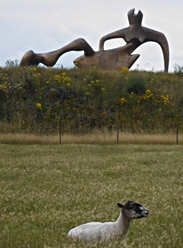
The gardens in which numerous finished sculptures are displayed are superbly laid out and well-maintained. Beyond the gardens, we walked through fields in which sheep graze overlooked by some of the larger of Moore’s creations on view at Perry Green. The sheep played a significant role in Moore’s creations; he often sketched them.

After stretching our legs and enjoying the lovely gardens and fields, we enjoyed hot drinks outside a well-designed modern building that serves as a café and visitor’s centre (including a shop where several books about Moore are on sale). One place that was closed to visitors because of the pandemic is the striking building housing the Henry Moore Archives. Originally, the archives were housed in a brick cottage of no architectural interest called Elmwood. Between 2012 and 2018, the architect Hugh Broughton and his project director, Gianluca Rendina added a large modern-looking extension to Elmwood. It is an attractive structure, which is larger than the old cottage and is clad in COR-TEN steel that has weathered (oxidised) to become a warm reddish-brown colour. Far more geometric and less organic than Moore’s artworks, the building, like Moore’s sculptures, makes a pleasing contrast to the bucolic surroundings in Perry Green. Incidentally, the modern visitor’s centre/café complex was also designed by the Hugh Broughton Architects practice.

Although I loved visiting the Henry Moore Foundation at Perry Green and can strongly recommend it as a wonderful day-out for anyone who loves the countryside and/or modern art, I have one reservation, which is purely personal. I have never regarded the body of Henry Moore’s sculptural works as highly as those of some other twentieth century sculptors. To be fair, some of Moore’s creations really impress and move me, but the majority do not. Often when I visit an artist’s or a historical figure’s former home, my appreciation of its former inhabitant increases, but, sadly for me, visiting Moore’s place did nothing to improve my admiration of his works. But, please do not let my aesthetic opinions deter you from driving down Hertfordshire’s narrow winding country lanes to Perry Green, where the garden alone makes the effort well worthwhile. I am looking forward to making another visit soon, not so much for the sculptures but for the sheer joy that the place gave me. Who knows, but another visit to Much Hadham might make me more sympathetic to Moore’s works?

Burger buns in Baldock: two for one

Shop


If, say, your dentist were to offer to take out two of your teeth for the price of one, and you  needed to have only one tooth extracted, would you be excited by this special offer? I bet you would not.

Supermarkets are always making offers such as buy one, get one free. Once, we needed four burger buns. We entered a branch of Tesco’s in Baldock (Hertfordshire, UK) and found that burger buns were sold in packets containing twelve buns. Reluctantly, as there were no smaller packs, we took one pack of twelve. As we were heading towards the check-out desks, a lady who worked for Tesco’s chased after us. She was carrying another pack of a dozen burger buns. She said:

You didn’t take these.”

We only want one pack,” I told her.

But you must take a second pack. There’s a special offer. Two for the price of one.”

I told her that we really did not need 24 burger buns; we only wanted four. As it was obvious that she was not going to take ‘no’ for an answer, we took the second pack of buns without any idea of what we were going to do with them. As far as I could see, we had simply helped Tesco empty their shelves of a perishable product, which if not sold would have had to be thrown away.

Another supermarket chain, tries to encourage purchases by offering the customer a free cup of coffee after paying for the goods. And if you have bought enough, a free newspaper is also on offer. These are nice gestures, but do they compensate for the higher than average prices of many of the goods on offer in their stores?

Parking in shopping centres can be costly. Some supermarkets have large car parks associated with them. They are often close to other shopping outlets, and charge a fee for parking. However, car owners who make a purchase in the supermarket are given a voucher that allows them to avoid paying for the parking.

Special offers are, of course, designed to attract sales. And, we as customers are often happy to take advantage of them. However, I still refuse to believe that many would go for a two for one offer on tooth extractions. But … maybe … I could tempt you to accept three extractions for the price of one!


Gandhi, Lenin, Stalin

gandhi

Non-violent Gandhi 

Beside three leading men

Who faced fate with force


This mantle-piece at Shaw Corner, the home of George Bernard Shaw at Ayot St Lawence in Hertfordshire, bears the portraits of (from left to right) Mahatma Gandhi, Felix Dzerzhinsky, Vladimir Lenin, and Josef Stalin. Shaw met all of these men.