Last secondhand book dealer in Hampstead

IN THE SIXTIES, there were at least six antiquarian/second-hand bookshops in Hampstead village. Two or three of them were in Flask Walk, a quaint passageway leading northeast from Hampstead High Street. Now, there is only one in Hampstead (apart from an Oxfam bookshop), and that is Keith Fawkes’s store on Flask Walk… currently, the last of the breed.

The amiable Mr Fawkes established his shop in 1964 when there were already a few dealers of second-hand books in the village. Over the years, he has branched out into antiques and bric-a-brac whilst retaining his well-stocked bookshop. It is a treasure house of interesting books, all packed into lines of shelving separated by corridors so narrow that it is difficult for one person to squeeze past another.

Very kindly, Keith Fawkes and his bookstore manager, Sam, have agreed to display and sell a few copies of my new book about Hampstead, “Beneath a Wide Sky: Hampstead and its Environs”, which is also available from Amazon (https://www.amazon.co.uk/dp/B09R2WRK92). While researching my book, Keith provided me with some information about another former Hampstead antiquarian bookseller, the illustrious Francis Norman, about whom I will relate more in a future post. Keith is acknowledged in my book.

So, next time that you are in Hampstead, do take a stroll along Flask Walk and look in at Keith Fawkes before having a pint in the nearby Flask pub, also mentioned in my book.

A magnet for modernists: Hampstead

YESTERDAY, 22nd February 2022, we saw an exhibition at the Pace Gallery in central London’s Hanover Square. The gallery stands facing a conventional sculptural depiction of William Pitt the Younger (1759-1806), created in bronze by Sir Francis Chantrey (1781-1841). I have been reading a great deal about Pitt in a wonderful, recently published biography of King George III by Andrew Roberts. What is being shown in the Pace gallery until the 12th of March 2022 is far from purely representational, as the exhibition’s title, “Creating Abstraction”, suggests.

By Barbara Hepworth

The exhibition contains works by seven female artists: Carla Accardi (1924-2014), Leonor Antunes (b. 1972), Yto Barrada (b. 1971), Saloua Raouda Choucair (1916-2017), Kim Lim (1936-1997), Louise Nevelson (1899-1988), and Barbara Hepworth (1903-1975). Most of these names were new to me apart from Nevelson and Hepworth. The latter interests me greatly not only because one of her sculptures is near the gallery on the southeast corner of John Lewis’s Oxford Street department store, but also because for a while she lived and worked in an area that fascinates me: Hampstead.

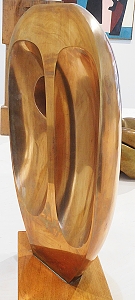
There are several of Hepworth’s works on display at Pace. One of them, “Two Forms”, was created in 1934. By then, she had been living and working in Hampstead for about seven years. For the first few years, she was living with her first husband, the sculptor John Skeaping, and then after 1931 with her second, the painter Ben Nicolson. In 1939, she left Hampstead.

Hepworth was not the only ‘modern artist’ living in Hampstead in the 1930s. I have described the active and highly productive artistic scene in the area in my new book “Beneath a Wide Sky: Hampstead and its Environs”. I have also explained why it was that artists like Hepworth, her contemporary Henry Moore, and many others were attracted to Hampstead between the two World Wars. Their reasons for congregating in the area differed somewhat from those of earlier artists, such as Constable and Romney, who were attracted to the place many years before. Read my book to discover why Hampstead easily rivalled Montmartre in Paris as a ‘mecca’ for artistic activity. The book is available as a paperback and a Kindle e-book from Amazon: https://www.amazon.co.uk/dp/B09R2WRK92

Rabindranath Tagore in Hove and Hampstead

FROM HOVE TO HAMPSTEAD

THE NOBEL PRIZE winning Rabindranath Tagore (1861-1941) was born in Calcutta (Kolkata). Raised in a culturally rich, wealthy household, he began writing poetry when he was eight years old. His family wanted him to join many of his compatriots, who travelled to England to become barristers. By becoming barristers, many Indian men were able to begin on the pathway to wealth and/or political influence both within the British colonial system, or against it.

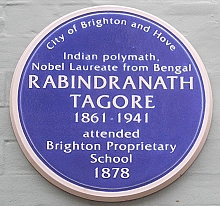
Tagore was enrolled in a school in Brighton in 1878. Whilst there, he resided in Medina Villas in Hove. His biographers, Krishna Dutta and Andrew Robinson, wrote in their book (published 1996) that one of Rabindranath’s (‘Rabi’s’) nieces:

“…retained fresh memories of Rabi Kaka (Uncle Rabi) in the family house at Medina Villas, between Brighton and Hove, where he settled for several months.”

Tagore wrote:

“Our house at Hove is near the sea. 20/25 houses stand in rows and the name of the complex is Medina Villas. When I first heard that we would be living in Medina Villas, I imagined a lot, such as there are gardens, big big trees, flowers, fruits, open space and lakes etc. After coming to my place I found houses, roads, cars, horses and no sign of Villas” (http://rabitalent.blogspot.com/2017/06/rabindranath-in-england.html).

The school that Tagore attended briefly, for about two months, was in Brighton’s Ship Street, close to the town’s famous ‘Lanes’ and a few feet from the seafront. Recently, a commemorative plaque was attached to the building which housed the school and is now part of a hotel, which used to be its neighbour. The plaque named the educational establishment “Brighton Proprietary School”.

I attended a preparatory school before moving on to a high school, but until I saw the plaque in Brighton I had never heard of proprietary schools. It seems as if they were private schools that were run as businesses, rather than not-for-profit organisations. A note on the National Archives website (https://discovery.nationalarchives.gov.uk/details/r/b1c290ea-4580-4c52-962b-10c0d281ac2a) revealed:

“The school was opened on 18 July 1859 under the title of the Brighton Proprietary Grammar and Commercial School for the Sons of Tradesmen. The proprietors … each had a share in the school and were entitled to take up places there. The education given had a Protestant bias and the first headmaster was the Rev John Griffiths, formerly of Brighton College.”

Brighton Proprietary School later became the Brighton, Hove and Sussex Grammar School (www.britishmuseum.org/collection/term/BIOG250324). Dutta and Robinson wrote:

“After spending a short time in a school in Brighton and Christmas with his family, he was taken away to London by a friend of his elder brother, who felt he was making little progress towards becoming a barrister. There he would stay during most of 1879, with a break to visit Devon, where his sister-in-law had taken a house, and, most probably, time spent with some cousins…”

Fast-forwarding to 1912, Tagore, by then a world-famous cultural figure, visited London. During his stay, he resided in Hampstead’s Vale of Health, as I recount in my book “Beneath a Wide Sky: Hampstead and its Environs” (available from  https://www.amazon.co.uk/dp/B09R2WRK92). Here is a brief extract from what I wrote:

“The only vehicular access to the Vale is a winding road leading downhill from East Heath Road. This lane is bordered by dense woodland and by luxuriant banks of stinging nettles in spring and summer. At the bottom of this thoroughfare, there are houses. Most of the expensive cars parked outside them suggest that the Vale is no longer a home for the impoverished. At the bottom end of the road, there two large Victorian buildings whose front doors are framed by gothic-style archways. They have the name ‘Villas on the Heath’. One of them bears a circular blue commemorative plaque, which has leafy creepers growing over it. It states:

“Rabindranath Tagore 1861-1941 Indian poet stayed here in 1912.”

I have visited the palatial Jorasanko where Tagore was brought up in Calcutta. The large (by London standards) ‘villa’ in the Vale is tiny in comparison. An article published in a Calcutta newspaper, The Telegraph, on the 13th of September 2009 reported with some accuracy:

‘In Hampstead, north London, regarded as a cultural “village” today for left-wing but arty champagne socialists, there is a plaque to Rabindranath Tagore at 3 Villas on Vale of Heath.’”

I have known about Tagore’s stay in Hampstead for a long time, but it was only during a recent visit to my wife’s relatives in Hove, that we first learned of the plaque commemorating Tagore’s brief educational experience in Brighton.

Hampstead: a town on a hill

Hampstead High Street

A town on high

Home of famous artists and authors

Hampstead by name

ENJOY my new book which takes a fresh look at north London’s Hampstead: its sites, its personalities, its character, and history. “Beneath a Wide Sky: Hampstead and its Environs” is available from Amazon: https://www.amazon.co.uk/dp/B09R2WRK92

Agatha Christie lived here

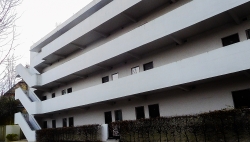
HAMPSTEAD’S LAWN ROAD Flats, better known nowadays as the Isokon Flats, was built in the 1930s as an experiment in communal living. This modernistic building was home to artists, writers, architects, and others. Many of its tenants were intellectuals fleeing from Nazi Germany. Amongst its many inhabitants were Henry Moore, Agatha Christie, and Walter Gropius.  Unintentionally, it also became a centre for Soviet Russian espionage activities. You can read about this amazing place and a great deal more about Hampstead in my new book, “Beneath a Wide Sky: Hampstead and its Environs”: https://www.amazon.co.uk/BENEATH-WIDE-SKY-HAMPSTEAD-ENVIRONS/dp/B09R2WRK92/

A NEW book about Hampstead in north London

AVAILABLE FROM AMAZON WEBSITES:

e.g.: https://www.amazon.co.uk/dp/B09R2WRK92
Hampstead is one of the highest places in London. There, the heavens are vast
and wide. Beneath this expanse of sky is an area with an eventful past and a
vibrant present. This book takes a fresh look at the locality and shows that
Hampstead is richly imbued with historical memories and has been home to a
multitude of fascinating and noteworthy people. Many books have been written
about Hampstead. Doubtless, there will be more. This one is different. It looks
at Hampstead from unusual as well as familiar viewpoints and gives the reader
a richer appreciation of what makes the place both delightful and intriguing.
This volume explores a wide variety of subjects, familiar and obscure, as well as
some which have never been described in other books about the locality. Here
is a fresh and at times quirky look at this place on a hill, one of London’s
treasures: a district, which is familiar to many people, yet full of surprises.
Although the bulk of this book is about Hampstead, there are also sections
describing some of its environs.

By reading this book, you can find out why John Constable, Samuel Johnson, Boy George, Mohammed Ali Jinnah, Mahatma Gandhi, Peter Sellers, Henry Moore, Maxim Litvinov, General de Gaulle, Stanley Spencer, Thomas Masaryk, Lee Miller, Agatha Christie, Jim Henson, Ian Flemming, Ernő Goldfinger, and many others, both famous and familiar, were all connected with Hampstead.

The book has several sections:
1. a brief survey of Hampstead’s general history and geography.
2. an introduction to Hampstead’s main thoroughfares with some
reminiscences of the area as it was during my youth.
3. the largest section of the book is a collection of chapters about
various aspects of Hampstead’s past and present. Recently, a friend of mine
bemoaned the fact that Hampstead High Street and Heath Street are lined with
branches of shops and cafés that can be found all over London. He is right. So,
if you wish to capture the true character of Hampstead, you need to stray into
the side streets and explore, which is what I hope this book will stimulate you to
do.
4. The last few sections of the book deal with some places of interest near to
Hampstead: Primrose Hill, North End, Go
lders Green, and Highgate.

TABLE OF CONTENTS

PREFACE … 7
INTRODUCTION: OH NO, NOT IN HAMPSTEAD … 7
SOME GEOGRAPHY AND HISTORY … 13
HEATH AND HIGH STREETS WITH SOME MEMORIES … 25
SATURDAY STROLLS … 25
PERRINS LANE, THE EVERYMAN, AND LOUIS … 34
DISCOVERING HAMPSTEAD … 41
A HOUSE ON HEATH STREET AND THE KIT CAT CLUB … 41
A CHURCH ON HEATH STREET … 45
FLASK WALK AND THE HAMPSTEAD SPA … 46
MORE ABOUT THE SPA … 56
THE VALE OF HEALTH … 60
POETS AND THE VALE OF HEALTH … 70
FRENCH CONNECTIONS AND ST MARYS ON HOLLY WALK … 76
ARTISTS IN HAMPSTEAD: ROMNEY, CONSTABLE, AND OTHERS 84
MODERN ARTISTS AND THE ISOKON … 95
BOLSHEVISM AND HEATH STREET … 109
A SINGER AND A PHILOSOPHER ON BRANCH HILL … 114
JUDGES WALK … 118
WHITESTONE POND … 122
EAST HEATH ROAD AND SOUTH END GREEN … 126
SIR HARRY AND ROSSLYN HILL … 137
PILGRIMS LANE AND MORE ON ROSSLYN HILL … 143
NEW END, CHOLERA, AND GROVE PLACE … 150
FITZJOHNS AVENUE AND SWISS COTTAGE … 155
SHEPHERDS WELL … 171
CHURCH ROW … 174
GRACIE FIELDS, FROGNAL WAY, AND FROGNAL … 179
WEST HEATH ROAD AND PLATTS LANE … 187
WEST HAMPSTEAD … 193
SHOOT UP HILL … 198
PRIMROSE HILL … 201
NORTH END AND GOLDERS GREEN … 211
NORTH END AND GOLDERS HILL PARK … 211
POETS AND GOLDERS GREEN … 228
LIFE AND DEATH ON HOOP LANE … 232
HIGHGATE … 241
CODA … 273
SOME BOOKS CONSULTED … 275
ACKNOWLEDGEMENTS … 278
INDEX … 279

Constable and the clouds

THE ARTIST JOHN Constable (1776-1837) loved Hampstead and eventually lived there. It was in that part of London, then a large village, that he became fascinated by the depiction of clouds. Here is an extract relating to this from a book about Hampstead, which I am in the process of writing:

In the last of a series lectures he gave to the Royal Institution in Albermarle Street in 1836, Constable emphasised his systematic approach to depicting nature, by saying:

“Painting is a science and should be pursued as an inquiry into the laws of nature. Why, may not landscape painting be considered a branch of natural philosophy, of which pictures are but the experiments?”

Clouds over Hampstead Heath by John Constable

One of Hampstead’s attractions for Constable was its wide expanse of sky, which, as the historian Thomas Barratt wrote, the artist:

“… regarded as the keynote of landscape art, and so assiduously did he study cloud, sky, and atmosphere in the Hampstead days that Leslie, his biographer, was able to become possessed of twenty of these special studies, each dated and described. Constable was a man of Wordsworthian simplicity of character, fond of all things rural, and devotedly attached to birds and animals.”

The website of Cambridge’s Fitzwilliam Museum reinforces what Barratt wrote:

“While living at Hampstead, Constable made a series of oil sketches of the sky alone, each one marked with the date, time and a short description of the conditions. His interest in clouds was influenced partly by the work of the scientist Luke Howard, who had in 1803 written a pioneering study, classifying different types of cloud …”

In “The Invention of Clouds” by Richard Hamblyn, a biography of the chemist and amateur meteorologist, who devised the modern classification of clouds (cumulus, nimbus, etc.), Luke Howard (1772-1864), it is noted that Constable, who was familiar with Howard’s work, focussed his concentration:

“… on the extension of his observational range and clouds were the means that he had chosen for the task. After years of searching for an isolated image, seeking a motif upon which to weigh his technical advancement as a painter, he had found it at last in the unending sequences of clouds that emerged and dissolved before his eyes like images on a photographic plate.”

During the summers of 1821 and 1822, Constable made over one hundred cloud studies on the higher ground of Hampstead and its heath.  Writing in 1964 in his “The Philosophy of Modern Art”, the art critic/historian Herbert Read (1893-1968), who lived in Hampstead, commented that Constable was:

“… rather a modest craftsman, interested in the efficiency of his tools, the chemistry of his materials, the technique of his craft. His preparatory ‘sketches’ are no more romantic than a weather report. But they are accurate, they are vividly expressed, they are truthful.”

Read next contrasted Constable with Turner, pointing out that the former was far more attentive to depicting nature accurately than the latter, who became increasingly extravagant in his portrayal of it, always moving towards what is now called ‘expressionist’. Barratt wrote that although Constable admired Turner, he had no desire to imitate him and:

“He knew his limits, and recognised that within those limits were to be found subjects worthy of the highest aspirations. “I was born to paint a happier land,” he wrote, “ my own dear England ; and when I cease to love her may I, as Wordsworth says, — ‘never more hear her green leaves rustle or her torrents roar..’”

Almost hidden from view

A GAP BETWEEN the houses almost opposite the long-established La Gaffe restaurant (opened in 1962) on Hampstead’s Heath Street leads into an alley lined on one side of a wall covered with overlapping planks of timber, i.e., clapboard. Steps lead down from the alleyway to a small sunken paved square surrounded by houses, some of which are 18th century.  This almost hidden nook is called Stamford Close. The name derives from the now-demolished Stamford Lodge, where John Constable and his family were briefly lodgers in 1823 after they had left their rented accommodation on Hampstead’s Lower Terrace, where they lived between 1821 and 1823.

According to Christopher Wade, in the 1930s, six old cottages were condemned and the close was considered to have been:

“…a miserable dark square – a black spot.”

Today, the square is far from miserable, and many would kill to own a house there. I am not sure how practical this would be as far as shifting heavy shopping and luggage is concerned. Also, parking cars is not possible close to the houses. Despite these disadvantages, this square would be a lovely place to live.

Mahatma Gandhi in Hampstead

WHEN I USED TO visit Hampstead with my parents in the early 1960s, we always walked past a place that intrigued me when I was a youngster. It was the still standing Hampstead Quaker Meeting House, which has a lovely front garden. The latter is overlooked by its neighbour, the late 18th centuryMansfield Cottage, which in the 1960s housed a tearoom or restaurant. The Meeting House with art nouveau (Arts and Crafts) features was built in about 1907 to the designs of Fred Rowntree (1860-1927). According to James D Hunt in his detailed book “Gandhi in London”, Mohandas K Gandhi (1869-1948), the future Mahatma, spoke in this meeting house on the 13th of October 1909:

“… perhaps travelling there by the recently opened underground line … The Society of Friends (Quakers) were not at this time much interested in Indian affairs … The 1909 meeting was sponsored by the Hampstead Peace and Arbitration Society”

The speech, as recorded by Robert Payne in his “The Life and Death of Mahatma Gandhi”, was entitled “East and West” and outlined the evils of the British occupation of India and the sufferings of Indians in South Africa. I knew nothing of this or about the house when we used to stroll down Heath Street.