WHEN I WAS a teenager, I made excursions – day trips – to places outside London with a small group of friends. Being too young to have driving licences, we had to rely on public transport. One place that we always wanted to get to is on the border between Somerset and Wiltshire: the gardens at Stourhead. Sadly, despite much research we could never find a way to reach it by public transport. It was only many years later (in the second half of the 1990s) that using a car, my wife and I were able to visit this place that my friends and I yearned to reach in the 1960s. We have visited Stourhead several times, both before and after the covid19 pandemic. Our latest trip there was on the 8th of July 2024. Despite it having rained extraordinarily heavily the previous day, the paths in the garden were not waterlogged.
The gardens were laid out between 1741 and 1780. They were designed to resemble the arcadian scenes as portrayed in paintings by Claude Lorraine, Nicolas Poussin, and Gaspar Dughet. The designer and source of inspiration for the gardens was the banker Henry Hoare II (1705–1785), also known as ‘Henry the Magnificent’. The resulting horticultural creation is a remarkably successful realisation of what had inspired him. A central water feature – a lake – is fed by streams and rivulets. Around the lake, are a series of picturesquely positioned neo-classical pavilions, a bridge, a Tudor cottage (which existed before the garden was created), and a man-made grotto.
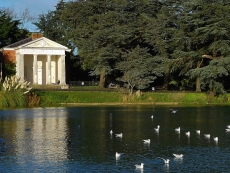
One of the neo-classical structures, The Pantheon (designed by Henry Flitcroft; 1697-1769 – he died in London’s Hampstead), contains a set of 18th century sculptures of Ancient Greek gods and heroes. It also contains a well-preserved Ancient Roman statue, which one of the Hoares bought while travelling in Rome. It was interesting to enter this building because on all our previous visits, it had been locked closed. Another pavilion, smaller than The Pantheon, contains a huge white vase made from Coade Stone (made from clay, quartz, and flint), which was regarded as a ‘wonder’ material by architects and designers in the 18th century. In those days, it was cheaper than most stones and timber. It is named after the businesswoman Eleanor Coade (1733-1821), who was very successful at marketing this material invented by Daniel Pincot. The reason I write about this is that currently there is a small exhibition about Eleanor Coade in the small neo-Classical pavilion that faces The Pantheon across the lake.
Even if you are unable to enter any of the pavilions surrounding the lake, a visit to Stourhead Gardens is a magical experience. Here, nature has been guided into creating the 18th century ideal of a classical landscape. It brings to life the Latin expression ‘Et in Arcadia Ego’, which means something like ‘even in Arcadia, there am I’.
BETWEEN 1983 AND 1994, I owned a house in Gillingham, Kent. It was not an exceptional building, but it had a long back garden – 180 feet in length and about 22 feet wide. Much of the garden was covered with a lawn bordered by plant beds. When I first moved in, I attended the garden keenly even though I had little idea about gardening. As soon as I unearthed weeds, they re-appeared. It was most disheartening. I discovered that planting shrubs was the best way to hide the weeds, about which I soon stopped worrying.
As for the lawn, I acquired a mowing machine, and for some months, or maybe years, I trimmed the grass regularly. Then, I found that whenever I cut the lawn, my nose would start streaming and I would have fits of sneezing. I realised that I had a grass allergy. So, I decided to cease mowing the lawn. I let the grass grow higher and higher. When it reached its greatest height, people sitting in the garden would be hidden by it. At the end of the year, the grass collapsed and more or less disappeared – only to begin growing again the following spring. I let nature take its course, and ceased worrying about it until a deputation consisting of my immediate neighbours came to my house to complain about my unruly lawn and garden. One of them, an elderly lady, was convinced that all the weeds and insects in her garden had come from mine.
One summer evening, I came home after dark and as it was a pleasant evening, I stood in my back garden looking up at the stars. As I did so, I was aware of a slight smell of burning. The following day, one of my neighbours saw me in the street as I was setting off for work. He told me that the neighbour on the other side of the garden had set fire to mine, hoping that the flames would kill the weeds. Luckily, he had spotted the conflagration, and extinguished it before it did too much damage.
Following the neighbours’ complaints, I conceived an idea about how to deal with my lawn. I decided that I would let it grow without interference, but I would mow a narrow sinuous path along its length. The idea was that I could then explain to the neighbours that the wild grass was part of my garden design. Meanwhile, my shrubs increased in size steadily and the weeds flourished. In the warmer months of the year, whenever I strolled in my garden, clouds of butterflies used to billow from the luxuriant vegetation.
Today, in June 2023, whilst walking in Kensington Gardens, I noticed that much of the grass was growing wild – not being mowed. Here and there, the gardeners had trimmed small areas of grass with a lawnmower, much as I used to do back in Gillingham in the 1980s.
To be honest, I let my garden grow wild because I could not be bothered to spend hours of my life making it look neat and tidy. Today, what I was doing – letting the plants ‘do their own thing’ – is known as ‘wilding’. Maybe, unwittingly I was a pioneer of wilding.
I AM ALWAYS WARY of ‘must see’ attractions because I dislike crowds and waiting in queues. So, last year when we visited Madeira, I thought it wise to avoid seeing the famous Botanical Gardens. In any case, most of Madeira’s capital, Funchal, is full of exotic plants and flowers – a veritable botanical garden in itself.
This May (2023), we decided to ‘bite the bullet’, and visit the Botanical Gardens high above Funchal. Getting there and back by local bus was easy. At the entrance to the Gardens, there was hardly any queue for tickets. And despite plenty of large tour buses parked nearby, the Gardens were not at all crowded.
Although I once owned a house with a 180 foot long garden in Gillingham, Kent, I am no gardener, and can hardly name any plant accurately. However, I love visiting gardens. The Botanical Gardens of Funchal are on the slopes of a hillside. All of the plants or groups of them are labelled. There are several terraces from which you can enjoy superb vistas of central Funchal, the sea, and the mountainous countryside.
The Gardens, which were opened to the public in 1960, are on land previously owned by William Reid, the founder of Funchal’s Reids Hotel. A bust in the garden commemorates Rui Vieira (1925-2009), a botanist who contributed much to the development of the botanical Gardens.
The highlight of the Gardens for me was a collection of mostly huge cacti, many of them bursting into flower. Everything else was also worth seeing in this well-kept, beautifully arranged garden. I am very glad that we visited this ‘must-see’ attraction on Madeira.
IN CENTRAL AHMEDABAD, a large city in India’s state of Gujarat, there is a curious café called Lucky. This popular eatery is not unusual because it does not serve coffee but because its tables and chairs are placed between Moslem graves. Lucky’s is sited on an old Moslem graveyard, but this does not put off a steady flow of customers from enjoying a wide variety of vegetarian snacks in this eatery. Closer to home, near the south side of London’s Lambeth Bridge, there is another café sited on a former graveyard. Unlike Lucky in Ahmedabad, which is housed in an architecturally unremarkable building, the café in Lambeth, The Garden Museum Café, is a marvellous example of contemporary architecture.
Café at The Garden Museum in London
The café, completed in 2018, is at the east end of the Church of St Marys, Lambeth, which now serves as the home of The Garden Museum. The church stands next to the main Tudor entrance of Lambeth Palace. The tower was built in about 1378. The rest of the church contains structural elements that were built in later eras. Appropriately for a museum dedicated to gardening history, the repurposed Church of St Mary’s is the burial place of the famous gardener and plant collector, John Tradescant the Elder (c1570s-1638). It is also the final resting place of Captain William Bligh (1754-1817) of The Bounty Mutiny (1789) fame. This famous mariner owned a house in Lambeth. Customers of the café do not sit on the graves of these two well-known persons, but on gravestones that, unlike the graves at Lucky in Ahmedabad which are raised above the ground, are level with the rest of the café’s floor.
The graves at Lucky in Ahmedabad are coffin shaped and probably contain the remains of the deceased. I am not sure whether there are human remains beneath the grave slabs in the floor of the café in Lambeth. A young waiter, whom I asked, was concerned to reassure me that he believed that there are no skeletons beneath the gravestones upon which customers walk and sit. I wonder whether this is really the case.
The Garden Museum was founded in 1977 by Rosemary and John Nicholson in order to preserve the church, which was due for demolition (https://gardenmuseum.org.uk/the-museum/history/). In 2015, the museum was closed for a year and a half whilst it was being redeveloped. Part of the improvements made was the construction of an extension at the eastern end of the retired church. The new construction, designed by Christopher Bradley-Hole and Dan Pearson, includes the café and other structures that together surround a new courtyard that contains a lovely garden, The Sackler Garden designed by Dan Pearson. It contains several tombs including that of the Tradescant family and of Captain Bligh.
The café borders the western side of the courtyard. Its mainly glass walls provide good views of the garden, the buildings across the river and the leafy remains of the churchyard west of the café. Where there is no glass, the walls are covered with overlapping brown coloured metal panels. Serving great coffee and both snacks and meals, the legs of the chairs and tables rest on the gravestones that form part of the floor.
Compared with Lucky, which is in a very busy part of Ahmedabad, the Garden Museum café, although close to a busy main road, is far more peaceful. However, both are delightful places to enjoy refreshments.
THE TINY VILLAGE of Madingley is just under 3 ½ miles west of Kings College Chapel in Cambridge, yet it feels a long way from anywhere. The settlement was recorded as ‘Matingeleia’ in about 1080, as ‘Mading(e)lei’ in the Domesday Book, and ‘Maddingelea’ in 1193. The name means ‘the leah of Mada’s people’, a ‘leah’ being a glade where mowing was done, in other words, a clearing. What became of Mada and his or her people, I have no idea. In 1086, there were 28 peasants in Madingley but by 1279, there were 90 people in the village (www.british-history.ac.uk/vch/cambs/vol9/pp165-166). The population in the 18th century reached about 150 and increased to over 200 in the 19th century. In 2011, there were 210 people living in the civil parish of Madingley (https://en.wikipedia.org/wiki/Madingley). Whenever I have visited the village, where my cousin lives, I have never seen many people out and about.
The earliest record of a church in Madingley was in 1092. Much of the present, attractive church (St Mary Magdalene), which was closed when we last visited, contains structures that date back to the 13th and 14th centuries (www.madingleychurch.org/history/). The building has a square tower topped with a tall steeple. The north side of the exterior of the nave of the church is brickwork made of irregularly shaped and equally irregularly arranged stones and mortar. The south side looks plain because the stonework is covered with plaster rendering. A church official who was passing by while I was taking photographs explained that the rendering, which protects the wall from penetration of rainfall, is probably original and that the church authorities are currently trying to decide whether to cover the north side with rendering.
The church stands next to the entrance to the grounds of Madingley Hall. A long drive climbs sinuously up a slope to the hall, whose construction was begun by Sir John Hynde (died 1550) who acquired the Madingley estate in 1543 (https://historicengland.org.uk/listing/the-list/list-entry/1000627). Hynde, who had studied at Cambridge University, was an important judge. He was called to the Bar at Grays Inn and became Recorder of Cambridge in 1520. In 1539, as a result of the Dissolution of the Monasteries (1536-1541) ordered by King Henry VIII, he was granted the Cambridgeshire estate now known as Anglesey Abbey and in 1542-43, he came to possess lands at Madingley (https://en.wikipedia.org/wiki/John_Hynde). The construction of the Hall was continued by John’s son, Sir Francis Hynde (c1532-1596). In 1756, Sir John Hynde-Cotton, employed Lancelot (‘Capability’) Brown (1716-1783) to landscape the Hall’s grounds. I do not know how much of the landscaping seen today was that created by Brown but the lovely pond at the bottom of the lawns sweeping down from the front of the house looks like one of his typical features. The property remained in the Hynde family until 1858. A descendant of the family, Maria Cotton, married Sir Richard King, who obtained the part of the estate that included the Hall. In 1861, Maria rented the Hall to Queen Victoria for use by the Prince of Wales, the future Edward VII, whilst he studied at Trinity College, Cambridge University. Currently, the Hall is home to the University’s Institute of Continuing Education and has sleeping accommodation both for those attending courses and also for visitors to the area.
In 1871, the Hall was sold to Mr Hurrell and then later to Colonel Walter Harding, who completely renovated the Hall. His heirs sold it to the University of Cambridge in 1948 (www.madingleyhall.co.uk/). Harding’s granddaughter Rosamund gave 30 acres of land on which the American Military Cemetery now stands beside the village of Madingley. The graves in this cemetery, mostly Christian and a few Jewish, are arranged neatly with military precision.
A half-timbered thatched lodge stands by the entrance to the drive next to the church. The former was built in about 1908 by Colonel Harding. The driveway crosses a bridge at one end of the lake or pond. This fake bridge was one of Lancelot Browns landscaping features. Sadly, when we last visited, most of the Hall was covered with scaffolding. Despite that, we were able to admire the mainly 16th century architecture of the building. One particularly interesting feature is the ogival gothic archway that leads into a courtyard behind the original Hall. Decorated with heraldic and other mouldings, this brick and limestone archway was originally part of the Old Schools in Cambridge. Sir John Hynde-Cotton brought the archway to Madingley Hall in 1758. It is worth passing beneath the archway, which bears the date ‘1758’, and entering the walled kitchen garden on the left of it. This area contains a lovely variety of well-tended plants and shrubs.
Tiny Madingley, dwarfed by the Hall and its gardens, has one pub, the Three Horseshoes. It has been in existence since 1765, if not before. Attractively thatched, as is the village hall nearby, the pub we see today was built in 1975, following destruction of an earlier building by fire. I have eaten at the pub once. My impression was that it is a place to which most of its customers drive from elsewhere. It is more of a restaurant than a typical pub. I am curious to know how many of the villagers use it to enjoy a pint or two. On our recent visit in April 2021, the establishment looked sad, being closed on account of the covid19 lockdown.
Peaceful Madingley is home to a private nursery school, housed in a building dated 1844 as well as a discreet complex of University of Cambridge animal behaviour laboratories. Apart from these attractions, there is a disused telephone box that now serves as a library where anyone can take books for free so long as they replace them with others. It is a pity that there is no village shop, often a focus of village life, but given the small population of the place, maybe its absence is not surprising.
Little Madingley is now a suburb of Cambridge yet it has not merged with the city physically. It remains at heart a picturesque and charming example of ‘village England’ – a place to take refuge from the stresses and strains of modern life.
EVERY VISIT TO GOLDERS Hill Park in northwest London gives me great pleasure. Now officially part of Hampstead Heath, it contains a lovely feature, its small zoo. This consists of a large paddock containing deer and sometimes a rhea. Close to this, is a series of cages, an aviary, containing exotic birdlife including a laughing kookaburra. These are located next to an enclosure that contains a small group of ring-tailed lemurs. The lemurs’ neighbours are several wallabies and a couple of donkeys, named Sienna and Calypso. The wallabies and the donkeys have a long rectangular sloping field in which to wander.
I have written about the park and the zoo before, and published it elsewhere (https://adam-yamey-writes.com/2020/11/19/walking-past-wallabies/). When I wrote that piece, I did not explore the small zoo’s history. It was certainly present well over 60 years ago, when I was less than ten years old. As a small boy, I remember seeing wallabies and flamingos. More recently, the flamingos have disappeared and have been replaced by ibis and various other exotic fowl. Before my time, the flamingos used to reside in the duck pond next to the park’s walled garden (https://londongardenstrust.org/conservation/inventory/site-record/?ID=BAR027).
The zoo’s history is difficult to ascertain. After searching the Google entries relating to the park and its history, I found only one reference that alludes to the presence of the zoo prior to WW2. This consists of a recording of an interview (https://sounds.bl.uk/Oral-history/Science/021M-C1379X0029XX-0001V0) with the scientist Sir Anthony Seymour Laughton (1927-2019), an oceanographer. Laughton was born in Golders Green, began his education in Hampstead at Heysham School, a ‘dame school’ (private elementary school) in Branch Hill, and moved to Gerrards Cross during WW2 (https://royalsocietypublishing.org/doi/10.1098/rsbm.2020.0021). As a young child, Laughton lived in one of the small roads that lead of North End Road and back on to Golders Hill Park. He and his brother were often taken to Golders Hill Park where he remembered that there was a small zoo with wallabies. This would have been before 1939, when he and his family moved out of London. So, we can conclude that the zoo was in existence before WW2.
According to Pam Fox, author of “The Jewish Community of Golders Green”, Golders Hill Park was popular with local Jewish families, who went:
“Golders Hill Park on Sundays to watch the peacocks strutting around the grounds of Golders Hill House.”
The House was destroyed in 1941. Laughton did not mention these in his interview and, sadly, there are none to be seen today.
To discover whether the little zoo existed before Laughton’s childhood, that is prior to 1927, I looked at a detailed map, surveyed in 1912. This was after the park was opened to the public by the London County Council in 1899, making it the first public park to have been opened in what was then the Borough of Hendon (now incorporated into the Borough of Barnet). I compared what was on that map with what is on modern maps and found that the park’s layout has not changed much since 1912. The bandstand that you can see today is where there was one back in 1912. Where there is the deer enclosure today, there was a similarly shaped and located fenced field in 1912. The same is the case for the long narrow field where you can see the wallabies and donkeys today. The 1912 map does not show any buildings where the aviary is located today, but apart from that the pattern of land enclosures in the part of the park where animals and birds are kept enclosed today is remarkably similar. The question is, and I cannot answer it, was what is now a deer enclosure, then a deer or other animal enclosure? Here is another as yet unanswerable question: did the long rectangular field where the wallabies live today enclose animals for viewing by the public as long ag as in 1912?
Prior to becoming a public park, Golders Hill Park was the gardens of the now long-since demolished Golders Hill House, built in the 1760s for the merchant Charles Dingley (1711-1769), who traded with Russia (www.leeandstort.co.uk/Stort%20History/Charles%20DINGLEY%20Biography.pdf). I have not found any references to any collections of birds and animals in Golders Hill Park prior to the childhood of Laughton, the oceanographer. It is possible that the merchant Charles Dingley or later owners of the property might have kept deer and even exotic creatures, but there is no evidence to confirm or deny this.
What is important, is that the little zoo, which I remember from the 1950s, is still thriving today and providing enjoyment for children of all ages. Whether the various creatures ‘enjoy’ being caged-up and gawped at is a question I cannot begin to answer.
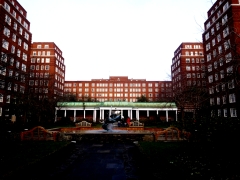
I HAVE NEVER VISITED MOSCOW, but I imagine that the huge, rather forbidding looking apartment block on Grosvenor Road facing the River Thames, would not look out of place in the Russian city. Covering seven and a half acres of land, built with twelve million bricks and almost seven thousand external window units, and containing at least twelve hundred flats, this mammoth building complex, which has been home to many of the famous and infamous, was completed in late 1936. This enormous residential complex is called Dolphin Square.
Maps surveyed in 1869 and 1913 reveal that the land on which Dolphin Square was built, which is west of St Georges Square, used to be the site of the several long buildings that together made up the Royal Army Clothing Department and its storage depots. Before that, the land was occupied by the work premises of the developer and builder Thomas Cubitt (1788-1855), who built much of Belgravia and Pimlico. A few years after his death, the army leased the site and the depot stood there until 1933, when the lease reverted to the Duke of Westminster (https://en.wikipedia.org/wiki/Royal_Army_Clothing_Depot).
An American firm, Fred F French Companies, bought the freehold of the former army clothing compound, and then, discovering it had insufficient funds to develop it, sold it on to Richard Costain Ltd. Costain commissioned the architect Stanley Gordon Jeeves (1888-1964), whose other works include the now demolished Earls Court Exhibition Centre and the still standing large, art-deco Latimer Court at Hammersmith, to design the residential complex that exists today. Writing soon after it opened, the writer AP Herbert (1890-1971) wrote a book extolling the virtues of Dolphin Square. He wrote that it is:
“…a city of 1,250 flats, each enjoying at the same time most of the advantages of the separate house and the big communal dwelling place …”
Commenting on the fact that the complex included a restaurant, he wrote:
“…fortunate wives will not have enough to do. A little drudgery is good for wives, perhaps. The Dolphin lady may be spoiled.” (quotes from www.theundergroundmap.com/article.html?id=2792)
From outside the building, Dolphin Square looks monolithic and forbidding. However, on entering the huge courtyard within it, this impression changes. For, the courtyard contains a lovely garden, which was designed by Robert Sudell in about 1937 (https://historicengland.org.uk/listing/the-list/list-entry/1455668). Though much modified since then, the formal garden retains much of the original design concept including an axial avenue lined with chestnut trees. Appropriately, the middle of the garden is adorned with a fountain with three sculpted dolphins. Created by the sculptor James Butler (born 1931), this was placed in 1987 to replace an earlier fountain. This pleasant garden would be one good reason to entice me to live in this extraordinarily massive complex.
As mentioned already, Dolphin Square offers its residents a restaurant. It also contains an arcade of shops, a café, a gymnasium, a swimming pool, a laundrette, underground parking, a bar, a brasserie, a hotel, a tennis court, and more. And all of this is within a short walk of Westminster and the Houses of Parliament. This proximity to the centre of government means that many MPs have made use of Dolphin Square as their London ‘pads’.
Apart from politicians, including Harold Wilson, William Hague, David Steele, and many others, Dolphin Square has been home to people of fame and notoriety. According to an article in Wikipedia, some of these include Oswald Mosley and his wife Diana Mitford; the novelist Radclyffe Hall; Christine Keeler and Mandy Rice-Davies; the comedian Bud Flanagan; the spy John Vassall; and the tennis player Rod Laver. Princess Anne lived in Dolphin Square briefly in 1993, General de Gaulle based his Free French Government in part of the Square in WW2, and Sarah, daughter of Sir Winston Churchill, was:
It seems that a fascinating book about the residents of Dolphin Square is waiting to be written.
I had passed Dolphin Square plenty of times before entering its garden recently, but until now I had no idea that this far from attractive building was home to such a fascinating range of people nor that it contained such a fine garden. Just as one should not judge a book by its cover, it is a mistake to judge Dolphin Square from its exterior.
ELEGANT BELGRAVE SQUARE is but a stone’s throw from Hyde Park Corner. Many of its neo-classical buildings are home to diplomatic missions and their staff. As with many London squares, the centre of Belgrave Square contains a private garden. That at Belgrave Square is adorned with sculptures, mostly statues of eminent people. At each of its four corners, there is one. The people depicted at these four positions are Prince Henry the Navigator (1394-1460); Christopher Columbus (1451-1506); Simon Bolivar (1783-1830), the liberator of Venezuela, Bolivia, Colombia, Ecuador, Peru, and Panama; and José San Martin (1778-1850), liberator of Argentina, Chile, and Peru. Almost facing San Martin on the north east corner of the square is a statue of Sir Robert Grosvenor, First Marquess of Westminster (1767-1845), upon whose estate Belgrave Square was built.
Elias George Basevi
On the eastern side of the square, close to the statue of Simon Bolivar and within the garden, there is a sculpture by Enzo Plazzotta (1921-1981), which was completed after his death by Mark Holloway. It is called “Homage to Leonardo. The Vitruvian Man”.
Interesting as all the above-mentioned are, the sculpture that intrigued me most is a bust of Elias George Basevi (1794-1845), who is described on his plinth as ‘architect’. I guessed that he was likely to have been involved in the design of Belgrave Square, and I was right. According to a plaque on the base of Grosvenor’s statue, he designed the neo-classical terraces surrounding the square for the Haldimand Syndicate, which was under the control of the brothers George (1781-1851) and William (1784-1862) Haldimand, of Swiss origin, sons of a banker born in Switzerland and an English mother. In 1825, William, a Member of Parliament:
“… negotiated successfully with the 2nd Earl Grosvenor, Seth Smith and William Cubitt for a 99-year lease on Belgrave Square, where he had 49 houses built: 16 to be owned by George Haldimand, 14 by himself, eight by Prevost, four by Smith and three by Cubitt…” (www.historyofparliamentonline.org/volume/1820-1832/member/haldimand-william-1784-1862)
The Haldimands were related to Frederick Haldimand (1718-1791), who became Governor of Quebec in 1777. Thomas Cubitt (1788-1855), who was involved in creating the square, was a major Victorian property developer.
As for Basevi, at first, I thought that his surname sounded Italian. His family might have come from that country as its origins were Sephardic Jewish. The Basevi surname is particularly associated with Sephardic Jews in Verona (https://judaism_enc.enacademic.com/2089/BASEVI). His father, Joshua, usually known as ‘George’, was a London City merchant (www.jewishencyclopedia.com/articles/2616-basevi-george-joshua). Elias George’s aunt, George’s sister Maria (née Basevi), was married to Isaac D’Israeli, whose son was Benjamin Disraeli, Earl of Beaconsfield (1804-1881), who was Prime Minister between 1874 and 1880. In 1810, Elias became a pupil of the great architect John Soane (1753-1837), who specialised in creating in the neo-classical style. According to the Dictionary of National Biography (‘DNB’) (https://doi.org/10.1093/ref:odnb/1615), from which I have gleaned much information about Elias, he:
“… also studied at the Royal Academy Schools, where Soane had recently been appointed professor of architecture. In 1815 he visited Paris with his brother, and on completion of his architectural training in 1816 he embarked on a three-year study tour of Italy and Greece, staying the longest in Rome and Athens, but also travelling extensively elsewhere in Italy and even visiting Constantinople.”
Regarding Belgrave Square, the DNB relates:
“Basevi designed and handled the construction of the terraced houses making up the four sides of the square (1825–40), though not the four detached villas at the corners. He treated the stuccoed terraces of eleven or twelve houses on each side as single palatial façades, giving each a central columnar portico and end pavilions in a similar manner to John Nash’s terraces in Regent’s Park … The financial success of this speculative development during an economically depressed period was due in large part to Basevi’s precise and scholarly attention to detail, not just in the design of the individual houses but also in the paving, street furniture, and composition of the square as a whole.”
Elias Basevi’s other projects included, to give just a few examples, St Thomas, Stockport, Cheshire (1822–5); work at several country houses; a building at Balliol College Oxford; Beechwood House and The Elms in Highgate; and the Fitzwilliam Museum in Cambridge, whose construction was completed after his death. Beechwood House was built for the architect’s brother Nathaniel, a barrister, in 1840, who was married to a niece of Sir Robert Peel (1788-1850).
Noticing Basevi’s buildings in Highgate, I looked at John Lloyd’s “History, Topography, and Antiquities of Highgate”, published in 1888, and discovered more about Basevi. He wrote that the Basevi family had been prominent in the Anglo-Jewish community. One member of the family, Napthali, the grandfather of Benjamin Disraeli’s mother, was an early President of The Jewish Board of Deputies, which was involved in the struggle for the emancipation of the Jews. The Basevis moved away from the Jewish faith as did their kinsmen the Disraelis.
Elias Basevi married Frances Agneta Biscoe. They produced eight children, one of whom was given the name James Palladio Basevi (1832-1871), who became an officer in the Royal Engineers.
On a personal note, I attended Highgate School between 1965 and 1970. Some years later, I acquired a copy of the “Highgate School Register 1833-1988”. Today, I looked up ‘Basevi’ in the index of pupils and discovered that in March 1840, James Palladio Basevi joined the school. This son of the architect joined the school two years after the Reverend John Bradley Dyne (1809-1898) had become headmaster. Dyne was to raise the school’s reputation considerably. Other Basevi family members attended the school were William Augustus Basevi (joined January 1841), George Henry Basevi (joined January 1842) Frederick Biscoe Basevi (joined April 1844), Charles Edward Basevi (joined June 1844). All of these fellows were sons of the architect of Belgrave Square. Why they went to Highgate School is a bit of a mystery. Part of the reason might have been that their uncle, Nathaniel, had his home at Beechwood, a short walk from the school. however, their father, the architect lived in central London. The historian Alan Palmer, who used to teach at the school, wrote that out of the 43 graduates of Dyne’s first ten years, only 16 came from homes near the school. His reputation as a headmaster was already excellent by the time that the first of the architect’s sons entered the school, which attracted boarders.
Elias, who became a Member of the Royal Institute of British Architects, and a Fellow of both the Society of Antiquaries and the Royal Society, ended his life in a frightening way. The DNB relates his tragic ending:
“He died on 16 October 1845, aged fifty-one, after falling through an opening in the floor of the old bell chamber of the west tower of Ely Cathedral while inspecting repairs. His remains were buried in Bishop Alcock’s chapel at the east end of the cathedral.”
The bust of Elias George Basevi is smaller than the other commemorative sculpture placed in and around Belgrave Square and easy to miss if you are walking around the square. I only noticed it because I was watching two people walking with their dogs within the square’s private garden. Had I not seen the bust, I might have never explored the life of this man whose family had connections with Highgate, where I attended secondary school.
MUCH OF GREATER LONDON is green space, which has not been built on. According to one source of information, Greenspace Information for Greater London CIC (‘GiGL’; http://www.gigl.org.uk):
“Roughly 47% of Greater London is ‘green’; 33% of London is natural habitats within open space according to surveyed habitat information and an additional 14% is estimated to be vegetated private, domestic garden land.”
Of this ‘green space’, much is accessible to the public either free of charge (e.g. Regents Park) or for a fee (e.g. Kew Gardens). This piece is about an example of a type of green space in London that is open to a select few. I am referring to many of the gardens in London squares that are or were surrounded by residential buildings. Some of these (e.g. Gordon Square in Bloomsbury) have been taken over by local councils and are now open to the public in general. However, many of these garden squares contain gardens that may only be entered by people who are eligible to be able to pay a fee for a key to unlock them. Some of the squares confine those eligible for keys to residents in the square or in neighbouring streets. I know of one privately owned garden, that within Princes Square near Bayswater, which is open to anyone who can afford the annual fee. This square garden, being privately owned, is dependent for membership fees to ensure its maintenance. Those eligible to use the gardens within squares, whether privately or partially privately maintained, can be expected to pay something towards the maintenance of these often-beautiful local amenities.
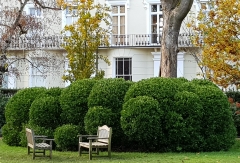
Recently, a friend admitted us to the garden of Norland Square in Kensington. Like many of these limited access gardens, it is surrounded by formidable cast-iron railings. These railings were removed during the Second World War when metals required for war materials were in short supply. They were only replaced in 2007. Like most of these squares, the passer-by cannot see much within the garden beyond the railings because of hedges and other vegetation grown just within them to preserve the privacy of those using the garden. So, being allowed to enter Norland Square provided us a rare opportunity to examine the interior of one of these ‘secret’ gardens.
Norland Square takes its name from the Norland Estate, 52 acres of land bounded to the south by Holland Park Avenue, on the east by roads now named ‘Pottery Lane’ and ‘Portland Road’, on the west by the boundaries of the parishes of Kensington and Hammersmith (www.british-history.ac.uk/survey-london/vol37/pp276-297). The northern edge of the estate was roughly 200 yards north of the present Wilsham Street. The estate passed through several owners in the 18th century. They lived in a mansion, demolished long ago, which used to stand close to the present number 130 Holland Park Avenue. The name ‘Norland’ was used as early as 1599 to describe the ‘Northlands’, the land in the northern part of the Parish of Kensington (north of the present Holland Park Avenue), which includes the estate (www.rbkc.gov.uk/sites/default/files/atoms/files/Norland%20CAPS.pdf).
Writing in 1878, Edward Walford, author of a series of books called “Old and New London”, noted that during the reign of William IV, the then well-wooded estate belonged to one of the Drummonds, a family of bankers of Charing Cross. Prior to these occupants, the first to live in the former Norland House was Thomas Marquois (died 1802), ‘Professor of Artillery and Fortification’, who used the building as an academy to teach both civil and military subjects to sons of the gentry, who were hoping to join the British Army. According to the website about the Norland Estate mentioned above:
“Board and lodging, plus instruction in Greek, Latin, French, writing and arithmetic could be had for thirty guineas a year, but fortification, mathematics, navigation, drawing, geography, dancing, fencing and riding were all charged as extras. Marquois’ prospectus contains a plan of the academy and its grounds, which were indeed very well suited to his purposes. Besides the house itself there were stables, a manege or riding house, a fives court, a cricket ground, gravelled drives for hack riding, and an artificial ‘mount’ from which the various activities of the pupils could be kept under constant review.”
Marquois relinquished the property after only four years in 1765.
In 1825, fire destroyed Norland House. In 1838, Benjamin Lewis Vulliamy (1780-1854), clockmaker to the Crown, who then owned the Norland Estate, sold it and the ruins of the mansion to a solicitor Charles Richardson, who raised money to develop the estate for building purposes. The layout and design of the southern part of the estate, including Norland Square, was carried out by the architect Robert Cantwell (c1793-1859). The houses on Norland Square were leased to their first occupiers by Charles Richardson in 1842 and 1843.
Except for Norland Square Mansions on the south-west corner of the square, which has a few features slightly suggestive of art-deco style, the other houses surrounding the square are those built in the early 1840s. The mansion block occupies numbers 53 to 57 Norland Square. Interestingly, these plots do not figure in a list of the original lessees of the other plots in the square. Number 52, which neighbours the mansion block was leased to Robert Cantwell in 1842. A detailed map surveyed in 1865 shows that where Norland Square Mansions stands today, there were no houses but instead a garden extending between number 52 and a house, now no longer standing, on the corner of the square and Holland Park Avenue (then named ‘Uxbridge Road’). On a map dated 1913, the position of the mansion block was occupied by a school. This same building, which has a different ground plan to the current block of flats was still present on a detailed map surveyed in 1938. So, it would be reasonable to say that the mansion block was built after 1938.
Getting back to the present, we found that the ‘secret garden’ in the centre of Norland Square is both attractive and well-maintained. In addition to an extensive lawn furnished with occasional wooden benches and a table, there are plenty of shrubs and trees. There is a small well-equipped children’s play area at one end of the garden and tennis courts at the opposite end. While we spent time in the garden, a couple of elderly women were taking their daily walk around it and a young lady was exercising her dog. Areas like this are invaluable during periods of ‘lockdown’ during the current covid19 pandemic, offering lucky city-dwellers a welcome respite from being ‘confined to barracks’ and if they are fortunate to have a garden, they provide a much larger open space to ‘take the air’ than their own smaller patches. We were both grateful and happy to have been able to see and experience what is usually hidden from us by iron railings and curtains of dense vegetation.
DRIVING ALONG THE NORTH Circular Road, I noticed a long wall over the top of which I could see what looked like the pinnacles of a Gothic revival garden folly. We were driving past Gunnersbury Park in West London and did not have time to stop. So, the next day, we drove back to the park and spent some time exploring it. What we found was a fascinating estate consisting of beautiful park land and a series of architectural delights. This is hardly far from where we live, but it was the first time that we had visited it. Had I not noticed what I did when on the North Circular Road, I am not sure that we would not have considered making a trip to find out what lies behind the wall next to which queues of slow moving traffic can often be seen.
The first impression one gets on entering Gunnersbury Park with its wealth of trees including many Cedars of Lebanon is that you are inside the grounds of a great house such as you can find at, for example, Ham House and Osterley Park. That impression is justified because Gunnersbury Park is basically what is left of the grounds of a mansion built in the Palladian style for the lawyer and politician Sir John Maynard (1604-1690) between 1658 and 1663. It was designed by the architect John Webb (1611-1672). Maynard died at Gunnersbury Park.
Between 1762 and 1786, Gunnersbury Park was used as a summer residence by Princess Amelia (1711-1786), who was King George III’s aunt (https://historicengland.org.uk/listing/the-list/list-entry/1000808). In 1761, she had bought the estate from George Furness (after 1688-1756). His father had been a ‘factor’ in the East India Company. George was a British merchant and politician as well as being an art collector. He was a Member of Parliament between 1720 and 1756 and had bought the property in 1739 from John Hobart (1693-1756), 1st Earl of Buckinghamshire, a British politician. Furness improved the grounds by employing the famous gardener William Kent (1685-1748). I am not sure how much of his original design has survived the passage of time.
Princess Amelia, the second daughter of King George II, did much to improve the grounds, by landscaping, arranging planting, and by adding ornamental buildings, which still add to the charm of the place. These buildings include the bath house and a neo-classical temple, which overlooks a circular pond.
The princess held fabulous parties at Gunnersbury. In “Handbook to The Environs of London” by James Thorne, which was published in 1876, the politician and intellectual Horace Walpole (1717-1797), author of the Gothick novel “The Castle of Otranto”, who attended some of these parties, is quoted thus:
“Ever since the late king’s death, I have made Princess Amelia’s parties once or twice a week … I was sent for again to dine at Gunnersbury on Friday, and forced to send to town for a dress-coat and a sword. There were the Prince of Wales, the Prince of Mecklenburg, the Duke of Portland, Lord Clanbrassil … The Princess, Lady Barrymore, and the rest of us, played three pools at Commerce till ten … While we were at the Dairy, the Princess insisted on my making some verses on Gunnersbury. I pleaded being superannuated. She would not excuse me. I promised she should have an Ode on her next birthday, which diverted the Prince; but all would not do.”
The next morning, Walpole composed three verses for the Princess. One of them (quoted in a letter from Walpole to HS Conway dated 18th of June 1786) reads as follows:
“Oh! Why is Flaccus not alive,
Your favourite scene to sing?
To Gunnersbury’s charms could give
His lyre immortal spring.”
Walpole admitted in his letter to Conway that his poem was not one of his best. He wrote:
“If they are but poor verses, consider I am sixty-nine, and was half asleep, and made them ex-tempore – and by command!”
Following the death of the Princess, the Palladian mansion was demolished in 1801. Its contents were sold by auction and the 205 acres of its grounds were divided into lots and sold at the same time. Most of their area was bought by Alexander Copland (1774-1834), who built a new house, which forms the basis for the present building, which now houses a museum, which is currently closed because of the covid19 pandemic. Copland, a builder and business partner of the architect Henry Holland (1745-1806), was a son of Alexander Copland and his wife Barbara (née Smirke). The Alexander, who bought Gunnersbury was a cousin of the architect Robert Smirke (1780-1867), whose brother, also an architect, Sydney Smirke (1797-1877) designed the Orangery, which was built at Gunnersbury Park in 1836, and has been restored beautifully.
Copland built The Large Mansion (now the museum). Either Stephen Cosser or Major Alexander Morrison, a retired East India Company officer who bought the plot from him, built the so-called ‘Small Mansion’ to the east of the Large Mansion, which is currently in a poor state of repair. A gardener explained to us that it was supposed to be cared for by one London borough whereas the Large Mansion was under the care of another. In 1828, the part of the estate with the Small Mansion was bought by Thomas Farmer, who lived there as Copland’s neighbour until 1835.
In 1835, Copland’s Large Mansion was bought by the banker Nathan Mayer Rothschild (1777-1836). After his death a year later, his widow Hannah (née Barent-Cohen; 1783-1850) used Gunnersbury Park as her second home and employed the architect Sidney Smirke to make alterations to it (https://family.rothschildarchive.org/estates/37-gunnersbury). Following Hannah’s death, her oldest son Lionel Rothschild (1808-1879), the first ever practising Jew to become a Member of Parliament, took over the property and enlarged its park as well as improving the house’s facilities. After his death and that of his widow Charlotte, the estate moved into the possession of their youngest son Leopold de Rothschild (1845-1917).
In 1889, Leopold purchased the Small Mansion and thereby reunited the two parts of the original Gunnersbury estate. Under the ownership of the Rothschild family, many improvements were made to the grounds, some of which I will mention soon. After Leopold died in 1917, the estate was broken up and parts were sold off. In 1925, both mansions and about 185 acres of attached grounds were purchased for public use by the then Boroughs of Acton and Ealing. Now, the park and its mansions are maintained by the boroughs of Ealing and Hounslow.
The Large Mansion is elegant but not as attractive as the one which was demolished long ago and can be seen in old drawings. Nearby, the temple that overlooks a pond is delightful and reminded me of some of the garden architecture at Stourhead (in Wiltshire). Wandering around the garden, you will come across the Gothic revival architectural features I saw when driving past Gunnersbury Park on the North Circular Road. These are built around ‘Princess Amelia’s Bath House’, a garden folly built in the 1780s. Not far from this, there are very picturesque ‘Gothick’ ruins near to the estate’s farm buildings. These might be the remains of the dairy mentioned above in the quote from Horace Walpole or possibly later additions to the grounds constructed by an owner who bought the Princess’s estate. One source (https://brentfordandchiswicklhs.org.uk/publications/the-journal/journal-10-2000/princess-amelias-bath-house/) suggests that what is now called the ‘Bath House’ might have been the dairy in Amelia’s time at Gunnersbury. Whatever its history, lovers of romantic Gothic revival ruins will get great pleasure from what can be seen at Gunnersbury Park.
The Orangery stands next to a large pond. This structure was built whilst the Rothschilds owned the estate. It was constructed in 1836, designed by Sidney Smirke. The family were responsible for another water feature on their estate. It has a name that intrigued us: the Potomac Pond. This almost circular water body is surrounded by a fence and almost hidden by the trees and other vegetation growing around its perimeter. It is only accessible to members of a local angling club. The Rothschilds had purchased a former clay pit and converted it into the pond. One of the claypit’s kilns was rebuilt to create a Gothic revival tower on its shore. This lovely folly, which would look at home in a painting by the German Caspar David Friedrich (1774-1840), might have once been used as a boathouse.
I have described a few of the features that make it well worthwhile to visit Gunnersbury Park, whose history is not exactly simple. The place is so near to London and the M4 motorway, yet it feels so far away. If it were not the background roar of the traffic and the low flying aeroplanes descending towards Heathrow Airport, fewer than usual these days, it would be hard to believe you were not deep in the countryside.





 yamey
yamey 