THERE IS A PUB in London’s West End called “The Cock and Lion”. It is located in Wigmore Street and was established in 1786. Its sign is a large golden lion with a tiny golden cock standing on its back. I wonder what this signifies.
Is the lion Great Britain and the cock France? If this is the case, why is the emblem of the once traditional enemy and rival of England perched on the back of an emblem of Britain? Does anyone know the meaning of this combination of bird and beast?
WE USED TO make long trips by car in France. Amongst the many sights we visited were various Cistercian abbeys, such as those at Citeaux and Clairvaux. Later, during trips to Wales, we often visited the ruins of the Cistercian Abbeys at Strata Florida and at Tintern on the River Wye. I do not know what drew us to these Cistercian places, but we went out of our way to see them. So, when we were staying near Warrington in Lancashire and I noticed that we were not far from yet another Cistercian site, we made a bee line for it. Overlooking the River Dee, the ruins of Basingwerk Abbey are located near the town of Flint in the county of Flint.
Though not as extensive as the ruins at Tintern, there is plenty to see at Basingwerk. Dedicated to the Virgin Mary, the abbey was founded in 1132 by Ranulf de Gernon, 4th Earl of Chester. Being on the border between England and Wales:
“Basingwerk was patronised by both the Welsh and Anglo-Norman nobility. Royal benefactors included Henry II, Prince Llywelyn ab Iorwerth (d. 1240), Prince Dafydd ap Llywelyn (d. 1246) and Edward I.” (https://www.monasticwales.org/browsedb.php?func=showsite&siteID=24).
Originally founded as part of the Order of Savigny, it joined the Cistercian Order in 1147. In about 1355, it was reported that the abbey was in a devastated condition. During the early 15th century, Basingwerk tried to encourage pilgrims to visit its shrine, hoping that this would raise funds to repair the place. Between 1481 and 1522, Abbot Thomas Pennant restored the abbey and improved its fortunes. Sadly, by 1537, the institution had been suppressed by order of King Henry VIII. In 1540, the site of the former monastery was sold. After changing hands a couple of times, it became the property of the Mostyns of Talacre.
In 1923, the ruins of the abbey were taken over by the government, and now they are well-maintained by CADW – the historic environment service of the Welsh Government. Despite the appallingly bad weather prevailing when we visited the remains of the Cistercian abbey, we were able to enjoy wandering around the ruins. To recover from the inclement conditions, we took refreshments in the nearby café/restaurant in Basingwerk House.
The town of Eye in Suffolk is twinned with Pouzauges in France. There is a French milestone from the region of France is in the centre of Eye.
Seeing this reminded me of the three months that I attended the University of Chicago Laboratory School in Chicago in late 1963. Every morning before classes began, we used to play a card game called “Mille Bornes” (i.e., ‘1000 milestones’). The game was vaguely educational in that it taught the players a few words of French. We were all obsessed with playing it. When I left the school to return to England, the class clubbed together and bought me a set of “Mille Borne” cards as a farewell gift. although my fellow students at the Lab School were about two years older than me, they made me feel very welcome and were extremely friendly towards me. The same was the case for my class teacher, Ms Alice Flickinger, and the sports teacher, Mr Patlak.
A COLOURFUL FABRIC artwork, a tapestry, by the artist Sonia Delaunay (1885-1979) hangs on a wall overlooking the grand staircase at the Institut français (‘IF’) in London’s South Kensington. Born in Odessa (Russian Empire) as Sarah Elievna Shtern, she spent most of her working life in Paris (France) after having studied art in both Russia and Germany.
Sonia Delaunay at Institut Francais in London
The stairs lead from the ground floor to the first. It is at this level that the IF’s main and biggest cinema, the Ciné Lumière 1, is located. This airy cinema has rows of comfortable seats each with enough legroom to satisfy even the tallest person. We had come (on the 3rd of September 2022) to watch a Spanish film called “Official Competition”, starring amongst others Penelope Cruz. Frankly, I found this much-hyped film dull, disappointing, and somewhat puerile. The plot revolves around filmmaking and competing egos. The audience is treated to too much philosophising (actually, navel contemplating) about acting and moviemaking, the content of which would be considered almost infantile by high school children. However, the cinema’s comfortable seating made watching the film almost bearable. In the past, we have seen far better films at the Lumière, to which we will return to see other films in the future.
Apart from the poor film, the visit to the IF was fun. It was great seeing the Delaunay and we enjoyed cool drinks in the pleasant Café Tangerine on the ground floor.
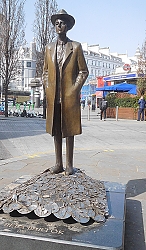
With his back to the former entrance to the Piccadilly line station at South Kensington and standing at the corner of Pelham Street and Old Brompton Road, is a sculpture depicting the Hungarian composer Béla Bartók (1881-1945). He visited Britain at least sixteen times, often staying in London. To save money, he stayed with his friend the diplomat Sir Duncan Wilson at least twelve times between 1922 and 1937. Wilson owned a house (designed by Basevi) in South Kensington, number 7 Sydney Place, which is just south of Onslow Square. The sculpture, depicting the composer standing on what looks like a pile of fallen leaves, was created by Imre Varga (1923-2019) and unveiled on a traffic island in 2004. This, Varga’s fourth sculpture of the composer, was moved to its present location in 2011.
Bartok statue in South Kensington
Moving northwards, possibly passing the residential Onslow Squares, we reach Queensbury Place, which connects Harrington Road with the section of Cromwell Road that runs past the Natural History Museum. A 20th century brick and concrete building on Harrington Road is home to part of a French school, the Lycée Français Charles de Gaulle de Londres. This educational institution for both French- and English-speaking children was created in 1915. After several changes of location, it moved into a building facing the Natural History Museum on Cromwell Road in about 1958. In 1980. the school was named after Charles de Gaulle.
At the east corner of Harrington Road and Queensbury Place, there is a French library. The southern half of the east side of Queensbury Place is occupied by the French Institute, whose building has an imaginatively decorated brickwork façade. This building houses cultural facilities including a library and an auditorium, which hosts the Ciné Lumière. There is also a café. It was designed by Patrice Bonnet (1879-1964) in the Art Deco style and ready for use in 1939. The edifice contains artworks by Sonia Delaunay and Auguste Rodin.
Facing the French Institute is number 16 Queensbury Place, home of The College of Psychic Studies. Founded in 1884, this organisation does the following (according to its website http://www.collegeofpsychicstudies.co.uk):
“The College of Psychic Studies offers courses, workshops and talks on all aspects of healing, self-development, spirituality, and psychic and mediumship training.”
The College moved into its current premises in 1925. A plaque attached to its building commemorates the creator of Sherlock Holmes, Arthur Conan Doyle (1859-1930). Apart from being a prolific author, he was President of the College from 1926 until 1930. The College’s website reveals much about his interest in spiritualism. He:
“… published his two volume History of Spiritualism and his novel, The Land of Mist, while he was the College’s President … [he] was tireless in helping the bereaved and spreading the word of spiritualism including urging people to join the Alliance and read the latest news in Light.”
Unlike Sherlock Holmes’s fictional address in Baker Street, this townhouse in South Kensington has a real connection with Holmes, at least with his creator.
RECENTLY, I WALKED in Mahatma Gandhi’s footsteps, neither in India nor in South Africa nor in London, but in southeast England.
I am sure that many years ago, at least once, I travelled by ferry across the English Channel from Folkestone in Kent to a port in France. Whether I was travelling by car or by train I cannot recall. Had I been travelling by rail I feel sure that I would have remembered the pier at Folkestone, but I cannot now recall it. If I reached the ferry by train, it would have had to have been before 2001, when the last ferry sailed from Folkestone.
The first ferry service from Folkestone to Boulogne began in 1843 (https://folkestoneharbourarm.co.uk/history/the-harbour-in-the-19th-century/). Passengers reached the boat from the mainline railway station by local transport. In 1847, a long viaduct was constructed to take a steeply inclined mile long branch line from the main line, which was 111 feet above sea level, to the shoreline. This track crossed the viaduct and a swing bridge, which still exist and separate the Inner harbour from the Outer Harbour. At the seashore, the track ran onto a newly constructed pier, The Harbour Arm, from which passengers and freight could be embarked and disembarked. The pier, which was only fully completed in 1904, had a station, a customs house, and warehousing facilities.
During WW1, the Harbour Arm played an important role in the conveyance of military personnel and materials between war-torn Europe and the UK. In December 1915, the famous spy Margaretha Geertruida Zelle (‘Mata Hari’; 1876-1917) was prevented from boarding a vessel at Folestone bound for France by Captain S Dillon of the Secret Intelligence Service. Another famous person, of far greater historical significance than Mata Hari, stepped of a vessel, the SS Biarritz, onto the Harbour Arm on the 12th of September 1931. This passenger was a Gujarati, the only member of the Indian National Congress, Mohandas K Gandhi (1869-1948), going to London to attend the Round Table Conference. A picture taken at the time (www.alamy.com/mahatma-gandhi-alighting-at-folkestone-kent-england-united-kingdom-uk-12-september-1931-old-vintage-1900s-picture-image346793736.html) shows him, dressed in white robes and a dhoti, stepping along a gangplank. The curved platform of the station on the pier, which still exists, is clearly visible in the picture. He is shown walking towards a group of policemen and reporters, some of whom are holding unfurled umbrellas. His arrival at Folkestone on a rainy day is also recorded in a short but amusingly commentated newsreel film (https://youtu.be/P6njRwz_dMw), which also illustrates the rapturous reception he received in the streets of London.
Far more recently, another arrival at Folkestone has hit the headlines. On the 19th of October 2021, a large puppet called Little Amal (‘amal’ meaning ‘hope’ in Arabic), over ten feet in height, first made its appearance in the UK in Folkestone. Little Amal has been carried on foot all the way across Europe from Turkey (www.creativefolkestone.org.uk/whats-on/the-walk-one-little-girl-one-big-hope/) as part of an exercise to raise the public awareness of the plights of refugee children fleeing their native lands. On British soil, she plans to tour the country for a while. Little Amal did not arrive, as Gandhi did, on a cross-channel ferry bound for Folkestone, but she did make her first an appearance on the Harbour Arm (www.kentonline.co.uk/folkestone/news/little-amal-coming-to-town-255932/). She was greeted by the actor Jude Law.
Folkestone harbour was heavily bombed during WW2 and then the pier was repaired after the war ended. Passenger services to France resumed in 1946, but limitations of the harbour’s depth, which prevented the docking of larger ferries, and the development of roll, on roll-off ports elsewhere, led to Folkestone’s gradual decline as a port. These factors and the completion of the nearby Channel Tunnel resulted in the ending of Folkestone’s life as a passenger port by 2000. After this date, the Harbour Arm and its buildings fell into decline and became dilapidated.
In 2014, the Department of Transport closed the railway line ad the facilities on the Harbour Arm. The following year, it was acquired by the Folkestone Harbour & Seafront Development Company (www.folkestoneseafront.com/). This organisation has tastefully restored the Harbour Arm and its buildings as well as the viaduct leading to it across the water. The rails on the viaduct have been preserved but submerged in the walkway in such a way that their top surfaces can be seen. The sinuous platforms and their canopies have been repaired, as have the signal box (now a café) and the old Customs House. Beyond the station, the pier runs out to sea towards a lighthouse. All along the pier, there are several eateries. Also, there is an artwork by Antony Gormley. What was once a busy transport hub has now become a delightful leisure facility, which along with Folkestone’s transformation as an artistic ‘creative hub’ has turned the town into a place well worth visiting, a far cry from what it was when Gandhi set foot on its pier. My wife and I wondered whether Little Amal, who is quite tall, will have as much influence on the future of the world as did the short man from India, who arrived in his dhoti at Folkestone in 1931.
I am pleased to have walked where Gandhi once stepped in Folkestone because I have also followed in his footsteps in various places in India including his birthplace Porbandar in Gujarat, Rajkot, Bhavnagar, Bombay, Madras, and Bangalore. In London, I have often walked by Friends House on Euston Road, passing the very door through which he left the building to greet his admirers back in 1931. In all these places, there are ample monuments and other reminders of the Great Soul (the Mahatma), but, as far as I know, Folkestone is yet to materially commemorate his brief presence there.
THE SMALL CORNISH village of Luxulyan has a fine old parish church, which is dedicated to Saints Ciricius and Julitta, both of whom are new to me. This edifice was built in the 15th century and restored in the 19th (https://historicengland.org.uk/listing/the-list/list-entry/1158407). The northern aisle of the church was filled with used books for sale when we visited it. A weathered Cornish cross stands close to the west end of the church. During the 19th century, this was brought to its present location from Three Stiles (near Consence). The church and its churchyard, along with the tiny village are charming, but what caught my eye and raised my curiosity was a building bearing the name ‘Captain TC Agar-Robartes Memorial.’
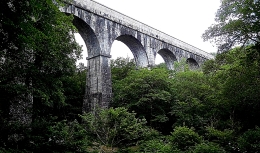
Treffry Viaduct near Luxulyan in Cornwall
The name Agar-Robartes intrigued me. My interest in it increased when I saw a small stone memorial near the River Fowey in Lostwithiel. It bore the words:
“Royal British Legion, Lostwithiel Branch, 1932-1997. Opened by Lady Robartes.”
Things became clearer after visiting the magnificent Lanhydrock House, originally constructed in the 17th century, and reconstructed quite faithfully after a huge fire in 1881. The house was created by John Robartes (1606-1685), 2nd Baron Robartes of Truro, 1st Viscount of Bodmin, and 1st Earl of Radnor. One of his many descendants, Anna Maria Hunt (1771-1861) married Charles Bagenal-Agar (1769-1811). One of their three sons, Thomas James Agar-Robartes (1808-1882), assumed the surname ‘Robartes’ in 1822 and tacked it on to his Agar surname. One of his ten grandchildren was Thomas Charles Reginald Agar-Robartes (1880-1915), the ‘TCR Agar-Robartes’, whose name is on the building in Luxulyan.
Thomas was educated at Eton and Christ Church College, Oxford. He was elected to represent the South-East Cornwall constituency as its MP in 1906. However, he was unseated a month after the election because of infringing some electoral regulations. He had been found guilty of bribery and other offences. Nevertheless, he was re-elected in 1908. His election campaign was based on support of free trade and reform of temperance laws. In August 1914, Thomas signed up as a 2nd Lieutenant in the Royal Bucks Hussars, and then in 1915, wanting to see action on the battlefront, he left for France as an officer in the 1st Battalion Coldstream Guards. In June 1915, he was promoted to become a captain. During the Battle of Loos in September 1915, he was shot in no-mans-land and never recovered.
The building, a working man’s institute and reading room in Luxulyan, which bears Thomas’s name, was first conceived in 1913, but only began to be used as such in 1924, when the edifice was completed. Naming it after Thomas is explained on a website page about the building (www.luxulyanpc.co.uk/Luxulyan_Memorial_Institute_32056.aspx): “ Tragically, as we know, young Tommy Robartes of Lanhydrock died after receiving wounds rescuing a comrade from one of those fields of battle. He had been well known and liked in the village, often coming to visit, accompanying the land agent dealing with tenants. The village picked up its interrupted thoughts on the Institute and Reading Room idea; whether the idea of a Memorial to Tommy, or just asking the Lanhydrock estate for a piece of land came first, is not clear, but it was agreed that a piece of land from the estate for a Memorial Institute was acceptable to all.”
Having already offered £50 towards building the Memorial institute, Dr Nathaniel T Coulson then offered a further £100 on condition that Thomas Agar-Robartes’s name was on the hall. Dr Coulson, who is described in the website, interested me because of his profession:
“He was born in Penzance in April 1853, abandoned by his drunken father at the age of 10 years and bound over to the farmer at Penquite Farm, Lostwithiel. He then spent some years in the British Navy and first arrived in San Francisco in 1875. For a while he worked for a stock-broking firm and wrote for several daily newspapers. In 1884 at the age of 30, he became a student at the dental department of the University of California, where he graduated after two years, receiving his degree as a Doctor of Dental Surgery. He was a member of several fraternal organisations, and generous with donations to many worthy causes. Among others in England, he helped finance the establishment of Coulson Park, Lostwithiel, in 1907. He travelled back here on several occasions, also visiting India after his retirement…”
So, that explains the hall that we saw in Luxulyan. I am not at all sure which ‘Lady Robartes’ is the one whose name appears on the British Legion monument in Lostwithiel, which bears the words “Opened by Lady Robartes”. If a Lady Robartes opened the branch in 1932, who was she? Only one of Thomas’s brothers married, Arthur (1887-1974). His wife, Patience Mary Basset, whom he married in 1920 might have been the ‘Lady Robartes’. Alternatively, she might have been one of Thomas’s sisters: Mary Vere (1879-1946) or Julia (1880-1969) or Edith (1888-1965) or Constance (1890-1936). If on the other hand the words refer to the inauguration of the monument in 1997, then I cannot offer any suggestions.
Luxulyan is worth visiting not only to see the things I have already mentioned, but also the impressive, massive, granite combined aqueduct and viaduct near to the village. It carries water and a railway track over the River Par. Known as the Treffry Viaduct, it was completed in 1844 and designed by the engineer and mining entrepreneur Joseph Treffry (1782-1850).
Until we visited Luxulyan, I had never heard of the Agar-Robartes family. Once again, visiting Cornwall has resulted in finding places and persons of great interest. The more I see, the more I want to know.
THE TOWER OF BABEL greeted anyone who climbed the staircase at my childhood home in Hampstead Garden Suburb. Well, actually it was a large engraving of the tower as imagined by Dolf Rieser (1898-1983). Dolf, who was born in King Williams Town in South Africa, was related to my mother’s grandmother Hedwig Ginsberg (née Rieser). My mother and Dolf were cousins. Even though they lived not far from us in north London, I saw little of Dolf and his family until about 1976 when I began studying dentistry. It was then that my uncle Sven, married to my mother’s sister, and his daughter told me that they were about to join the printmaking classes that Dolf held in his studio above his home in Sumatra Road, West Hampstead. As I liked drawing and painting, I signed up as well. The three of us attended the weekly evening classes that Dolf held on Tuesdays. Out of a class of on average six to eight students, three of us and the teacher were all closely related.
At the top of the stairs leading to the studio, there was a small colourful image created by the artist who is now very famous. It was a gift to Dolf given by the artist when both were living in Paris in the 1920s and 1930s. Dolf, who had studied biology in Switzerland and was awarded a PhD in 1922 (https://dolfrieser.com/), began studying art in Munich in 1923, and then moved to Paris to study print-making in Atelier 17, the studio of the great surrealist painter and etcher Stanley Hayter (1901-1988) and the engraver Jozef Hecht (1891-1951).
In the compulsory half hour tea breaks during the classes, we used to sit with Dolf whilst he regaled us with tales about his life in Paris during the 1920s and 1930s. Every winter, he used to go to Switzerland to ski. He used to enter the railway station carrying his wooden skis, and Parisians would stop him to ask what they were. For, in those days, it might surprise you to learn, the average Frenchman was unfamiliar with skiing. Dolf used to visit the Café Les Deux Magots in the Saint-Germain-des-Prés district of Paris, where he would enjoy the company of other artists. He told us that he often saw Pablo Picasso there, sitting at one of the tables. Dolf said that being a junior and relatively unknown artist at the time, he had to sit at a table near to Picasso’s, which was reserved for the ‘upper echelon’ of the artists community in the city. I cannot recall all that he told us, but much of it was both informative and highly entertaining, if not always entirely suitable for polite company. One bit of French that I learned from him during these entertaining intervals in the class was ‘poule de luxe’, which you can look up for yourself.
Dolf’s lofty studio had several large tables where we worked on our copper and zinc plates. At one end of the studio there was a raised platform, a gallery, on which there was a couch or bed. The tables were surrounded with a great assortment of stuff, both works of art by Dolf and the plethora of materials and equipment need to make prints, not only on paper but also on plastic and silk, techniques he developed. There was a table with large shallow trays containing nitric acid in which plates of zinc prepared for etching were bathed. The acid in the trays was of variable concentration, unknown even to Dolf, who used to periodically chuck in unmeasured dollops of concentrated acid from brown glass Winchester bottles whenever he felt (rather than knowing for sure) it might be necessary. Often, he did not tell us when he was about to strengthen the liquid. This could prove difficult if someone were trying to make small delicate adjustments to his or her zinc plate. Occasionally, one or other of us would shout, dismayed:
“Oh, Dolf, you didn’t say you were adding acid. Now, see: the acid has eaten deeper than I was expecting.”
But the ever-ingenious Dolf usually always had a way of remedying what looked to be disastrous at first sight. Today, I doubt that the studio would have passed health and safety rules. There were no extractor fans above the acid baths to remove the toxic fumes emitted when a plate was in the acid. This did not bother any of us.
One end of the studio near the acid baths was dominated by a large, hand operated printing press. The etched or engraved plate was placed on a soft woollen cloth, after having been inked up. A sheet of damp paper was placed over the plate, and this was covered by another cloth. Then, Dolf or one of us turned the large wheel that drove the plate between a pair of metal rollers that applied high pressure to the dampened paper, driving it into the ink-filled grooves on the etched or hand-engraved plates. When Dolf turned the large wheel, always moving his body rhythmically, he often used to say in Swiss German:
This referred to a slightly lewd joke he often told us. It went like this. Two Swiss peasants come to Zurich, where they decided to employ the services of a prostitute for the first time in their lives. To save money, they agreed that only one of them should pay for the experience. When the chosen one had finished with the prostitute, he joined his friend, who asked him how it was. The other fellow replied that it was quite pleasant, adding: “Aber die Bewegung is immer die glierchen.”
Printing was always a messy business. To remove the ink from one’s hands, we used a petroleum-based jelly often used by motor mechanics, which Dolf kept in his studio. Removing the ink from one’s hands was easier than removing the lacquer that was painted on to zinc plates to prevent acid from reaching parts that were not to be etched. To explain, a zinc plate is covered with lacquer, which is then removed with tools of varying sharpness to expose parts of the plates which the artist requires to be etched. This is of course an oversimplification. Dolf who was very inventive showed us many other techniques for producing etched plates. It is likely that his early training in science helped him to develop interesting new ways in printmaking. Dolf maintained an interest in science, as is exemplified by his book “Art and Science”, published in 1972. Its opening words are:
“Art and science are generally considered totally different disciplines. The aim of this book is to draw attention to some of the qualities they share.”
Dolf was a superb teacher. Although the students in our classes were of mixed ability, he brought out the best in each and every one of us. I found that he was particularly good on critiquing composition. The compositions and ideas embodied in his own creations were mostly superb. He used to look at one’s work, immediately understand what we were trying to achieve, and to nudge us gently and constructively in such a way that we ended up with what we were hoping to produce and express.
Once, he held an exhibition of our, his students’, work in his studio and asked us to invite our friends. At the end of the evening, Dolf had sold several of his own prints, but none of us managed to sell any that we had created. Dolf told us off, saying that none of us had worked hard enough, if at all, on getting our friends to buy our works.
After Dolf’s wife died, he continued the classes, but used to be reluctant to see us leave at the end of the evening. I liked Dolf so much that I was always sad when the classes came to an end. However, after he became a widower, we used to follow the classes by walking with him to a Turkish restaurant nearby in Willesden, where we all enjoyed a late supper with him.
The last time I saw Dolf was when he was lying in a hospital bed near the end of his life. Even in hospital, he was in reasonably high spirits, telling his visitors stories and jokes. His house in Sumatra Road still stands. I do not know whether his wonderful studio is still being used to create works of art, but it is with Dolf and his students that I will remember it.
Finally, having read the above, I hope that you will not get the wrong idea when I invite you to “come up and see my etchings”. Many years ago, a young lady did accept this invitation when I made it; she is now my wife.
GENERAL CHARLES DE GAULLE (1890-1970), an eminent refugee from France, was dead against Britain joining what was the Common Market and is now the European Union, despite the country having generously hosted him during WW2, when his country was invaded by Germany. This is quite well known, but far less known is the fact that he lived in Hampstead, north London. His home was at 99 Frognal in what is currently St Dorothy’s Convent.
The convent building, Frognal House, was built in about 1740 and later modified in various ways (https://historicengland.org.uk/listing/the-list/list-entry/1113077). The convent building stands on the site of a 15th century tenement known as ‘house called Frognal’ (www.british-history.ac.uk/vch/middx/vol9/pp33-42). At the beginning of the 18th century, the land on which this stood was owned by the bricklayer Thomas Smith, who probably built the present building, which became known as ‘Frognal House’. During the Crimean War (1853-1856), the house became The Sailors’ Orphans Home (from 1862-1869), which later shifted to the northern end of Fitzjohns Avenue in 1869 and which was constructed on land once owned by Sir Harry Vane (1613-1662).
“The reception rooms on the ground floor have remained, but the General’s Cabinet de travail is now the chapel … The first floor panelled library is where I would feel his spirit most strongly hovering as I would work alone early in the morning … In the garden roses grew, I drew and painted them in the late afternoon … His spirit was there too, and I used to wonder how often he would have come back from his headquarters in Carlton Gardens worn and weary with cares, to wander off to the peace of the leafy bowers and refresh his tired mind and soul … From the roof terrace overlooking the whole of London below, he would stand at night and watch the German bombings on the City of London during the Blitz …”
While living in Hampstead, De Gaulle used to attend masses at St Mary’s Catholic Church in Holly Walk. It was the first Catholic church built in Hampstead after the Reformation (16th century). It opened its doors to worshippers in 1816. Its first pastor was a refugee, one of 500 clergy fleeing from the French Revolution, the Abbé Jean-Jacques Morel (1766-1852; https://parish.rcdow.org.uk/hampstead/about-the-parish/). Thomas Barrett, a historian of Hampstead, writing in 1912 in his “Annals of Hampstead”, noted:
“Towards the end of the eighteenth century another interesting religious association came into the life of Hampstead, in a very modest and unassertive way, as one of the minor overflows from the French Revolution. Among the priestly refugees from France was a certain Abbe Morel, who had been connected with the Grand Seminary at Bourg. He was attracted to Hampstead by the fact of there being several French families living there—Talleyrand among the rest, some say—exiles like himself, to whom the question of religious worship according to their own faith was becoming a matter of difficulty…”
Barrett believed that Talleyrand, Charles Maurice de Talleyrand-Périgord (1754-1838):
“… lived for a time at Tensleys, on Hampstead Green, during his service as French Ambassador from 1830 until 1834 … It was pulled down, and the site is now partly covered by the Hampstead General Hospital.”
This is now the location of the Royal Free Hospital. Barrett quotes the following anecdote that reveals that the refugees included members of the French aristocracy:
“… A story is told of two handsomely dressed ladies visiting Hampstead in 1819. They drove in a carriage to the bottom of Holly Hill, and then got out and walked to the top; and sometime later the Abbe was seen walking down the road bareheaded, respectfully escorting them. As the elder of the two ladies got into the carriage she kissed the Abbe’s hand and shed tears. This lady, it was said, was the Duchesse d’Angouleme.”
After some years in Hampstead, Morel:
“… was put to a severe ordeal when, the Revolution having come to an end, it became possible for the refugees to go back to their native country. Most of the little congregation for which he had been officiating returned. He would fain have gone with them ; but in Hampstead he had found a real haven of rest after the turbulence which had preceded his exile, and had formed many ties with the people of the village. He decided to remain, and for many years after that Abbe Morel was a worthy and loved figure in Hampstead.”
In 1941, Fr Joseph Geraerts became the parish priest. During this period:
De Gaulle returned to France in June 1944. After initially declining to join the Common Market, Britain applied to join in 1963. De Gaulle was dead against this (https://en.wikipedia.org/wiki/Charles_de_Gaulle#European_Economic_Community_(EEC)). It was only after De Gaulle resigned as President in 1969 that Britain was able to join the European community, which it has left recently.
Frognal House was converted into its present role, the home of St Dorothy’s Convent, part of a religious community based in Malta, in 1968. The organisation:
“… caters for young ladies coming to study in London or for a short holiday from all over the world. It aims at providing not only a boarding house, but a homely environment where guidance and advice assure the well being and comfort of all the students. Besides catering for the students, the sisters are very much involved in their Parish St Mary’s.” (www.stdorothysmalta.org.mt/convents.html).
Apart from a couple of restaurants in Hampstead, the former Cellier du Midi and the still extant Cage Imaginaire, I had never considered that Hampstead had any other French connections. However, seeing the convent today and looking into its history, has shown me that France had a significant role in Hampstead’s history.
PS: I almost forgot to mention the onion sellers, who used to come to Hampstead from France with their bicycles ands strings of onions. And, also, there is a French creperie in Hampstead next to the King William IV pub on Hampstead High Street.
ONE EASTER DURING the late 1990s, we drove to Provence in the south of France. There, we hired a lovely rural cottage (a ‘gîte rural’) located on the edge of a village next to an orchard of trees overladen with ripe cherries. That year, there was a heatwave in the south of France, daytime temperatures reaching and staying at 37 degrees Celsius. We were pleased that our Saab saloon car had built-in air-conditioning and that our gite had a large garden and a shady terrace.
Roman amphitheatre, Orange, France
Despite the high daytime temperatures, we managed to do plenty of sight-seeing. One day, we decided to explore the delights of the city of Orange, which was not far from our gite. The city is rich in Roman remains including a magnificent open-air theatre with steps, on which the audience perched, arranged in a circle.
In the 12th century, Orange and its surroundings became a principality within the Holy Roman Empire. In 1554, William the Silent, Count of Nassau, who had possessions in the Netherlands and became a Protestant, inherited the title ‘Prince of Orange’. The Principality of Orange was incorporated into what became the House of Orange-Nassau, whose royal family continues to rule the Netherlands today. One member of the family became King William III of England in 1689. Orange remained a Dutch possession more or less continuously until the Treaty of Utrecht in 1713, under whose terms it was ceded to France.
So much history and clambering around the Roman ruins made us ready for lunch. We had no idea which restaurant to choose in the centre of Orange. My wife had the bright idea of entering one of the local shops, a shoe store, to ask where its workers went to eat their midday meal. They told us about a small restaurant around the corner. This busy eatery had a name which brought to mind associations with the American Wild West, ‘Le Buffalo West’, or something similar. It was a good recommendation and the food it served was excellent quality, reasonably priced French fare.
After a decent meal, we drove to a parking plot near a Roman triumphal arch. To enter the parking area, one had to drive below an arch designed to keep out large vehicles, and then down a steep ramp. Unfortunately, I turned the steering well before the car was fully off the ramp. We became grounded on a large concrete rock. The engine cut-out. I could not restart it. The car was well and truly stuck on the rock. Some people nearby saw our plight and told us that there was a repair garage a few yards away. We walked there.
The garage people sent out a team with a tow truck. Sadly, the truck was too high to pass beneath the height-restricting arch. Seeing the problem, three garage employees set to work with spades to dig around the rock on which our Saab was marooned. After at least an hour and a half’s hard toil in the baking afternoon heat, they removed the boulder and thus freed the car. Then, they pushed it beneath the arch so that it could be attached to the towing truck.
Raised on a ramp, it was easy to see where the rock had ruptured the Saab’s fuel line. It did not take the engineers long to replace the fractured section. Luckily, little other damage was visible beneath our car. Finally, we were ready to leave. It was with some anticipation that I asked to settle the bill. Imagining how expensive this labour-intensive episode would have been in the UK, I was expecting a bill of at least £300. So, I was not surprised when I was asked for about 300 French Francs. Then, a moment later, I could not believe my luck. A quick calculation had revealed that I was being asked not for £300, but for the Franc equivalent of about one tenth of this amount.
We returned to our gite, highly relieved that the car was back in service so quickly. That evening, as the sun set, we sat outdoors and enjoyed glasses of the local rosé wine whilst the charcoal on our barbecue began to reach the glowing stage that is best for grilling the meat that we had bought in one of the local markets.
The Saab remained in use for several more years but, to the surprise of our local dealer who serviced it annually, it began developing ominous cracks in its chassis. It was providential that these did not develop immediately after my driving misjudgement in that car park in Orange.






 yamey
yamey 