A refreshing breeze in Goa

I SHOULD NOT BE TELLING you about a wonderful place in the heart of Panjim in Goa, but I will.

The Clube Vasco da Gama is situated on the first floor of a building beside Panjim’s lovely Municipal Garden. Founded in 1909, it occupied other buildings before it moved to its present site. With a pleasant decor, which evokes times long past, the Clube serves a wide range of drinks and superbly prepared Goan food. Today, we enjoyed baby squids stuffed with minced vegetable and chopped up squid, served in a tasty sauce. We also ate croquettes filled with a mildly spiced prawn purée. In addition, we consumed fried fish served in a very spicy sauce. Everything tasted wonderful, and as we will be in Panjim for several days, we will work our way through the menu.

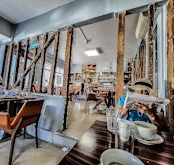
We first came across the Clube in April 2018, when the weather was almost unbearable: extremely hot and humid. Quite by chance we came across the Clube and decided to enter it. We discovered that it has two small balconies, each overlooking the Gardens. Each of them has a small table with three chairs. All day long, there is a lovely, cooling breeze blowing across these two tables, making them the coolest places to sit in central Panjim (without resorting to finding places with air-conditioning).

It is because there are only two of these wonderfully positioned tables, it is with some trepidation that I am telling you about them. I do not want to turn up at the Clube to find them occupied by those who have just read this!

Beverages beneath the banyans

ONCE A CITY FILLED with lovely gardens and other verdant open spaces, Bangalore (Bengaluru) is growing alarmingly rapidly. So, public spaces that have been as yet saved from being built on are valuable amenities. One of these areas of greenery is the so-called Tivoli Garden, which is in the grounds of Airlines Hotel in the heart of the city.

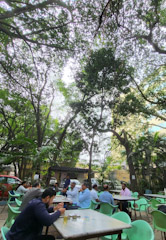
Known popularly as ‘Airlines’, the Tivoli Garden, a name by which it is hardly known, has tables and chairs set out in an open space, a clearing, surrounded by trees, several of them being elderly banyans.

Opened in 1969, the open air café and eatery is still supervised by a man who helped set it up two weeks before it opened all those years ago. Despite its rather untrendy appearance, Airlines is popular with Bangaloreans of all ages. Quite a few of them are students, but many are office workers. Very good South Indian filter coffee is served at Airlines. A wide range of South Indian vegetarian dishes is also served.

The coffee, other drinks, and food are prepared in the kitchen of the hotel. Waiters in white uniforms carry drinks and food across the car park from the kitchen, which is located at the far end of a dingy dining hall, to the garden seating area. Some customers prefer to have their orders served to them whilst sitting in their parked cars.

For my wife and me, Airlines has several attractions. One is the coffee. Another is the pleasant ambience under the trees. And yet another is nostalgia. My wife used to visit Airlines with her family in her late teens. And together with our daughter, my wife and I have been regular visitors to Airlines since when we married in 1994.

For several years, Airlines has been under threat of closure by the people who own the land. Over a decade ago, these people reclaimed half of the area occupied by the café. They built an ugly grey wall (rather like a Berlin Wall) to separate what is left of Airlines from what has now been built on. The supervisor, whom we have known for ages, assured us that as far as he knows the remaining part of the establishment will remain safe from redevelopment.

It would be tragic if Airlines were to disappear, not only because we love it but also it would be yet another example of how what was once a lovely garden city is becoming more and more of an urban jungle

A Turkish delight in London’s Dalston

KINGSLAND ROAD AND nearby in London’s Dalston area is rich in restaurants and other eateries serving Turkish food. Early in this century, “Time Out” magazine rated the Mangal Ocakbasi (now called ‘Mangal 1’) restaurant at number 10 Arcola Street as being one of London’s best Turkish restaurants. For those who do not know, ‘ocakbasi’ means ‘fireside’ and ‘mangal’ means ‘barbecue’ or ‘grill’. When we first went to Mangal, and for many years after that, there were tables alongside the long rectangular pit filled hot charcoal, upon which meat and vegetables are grilled. Recently, the restaurant has been redesigned and the grilling area is no longer alongside the tables.

Lokma

The meat served is top quality. It seems far better than that served in the many other Turkish restaurants we have tried in London. Although there is a wide variety of main courses on offer, the range of ‘starter’ dishes on the menu is not as great as at some other restaurants. If it is starters and meze that you are after, the nearby Umut 2000 (on Crossway) is worth visiting. However, their main meat dishes are not nearly as tasty as those at Mangal in Arcola Street. Having said that, Mangal does serve an excellent freshly grilled aubergine hors d’oeuvre. Desserts are not available, but there are plenty of places along Kingsland Road offering a wide range of very sweet but tasty confectionery.

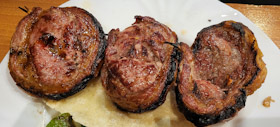
Our favourite dishes at Mangal are lokma, which is grilled rolled fillet of lamb, and yorgutlu Adana, which is pieces of semi-spicy Adana kebab in a yogurt and tomato sauce with lumps of Turkish bread. The lokma and other kebab dishes are served with generous quantities of fresh mixed salad containing many ingredients. As for drinks, you can bring your own alcohol or buy it from the restaurant. If I order a drink apart from water, I always go for Şalgam, which is a purple-coloured drink containing fermented turnip. This has a deliciously sour taste.

We first ate at Mangal in the early 2000s, when we attended a play in which one of my dental patients was acting. The theatre, The Arcola, was across the road from the restaurant, but has now shifted to larger premises on nearby Ashwin Street (close to Dalston Junction station). We loved the food at Mangal from the very first bite. We have been eating there occasionally ever since then, and the quality of the food has never once faltered. We have been there so often that the older members of its staff recognise us, welcome us warmly, and remember what we like eating. Even though this Turkish delight, frequently patronised by the artists Gilbert and George, is far from where we live in Kensington, it is well worth ‘trekking’ across London to get there.

More than meets the eye on the moor

FROM OUTSIDE IT looked like a ‘bog standard’ pub on Dartmoor. The kind of pub in which you would expect to find weary walkers and cyclists, all dressed in appropriate outdoor gear splattered with mud. The sort of place where the customers wear walking boots and thick woolly socks that reach halfway up their calves. An old-fashioned country pub with a roaring open fire. You know the kind of place, quaintly decorated with folks objects such as horse brasses, copper bed pans, Toby jugs and so on. A pub where you would find sandwiches and chips as the only solid fare. However, despite looking like the kind of hostelry just described, The Dartmoor Inn Merrivale is  quite a different ‘kettle of fish’.

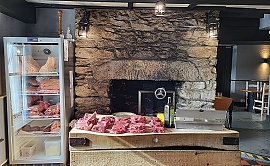
On stepping through its entrance door, the first thing you will notice is a large wooden butcher’s slap piled with raw steaks of various kinds and cuts: sirloin, rumps, chateaubriand, rib eyes, huge tomahawks, and other tasty chunks of meat. Behind this in what was formerly a fire place, there is a sophisticated charcoal grill for cooking these meaty offerings. A chef coats the meat with sprinkling of salt, oil, and herbs before grilling it. 

The pub’s decor is far from traditional.  It is simply decorated in a contemporary style with a few good artworks on the walls. The pub is owned by a local organic farm, which also has shops in Marlborough, Totnes, Tavistock, and London (in Selfridges Food Hall).

For our midday meal, we ordered a Ploughman’s Lunch contains amongst other things excellent cheddar and locally made ham, and a plate of superb barely cooked roast beef. The food could not be faulted. The staff were enthusiastic about food and were very attentive.

The Dartmoor Inn has reasonably priced rooms for overnight stays. We hope to return, spend the night, and sample the excellent looking steaks on offer.

Just as it is unfair to judge a book by its cover, one should not rate a pub by its external appearance.

Macchiavelli and spicy masala meat dishes

RAAVI KEBAB BEGAN serving Pakistani and Punjabi food in the mid-1970s. It is located on Drummond Street, close to London’s Euston Station. This unpretentious eatery with barely any internal decoration except some mirrors with Koranic verses engraved on them in Urdu script, is next door to the Diwana Bhel Poori House. It was at the latter that we used to enjoy Indian vegetarian dishes when we were undergraduate students at nearby University College London during the first years of the 1970s. In those days, Raavi, named after the river that flows through the now Pakistani city of Lahore, did not yet exist. It was only in the early 1990s that a friend visiting from Bombay suggested that we ate with him at Raavi’s. When the grilled kebabs arrived at our table, it was love at first bite. We have been returning to Raavi’s ever since.

Raavi’s with Diwana in the backround

Yesterday (1st of September 2022), we made yet another visit to Raavi’s. As we sat down, I noticed a thick wad of photocopies held together with a bulldog clip. They were resting on top of a neatly folded shawl. Out of curiosity, I looked at the top sheet, which was a page copied from a book with annotations added in red ink. I looked more carefully and noticed that the printed text was in Italian. The page was headed “<De ingratitudine> Joanni Folci Niccolaus Maclavellus”. It is a chapter (‘The ingratitude of Joanni Folci’) from a book by Niccolò Machiavelli (aka Maclavellus), who lived from 1469 to 1527. The rest of the text on the photocopied page appeared to be a learned commentary on Macchiavelli’s chapter.

I do not know why, but I felt that Raavi’s was the last place I would expect to find scholarly papers lying about so casually. I associate the place, as do most of its many customers, with grilled meat and spicy masalas. I asked the waiter about the papers. He shrugged his shoulders and said that someone must have left them behind after eating, and that he had no idea whether anyone would return to retrieve them.

Eating well in a town in Essex

PARADISE IS A café in Great Dunmow, a small town in Essex. With several small eating areas and a cool breeze blowing through it, this comfortable eatery was a good place to eat lunch on a day when the air temperature was 32 degrees Celsius. Judging by its menu, which includes gözleme and shish kebabs, and the fact that the staff were speaking Turkish, it would be correct to say that Paradise is a Turkish run establishment.

Having noted that, it would be fair to say that this place is a well above average “greasy spoon caff”. However, the food is not at all greasy. In addition to food items usually associated with Turkey, Paradise offers the full range of English breakfast items, as well as wraps, burgers, sandwiches, and chicken curry.

One impressive feature of Great Dunmow’s Paradise, apart from the attentive and efficient staff and tasty food, was flexibility: we were able to order exactly what we wanted even if it was not on the menu.

It is always fun to discover reasonably priced, unpretentious places like Paradise. We will return there next time we are in the area.

The oyster merchant’s clock tower

BURNHAM-ON-CROUCH in Essex is a picturesque port on the River Crouch. Currently, it is a leisure resort and a centre for ship maintenance and boating. It was once famed for what grew in great numbers on the muddy bed under the water of the Crouch: oysters. For several centuries before the river became polluted in the 19th century, the oyster beds in the Crouch (and a few other places in Essex) were very profitable, providing much employment.  

“On the shores of England the principal nurseries of oysters, not only for the English markets, but also for the foreign, are those on the coast of Essex and the estuaries adjoining: those taken there are called ‘ Natives/ Mr. Sweeting claims the name as peculiarly applicable to his fishery, as within his memory no strange oysters have ever been introduced…”

Men were required both to dredge the oyster beds and process the molluscs as well as to protect the precious creatures from thieves based in other places on the Essex coast.

Today (11th of July 2022), we visited the small but excellent museum in Burnham-on-Crouch. On the ground floor, we saw a retired mechanised oyster grading machine (made in France and capable of sorting 7000 oysters per hour) amongst the exhibits. On the upper floor of the museum, which is housed in a former boat repair building, we met the museum’s treasurer, who is a mine of interesting local history. He told us several things about Burnham’s oyster heydays. I hope that what I am about to tell you is a reasonably accurate summary of what he told us. If it is not totally accurate, I hope that he and you, dear reader, will forgive me.

For 10 years, I used to live in north Kent and often visited Whitstable to enjoy eating oysters for which this Kentish seaport is famous. The treasurer in Burnham told us that many of what are described as ‘Whitstable oysters’ were born in the mud beneath the river in Burnham-on-Crouch. From what I can recall, the young oysters, which grow in the mud beneath the Crouch, are dredged and then placed on boards to which they attach themselves. Keeping them submerged in seawater, the boards to which the young oysters are attached, were transported to Whitstable where they matured in its waters. The Burnham oysters were ‘native’, meaning that they began their lives there; they were not imported, as Thomas Campbell Eyton described in “A history of the oyster and the oyster fisheries” (published in 1858):

“On the shores of England the principal nurseries of oysters, not only for the English markets, but also for the foreign, are those on the coast of Essex and the estuaries adjoining: those taken there are called ‘Natives’. Mr. Sweeting claims the name as peculiarly applicable to his fishery, as within his memory no strange oysters have ever been introduced.”

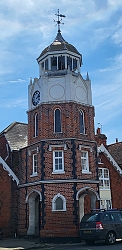
One of the exhibits in the museum is a large model of the octagonal Victorian clock tower that dominates Burnham-on-Crouch’s High Street. The tower stands next to the building that used to house the former St Mary’s School. It was erected in 1877 to honour the local philanthropist Laban Sweeting (1793-1876). So, what, you might ask, and what has he got to with what I have been writing about?

Laban Sweeting, mentioned in the quoted from Eyton’s book, was a philanthropist; a member of The Burnham River Company; and he was one of the town’s oyster merchants. The museum has amongst its exhibits a small barrow, which used to be wheeled around Burnham by a member of the Sweeting family. It would have carried baskets of oysters ready for sale to the town’s populace.

We had visited Burnham once before, and although I was impressed by the clock tower, I knew nothing of its history. Neither did I know about the town’s association with oysters, which were poor people’s food in the 19th century, when chicken was a luxury. How times have changed.

A chiming pub in Cornwall

EGLOSHAYLE IS ACROSS the Camel river, facing the Cornish town of Wadebridge. The Earl of St Vincent pub is hidden away up a hill behind Egloshayle’s St Petroc church. It is housed in a building built in the 17th century as a boarding house for masons. Later, it became a pub. One of its many guests was Admiral Sir John Jervis (1735-1823).

The interior of the pub has timber roof beams and a delightful feeling of times long gone by. It is a great example of many people’s idealised vision of a typical ‘olde worlde English’ country pub. Soon after entering the dimly lit establishment, and your eyes adjust to the low light levels, it becomes evident that the pub is full of clocks, mostly differing in design. Most of them appear to be in working order, but not many of them show the same time. A great number of the clocks chime at least once an hour, but not all at the same time. This being the case, there is usually at least one clock chiming at any given moment. This produces a lovely background symphony of chimes.

I asked one of the pub’s staff why there were so many clocks in the pub. She replied:

“Some people like children. We like clocks”

Later, I asked the landlady about the clocks. She told me that when they took over the pub some years ago, there was no clock in it. She and her husband bought one clock for the pub, and this became the start of their collection. They could not stop buying timepieces. She told me that there are over 200 clocks in the pub and winding them up every day is quite a huge task.

Apart from the fascinating clocks, the pub can be recommended for the delicious, excellently prepared, unpretentious food that can be eaten there.

Czech it out

JAN GARRIGUE MASARYK was born in Prague (Czechoslovakia) in 1886. Son of the first President of Czechoslovakia, Tomáš Garrigue Masaryk (1850-1937), Jan was Foreign Minister of his country between 1940 and 1948, when two things happened. First, the Communists began tightening their grip on Czechoslovakia and possibly connected with that, Jan Masaryk was found dead in his pyjamas in the courtyard of the Foreign Ministry in Prague on the 10th of March. By 1948, Prague already had a reputation for defenestration. Whether or not Jan was pushed out of a window remains uncertain. Two years earlier, a large non-descript house in Hampstead’s West End Lane became home to the recently formed National House, a meeting place for Czechoslovaks (mainly war veterans) in London. Now, it is known as Bohemia House. Its website (https://bohemiahouse.london/beginning-of-national-house/) explains:

“After communist revolution in 1948 and the USSR invasion to Czechoslovakia in 1968, providing the homely atmosphere as well as traditional cuisine. Converted into public house in mid 80’s, the National House serves also as a traditional restaurant showcasing Czech & Slovak cuisines to the public.”

It was in the 1980s that I first began visiting the place to sample Czechoslovak food and drink. After many years, I revisited the place recently (in March 2022).

If it were not for the sign advertising Pilsner Urquell beer projecting above a tall privet hedge, most passers-by would hardly notice that they were passing what is now a bar and restaurant. Immediately after entering via the front door, I noticed several commemorative plaques. One of them honours the British historian RW Seton-Watson (1879-1951), who fought for the rights of the Czechs and Slovaks and other subject people/nations of the former Austro-Hungarian Empireafter WW1. Next to that, there is a large metal plate remembering the Czechoslovak “soldiers, airmen, and patriots”, who fell in WW2. It makes special mention of the Czechoslovak men who flew from Leamington Spa and were parachuted into their Nazi-occupied country to assassinate Heydrich (see https://adam-yamey-writes.com/2021/11/25/leamington-spa-heydrich-and-the-tragedy-at-lidice/).

A doorway from the hallway leads into a front room used as a formal dining room. This is decorated in a mildly baroque style. A gold-framed portrait of TG Masaryk faces the door. Various other framed portraits including one of Queen Elizabeth II hang on the walls. A metal bust of TG Masaryk stands on a mantlepiece next to a credit card machine and a metal sculpture of a Czech airman and there is an old-fashioned gramophone with an LP on its turntable between the two metal sculptures. The formal dining room is separated by a folding screen from a much larger room behind it. The latter, with tables and chairs, a pool table, and a table-football unit, is a less formal space, which I do not remember from the 1980s. In those days, food was served to ‘outsiders’ in the formal front room.

The larger, rear room with windows overlooking the back garden has several interesting objects on its walls. A sombre-looking metal plate covered with many names lists those who “gave their lives for Freedom” between 1939 and 1945. On the wall facing this, there are two posters with photographs of Alexander Dubček (1921-1992), a Slovak Communist politician, who tried to reform the Communist government during the Prague Spring of 1968, which ended after a few months when the Soviet Army invaded his country. On a wall behind the table-football unit, there are two large, colourful, framed maps. One is of the Czech Republic and the other of the Slovak Republic. Between the end of WW1 and 1993, the two now independent countries were parts of one country: the former Czechoslovakia.

A visit to the toilet involves climbing the stairs to the first floor. After ascending the first flight of stairs, the next short flight approaches a huge painting depicting TG Masaryk dressed in a flowing light beige coat and sporting a straw hat with a black ribbon tied above its rim.

Today, Bohemia House continues to welcome guests, both from the lands, which were once Czechoslovakia, as well as others. Its bar offers a range of beers, spirits, wines, and soft drinks, from that region of Central Europe. I sampled a can of Kofola, a carbonated Czech soft drink, whose taste vaguely resembles Coca Cola. The pint of Pilsner Urquell beer was more enjoyable. We also tried a variety of dishes typically cooked in the Czech and Slovak republics. They were enjoyable enough, but I prefer the cuisines of both Poland and Hungary. However, do not let this comment put you off paying a visit to Bohemia House, where you will receive a warm welcome from its charming staff. And … if you wish to know more about Hampstead’s Czechoslovak, other Central European, and Soviet historical associations, you could do no better than to read my new book about the area, available from Amazon [https://www.amazon.co.uk/dp/B09R2WRK92] and bookdepository.com [https://www.bookdepository.com/BENEATH-WIDE-SKY-HAMPSTEAD-ITS-ENVIRONS-2022-Adam-Yamey/9798407539520]).

Eating in The Ark

THE SHED IS aptly named. It is a restaurant in a long lean-to shed amongst the more solidly built edifices on Palace Gardens Terrace in Notting Hill Gate. This ramshackle-looking wooden structure has been home to a restaurant for many decades. For most of that time, it was called ‘The Ark’. It served lovely French-influenced food including my favourite on its menu, rack of lamb. The Ark was a popular local eatery, which attracted some celebrities including Prince Charles and Ingrid Bergman in the 1960s.

On one occasion a friend, let us call him ‘X’, who had eaten at our home many times,offered to treat us at The Ark. We accepted willingly. As soon as we sat down, X ordered the restaurant’s most expensive bottle of red wine. When, during our meal, it came to an end, he ordered another of the same. When the bill arrived at the end of our dinner, X fumbled in his pockets, blushed, and then, stammering, said:

“Oh, I have left my wallet at home.”

His home was a long way from Notting Hill Gate. He continued:

“This is all I have got”,

and placed a £10 note on the table. £10 barely covered half the cost of one of the bottles of wine he had ordered. Naturally, we paid the bill, and he said he would refund us the money, which he must have forgotten to do.

The Ark closed and then re-opened as a branch of the restaurants run by the chef Jean-Christophe Novelli. It served what I considered to be rather over-priced pretentious food. On one occasion, the Novelli restaurant took part in a scheme run by the Evening Standard newspaper. For £15, restaurants in the scheme offered a full meal without drinks – a bargain. My wife rang Novelli at the old Ark and asked whether we could book a table that day and use the voucher in the newspaper for the discounted meal. She was told that the restaurant was fully booked. So, I rang about two minutes later and asked to book a table, but without mentioning the newspaper offer. The lady, who answered the ‘phone at the restaurant, told me:

“Certainly, we have plenty of tables. Come when you like.”

Novelli’s closed, and the old Ark building remained empty for a while.

In 2012, the Gladwin brothers opened The Shed restaurant in the shed that once was home to The Ark. Time Out magazine (www.timeout.com/london/restaurants/the-shed) described it well:

“Tucked away behind a curtain of tousled ivy, The Shed serves up small, resourceful dishes built with foraged and locally-grown ingredients from the countryside. Led by the Gladwin Brother trio, who have their own farm and vineyard in Nutbourne, West Sussex, as well as two additional London restaurants, their flagship Shed was quick to become a local neighbourhood favourite when it first opened in 2012.

Though the menu changes seasonally, the original plates are still the best bet. (Note: everything is served tapas-style and 2-3 dishes per person is the recommendation.)”

I have been there a couple of times and found it to be both pleasant and original from the culinary vantage point. The serving staff, which briefly included our daughter, are obliging and well-trained. When ordering, the waiter or waitress discusses the dish and its ingredients knowledgeably. Pleasant as it is, it is not as enjoyable as The Ark was in its time.