A country church with a thatched roof

SNAPE MALTINGS ON Suffolk’s River Alde is a famous venue for music (mainly) and the other arts. It is the home of the Aldeburgh Festival, started in 1948 by the composer Benjamin Britten (1913-1976) and his partner, the singer Peter Pears (1910-1986). We have yet to attend a concert there, but we have eaten a fine lunch in its beautifully designed River View eatery. From the Maltings, you can enjoy views across the water meadows and if you look carefully enough, you can spot the tower of the Church of St Botolph in the tiny village of Iken across the river.

St Botolph, who died in about 680, is believed to have brought Christianity to Iken in about 654. He is the patron saint of boundaries, and, because of this, also of trade and travel. The present church dedicated to him is curious because its nave has a thatched roof. It was preceded by a minster built by Botolph but destroyed by the Danes in the 9th century. In 870, a Saxon timber church was constructed. This has also gone. It was replaced by a stone edifice, the beginning of what we can see today.

The Norman flint-rubble nave of the current church was built between about 1070 and 1110. The western tower, also with flint and other masonry was constructed soon after Robert Geldeny and William Baldwyn bequeathed money for its construction in 1450 and 1456 respectively. During the Reformation in the 16th century, various changes were made to the church’s interior to conform with the restrained liturgical requirements of the Reformed Church. This would have included whitewashing over colourful frescoes and destruction of stained glass and other decorative features.  By the 19th century, the church was becoming somewhat dilapidated. Between 1850 and 1860, restoration works were undertaken. A new chancel was constructed in the style of the early 14th century on the foundations of the original mediaeval chancel. It was designed by John Whichcord (1790-1860) of Maidstone in Kent.

In 1942, during WW2, the whole of the population of Iken was evacuated so that the area could be used for battle training. The church was also closed. It reopened in 1947 after the villagers returned to Iken. During the 1950s, they did much work to improve the condition of their church. In 1968, sparks from timber being burnt nearby set fire to the thatched roof of the church. The nave was badly damaged, but the chancel survived. Today, visitors to the church would not be able to imagine that it had suffered such a conflagration, so well has it been repaired.

Inside the church, several things attracted my attention. The most fascinating is the Saxon cross shaft in the northwest corner of the nave. Covered with bas-relief Celtic-style carvings this 4 ½ foot fragment of a stone cross (possibly, originally 9 feet in length) was created either in the 9th or 10th century. Near to this, there is a lovely octagonal stone font, which is 15th century. It is covered with superb carvings, some of which depict the emblems of the four Evangelists. These are separated from each other by angels. The wooden altar reredos, a panel behind the altar, was carved by Harry Brown of Ipswich and dedicated in 1959. It bears a bas-relief of The Last Supper, which Mr Brown based on the famous painting of that occasion by Leonardo da Vinci. I have mentioned a few of the items within the church that I found interesting but there is plenty more to see, all listed in an informative booklet on sale in the church.

From the boundary of the graveyard surrounding this lovely church, you can catch glimpses of the River Alde, which flows nearby. Visitors to Snape Maltings should spare some time to visit the church at Iken. It is so nearby yet feels so far away.

He paid with spears and swords

MALDON IN ESSEX is best known for the sea salt, prized by cooks and gourmets, which is produced nearby. The town perches on a hill overlooking a marshy inlet of the River Blackwater and the River Chelmer, after which Chelmsford is named, flows through a lower section of the place. We have visited Maldon several times over the last 18 months and always walked along part of its promenade that provides attractive views over the marshes and streams watered by the Chelmer and the Blackwater. However, it was only during our most recent visit (August 2021) that we walked the entire length of the promenade to its end point, which is out of sight of the town. The promenade ends abruptly, a bit like the end of a pier. There at the furthest extremity of the walkway, there is a tall statue. It depicts a man in a helmet, brandishing a sword in his right hand, holding a circular shield in his left, and looking out to sea.

The statue overlooking the sea is a sculpture of Byrhtnoth, Ealdorman of Essex, an Anglo-Saxon aristocrat or high official, who lived during the reign of Ethelred the Unready (c996-1016). Byrthnoth died during the Battle of Maldon on the 11th of August 991. The battle was fought by the Anglo-Saxons against an army of Viking invaders. It is said that before the battle, the Vikings offered to sail away if they were paid with gold and silver. Byrhthnoth was recorded as replying that he would only pay the attackers with the tips of his men’s spears and the blades of their swords.

After the battle, the then reigning Archbishop of Canterbury, Sigeric the Serious, advised Ethelred to pay off the Vikings instead of continuing the fight against them. According to an article on Wikipedia, this payment of 3,300 kilogrammes of silver was the first example of the so-called Danegeld in England. This was a ‘tax’ paid to the Vikings in exchange for them desisting from ravishing the territory which paid it.

So, the statue depicts a participant in a defeat of the English (Anglo-Saxons), and much loss of life amongst the Viking invaders. It was created by John Doubleday (born 1947) and unveiled in 2006. Byrhtnoth stands on a tall cylindrical base decorated with bas-relief depictions of scenes of life in the 10th century and moments during the Battle of Maldon. A plaque embedded into the promenade’s pavement near the statue gives more background to the historical event. It reads:

“Byrthnoth, represented by the figure standing on this monument, was the principal voice in rejecting the policy of appeasement which dominated the court of King Ethelred in the closing years of the 10th century. The leading military figure of his time; he was probably aged 68 when he confronted the Vikings at the battle of Maldon. He surrendered his life in defence of the people, religion and way of life represented in the lower relief panel of the column. Above it you will see aspects of the battle in which he died. Around the base is a quotation from his final prayer as recorded in the surviving fragment of the poem ‘The Battle of Maldon.’”

The poem, mentioned above, was written in Old English. However, much of it has now been lost.

Apart from the statue, Maldon has much to offer the visitor. Along the quayside, there are several old Thames Barges with their maroon/brown sails and a lovely pub, The Queen’s Head Inn. Church Street climbs from the riverside to the High Street which is lined by several old houses; a disused church, now a museum; an attractive parish church; and plenty of decent places to eat and drink. Within easy reach of London, this is a delightful place for a day out or as a base for exploring rural Essex.

Amazing Grace was written here in this small hut

MANY PEOPLE KNOW, but I did not, that the words of the hymn “”Faith’s Review and Expectation”, now better known as “Amazing Grace”, were written by John Newton (1725-1807), an Anglican clergyman. What fewer people know is that John Newton had once been the captain of ships that transported slaves across the Atlantic, but also a slave himself. In 1745, having fallen out with the crew on the ship he was sailing, he left his ship in what is now Sierra Leone. He was captured and enslaved and became the property of a princess of the Sherbro People, who lived in that part of Africa. He remained enslaved until 1748, when he was rescued by a sea captain, whom his father had sent to rescue him. On the voyage back to England, he received his spiritual calling.

Cutting a long story short, Newton was ordained as a priest in 1764. Soon after, he became the curate of a church in the small town of Olney in the north of Buckinghamshire. He remained in Olney until about 1779. While living in Olney, Newton struck up a friendship with the poet William Cowper (1731-1800; pronounced ‘koo-per’), who moved to the town in 1767. They collaborated on several literary projects.

From 1779 until his death, Newton was Rector of St Mary Woolnoth in the City of London. In 1788, Newton published his “Thoughts upon the Slave Trade”, a pamphlet that described to horrors on board the slave ships crossing the Atlantic. It was also a confession of his error of having been involved in such an inhumane business. He became an ally of William Wilberforce in the campaign to abolish the slave trade.

Olney is a charming little town, which we visited recently. Close to the market square, there is a large building in which William Cowper lived between 1768 and 1786. It now houses a museum dedicated to commemorating both Cowper and Newton. Behind the house, there is an attractive garden, which leads to another equally lovely garden. In the further garden, there is a small hut with white plastered walls and a tiled roof. It is just large enough for one person to sit inside it. It was here that Cowper’s friend John Newton used to sit and write. It is said that one of the hymns he wrote here in this tiny edifice was the hymn, now known by the words of its first line, “Amazing Grace”. This hymn was probably written in 1773.

A conspiracy at the crossroads

DUNCHURCH IN WARWICKSHIRE is located where the old road between Oxford and Leicester crosses that between London and Holyhead. This charming village was a place where, in its heyday, up to forty carriages a day stopped to change their horses for a fresh team. This was done at the various coaching inns in the village. One of these hostelries, which is still in business today, is The Dun Cow, where we ate a good English breakfast. Some of this inn’s previous guests included the engineer George Stephenson (1781-1848) and his son, another engineer, Robert (1803-1859), who dined at the hotel on the 23rd of December 1837. Their dinner was to celebrate the completion of the Kilsby Tunnel on the Birmingham to London Railway, a project supervised by Robert.

While we were wandering around the graveyard of Dunchurch’s St Peters Church, which dates back to the 12th century, we asked a gardener working there about where one of Dunchurch’s former famous characters had once stayed. He told us that he had no idea. Half-jokingly but with some earnestness, he added: “…we could do with another one like him.”

Guy Fawkes House in Dunchurch

The man about whom we were asking had associates, who were staying at the village’s former inn, The Lion Inn, in the early 17th century, the year 1605 to be exact. It was in early November of that year that those waiting at The Lion in Dunchurch were wondering about their colleague who was 79 miles away in London.

The fellows at The Lion were waiting to hear whether their co-conspirator Guy (Guido) Fawkes (1570-1606) had been successful in blowing up the House of Lords in London. He was not, and the conspirators waiting in Dunchurch were arrested. Had the plot to blow up Parliament and along with it the Protestant King James I succeeded, the men at The Lion were to have travelled to nearby Combe Abbey to seize Princess Elizabeth (1596-1662), who became Queen of Bohemia. As an informative website (www.ourwarwickshire.org.uk/content/article/rugby-school-science-teaching-around-1900-2) explains:

“In 1605 the monarch was James I; the Princess Elizabeth was his eldest daughter and sister to the future Charles I. In 1605 she was nine and being educated by Lord Harington at Coombe Abbey. She wasn’t a Catholic, but the conspirators planned to convert her and use her as their figurehead … Her main importance with regard to British history is that one of her grandsons (the son of her youngest daughter Sophia of Hanover) became King George I.”

The man about whom we were chatting with the gardener was neither of the Stephensons, who dined at The Dun Cow, nor the Duke of Wellington, who also stayed in the village, nor Lord John Douglas-Montagu-Scott (1809 – 1860), whose statue stands facing The Dun Cow. He was referring to Guy Fawkes, but this time a Guy Fawkes who completes the job before being arrested!

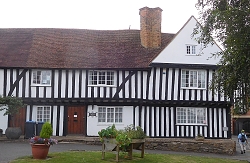
The former inn, a lovely half-timbered edifice is now a private house, named ‘Guy Fawkes House’, even though the famous man never lived there. The rest of the village contains several old thatched cottages, a thatched bus shelter, and the old village stocks. Close to the town of Rugby, this village is well worth a visit.

A pillar box

In Britain, posting boxes for letters and small packages are sometimes referred to as ‘pillar boxes’

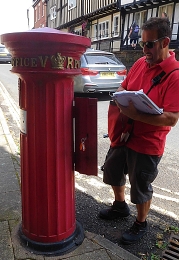
While visiting the town of Warwick, famous for its castle, we spotted a letter box that is truly a pillar box.

This post-box (pillar box) is shaped like a classical pillar. It was made in cast-ron in 1856 and is one of two of this design in the town of Warwick. They are still in use.

An artist in Germany, Norway, Scotland, Isle of Man, then Somerset

AN UNUSUAL CRUCIFIX hands within the church of St Mary in Bruton, Somerset. It is a sculpture typical of early 20th century German Expressionism, yet it was created in 1969, long after the heyday of this artistic trend. The creator of this religious sculpture was Ernst Blensdorf (1896-1976). He was born Ernst Müller in North Germany, but after his marriage to his first wife, Ilse Blensdorf, in 1923, he changed his surname to ‘Müller-Blensdorf’, then later to ‘Blensdorf’.

At first, Blensdorf became a seaman. After having been interned as an enemy alien by the British during WW1, Ernst travelled to Johannesburg in South Africa with a fellow internee. It was here that he made a table-top wood carving of an African village. On his return to Germany, this fine carving persuaded Ernst’s father that his son had a future as an artist and was willing to support him towards this aim. While in Africa, Ernst had seen African art first-hand and exposure to this certainly helped influenced his future creations.

After a brief spell at an art school in Barmen, he left to become apprenticed to a master joiner. By 1922, he had become a journeyman for a furniture company, which specialised in manufacturing luxury items. During this period, he was influenced by the Bauhaus artist Paul Klee and the sculptor Alexander Archipenko. The skill that Ernest acquired and developed whilst manufacturing wooden objects for the furniture company became useful as he moved from applied craftsmanship to artistic endeavours. In addition to other activities, he taught at the art school in Barmen during the 1920s. By the 1930s, he had become an established sculptor and had exhibited his works at various exhibitions in Germany, where he received both private and public commissions.

When the Nazis took power in Germany, Blensdorf became one of the first artists whose works were categorised as ‘degenerate’ by Hitler and his regime. This led to him losing his teaching post at Barmen and his studio being wrecked by the Nazi’s loutish followers. Ernst, his wife, and children, moved to Norway, where he was planning a giant peace monument to honour the Norwegian statesman and Nobel Peace prize winner Fridjtof Nansen. In Norway, he worked on this project and made a living creating and selling artistic ceramic works, alongside the Norwegian ceramicist Eilif Whist. 

When the Germans invaded Norway in spring 1940, Blensdorf and his children fled to Scotland. His wife, Ilse, remained behind, saying that she was a follower of Adolf Hitler. Following his arrival in the UK, Blensdorf was once again interned as an ‘enemy alien’. Along with many others, including a good number of men with artistic talent and German nationality, he was interned on the Isle of Man (from 1940 to 1941). His children were placed in a couple of orphanages. While interned, he, along with fellow artists, were allowed to satisfy their creative urges and even to sell their creations. Using whatever materials he could find during this period of scarcity, Blensdorf’s creative output was impressively large. For the first time in his life, he had plenty of time to undertake artistic work in the absence of anxieties such as he had experienced before arriving on the Isle of Man.

Blensdorf was released from internment in 1941. He went to live with an Austrian couple, the Schreiners, whom he had met in the internment camp. They lived in Charlton Musgrove in Somerset. With him, the Schreiners planned to set up an art school, but this failed for financial reasons. Ernst remained in Somerset. His first job was teaching pottery at a school in Bratton Seymour. It was here that he met his second wife, Jane Lawson. They married in 1942 and moved into a house near Wincanton, where they were joined by his children. Blensdorf taught in various schools in Somerset including the King’s School in Bruton.

In 1943, Blensdorf and his family bought a run-down 17th century house close to Bruton. Gradually, the house was restored and improved. It remained his home for the rest of his life. Although he exhibited often and in prestigious venues, Blensdorf never realised the great reputations that other artists, such as Henry Moore, Elizabeth Frink, Anthony Caro, and Barbara Hepworth, gained in the UK and beyond. For this reason, seeing his work for the first time during my first visit to the lovely Bruton Museum in July 2021, was a wonderful surprise and an exciting eye-opener.  In one corner of this small museum, there is a large glass cabinet that contains examples of Blensdorf’s sketches, ceramics, and sculptures. When I told the lady, who was looking after the museum, how much I liked what I had seen of his works, she told me about the crucifix in the local church, which fortunately I was able to see. She also sold me a copy of a well-illustrated catalogue of an exhibition of his works that was held some time ago in the Bruton Museum. It is from this publication that I have extracted much of the information above. Bruton is a gem of a town. Visiting its museum is a ‘must’ because not only does it allow you to ‘discover’ the works of Blensdorf but also to see a display of artefacts relating to the author John Steinbeck, who lived close to Bruton between March and September 1959 … but that is another story.

Shifted to Somerset from London

EVERY YEAR SINCE 2000, excepting 2020, The Serpentine Gallery in London’s Kensington Gardens has erected a temporary summer pavilion. Each pavilion is designed by a different architect or group of architects. What they have in common is that their pavilion is the first of their designs to be constructed in London, or maybe the UK. They stand in front of the Serpentine Gallery during the summer months and into early autumn. They are always fascinating visually and always contain a café with seating. Over the years some of them have been used as event spaces.

At the end of the season, the pavilions are dismantled and are never seen again in Kensington Gardens. Some of them might be sold and others re-erected elsewhere, but until recently I have never seen one again.

A few years ago, a contemporary art gallery, Hauser and Wirth, which has a branch in London’s West End, bought a farm on the edge of Bruton in Somerset. They have used some of the farm buildings and constructed some new ones to accommodate another branch of their gallery. In addition to the exhibition spaces, there is a superb restaurant, an up-market farm shop, and a wonderful garden created by the Dutch garden designer Piet Oudolf (born 1944).

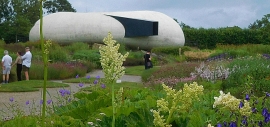
The garden slopes upwards from the gallery. At the top of the slope, there is something that at first sight looks like a giant hamburger patty or the profile of an oversized bagel. I recognised it immediately as being one of the former summer pavilions that once stood next to The Serpentine Gallery in Kensington Gardens. It is the 2014 Serpentine pavilion designed by Smiljan Radic (born 1965 in Santiago, Chile).

When I saw it in London in 2014, I was not overly impressed by it. However, seeing it at Hauser and Wirth in Somerset, it looks great. My description of it as an oversized bagel is not too far from the truth. It is, basically, an annular structure like a ring or a bagel, but it is far more interesting than that. Supported on rocks, the ring is not in one plane, but it undulates gradually. Irregularly shaped holes in its translucent skin provide intriguing views of Oudolf’s garden, which looks good in all seasons, and the surrounding hilly Somerset countryside.

A visit to Hauser and Wirth in Somerset makes a fine day out even if you have only a scant interest in contemporary art. The food served in the restaurant is of a high quality and not unreasonably priced. The buildings on the estate are lovely and the garden is hard to beat for its beauty.

Eating ice cream in an old harbour

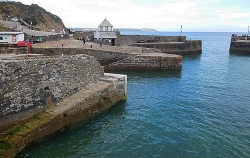
CHARLESTOWN IN CORNWALL should not be confused with the dance named after Charleston in South Carolina, as it is just south of the Cornish town of St Austell. The latter, named after a sixth century Cornish saint, St Austol, was first associated with the tin trade and then with the China clay industry, which burgeoned after the material was discovered in the area by William Cookworthy (1705-1780) in the 18th century.

In 1790, only nine families lived in the tiny seashore settlement of West Polmear, a fishing village just south of St Austell. A year later, much was to change in this little place. For, in 1791, Charles Rashleigh, a local landowner, began building a dock at West Polmear, using designs prepared by the engineer John Smeaton (1724-1792), who is regarded by many as ‘the father of civil engineering’. By 1799, a deep-water harbour with dock gates had been constructed. The water level in this dock was maintained by water that travelled in a ‘leat’ (artificial channel) from the Luxulyan Valley, some miles inland. The harbour was fortified against the French with gun batteries.

Named after nearby Mount Charles, the Charlestown harbour was used first for loading boats with copper for export, and then later with China clay, also for exportation. Charlestown prospered during the rapid expansion of the Chana clay industry that lasted until the start of WW1. By 1911, the former fishing village, by then Charlestown, had a population of almost 3200. Between the end of WW1 and the 1990s, Charlestown continued to be a port for exporting clay, but rival ports and the use of ships too large to be accommodated, led to its gradual decline. Now, the lovely, well-preserved 18th century harbour has become a tourist attraction and a home for a few picturesque tall ships. It is also used occasionally as a film set.

We visited Charlestown on a warm, sunny, late June afternoon. After exploring for a while, we homed in on an ice cream stall, a small hut with a pitched roof tiled with slates, located above the northern end of the dock. After queuing for what turned out to be first class ice cream, we sat at a table near the stall to enjoy what we had ordered. It was then that I noticed that some of the tables and chairs were standing on a vast cast-iron plate, which was covered with geometric patterns and some words, which I examined. My suspicion that this plate had once been part of a weighbridge was confirmed when I noticed the words: “20 tons.  Charles Ross Ltd. Makers. Sheffield”. I checked this with the ice cream seller in his stall. He told me that his stall had been the office of the officials who used the weighbridge and pointed out that there was another weighbridge nearby. I found this easily. Its metal plate bore the words: “Avery. Birmingham-England”, Avery being a well-known manufacturer of weighing machines. And the hut that used to be used by the officials now sells a range of snacks.

After eating our ice creams and examining the former weighbridge plates, a trivial thought flashed through my mind: by consuming ice cream at this stall, we were putting on weight at the weighbridge.

A recycled telephone kiosk

RURAL TELEPHONE BOXES (kiosks) are often used (re-purposed) to house AED defibrillators and small book libraries. Occasionally, they still contain coin-operated telephones. We were driving through rural Cornwall between Bodmin and Luxulyan, when we took a wrong turn and drove along a small lane. After making a three-point turn, I spotted an old telephone box partly covered with vegetation. Its original glazed door had been replaced by a wooden one that was quite out of keeping with the box’s elegant design. The present owner of the telephone box has been using this as the entrance to his or her garden. I was pleased to make find this quirky modification of an old telephone kiosk.

Gone for a barton in Bruton

BRUTON IN SOMERSET lies along the River Brue. Most of the old town is high above the river on its steep banks. Narrow passageways run along the steep slopes, connecting the High Street with the riverbank below. These steep passageways in Bruton are called Bartons. The word ‘barton’ means ‘farmyard’ in Old English. However, why these passages are called ‘bartons’ in Burton is a bit of a mystery despite the fact that there used to be farmsteads close to the town.