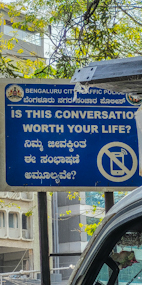
Please ask yourself
If phoning while driving
Is so very important

Please ask yourself
If phoning while driving
Is so very important
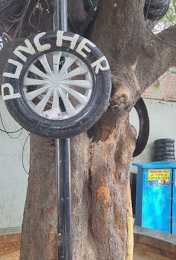
WHEN I FIRST visited India – that was in January 1994 – I carried my British and International driving licences with me. Boldly, I drove in the heavy traffic and densely crowded streets of the busy City Market area of Bangalore and also all the way to Ootacamund (‘Ooty’) – over 270 Km, and that was before the highway was constructed. You can share in these experiences by reading my book about travels in India, “The Hitler Lock & Other Tales of India”. This book/kindle is available from Amazon (https://www.amazon.co.uk/HITLER-LOCK-OTHER-TALES-INDIA/dp/B0CFM5JNX5/ ), and IF you live in India, from: https://store.pothi.com/book/adam-yamey-hitler-lock-and-other-tales-india/ .
ON THE FIRST OF August (2023), we went to one of our favourite kebab shops – Raavi in London’s short Drummond Street (near Euston station). There was a large Datsun saloon car parked outside Raavi, and another across the road. Neither of them was in pristine condition. Both were covered with stickers, and each had Kuwaiti registration plates. On the front bonnet of each of them were the words:
“Kuwait to Paris to London 2023”
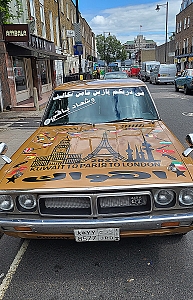
Beneath these were words in Arabic. Above the word ‘Kuwait’, there was an image of London’s Big Ben. Above ‘Paris’, there was an image of the Eiffel Tower, and above ‘London’, there was a picture depicting some Kuwaiti landmarks. In Arabic, one reads from right to left. Therefore, reading the Arabic way, the images depict: Kuwait to Paris to London’.
On each of the car’s bonnets, there were flags of different countries and either a boat or an arrow between neighbouring flags. Reading the bonnets from right to left, the route taken by the intrepid drivers of these cars was as follows:
By sea from Kuwait to Turkey; by road from Turkey to Bulgaria to Romania to Hungary to Slovakia to Poland to Holland to Czech Republic to Austria to Belgium to Germany to Italy to France to England to Spain. Then, by ship to Morocco.
The order of the countries seems a little odd. Maybe, a few have been omitted. Because there is an arrow rather than a ship between France and England, and between England and Spain, I guess that the cars travelled through the Channel Tunnel.
I do not know why these cars were parked in Drummond Street, but whoever drove them had made a journey that I am sure I would have enjoyed.
THE GREAT SAMUEL Johnson (1709-1784) is supposed to have said to James Boswell on the 20th of September 1777:
“Why, Sir, you find no man, at all intellectual, who is willing to leave London. No, Sir, when a man is tired of London, he is tired of life; for there is in London all that life can afford.”
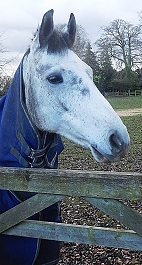
Now, 245 years later in 2022, I largely agree with Dr Johnson, but not completely. Every now and then, it is wonderful to leave London in search of the open countryside, fresh air, wide expanses of sky, and a different way of life. Equally, it is satisfying to return to the city feeling refreshed and, sometimes, having been away from it, seeing familiar things in a new light. Our excursions from London have ranged from several months to several hours. The latter, shorter outings, have been invaluable during the recent period when because of covid19 travelling abroad has been difficult, to say the least.
One of our current favourite destinations for brief outings is the tiny village of Abingdon Piggots in southern Cambridgeshire. Although it is only about 90 minutes’ drive from central London, it feels as if it is almost in a different world from the metropolis. Despite being close to Baldock and Royston, the village seems as if it is in the deepest countryside. It has not more than 60 well spread-out houses, a church, and a hostelry called the Pig and Abbott.
The Pig and Abbott is run by Pat and Mick. It is a traditional country inn where one can enjoy a drink as well as eating superbly cooked, tasty food. We have visited the pub at least six times since we first discovered it in July 2020. Each time we go there, we are welcomed like old friends. I suppose we have become regarded as ‘regulars’. Mick told me that most of the regulars come from the area around the village. Of the 60 or so households on the village, only about 10 use his pub. I asked him whether we were amongst his furthest customers. He told me that we were, but one of his regulars, who lives in Alaska, always drops in when he visits Cambridge, where he has work colleagues.
After a hearty meal at the Pig and Abbott, we always take a stroll along Church Lane to see the small church in which there are graves of members of the local Piggott family. The lane is flanked by fields in which one can watch sheep and horses grazing. There is hardly any sound to be heard except birdsong.
Pleasant as is this bucolic scene, it would not suit me to live in it for more than a day or two. I am an urban creature at heart and the humdrum of city life suits me well. My childhood was spent amongst gardens and trees in the Hampstead Garden Suburb in north London, yet I never enjoyed the place as much as central London, which I began visiting with my parents at a young age. I guess that although I enjoy my occasional forays outside London, I cannot disagree with what Johnson said to Boswell all those years ago.
WE DROVE TO BUXTON from Macclesfield, crossing part of the Peak District, which was shrouded in dense morning mist despite it being mid-September. The town, once an important spa, is delightful. Its centre is rich in Victorian buildings, as well as some 18th century edifices, such as The Crescent, now a hotel. In appearance, the Crescent, which was built for the 5th Duke of Devonshire between 1780 and 1789, rivals the fine crescents found in Bath. Another notable structure in Buxton is The Dome, now a part of the University of Derby. This huge dome was built to cover a stable block for the horses of the 5th Duke, which was constructed between 1780 and 1789 to the design of John Carr (1723-1807). The dome itself, which is 145 feet in diameter and larger than those covering Rome’s Pantheon and St Peters, was added between 1880 and 1881, by which time the building it covered was being used as a hospital. It is the second largest unsupported dome in the world.
In common with great cities such as Vienna, Milan, Paris, Manaus, London, New York, and Sydney, tiny Buxton also can boast of having an opera house. Located next to a complex of Victorian glass and iron structures including a plant conservatory and the Pavilion with its attached octagonal hall, the Opera House was designed by the prolific theatre architect Frank Matcham (1854-1920) and first opened its doors to an audience in 1903. Live theatrical performances, not confined to opera, were held there regularly until 1927, when it became a cinema. Between 1936 and 1942, the Opera House, although then primarily a cinema, hosted annual summer theatre festivals, two of which were in collaboration with Lillian Baylis (1874-1937) and London’s Old Vic Theatre company (https://en.wikipedia.org/wiki/Buxton_Opera_House). In 1979, the theatre was restored, and an orchestra pit added. Since then, the Opera House puts on a programme of live performances, which include a little bit of opera. Unfortunately, during our visit to Buxton, the auditorium was closed, but we did manage to enter the lovely foyer with its mosaic-bordered floor and its ceiling painted with a scene evoking the style of 17th and 18th century painters.
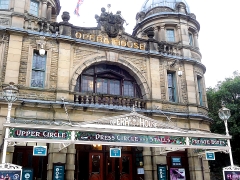
The Opera House, the Crescent and the Pump Room opposite it, and The Dome, all add to the charm of Buxton. They are all close to a lovely park, through which the River Wye (not to be confused with the river with the same name in Wales) runs through. Buxton’s Wye flows into the North Sea via the River Humber. High above the park, runs the High Street, where we stumbled across a fabulous bookshop, Scrivener’s, which boasts five floors packed with books, many of them second-hand or antiquarian. So, if it is literature (fiction and non-fiction) rather than drama that appeals to you, this shop is a place that must be visited.
It was well worth winding our way across the hills to Buxton through the low clouds, which made visibility very poor. The town is filled with interesting things to see, some of which I have described above. However, it was the Opera House that intrigued me most. Had it been given a name other than Opera House it might not have fascinated me quite as much. That a town or city can boast an opera house, gives the place a certain ‘caché’ that places, which do not possess one, lack.
MY PARENTS, ESPECIALLY my mother, were keen that I learned to swim. It took me a long time to learn this activity. For many years, I was taken to various indoor pools to take lessons with a variety of swimming teachers, some professional and others not. One of the latter was a young Asian lady, who gave me a few lessons in the pool at the White House. This was not the famous establishment in Washington DC but a 1930’s apartment block, now a hotel, near Great Portland Street Underground station in London.
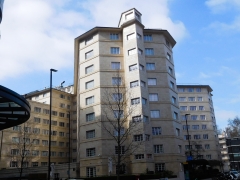
The teacher, who had no success with getting me to swim, lived in the White House and was recommended to my parents by another resident, a family friend, whom we knew as ‘Sakki’. Like my parents, Sakki was born in South Africa and my father told me that his family and Sakki’s were either remotely related and/or in business together. Both Sakki and my father were on the academic staff of the London School of Economics (‘LSE’). Sakki was the anthropologist Professor Isaac Schapera (1905-2003). He had become an expert on the anthropology of indigenous people of Botswana and South Africa. Amongst his many published works was “The Khoisan Peoples of South Africa”, published back in 1930.
Apart from providing me with one of my many swimming instructors, Sakki took a great interest in my sister and me. He gifted me several books, amongst which was several books about the adventures of Hergé’s cartoon character Tintin. These were in French and were volumes that were at the time neither available for sale in the UK nor translated into English. When I graduated with my PhD in 1976, he presented me with a two-volume book about magic, myths, and science.
In the very early 1960s, Sakki joined us on a family driving holiday in France in our smallish Fiat 1100. My mother, who had been involved in a serious car accident in the 1930s, had installed seatbelts in our car, a rare thing for the time. Sakki had to travel in the rear seat with my sister and me. Sakki had his own seatbelt (lap design), and my sister and I were strapped together in the other belt, separated from each other by a pillow. It soon became obvious to my parents that Sakki was not enjoying being confined in the rear of the car with two young children. My parents solved the problem by stopping at regular intervals at roadside cafés so that Sakki could enjoy a glass of cognac. This seemed to help him tolerate the journey, about which I remember little else.
During my childhood, Sakki was a regular visitor to our family home. He used to amuse us kids with comical verses, only one of which I can remember. It sounded to my ears something like this: “Olke, bolke, reeby, solte. Olke, bolke, knor.” While writing this piece, I looked for this on the Internet, and now know that what he was telling us was the words of an Afrikaans song that goes:
“Olke bolke Riebeeck stolke, olke bolke knor…”
Well, now, many years since I last saw Sakki, I know that what he was telling us was not his invention, as I had always believed as a youngster.
Sakki underwent surgery on his vocal cords. This affected his speech badly and drove him to avoid socialising in his later years. However, he did visit our home on at least one occasion after his voice had been affected. I was a young teenager then and I can still remember that when he spoke, all that one could hear was a hoarse, rasping, whisper. After conversing with me for a few minutes, he said to me:
“You don’t have to whisper just because I am talking so softly.”
And then he added:
“I have noticed that everyone with whom I talk gradually lowers their voice to a whisper whilst they converse with me. It is strange how the loudness of my voice affects that of people who are talking with me.”
That people unconsciously adjust their voices to match that of their interlocutors made a great impression on my young mind, and I have never forgotten it.
I do not believe that I ever met Sakki again between 1976 and 2003, when he died. By then, the White House had almost completely changed from being an apartment block to becoming a hotel. Sakki lived there until he died and was one of the place’s last full-time residents from the time before it became a hotel with a few flats.
And, just in case you are wondering, I did learn to swim eventually, not at the White House but in the pool of the old YWCA near to Tottenham Court Road station.
ONE OF THE JOYS of travelling around in one’s own car is the ability to go almost anywhere one wishes and by any route, direct or indirect. Recently, we were driving along the A1141 between the Suffolk wool towns of Lavenham and Hadleigh when we noticed a small brown and white sign directing tourists to “St James Chapel”. We turned off the main road and drove along a narrow, winding by-road, which threaded its way through cultivated fields and small clumps of trees. We had no idea where the chapel is located and it was almost by chance that we noticed the small building, which is located well away from the lane. The best view of this tiny edifice is through a farmyard next to which it stands, otherwise it is well concealed by tall hedges.

Maintained by English Heritage, the chapel is approached via a narrow L-shaped passage between it and the hedges. A board close by gives the history of the place. The tiny 13th century chapel served the nearby Lindsey Castle, which was abandoned in the 14th century and now exists only as earthworks (www.heritagegateway.org.uk/Gateway/Results_Single.aspx?uid=384905&resourceID=19191). During the 13th century, a lady called Nesta de Cockfield (c1182-c1248; https://our-royal-titled-noble-and-commoner-ancestors.com/p5161.htm#i154959), who was born near Lindsey Castle at Kersey, established a tithe (tax) to maintain the chapel of St James. Along with all other chantries (usually, chapels on private land), St James was closed in 1547 as part of the religious reforms instigated by King Edward VI.
The chapel was used as a barn from 1547 until the early 1930s, when it became designated as a historic monument. The building is built with roughly cut flints held together with mortar or cement. The entrance with its gothic archway and the windows are trimmed with well-cut stone blocks. The interior walls are not plastered and look the same as the exterior. On the south wall there is a niche or ‘piscina’ (used for draining water used in the Mass in pre-Reformation church services), which, like the windows, is topped by a gothic arch. Apart from the piscina, there is nothing else left within the chapel apart from the ghosts of those who prayed there many centuries ago.
The ceiling of St James is formed of the exposed timbers that support the roof, which is attractively thatched, and looks well-maintained. The north wall of the chapel faces the road across the car park of the farm next door to it.
Without a car or bicycle or horse, reaching the tiny chapel of St James would involve a tiring walk. Without a car and plenty of leisure time we would most likely never have visited this delightful remnant of East Anglia’s rich mediaeval heritage.
WE LIVE IN A SMALL flat without neither garden nor a balcony, but near the centre of London and two large parks. For several years, we used to drive to France, where we hired country houses in rural locations from an organisation called Gîtes de France. A ‘gîte’ is essentially a furnished house available for rent to holidaymakers.

The organisation used to issue handbooks listing the houses available in various regions. Each home is given a category between the lowest 1 and the highest 3 ‘épi(s)’ (ears of corn). When we planned our trips, we used to choose from the houses on offer in the 3 épis grade. We had several criteria that determined our choice of holiday home. First, it had to have at least 100 square metres of usable space because we wanted to experience living in a spacious place for at least one week per year. Second, it had to be equipped with machines both for both clothes and for dishes. In addition to fulfilling these requirements, there was one more thing we always wanted: a barbecue.
My wife had hired gîtes before we married, which is why we considered doing this for our family holidays. The first one we hired was in a small village, Poilly-sur-Serein near the famous wine-producing town of Chablis in Burgundy. The building was easily large enough to house my wife, her parents, who had flown over from India, our daughter, and me. We used the barbecue almost every evening, preparing vegetarian kebabs for my in-laws and meaty ones for the rest of us. Staying in Poilly-sur-Serein whet my appetite for trying other gîtes.
One April, we hired a lovely house in the south of Provence, not far from Orange. It was next to a cherry orchard and had a large garden. We could not use the garden much during the day because that year there was a heatwave in the south of France. Temperatures were hovering around 37 degrees Celsius and the best place to be was in our air-conditioned car, in which we explored the local and not so local sights.
One of our favourite hires was also in the south of France, in the Aveyron region. The house was located inside the walls of the ruined Templar’s castle at St Jean d’Alcas, which is but a few miles south of Roquefort-sur-Souzon, the centre of Roquefort cheese-making. We visited the small town of blue cheese fame several times and ate some meals in its restaurants. At one of these, a cheese trolley bearing thirteen different types of Roquefort was wheeled to our table. Although they looked alike, our waiter patiently explained the characteristics of each before advising us that it was best not to select more than four of them on a plate at any one meal. At another eatery in the town, I could not resist sampling the ‘Menu Roquefort’, a three-course lunch consisting of dishes that included the town’s famous blue cheese. My starter was an omelette which incorporated the cheese. This was followed by meat in a sauce based on Roquefort. The dessert was a Roquefort soufflé. Although this might sound heavy, it was not because whoever prepared it was a good cook with a light touch.
The gîte at St Jean d’Alcas was so lovely that we hired it a second time, a year after our first visit. During the second stay, there was a grand celebration in the tiny village. It was probably Bastille Day. Long tables were set out in the lane running alongside our house. In the evening, we were invited to feast with the locals, who had flocked in great numbers to the usually deserted village. We joined the friendly crowd seated at the tables and were offered one of two main courses. On offer from huge cooking vessels, there was either tripe in a delicious sauce or grilled local sausages. It was a fine occasion with unlimited wine. The following morning, the tables and benches had disappeared, and the picturesque village had returned to its normal sleepy state.
There was only one shop in St Jean d’Alcas and its merchandise was limited in range but delicious. It sold bottles of a liqueur like ratafia, but with a different name. Apart from that, we had to buy our food supplies elsewhere, mainly in street markets and supermarkets. Shopping for daily needs was one of the many attractions of having our own home away from home.
One curious feature common to all the gîtes that we hired was that each of them had only one toilet/bathroom however large the building. In 2000, we hired a large house in the Haute Loire at a tiny village with a ruined castle, Arlempdes. Its location next to the castle walls was wonderful. It overlooked a sharp curve in the river. This four-storey building had accommodation for eleven people, but only one toilet and shower. Both were inconveniently located in the basement of the gîte. Had there been eleven of us, or even just five of us, having only one toilet would have been extremely inconvenient. As we were looking for extra space to enjoy, this property more than fulfilled our requirements.
We gave up driving through France several years ago. Most of the places we wanted to visit were more than a full day’s tiring drive across France. On the way out, this did not matter as we had an exciting holiday to enjoy. But the return journey was never much fun. There was the long drive through France towards the English Channel, much of which involved driving through the often-dreary areas of the northern part of the country. Then, there was a shorter but much more exhausting ‘schlep’ through Kent and south-east and central London … and the prospect of returning to work. By the time we reached our tiny flat, we were ready for another holiday.
SINCE THE FOURTH OF JULY 2020, the anniversary of the day Britain lost a large American colony and when our worldly wise Prime Minister deemed it safe for all of us to be liberated from the constraints of ‘lockdown’ and encouraged us to ‘eat out to help out’, a policy that appears to have helped to spread the covid19 virus as well as restaurant owners, we have been roaming around the countryside, discovering what a beautiful country we inhabit. What has struck me when driving from A to B is the number of exceptionally attractive, yet not well-known, villages we have passed through. The village of Comberton in Cambridgeshire was one of these, which we nearly drove past without examining it. However, as time was on our side and it looked so lovely, we stopped there for a few minutes and took a stroll around.
We parked next to an oddly shaped small village pond in which clumps of reeds were growing. A small family of ducks wound its way between the vegetation, occasionally disappearing from view. At the far end of the pond, there is an old low brick wall. Behind it, there is a long two-storey house with a brick roof and decorative chimney stacks. Before describing some of the other lovely buildings in the village, let me give you a flavour of its history.
Sometime between 4000 BC and 2500 BC, someone dropped a polished Neolithic stone axe near where the village stands today. Somewhat later, the Romans built a villa near Comberton. Even later, the village’s name began to evolve, as is described on the village’s website (http://www.comberton.org/home/about-comberton/history-of-comberton/):
“A lot is said about the name of the village and its origins. It is believed that the name is of Celtic origin, possibly named after a landowner by the name of Cumbra. The Domesday Book (1086) has it recorded as Cumbertone. According to William Kip’s map of the area in 1607 Comberton is spelt as it is today and interestingly Barton is spelt Berton”
The village has several churches, which we will visit in the future. One of these is St Mary’s, is in the Early English style with later modifications. Another still extant place of worship is used by non-Conformists. There have been associations between non-Conformism and Comberton since as early as the 17th century. The Puritan William Dowsing (1596-1668), an iconoclast, visited the village in March 1643, and recorded:
“‘We brake downe a crucifix and 69 superstitious pictures we brake downe, and gave order to take downe 36 cherubims, and the steps to be taken down by March 25.’”
Prior to 1772, when a new road, a turnpike (now the A228), was built, Comberton was on the road connecting Oxford with Cambridge. Apart from the usual activities found in villages, such as butchery, bakery, saddlery, harness-making, inn keeping, blacksmithing, and so on, the place had one industry for a while. That was in the 19th century when Comberton became a small centre for mining coprolite, fossilised dung. This material used to be ground in a mill to produce a powder that made a good crop fertiliser. Judging by the good state of the houses and the high-quality cars parked near them, the inhabitants of Comberton appear make their living in reasonably well-paid jobs. Were I to have had a profitable career in or near Cambridge, this village might have been a good place to live.
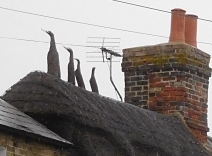
Every village is unique, but many share the same features. In Comberton, we saw several houses with well-maintained thatched roofs. However, we also saw something I had never noticed before. Some of the houses had what you might describe as ‘hybrid’ roofs: partly thatched and partly tiled. One house near the village pond had something we have seen on thatched roofs in many other villages. That is, the ridge of the thatch is decorated with animals made of thatch. Here in Comberton, this one roof was adorned with thatch sculptures of four birds with long necks, that made me think they are supposed to be depicting geese rather than ducks or swans.
The village pond, which is across the road from a dental surgery and ‘Millionhairz’, a hairdresser’s salon, is encircled by an attractive low, neatly built stone wall that curves around the water in a visually pleasant way. On the green next to the pond, there is a timber post that supports a sign (erected 1977) with the name of the village and a two-sided picture above it. On one side, a priest is depicted handing fishes to three people with outstretched arms. This refers to years long past when herrings were handed out to the poor in the village soon before Easter. The other side of the picture above the village name depicts a farmer ploughing his field with a plough drawn by a horse. Behind the farmer high on a hill, there is a white coloured wooden windmill. This reminds us that once Comberton had two working mills.
Our visit to Comberton lasted no more than ten minutes partly because we had to reach somewhere to meet my cousin and because the weather was miserable: grey, cold, and wet. However, what little we saw of this delightful place made us realise that it was well worth stopping en-route to our destination. We have already driven through so many intriguing villages on our excursions through the English countryside. I would have liked to spend time in all of these, and hope to return to some of them in the future. I would rather spend time wandering around picturesque villages than sitting for hours in traffic jams, as happens so often these days.
‘PIERRE’ IS A FRIEND of my father. He and his American wife Bobbie lived on the outskirts of Paris with their lively intelligent children. I went to stay with them over Christmas when I was about 16. After a rough crossing of the English Channel and a long train journey, I arrived at the station near where they lived. Pierre met me there and whilst driving me home told me that he had a high temperature. He disappeared leaving me at the front door, where the family’s unruly dog wrapped his jaws around one of my wrists.
Bobbie greeted me, and then took me into the kitchen. I was tired and completely unprepared for what I was to experience. The work surfaces in Bobbie’s kitchen were higher than my shoulders. I felt as if I had shrunk. I wondered whether the rough sea voyage had affected me in some strange way. But this was not the case. Bobbie, who was tall, explained to me that she had had the kitchen constructed in such a way that she would not need to bend her back whilst working in it. My hands could hardly reach the work surfaces, but her energetic children had no difficulty; they climbed up onto them and ran along them with great agility. As Bobbie showed me around the rest of the house, we passed a bedroom where Pierre was shivering feverishly in bed under his sheets and blankets. I wondered whether he was going to be fit enough to embark on the trip to the French Alps that we were supposed to be making on the next day.
On the day after I arrived, Pierre was still extremely unwell. A doctor visited him that morning and gave him some medicine. At 3 pm that late December day, we decided to set off on our more than 400-mile journey. The journey began badly. After driving a few miles along an autoroute, Pierre realised that we were on the wrong motorway. We drove in reverse at hair-raising speed back along the way we had come until we reached the motorway junction where we had chosen the incorrect road, and then we joined the correct highway. At about midnight, we stopped for dinner at a motorway restaurant near to Bourg-en-Bresse. Then, we drove upwards into the Alps.
After passing through Albertville at about 2 am, we drew near to our destination Méribel-les-Allues. Then, we lost our way. The place to which we were heading was one of several settlements that made up the locality known as Méribel. By now, Pierre, who was driving and still unwell, was becoming exhausted. He and Bobbie began arguing. The children were fast asleep. As we drove around aimlessly along the dark winding snow lined alpine roads, I realised that we were going around in circles. However, I did not want to risk my hosts’ ire by suggesting this. After a little thought, I volunteered as tactfully as possible:
“I believe that when we go around this bend, we will pass the Hotel de La Poste again.”
And, sure enough, we did. My hosts realised that we were in fact going around and around the same roads, and soon after that, we reached our destination at last. It was a holiday colony owned by the ministry for which Pierre worked.
I was accommodated in a dormitory for young men and my friends shared a family room. The place where we were staying was for the exclusive use of employees of the ministry and their close families. So, soon after I arrived, some of the others in my dormitory asked me why I spoke English rather than French and also why the woman with whom I dined and spent time spoke ‘American’. Atypically for me, I rapidly improvised an answer that seemed to satisfy them. I told them that Bobbie was my aunt from Canada and that she spoke both French and ‘American’.
Some years later, Bobbie came to visit us in my parents’ home in London. It was a hot summer’s evening. She was expected to join us for dinner at a particular time but arrived about an hour and a half late. When my mother went to open the front door for her, we all heard a long sigh and then we could hear Bobbie asking whether she could use my parents’ bedroom before joining us. When she arrived at the table, she presented my mother with a gift from Paris. It was a box of instant soup powder. The sachet containing the powder had been torn open. Bobbie explained that she had opened it to check whether it contained exactly what she wanted to give us. Then, she apologised to my mother for losing the other gift that she had brought for her.
She told us that to avoid injuring her bad back by carrying heavy baggage she had worn all of the clothes that she was going to need for her short stay in England, wearing layer upon layer. While she was travelling on the Underground to reach our home, she had begun to feel unbearably hot. So, she un-wrapped my mother’s other present, a bottle of perfume spray with a bulb for pumping it. At this point I must tell you that, at the time, London was the target of many IRA bombs, and the public had been told to be vigilant. So, when the passengers sitting near to Bobbie saw what looked a bit like a hand grenade, the squeezable bulb attached to the perfume bottle, they moved away from her. She told us that seeing this, she panicked and threw the perfume spray away from her, and it had broken on the floor.
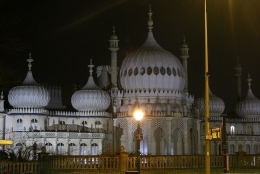
After dinner that evening, she and I set off in a car, which she had been lent. It belonged to a man whom she had asked us to invite for dinner with her that evening. He drove us to where he lived in London and left us his car. Then, Bobbie began driving the two of us towards Brighton, where the rest of her family were staying in a borrowed house. As soon as we got onto the motorway just south of London, we were engulfed in dense fog. It was then that Bobbie admitted that she was wearing the wrong glasses for driving. It was after midnight and I had not yet learnt to drive. So, I was unable to take over the driving. She asked me to keep an eye out for the line on the left side of the carriageway, and to tell her whenever we began to stray from it. Fortunately, when we reached Brighton, the fog had lifted, and we arrived at our destination intact.
I have lost touch with Bobbie and her family, whose identity I hope has been disguised adequately, but I still remember them fondly and should they recognise themselves, I hope that they will not mind me relating these memories of the many good times I enjoyed with them.
 yamey
yamey 