Shakespeare in the forest

BIG WOOD SEEMED large to me when I was a child. Although it does not live up to its name, it feels like a big wood once you enter it. Located in the heart of Hampstead Garden Suburb (‘HGS’), this woodland and the much smaller nearby Little Wood are quite ancient. They were part of a forest that was at least 1000 years old, part of land given to Wealdhere, who became Bishop of London late in the 7th century. The woods and surrounding land remained church possessions until 1911, when they were leased to the HGS Trust by the Ecclesiastical Commissioners. According to the londongardenstrust.org website:
“When Hampstead Garden Suburb was being planned in 1907, its instigator, Dame Henrietta Barnett, was committed to providing green spaces within the housing, planting trees and preserving those that existed. When additional land was acquired to extend the Suburb in 1911, Big Wood was leased from the Ecclesiastical Commissioners and preserved as woodland. In 1933 Finchley UDC took on the freehold.”

BIG 12

Stage and auditorium of Little Wood Theatre

There is a report that circus elephants used to be kept in a field that existed between Big and Little Woods before the construction of houses in this location (now Denman Drive North and South). Colin Gregory wrote (www.hgs.org.uk):

“Before leaving this story, we should pay our respects to one of the last occupiers of Park Farm: the circus proprietor Lord’ George Sanger … His descendants continued the circus in operation until the 1960s. It is said that when he owned Park Farm he allowed the circus animals to winter on his land. An elderly resident of Denman Drive – constructed in 1908 on what was once Westminster Abbey’s land – used to recall ‘elephants grazing’ in the field between Big Wood and Little Wood, before Denman Drive North and Denman Drive South – constructed in 1912 on what was once the Bishop’s land – were completed.”

We re-visited the woods recently on a hot sunny afternoon. We entered Big Wood from the end of Temple Fortune Hill. At this entrance to the tiny forest there is a wooden gate that was put up to commemorate the 29 residents of HGS who died during WW2.  I do not remember seeing this gate when I was a child in the 1960s. Often in those days, my friends and I used to play in the woods, which I recall as being dark and dingy.

Lopa and I walked leisurely from one end of Big Wood to the other along good paths in about five minutes. This made the wood seem far smaller than its name suggests. However, when we wandered off the main tarred paths onto the numerous dirt tracks, made uneven by semi-exposed roots, threading their way amongst the trees, tree stumps, broken branches, and clumps of stinging nettles, the wood seemed dense and dank despite the fine blue sky above the tree tops. Calls of hidden birds punctuated the silence.  On these small paths, we lost all sense of direction and managed to get lost within the tiny area of woodland.

We had asked some locals how we could reach Little Wood from Big Wood and they had told us to follow a certain path, which they pointed out. We set off along it, but it kept bifurcating every few yards and we were clueless as to which of the two branching paths was the one to follow to arrive at Little Wood. Eventually after going around in circles, we gave up and left Big Wood via Oakwood Road, which is appropriately named as many of the trees in the two woods are oaks. We entered Little Wood from Denman Drive North, the continuation of Denman Drive South. These differently named sections of the same stretch of road link the two woods and must pass close to the field where circus elephants once grazed.

Little Wood, whose history is the same as that of Big Wood, contains one of London’s lesser-known performance spaces, a small open-air theatre.  This was created in 1920 by the Play and Pageant Union, one of two drama groups that later merged to form the Garden Suburb Theatre. It was restored in 1997, and now looks like it would benefit from some more restoration. The stage is a clearing in the woods surrounded by trees and bushes. The audience sits on a circular stepped auditorium consisting of three layers of paving stones set in a curve around the stage.

The theatre in Little Wood occupies an important place in my memories of childhood. It was here when I was about ten years old, back in the early 1960s, that I first saw a performance of Shakespeare’s “A Midsummer Night’s Dream”. It must have been on a summer evening when I watched this with a sense of wonder that still lives with me. Apart from the odd logs, there were no other props. The actors and actresses appeared on, and disappeared from, the simple stage almost magically, popping through gaps between the trees and bushes surrounding the theatre.

I cannot begin to imagine what The Bard was thinking when he created The Dream, but I feel sure that he would have approved of its being acted out in on the sylvan stage in Little Wood. Furthermore, I think that he would have appreciated a play that contains six amateur actors in its plot being performed by a troupe of amateur actors such as we were watching that far-off evening. Since watching that play in Little Wood so many years ago, I have seen several other performances of “A Midsummer Night’s Dream”, and only one has given me as much pleasure as that. It was a recent staging of the play directed by Nicholas Hytner at the relatively new Bridge Theatre near London’s Tower Bridge. In that recent show, as the theatre’s publicity said:

“The theatre becomes the forest – a dream world of flying fairies, contagious fogs and moonlight revels.”

And, the result at the Bridge was more than wonderful, although seeing the play in a real forest (Little Wood, in my case) is hard to beat.

Returning to the little theatre in Little Wood the other day, though it was out of use during the Covid-19 pandemic, it kindled many happy memories. Although I had not visited that theatre for many decades, it looked just as I remembered it.

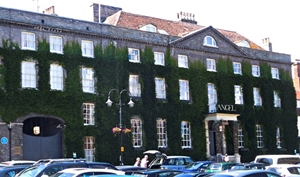
The Angel Hotel

BLOG BURY

SOME CLOSE FAMILY FRIENDS used to live in Cambridge. My father had known Cyril S, a ‘don’ at one of the older colleges, since they were both students at the University of Cape Town. Every now and then in the 1960s, we used to be invited to eat Sunday lunch with the S’s in their lovely Victorian house in Cranmer Road. The S family always kept Siamese cats. Their litter tray filled with a greyish coloured gravel occupied part of the black and white tiled floor of the spacious ground floor toilet close to the house’s main entrance. Whenever I used that toilet, I was always afraid that I might step into the litter tray that was usually studded with feline waste deposits. I do not think that I ever did intrude on that part of the cat’s territory.

On one occasion, Cyril invited us to see his rooms in the college. When we were leaving, he said that we could walk across the grassy quadrangle, instead of around it as most ‘ordinary mortals’ must. He told us proudly:
“This is one of the privileges of being a don. I am allowed walk across the grass and I can take my guests with me.”

We could have driven easily straight to Cambridge from our home in northwest London, but we did not. Instead, we used to spend the Saturday night before our Sunday rendezvous in the Angel Hotel in Bury St Edmunds, a small city in Suffolk.

In those far off days, the ivy-covered Angel Hotel opposite the Abbey Gardens was an old-fashioned provincial hotel. The rooms had a curious ‘safety’ feature. The reason I put the word safety in inverted commas will become obvious when I tell you about the feature. Each room had a harness next to its window. The harness was attached to a strong cord, which was connected to a winding mechanism. Had there been a fire, each occupant of a room would in turn fasten the harness around his or her waist, and then climb out of the window. The mechanism was designed to lover the person slowly to the ground outside. The lowered harness could be cranked back up into the room for the next person to escape. Long before we did, the author Charles Dickens stayed at the Angel.

As a child, I could not understand why it was necessary to spend a night in Bury St Edmunds, when the following day we could drive back to London without a stop-over. many years later, it dawned on me that we were not actually breaking a long journey, but it was a way that my parents enjoyed having a night away from home.

Yesterday, the 28th June 2020, we made a day trip to Bury St Edmunds. After eating exceptionally well-prepared fish and chips bought at the amusingly named ‘The Cod Father’ fish and chips shop, run by Bulgarians, we strolled into the centre of the city. The ivy-clad Angel Hotel stands opposite the impressive mid-14th century Abbey Gate. Passing through the Gate tower, one enters the Abbey Gardens. This attractive park is filled with strange looking fragments of what was once a huge abbey complex. Most of them look like oddly shaped piles of stones. They are the rubble cores of what had once been covered with carved masonry. The masonry that adorns the exteriors of mediaeval churches and abbeys is simply a covering for structural cores consisting of rubble and cement of some kind. On some of the fragments in the Abbey Gardens, it is possible to discern the slots into which the carved masonry was placed. However, most of the rubbly remains have disintegrated to become forms that give little clue as to their original shapes.

There is more to the city than the Angel Hotel and the gardens containing the ruins of the abbey. Near the Abbey, there is a cathedral, St Edmundsbury, surrounded by pleasant grounds. At one side of the grounds there is a well-preserved Norman gateway with splendid Romanesque architectural features and a pair of gargoyles that depict serpents with their forked tongues. In the centre of the lawns in the cathedral grounds, there is a fine statue of St Edmund clutching a cross close to his chest. This was sculpted in 1976 by Elizabeth Frink (1930-1993), who was born in Thurlow, which is near to Bury St Edmunds. Frink was a close friend of my late mother. I remember meeting ‘Liz’ at our home, where she was a regular dinner guest.

Seeing the Frink sculpture (for the first time) and the Angel Hotel yet again reinforced my long-held affection for Bury St Edmunds and revived happy memories of the place and our visits to the family of Cyril S, who died suddenly in 1974. His death deprived the world of a lovely man with a great sense of wit and humour.

Some years later, I was staying with Cyril’s widow in Cranmer Road, when she made me a Bloody Mary cocktail. It was the first time I had tried this delicious concoction, and hers was one of the best I have ever tasted.

Red rover

MY GRANDMOTHER LIVED a serene life in Port Elizabeth in South Africa. Born in the 1890s, she came with her parents from what is now Lithuania to what was then the Cape Colony. She married my father’s father in Cape Town. She raised four children and also helped her husband run a general store in Tulbagh, a small town, almost a village, near Cape Town. When her husband died young in 1931, she continued running the shop for a few years before marrying a widower who lived Port Elizabeth (‘PE’). Through this  second marriage, she acquired three stepsons and her fifth son. Hers was a tough life to begin with. By the 1960s, when the children had grown up and dispersed, she began living a quieter life in PE.

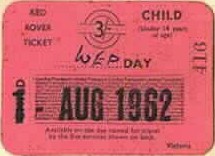
GRANNY red-rover-ticket john harper

Once every couple of years Granny used to visit her son, my father, and his half-brother in the UK. Although I met her when I was three years old, I only remember her from the time I was about nine. She used to sit in our ‘lounge’ (colonial term for ‘sitting room’) and did little except meet people. Every day in the late afternoon, she enjoyed a glass of whisky before the evening meal. It was in our home that she first ate bacon. My mother, although Jewish, was far from observant and was almost unaware of dietary rules. We ate ham and bacon regularly. She served bacon quite innocently to Granny, who had not encountered it before, enjoyed it, and appeared unperturbed to discover that this delicious food item was derived from pigs.

I was about ten when I suggested to Granny that we went on an outing together. It was an outing quite unlike any granny had ever done before or was ever likely to do again. I suggested that we should buy Red Rover tickets and then set off into the unknown. Few readers will be familiar with Red Rovers. So, I will explain. A Red Rover ticket allowed the holder unlimited travel on London Transport’s red buses for a whole day. In the early 1960s, an adult Red Rover ticket cost six shillings (30 pence) and children paid half of that. To my surprise and joy, my not too sprightly seventy-year-old grandmother agreed to the plan.

We set off from the bus station at Golders Green one morning and travelled to Chingford, which at that time was the terminus of the long 102 bus route. Then, another long bus journey through dreary parts of north-east London ended at Ponders End. By this stage, both Granny and I had enough of being jerked around on double-decker buses, but we had to face a couple more tedious bus journeys in order to get us back to Golders Green. For the rest of her life, Granny would recall this trip and the name ‘Ponders End’. When my father’s half-brother moved to a new house to north-east London, we were both amused because it was not far from Ponders End.

Many decades later, about two years ago, I decided walk south along the River Lee Navigation canal, starting near Waltham Abbey. After walking slowly for almost a couple of hours along the canal, which is flanked by large reservoirs, many electric pylons, and occasional industrial buildings, I reached the lock system at … Ponders End. Although I could not remember what Ponders End was like back in the early 1960s except that it was dismal, I found that although there had been much new construction, it had remained dismal.

I am glad that I got the idea of using a Red Rover out of my system. Until the arrival of the Coronavirus pandemic in London, my wife and I loved using London’s superb bus system. Since mid-March, we have not boarded a bus. Now, it is mandatory to wear a face covering on public transport. We see people waiting at bus stops, their noses and mouths covered by everything from a fairly useless single-use paper mask, such as I used when treating dental patients, to colourful home-made fabric coverings. However, things go wrong once these masked passengers enter the bus. We have noticed that many people travelling on buses that pass us have removed their face coverings once they are on board. Also, many bus drivers do not wear them.  So, if you were to gift me a Red Rover, you can be sure that I will not be using it in the foreseeable future.


Photo from john-harper.com

Very late at night

MY PARENTS USED TO go to bed early, usually just after hearing the 10 pm BBC news on the radio. When I was a youngster living at home, this used to upset me because I did not want to go to bed so early or to stay up without company. However, my aunt, my mother’s sister, and her husband were ‘night owls’. They lived a few minutes’ walk away from our family home.

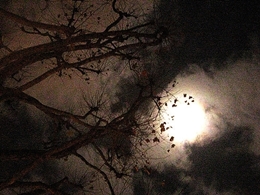
BLOG BED Autumn leaves viewed nocturnally_500

Often, I used to wander over to their house after my parents had gone to bed. I would join them in their comfortable living room, and we would chat. Every now and then, our coffee cups would be refilled. And as the hours ticked by, the empty cafetieres would be replenished with coffee – one with normal coffee and the other with decaffeinated. As night merged into early morning, the three of us would nod off for a few moments and then wake with a jolt.  This would happen several times during the early hours of the morning. I used to love these late-night sessions with my relatives. Frequently, I left my aunt and uncle’s home at about 3 am.

I used to walk home along the tree-lined streets of Hampstead Garden Suburb that were illuminated by the strange orange glow from the bulbs on the concrete streetlamps. The streets were deserted, without cars or other pedestrians. If you were lucky, you might have spotted a fox scuttling past. To be honest, even in daytime, the thoroughfares of the Suburb were almost as dead. Occasionally, I would encounter a policeman on his nocturnal beat. Usually, these encounters led to me being questioned politely. What was I doing out so late? Where was I going? My answers, my innocent mien, and the lack of a sack of swag probably reassured my questioner that I was innocently going about my business.

On weekdays, despite going to bed late, my uncle was ready to drive with his wife to Golders Green station at 8 am. This was the time I headed in the same direction on my way to school. Oddly, although my parents had retired just after 10 pm, they were always still lying in bed when I left the house at 8 am, having prepared my own breakfast.

Something that has only struck me whilst writing this is that my parents did not give any hint that they were concerned at me wandering the streets alone in the early hours of the morning. When our daughter reached the age when she went out with friends at night, often returning at 3 or 4 am, I could not fall asleep until she returned home. These days, so many decades after I was a youngster, the streets are not nearly as safe as they used to be. I am not saying that the streets of London were 100 percent safe when I was old enough to first venture out alone, because there were hazards. However, many new dangers have been added to those that I might have had to face ‘when I was a lad’. ‘That’s progress’, you might say, but, remember that, speaking medically, a disease that progresses is one that is getting worse.

So long Soho

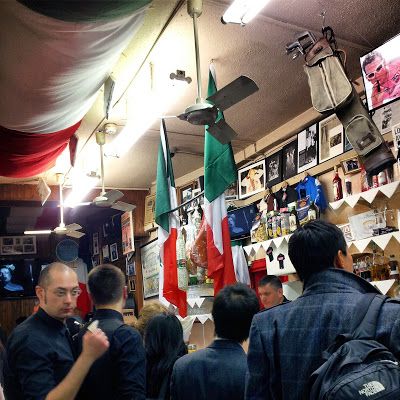
SOHO BAR ITALIA

IN MANY MINDS ‘SOHO’ conjures up sleazy night spots, strip joints, sex shops, and risqué nightlife. For me, Soho contains many memories of my childhood. And before you wonder about what kind of upbringing I had, let me emphasise that these recollections have nothing to do with the seamier side of this colourful district in London’s West End. If you are hoping for something more ‘exciting’, stop reading now to avoid disappointment.

My mother was an artist. Her preferred metier was sculpture. In the 1960s, she used to work in the sculpture workshops at the St Martin’s School of Art on Charing Cross Road. She welded pieces of metal to create artworks. Her companions in the studio included now famous artists such as Philip King and Anthony Caro.

In addition to being a sculptor my mother was acknowledged by friends and family as being a good cook. She was a disciple of the food writer Elizabeth David, who helped introduce French and Italian cuisines into British kitchens. Ms David’s recipes required ingredients and cuts of meat not readily available to British shoppers in the 1960s. However, St Martin’s was close to Soho, in particular Old Compton Street and Brewer Street, where the ‘exotic’ ingredients needed for Ms David’s recipes were easily accessible. These streets contained a variety of shops that catered to French southern European culinary needs.

We lived in Hampstead Garden Suburb, an attractive but, in my opinion, rather dull place. As a youngster, I loved being taken into central London. My mother often took me to the West End. We used to take the ‘tube’ to Oxford Circus Station. Near there, we always entered Dickins and Jones department store. Why, I cannot say, because my mother rarely bought anything there. The ground floor of the shop was dedicated to perfume and other cosmetic sales. Once, one of the salespeople, called to me. Without prompting, she advised me never to use after shave lotions. I was far too young to have begun shaving, but I have followed her unsolicited advice ever since then. I have not yet been brave enough to experiment with these lotions and to discover why she advised against them.

After leaving the department store, we used to visit the Danish Centre in Conduit Street, where I would be treated to an open sandwich and a kransekage, a Danish confection containing marzipan. From there, we used to head for Soho.

Meat was always bought at Benoit Bulcke, a Belgian butcher shop on the corner of Old Compton Street and a smaller side street. According to my mother, only this place knew how to cut meat properly, and she was not someone to argue with. Their motto was “Meat to Please You, Pleased to Meet You”. They moved from Soho to northwest London some years ago. 

Coffee was always purchased at the still extant Algerian Coffee Stores. The shop’s appearance remains unchanged since I was a child. My mother used to choose Mocha Mysore, a name which meant nothing to me as a child. Decades later, when I began visiting India, I got to visit Mysore and also Indian coffee plantations. One innovation at the Algerian Coffee Stores instituted long after my childhood, and well before the Covid-19 crisis, was the inclusion of a small counter where exquisitely made espresso coffee is served.

Other groceries were bought at Lina Stores, still in existence, and Camisa, another Italian grocery nearby. Almost every visit to Soho included a stop at Bar Italia. Founded in 1949, this coffee bar still exists. Entering it is like stepping straight from Soho into a typical bar in Italy. Much of its décor remains as I first remember it, but now the far wall of the café is lined with an enormous TV screen on which Italian football matches can be watched. Whenever we visited Bar Italia, my mother would point at a doorway close to it and tell me that it led to Jimmy’s restaurant. Founded in 1948, it was the first Greek restaurant to be opened in Soho.  Although she always mentioned the place, we never ate there. However, close by in a parallel street there was an Italian restaurant, Otello, which my parents visited often, sometimes taking my sister and me.

One shop that no longer exists was on the short stretch of Old Compton Street between Moor Street and Charing Cross Road. It had trays of vegetables and salad greens on stalls on the pavement outside the front of the store. It was a French run greengrocer, whose name I cannot recall. One of the things my mother bought there was something that sounded to my young ears like ‘mush’ (rhyming with ‘slush’). I had no idea what it was or what it was used for, but I know that my mother prized it greatly. Many, many years later, I realised what she was buying was in fact ‘mache’, also known as ‘lambs lettuce’ or ‘corn salad’, and to botanists as Valerianella locusta. In the 1960s when my mother was buying mache in Soho, hardly anyone in the UK would have heard of it, let alone eaten it. Today, it is a common ingredient of packaged salads found in supermarkets. I had no idea that back in the 1960s, my mother had become a foodie trend-setter by serving us mache in our salads.

My mother died forty years ago, and Soho has changed since then, but much remains that she would have recognised. Whenever I sip coffee at Bar Italia, I raise my tiny cup of strong black coffee to her memory. Mache more than that, I cannot do!

Books of choice

Beerwolf_500


I HAVE LOVED READING ever since I was first able to master this skill. During my childhood, we used to drive to Hampstead (in north London) every Saturday morning. We always used to visit the now long-since closed High Hill Bookshop on Rosslyn Hill. Our parents allowed my sister and me to choose one book each Saturday and bought them for us. Week by week, my collection of the adventures of Tintin by Hergé grew until I had all the episodes that had been published in English. There was little, if any, censorship of our choices. However, I had the distinct impression that my parents preferred that we avoided books by Enid Blyton. So, I have not yet had the pleasure of reading any of her extensive literary oeuvre.

I discovered and fell in love with “Mad” magazine, which was not available at High Hill Bookshop. I bought copies of it at a local shop, using my pocket money. My parents appeared not to approve of the magazine, but my father (not my mother) was always happy to read my copies of it when I had finished with them. “Readers Digest”, like Enid Blyton, did not fulfil my parents’ criteria of ‘good’ literature. I enjoyed leafing through this periodical and particularly remember reading and re-reading an article written by someone who was conscious during his brain surgery. I did not need to buy “Readers Digest” at full price as it was possible to buy boxes crammed full of old issues, sold as a job lots for a few pence at local jumble sales.  

There was only one book that was deemed strictly forbidden during my childhood. It was “Struwwelpeter” by Heinrich Hoffman, published in 1845 and reprinted many times since then. It is a series of moral tales about children who misbehave. For example, when Konrad disobeys his mother’s instruction not to suck his thumbs, an itinerant tailor appears and cuts off Konrad’s thumbs. Each tale is illustrated by frighteningly graphic illustrations. On afternoon, my sister and I, who had discovered this book by accident, were interrupted by my mother. She seized the book and tore it into pieces, which she stuffed into the wastepaper basket. Apart from this violent reaction to a book and the hints that Enid Blyton was to be avoided, I could read pretty much anything I wanted.

At school, books were recommended as being worth reading, especially those by famous 19th century British authors. I never read any of these. For some unknown reason, probably contrariness, if someone told me that I ought to read a particular book, this put me off even opening it. I wanted to read what I had chosen myself, not what had been chosen for me because it might be “good for you”. Similarly, if someone tells me that this or that food item is “good for you”, I do not rate that as a positive recommendation.

At Christmas 1963, we were in New York City. A friend of my parents, ‘E’, met us in the book department of FAO Schwarz, a toy store on Fifth Avenue. She wanted her son and me each to choose a book as a gift from her. E showed me a thick encyclopaedia of anthropology, which she had decided either that I would enjoy it or that it would be good for me. Well, I took one look at it and decided to check out the other books on display. I homed in on an illustrated history of the FBI. It was filled with intriguing black and white photographs, some quite gory. I took the book to E, who looked at it disapprovingly and then asked whether I was sure that I did not want the fine book on anthropology. I was sure, and a few minutes later I became the proud owner of the book about the FBI. E’s son, who was clearly more easily influenced by his mother than me, chose to buy the anthropology book. Years later, he qualified as a psychiatrist and I as a dentist. I am not sure what can be concluded from that.

My parents’ suggestion that there was something not quite right about Enid Blyton left a lingering doubt about the author in my mind. In the mid-1990s, I began visiting India regularly. There, I discovered wonderful bookshops, some of which were (and still are) much better stocked than those in London. What surprised me in those shops were the huge numbers of books by Enid Blyton on sale. Clearly, Enid was well-read and her books much purchased in India.  So, when I heard that there was going to be a lecture about Enid Blyton and India at the Nehru Centre in London, I felt that this was not to be missed. The speaker was none other than Enid Blyton’s very articulate daughter. She told us that British educators often frowned upon her mother’s works (just as my parents had done). The reason they were not keen was that it was considered that Enid’s vocabulary was not rich or varied enough. She revealed that when the texts of her mother’s books were analysed numerically, the vocabulary used I them was, in fact, no less rich or varied than that employed by other authors writing for the same age groups.  

In recent years, I have changed. Maybe, I have become a little less stubborn about book recommendations. If someone suggests a book to me, I no longer instantly reject the idea of reading it. There is a good chance that I will look it up to see what others think of it. If it is about a subject that might chime with any of my interests, there is a good chance that I will buy a copy and add it to the ever increasing pile of unopened books waiting to be read by me.  However, you will still not be able to find Dickens, the Brontes, Thomas Hardy, or titles that would “be good for me” on their spines.

Where there is smoke, there is fire

I WAS EATING CHEDDAR cheese at tea time at my best friend’s house when his mother announced:

“We don’t like Jews, but you’re different, Adam”

I was less than ten years old at the time, but I can still picture the room in which this was said. I do not remember that I  told my parents about what my best friend’s mum had told me, but I remember it almost sixty years later.  Knowing how she felt about Jewish people did not spoil my friendship with, ‘R’, her son.

BLOG JUICE

When I  was thirteen, I  entered Highgate School,  which I  had chosen because ‘R’ was going to be there. At that time, I still regarded ‘R’ as one of my best friends. However, he did something that made me move away from him. One day he was with a group of other boys when in front of them he directed an anti-Semitic remark at me. Although that did not make me hate him, it marked the end of our long friendship.

I had other friends during my schooldays, who were half Jewish. One of their parents was Jewish. They preferred to forget that fifty percent of their heritage. Such amnesia would not have saved them had the rules formulated at the  Wannsee Conference been applied to them.

During the 1970s, I worked on my PhD topic in a laboratory at UCL. During the second year of this, a new PhD student, ‘J’, commenced working on her PhD project. ‘J’, like the others, in the lab seemed very pleasant until one day when she asked me to lend her a pencil.

At this point, you need to know that there was a shortage of pencils in our lab. I have no idea why this was the case. So, when I handed my pencil to ‘J’, I said:

“Please return it.”

To which ‘J’ snapped:

“Don’t be so Jewish, Adam”

I knew that J was most probably unaware that I am of that faith, but what she said upset me. My PhD supervisor’s wife heard what ‘J’ had said, and quickly told her:

“That was not a nice thing to say.”

I was pleased because I  was somewhat lost for words.

A few months later, everyone in the lab was invited by my supervisor to attend the large formal Annual Dinner of the Physiological Society. I sat next to my supervisor’s wife and across the table from ‘J’.

When the main course arrived, there were green peas on the plates. I detest this vegetable. ‘J’ noticed me separating the peas from the rest of my food and said:

“When we invite you round for dinner, I must remember not to serve you pork or peas.”

Remembering the pencil incident, I told her immediately:

“If you ever invite me to dinner, I shall refuse without hesitation.”

My supervisor’s wife turned to me and murmured:

“Well said.”

J’s face turned deep red, tears began running down her cheeks, she stood up, and left the room.

‘J’ abandoned her PhD a few weeks later.

Although I am regarded as being religiously unobservant by most Jewish people who know me, casual prejudice against Jews, or anyone else for that matter, does make me anxious. Prejudice, even if expressed casually, is potentially dangerous. Always remember: where there is smoke, there is usually fire.

Orange juice in North London

AT A REUNION LUNCH held for students who (like me) had attended Highgate School in north London during the 1960s, the Headmaster, Mr Petitt, gave a speech. He said that we, the former students, had reached the age when the ‘nostalgia gene’ kicks in. In my case it has kicked with a vengeance. When I lived near Golders Green, which is not far from Highgate, I would never have believed that one day I would write nostalgically about this, let us be honest, fairly unexciting suburb in northwest London, but here I am at the keyboard doing just that. Squeezing some oranges to produce juice to flavour a dish containing red cabbage triggered one of my earliest memories, that of walking with my parents to the church hall next to St Albans Church in Golders Green to collect bottles of orange juice.

The juice collected from the church hall was quite delicious and richly flavoured. It was contained in large glass medicine bottles with cork stoppers. The juice was supplied free of charge by the state during the 1950s. It was first supplied gratis by the state in 1941 and distributed to reduce the risk of vitamin C deficiency amongst young British children. In 1951, just before I was born, the Conservative Party won a General Election. Soon afterwards, the government restricted the supply of free orange juice to children under two years. My sibling was born in 1956, four years after me. Therefore, I must have been well under six years old when we made these trips to the church hall in Golders Green. Thinking about this juice led me to recall other aspects of Golders Green as it was during my early childhood.


BLOG JUICE

St Albans church hall in Golders Green

One dimly recalled early memory of Golders Green is of a delicatessen near the corner of Golders Green Road and Golders Green Crescent. The place was called Apenrodt’s. I remember this shop had a large wooden barrel that contained pickled gherkins submerged in a liquid. This was not a surprising thing to see in a suburb with a large Jewish population, many of eastern European heritage in my early years. My father enjoyed pickled gherkins. I developed a taste for them in my twenties, as I did for smoked salmon. In my childhood, smoked salmon was relatively more expensive than it is today. My parents regarded it as a treat. I remember them buying it at the aptly named Cohen’s Smoked Salmon, which, like Apenrodt’s, was a Jewish delicatessen.

Two shops in Golders Green particularly intrigued me when I was a little boy. One was an old-fashioned shop, Franks. It sold various clothing items, much of it was hosiery and lingerie. It was not the garments that interested me but the pneumatic system that was used to send money and receipts from the shop floor to an office somewhere else in the shop. Money, bills, and receipts were placed in cylindrical capsules that were placed in tubes along which air was pumped to propel them from one part of the shop to another.

The other establishment was Importers, a coffee retailer with a café behind it. The front windows contained cylindrical coffee roasters, which could be seen from the street. The cylinders were made with fine metal meshwork. Filled with coffee beans, they rotated slowly above gas burners. The air inside the shop was filled with a wonderful aroma that must have helped sell the coffee beans and powders stocked on the shelves of the shop and in the sacks on the floor. We used to pass this shop often, but rarely entered it because my mother preferred to buy coffee at the Algerian Coffee Store, which still exists in Old Compton Street in Soho.  Despite this, I always stopped to watch the roasters rotating and savour the odour of the coffee whenever I passed that shop.

During the last three months of 1963, we lived in Chicago, Illinois. There, we experienced and enjoyed self-service supermarkets for the first time. So, I was excited when the first supermarket opened in Golders Green soon after we arrived back from the USA. I cannot recall the supermarket’s original name, but soon it was called Mac Market, when it was taken over by the Mac Fisheries Company. Prior to taking over the new supermarket, the company had run two grocery shops near to Golders Green station. These were stores where one queued up to be served by shopkeepers standing behind counters laden with food items. If you wanted a product, butter for example, the assistant cut the amount you required, weighed it, and wrapped it up.  

The supermarket occupied a plot on the corner of Golders Green Road and a small service road called Broadwalk Lane on which there used to be a small pet shop. Years later, the building that housed Mac Market was occupied by a newer supermarket that stocked many Kosher and Israeli products. Currently, a branch of Tescos occupies the site of Golders Green’s first ever supermarket.  Another supermarket built far later, a branch of Sainsburys, occupies the site of the Ionic, one of Golders Green’s two former cinemas. The other cinema, long since demolished, was the ABC that stood on Golders Green Road northwest of the main shopping area at the end of Ambrose Avenue. A care home now stands in its place. Although another of the area’s entertainment centres still stands, the huge Hippodrome Theatre, where as a child I enjoyed the annual pantomime and adults enjoyed pre-West End runs of new plays, this now houses the Hussainiyat Al-Rasool Al-Adham community centre, a religious organisation.

The supermarket was close to the bridge that carries the Northern Line of the Underground over Golders Green Road. We used to visit a small shop that nestled close to the southwest corner of the bridge. This was Beecholme’s Bakery, which was run by Harry Steigman and his family, who were related to my aunt’s husband. We visited the shop not to buy baked goods, but to greet these relatives of my father’s sister. She lived in South Africa, which felt very distant at a time when international telephone calls were costly, and the means of electronic communication that are now in common use were probably unimaginable even in the minds of science fiction writers.

What I did not know at the time was that one member of the Steigman family, Natty, the youngest of four brothers who helped their parents run the forerunner of Beecholme Bakeries, had volunteered to fight against Franco in the Spanish Civil War.  Tragically, he was killed at the battle of Jarama (in February 1937) only two weeks after his arrival in Spain.  

Crossing the main road from Beecholme’s and walking under the bridge, one reaches Golders Green Public Library. During my childhood, I loved this place. Until a certain age, maybe 12, I was confined to using the well-stocked Children’s Library. When I passed that age, I could borrow books from the much larger, and far more interesting Adults Library. One bookshelf of this section of the library contained books about the sad story of the Jewish people during period of the twentieth century when their persecution and destruction was being carried out to fulfil the evil plans of Adolf Hitler and his sympathisers. Reading books about this terrible period catalysed my interest in twentieth century history and what led up to it. When I was at school in the 1960s, every school year our history syllabuses led us from the arrival of Julius Caesar in Britain to just before the start of WW1, never beyond it. And, the emphasis was not on what happened and why, but on the dates of events. These books in the library opened my eyes to the history of a period that I found far more interesting than what we were expected to learn to pass examinations. Since those days exploring the shelves of Golders Green Library, my interest in history has gradually expanded from the twentieth century back to far earlier times.

The library was next to a branch of Woolworths. This old-fashioned store, a magnificent emporium, stocked everything from plant bulbs to lightbulbs, from liquorice to lawnmowers. Its ceiling was decorated with an elaborate stuccoed pattern. Although illuminated with electric lamps, some of the shop’s old-fashioned gas lamps still hung from the ceiling. They had little chains dangling from them to regulate the gas flow. Shoppers were assisted by salespersons. It was not a self-service store. Oddly, I have no memory of the shop after its modernisation in 1971.

Although the shops I remember from my childhood have disappeared, Golders Green Road’s buildings look much as they did when I lived near there, and the pavements are just as busy as they were in the late 1950s and early 1960s.

All the shops I have described have been replaced by others, reflecting the passing of time and the changes in the ethnic mix of the population living in the area. There is still a strong Jewish presence in Golders Green, albeit now biased towards the ultra-orthodox communities. To this has been added people from a diverse range of backgrounds.  When I was a child, the idea of eating Japanese, Korean, Turkish, or even, surprisingly, Israeli foods would have been unthinkable in Golders Green Road.

St Albans Church, designed by the architect Sir Giles Gilbert Scott and built in 1933, remains unchanged.  Neighbouring St Albans, the church hall, where we used to walk to collect the orange juice, also looks as I remember it so many decades ago. 

Today, the shops that we visited when I was a child and collecting orange juice in corked glass bottles are merely memories of a childhood long since passed. As I type the final words of this piece, another memory of the church hall springs to mind. Between the ages of four and eight, I attended Golders Hill School on Finchley Road. Once, we, the school children, performed a play for our parents. We acted it on the small stage in the church hall. I had a minor role as a magician. The costume I wore included my beige dressing gown onto which my mother had embroidered different coloured cloth patches. They were cut to look like stars. For a long time after that show, I treasured the dressing gown as it held memories of an evening I had enjoyed greatly. I outgrew the dressing gown, but memory of it still lingers in the folds of my brain. And, yes, Mr Petitt was right, my ‘nostalgia gene’, clearly a dominant version of it, has become most powerfully active.

Love at first bite

I WAS A VERY FUSSY eater when I was a child. Because the first few weeks of my life were fraught with medical problems and then later I was a poor eater, my mother was extremely anxious about me, She allowed me to eat only what I liked and not what might have been good for me, but which I did not even want to try. In short, I was a spoilt child when it came to being fed. As I grew, I remained unadventurous gastronomically. We travelled to places like France and Italy where food is exciting and varied, but instead of exploring the wonderful foods that my parents ate in those places, I stuck to a boring diet of steak or ham (or, occasionally, Dover sole) and chips. Looking back, I regret turning down the undoubtedly delicious alternatives to these mundane foods.

FOOD Pizza Etna_800 BLOG

My parents were not keen on pizza. At least, I never saw them eat it even though we had holidays in Italy every year. They ate pasta and many other delicious Italian dishes. Naturally, given my unadventurous approach to food, I never ate it, at least not until I was about 17 years old. When I reached that age, I decided to spend a few days travelling alone in Italy whilst my parents stayed elsewhere. I used local transport to visit Volterra, Grossetto, and then reached the city of Orvieto. Believe it or not, I was extremely shy at that time and minimised speaking to anyone. Consequently, by the time I arrived in Orvieto, I was feeling miserably lonely. I felt to shy to enter restaurants and wandered around Orvieto from one eatery to the next, becoming ever hungrier.  Finally, I reached a shop that sold squares of hot pizza at a counter. The aroma coming from the pizza ovens was irresistible. I bought a square, took a bite of it, and … it was love at first bite.

Although she died forty years ago, people still fondly remember my mother’s cold rice salad, which was cooked white rice mixed with small specks of red and green peppers. Whether it was in my mother’s much praised salad or in the school rice pudding, I refused to eat rice when I was a child. This situation changed just before my 19th birthday. I was travelling around France with a friend who was studying at Cambridge University and four of his friends. One of these was Matthew Parris, who would later become a Member of Parliament and is now a frequently read columnist in the London “Times” newspaper. He was our driver. He drove us around France in an old car, which he had driven from Southern Rhodesia (now Zimbabwe) across Africa and Europe to England. One day we camped near Cerbère on the Mediterranean. As we were close to the Franco-Spanish border, we crossed it one evening to eat a meal in Port Bou (in Catalonia). Everyone wanted paella, which is a rice dish. For some inexplicable reason, I decided to try some. It was the first time that I ate rice. It was love at first bite.

During that trip around France, we used to eat our midday meals ‘al fresco’ at scenic spots. The money we saved by having picnics was spent eating more lavish meals at restaurants. Usually, everyone ordered meat (often beefsteak). One evening at a restaurant in Provence, I decided, unusually for me given my history of conservative eating tastes, to order something different. Without knowing what would arrive, I ordered an andouillette. I regretted my choice as soon as I cut what looked like a sausage. As I incised the skin covering the andouillette, little bits of what looked like rubbery material leapt out on to my plate. The thing was filled with chopped-up innards, and I was filled with disgust. Winding the clock forward a few decades, I now enjoy various kinds of innards (e.g. liver, sweetbreads, and tripe, but not kidneys) if they are prepared tastily.

My parents favoured Mediterranean cuisine. My mother was a keen follower of Elizabeth David, whose recipe books help bring the dishes of France and Italy onto British dinner tables. There were often bowls of olives available, especially on the many occasions that my parents entertained guests at our home. Having smelled these olives a few times, I decided that I was not even going to taste them. In 1975, I travelled across Europe to northern Greece with my friends Robert and Margaret. Every summer, they spent about six weeks camping by the seaside just south of the village of Platamon. Every evening while camping, as the sun began setting, we used to sit outdoors on folding camping chairs around a rickety table. Robert mixed himself gin and tonic and I joined Margaret with a glass of red (sweet) Martini. There was always a bowl of Greek olives on the table. On the first evening that I enjoyed an aperitif with my two friends, something inside me made me lean forward and pick up an olive. I popped it into my mouth … it was love at first bite. Since then, I cannot resist eating what I had avoided for a quarter of a century. My favourite olives are, just in case you are interested, the black Amfissa variety. They are plumper and juicier than Kalamatas, and at least as tasty.

In 1976, I began studying dentistry at University College London. My year had 50 students. We were a friendly bunch. One year, Jayne S, invited us all to her home in north London to celebrate her birthday. It was an afternoon event. The only food on offer was fried chicken from KFC (then, known as ‘Kentucky Fried Chicken’). There were large buckets of it, filled with legs, breast pieces, and wings: an ‘embarass de richesse’ of fried poultry.   As with so many foods, I had fought shy of trying this popular product. By then I was about 27 years old. I had eaten chicken, but never the crumb coated deep-fried variety. That afternoon at Jayne’s party, I do not know what over came me, but as soon as I saw the buckets, I seized a piece of chicken, bit into it, and …it was love at first bite. I would not go as far to say that KFC is my favourite chicken dish, but every few months I yearn for it.

Time passed, and my enthusiasm for trying new dishes and ingredients has grown exponentially. So much so, that once I was in a Chinese restaurant in London’s Chinatown when I spotted duck’s feet on the menu. I felt that I had to try them. I ordered a portion, and the Chinese waiter snapped:

“You won’t like them”

Defiantly, I responded:

“Bring me a plate of duck’s feet, please.”

“You will not like them.”

“Never mind,” I answered, “I want to try them.”

“You won’t like them”

“Look,” I said, “I want to try them. Even if I don’t like them, I promise to pay for them.”

The webbed feet arrived. They tasted quite nice, but I did not like their slimy texture.”

The waiter was right. I am glad I tried them, but was not … love at first bite.  

My sporting life

THE ONLY SPORTS PRIZE I have ever won was at a sports day held by my primary school in Golders Green sometime before 1960. I was in a relay race. Our team members were awarded a green badge. I have no idea whether we were first or just in one of the three fastest teams. Since that glorious day, my sporting ‘achievements’ have been anything but glorious.


boys in white shirt and white pants playing baseball


Once, while playing football at the Hall School, which I attended from 1960 to ’65, I did manage to score a goal. The ball was coming my way, I put out my foot, and the ball bounced off it, into a poorly guarded goal. The only problem was that I had scored an own goal. My fellow team-mates were not amused.

I entered my senior school, Highgate School, in 1965, four hundred years after its establishment by Sir Roger de Cholmeley in the final months of his life. On the second day of my first term, I had to take part in a game of football watched by senior boys and teachers, who wanted to assess the playing skills of the boys new to the school. It was a very rough experience. The other players struck me as being very aggressive.  Twenty-four hours later, two senior boys, both much taller than me and dressed in the black blazers that only prefect wore, approached me. Very apologetically, they informed me that I was not good enough to play in our house football teams. They asked me to choose another sport instead of football. The choices included Eton Fives, which I had never come across before, and cross-country running. I chose the latter because I had heard of running.

It turned out that I had made a good choice. On most sports afternoons (Wednesdays and Saturdays), cross-country running was unsupervised. I used to change into my school running gear and wander over to the school tuck shop (a confectionery store) to buy some sweets. Then, I used to cross Hampstead Lane and enter the grounds of Kenwood, where we were supposed to run. After a respectably long enough leisurely ramble through the park, eating my sweets and maybe talking with someone else who was ‘going for a run’, I returned to the changing room, and got ready to go home. Showering was unnecessary because I never worked up a sweat nor roamed through muddy parts of the park.

Once a year, our housemaster (pastoral carer), Mr Bowles, took his boys for a run. This was a more strenuous event than my usual outings. We followed him off the paths and into the wilder parts of the park. Once, he stopped and turned to me, saying:

“Yamey, how is it that there is no mud on you?”

I replied:

“Mr Bowles, I don’t know. Anyway, I thought that the point of this was to get exercise, not to get muddy.”

He took this surprisingly well. Although he was the only teacher in the school not to have a degree from Oxford or Cambridge, he had more common sense that the rest of the staff put together.

Summer terms gave rise to another problem: cricket. This sport terrified me. I was constantly worried that I would be hit and badly injured by a hard cricket ball flying at speed. Also, I was useless at catching balls, hard or soft. So, when the school began recruiting pupils to be umpires, I volunteered. For a few days, I attended umpiring classes. Each of the new umpires was given a small pocket-sized blue covered book of the rules of cricket. None of it made any sense to me, but one thing stuck firmly in my mind: the umpire’s decision is final.

Fully ‘qualified’, I began my umpiring career. One of the umpire’s duties is to count the number of balls that have elapsed in each over of six balls. I had been advised that a good method of doing this was to place six coins in one hand and then after each ball ahs been bowled, to transfer a coin from one hand to the other. The only problem was that often during an over I forgot in which direction the coins should have been passed. Was it from left to right or vice-versa? Usually, the scorers pointed out when I had miscounted.   Often, the players questioned my decisions. My response was to withdraw the rule book slowly from my pocket and ask the petulant players:

“Have you read the very latest rules?”

This usually worked. On one occasion, the bowling team shouted “howzat” jubilantly. Without any idea why they did that, I declared that the batsman was ‘out’. This caused an uproar, but I knew that the umpire’s decision is always final, and I stuck to it.  Many of my decisions, I must now confess, were based on trying to get the game finished so that I could go home early enough. Had I been more scrupulous and better informed and more interested in cricket, the games that I umpired would have stretched on well after 5pm, which would have messed up my daily routine. At this point, it is only fair that I offer my apologies to anyone who felt aggrieved as a result of my umpiring activities.

Mr Bowles realised that sports was unlikely to do me any good at all. In the last two years of school, he allowed me to visit exhibitions in central London instead of getting in everyone’s way on the playing fields of Highgate. For example, during this period, I visited the exhibition about the Bauhaus three times at the Royal Academy.

When I was about 13 years old, an uncle, who was a keen bodybuilder, gave me a set of weights and a metal bar on to which these heavy metal discs fitted. It was a kind, well-meaning gesture. However, it was not a gift that appealed to me. It lay idle in my bedroom until a friend, who was keen on rowing, asked to borrow them. I lent them to him and was not perturbed that they were never returned.

At University College London, there was no requirement for me to do any kind of sport. So, I did not. While I was doing my PhD, I became good friends with my supervisor Robert and his wife Margaret. For thirty years after finishing my doctorate, I used to visit them at their home near Slough. They had a tennis court in their extensive grounds. Margaret was a fine tennis player, usually winning the finals of the tennis tournament played at the annual Physiology Department sports day held at Shenfield in Hertfordshire.

Whenever I visited Robert and Margaret, I was ‘roped in’ to playing doubles with Robert and Margaret and one other, usually their Irish son-in-law. I was reasonably good at serving and returning, but only if the ball flew towards where I happened to be standing. Margaret told me that I might have become quite a good player if I had bothered to run around the court when I saw where the ball was heading.

One weekend afternoon in early May 1984, while I was on the court with Margaret and Robert, I felt something slip inside one of my knees. As we walked back to the house for afternoon tea, I felt that I could not straighten my leg properly. I did not mention this to anyone for a good reason. It happened a few days before I was about to fly to Yugoslavia to begin a two-week tour of neighbouring Albania. I had been wanting to visit Albania for many years, ever since I was about 15 years old. I did not want to risk seeking medical advice just in case I was told not to travel. I decided that whatever the condition of my leg, I would travel to Albania. I believed that should my leg continue to trouble me, I could seek medical help in the country that had intrigued me for years.

After arriving in Albania and a few alcoholic drinks at various meals, my leg ceased to trouble me. One member of our group fell ill when we were visiting a hunting lodge in rural Albania. This lodge near Lezhë had been built in the 1930s for Count Ciano, Mussolini’s son-in-law. As if by magic, when the lady on our tour began feeling poorly, a doctor and two nurses dressed in white uniforms suddenly appeared to assist her. I imagine that our tour bus was followed closely by a medical team.

I mentioned the story of my leg because, contrary to all I have been told, I have noticed that sporting activities are not entirely beneficial. During the 35 years that I practised dentistry, I had several patients a week, who entered my surgery limping. Almost all of them had injured their knees or other body parts while attempting to ‘keep fit’.

Now, I do not want you to think that I am a slovenly ‘couch potato’, whose main form of exercise is breathing. I climb up and down the 50 steps leading to our flat and walk two to three miles a day on average. I walk mainly for enjoyment. If walking helps to keep me fit, that is a bonus.

So now, patient reader, you have been apprised of the secrets of my sporting life.

PS: you will be amused to learn that for a long time I thought that a ‘six-pack’ was a package of six cans of beer or lager. Now that I am better informed, I have looked in the mirror but fail to see any sign of my six pack; it remains hidden.

Photo by Patrick Case on Pexels.com