A slave trade abolitionist in Fulham

LESS FAMOUS THAN William Wilberforce (1759-1833), but equally important in helping to end Britain’s involvement in the slave trade, was Granville Sharp (1735-1813). Born in Durham, Sharp was apprenticed to a linen draper in London at the age of 15. A scholar at heart, he left his apprenticeship to become Clerk in the Ordnance Office at the Tower of London, a job that gave him more time to pursue his scholarly studies and music. One of his brothers, William Sharp (1729-1810), was a physician, who is believed to have treated King George III.
All Saints church in Fulham

One of William’s patients was Jonathon Strong (c1747-1773), a black slave from the West Indies, who had been badly beaten-up by his master, a lawyer called David Lisle. William and Granville helped tend to Strong’s injuries and paid for him to spend four months in St Bartholomew’s Hospital. Lisle instigated a number of court cases to protect his ‘possession’ of Strong. Granville was deeply involved with making sure he lost them and that Strong became a freed man. The Strong case was the beginning of his keen and active involvement in the movement to abolish slavery. His involvement with this and subsequent legal cases connected with the unjustness of the slave trade gave him the reputation of being a “protector of the Negro”.  

In 1787, Granville became one of the founder members of the Society for Effecting the Abolition of the Slave Trade. Though sometimes overshadowed today by other abolitionists such as Wilberforce and Thomas Clarkson (1760-1846) played a major role in hastening the end of the slave trade and slavery in places ruled by the British.

By the 1780s, there were approximately 15,000 ‘black’ people in Britain, many of them without employment. Ideas began to circulate that it would be a good idea to form a settlement in Africa to which the Africans could ‘return home’ and live as free individuals. One place that was suggested was Sierra Leone. Granville Sharp was consulted on this and felt that it would be an ideal location to set up a model community for the ‘blacks’. He suggested calling it ‘The Province of Freedom’. Sadly, the well-intentioned province that included a settlement called Granville Town was a failure.

Granville lived long enough to learn that the Act of Abolition received Royal Assent in 1807, but not long enough to know about the final abolition of the slave trade in the British Empire (in 1833). Granville’s brother William had a country dwelling, Fulham House, in Fulham. It was here that the ageing Granville moved after William died. He lived there with William’s widow, Catherine, and her family. It was in this house that Granville breathed his last.

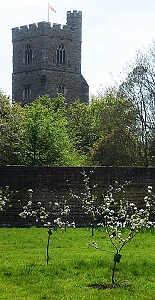
Probably Fulham’s greatest resident, Granville Sharp was buried in the cemetery of Fulham’s parish church (All Saints). His funerary monument, which stands close to the boundary fence of Fulham Palace commemorates him, his brother William, and his sister Elizabeth Prowse. William’s wife Catharine (née Barwick) is also buried beneath this stone, which was restored in 2007.

Hampstead lies slightly west of the Greenwich Meridian

ST JOHNS CHURCH in Hampstead’s Church Row lies 0.1811 degrees west of the Greenwich Meridian. Its longitude is 0.1811 W. This fact is unimportant to most people living in the area because Hampstead is high above sea level. However, an accurate measurement of longitude (and latitude) is extremely important to seafarers.

Tomb of the Harrison family in Hampstead

I am no expert in navigation, so please excuse me if the following explanation seems oversimplified. Latitude can be assessed measuring the positions of fixed astronomical objects such as the sun and the North Star and relating them to the horizon. Longitude proved far harder to measure because it involves relating the local time to the time at a reference position, now at the commonly accepted Greenwich Meridian.  The difference in the time at a position in the sea and that at Greenwich is the way that the calculation of longitude is made. Local time can be measured by means such as observing where the sun appears in the sky. Until the 18th century, no clocks existed that could reliably record the time at the reference position whilst at sea. The uncertainty involved in assessing longitude resulted in many unfortunate disasters at sea. In 1714, the British Parliament passed the Longitude Act of 1714, which offered prizes for a simple and practical method of assessing longitude out at sea.

To solve the problem, a clock that accurately recorded the time at Greenwich was required. This clock had to remain accurate despite the many changes that it would encounter as it moved across the seas. It had to record Greenwich Mean Time accurately and reliably despite changes in temperature, humidity, air pressure, motion of the vessel, and so on. Major advances in the solution of this demanding technical problem were made by a carpenter and clockmaker John Harrison (1693-1776), who was born near Wakefield in Yorkshire. For over 40 years, he worked on the problem, producing ever more reliable chronometers, which were tested at sea. Eventually, his H4 design became the prototype for what was best suited to the job. With the help of his son William Harrison (1728-1815), Harrison was rewarded with much of the financial reward offered in the wording of the Act passed in 1714.

When he died, John Harrison was living at his home in Red Lion Square in Holborn, whose longitude is 0.1186 W. He is buried in the same churchyard as the great artist John Constable: in the cemetery next to St Johns Church in Church Row, Hampstead. His tomb, which close to the south wall of the church, is of Portland stone and decorated with pilasters in the style of the architect Robert Adam. The north side of this shoebox shaped monument has an inscription that gives a brief biography of John Harrison. His wife, Elizabeth, who died in 1777, aged 72, is also commemorated on this tomb. The south side gives a short biography of his son William, who is also buried here. In addition to helping his father test his chronometer, he was also a Governor of the Foundling Hospital in London and High Sheriff of Monmouthshire (in 1791).

According to Christopher Wade in his “Buried in Hampstead”, several persons, who were not resident in Hampstead were interred in the churchyard of St John. The Harrisons figure amongst these. Wade states that there is no evidence that John Harrison and his family had any connection with Hampstead. He speculates that they obtained a burial plot there because they were “… affected by the charm of this particular graveyard.”  

The graveyard still retains its charm. It contains the resting places of many people, who have achieved fame in diverse fields of activity. Some of them are mentioned in my new book about Hampstead, which is available as a paperback from Amazon (https://www.amazon.co.uk/dp/B09R2WRK92) and as a Kindle e-book.

John Constable and a bookseller’s grave

ST JOHN’S IS the parish church for the C of E parish of Hampstead. The present building, designed by Henry Flitcroft and John Sanderson, was dedicated in 1747. It stands on Church Row, which is lined with elegant 18th century houses and links Heath Street with Frognal.

Church Row, Hampstead, London

The church is at the northern edge of a graveyard well populated with funerary monuments, including the grave of the artist John Constable (1776-1837). This grave is in the old part of the church’s cemetery, which was hardly used after 1878, when it was officially closed. A larger, newer graveyard is on a sloping plot across Church Row and north of St John’s. This is the burial place for a host of well-known people as well as the family of Hampstead’s Pearly Kings and Queens.  

When I used to visit Hampstead in the 1960s and early 1970s, I used to ‘haunt’ a most wonderful second-hand bookshop on Perrins Lane, which leads east from Heath Street. It was owned by an old gentleman, whose name, Francis Norman, I only learnt many years after he died. Recently, I met a member of Mr Norman’s family. He told me that Mr Norman died in 1983 and is buried in the cemetery at St Johns, describing the location as: “by a wall near Harrison and the children’s playground”.

I was not sure to whom he was referring when he mentioned “Harrison”. At the church, we asked a lady about Mr Norman’s grave.  Hearing that he had died in 1983, she suggested that we looked in the newer part of the cemetery. This has a wall that borders a children’s playground. When I looked around carefully, I found  neither any monument to Harrison nor Norman’s gravestone.

On returning to the church and explaining our unsuccessful quest, the lady sent me to see another church official, who was working in an office attached to the church. This lady knew exactly where Mr Norman was buried. She took me into the older part of the cemetery and showed me the gravestones of Francis and his wife Sonia, which lie next to each other. They are next to a small wall and close to a large monument to the clockmaker John Harrison (1693-1776). He was the inventor of a marine chronometer, which solved the problem of how to ascertain longitude whilst at sea. His story can be read in “Longitude” by Davina Sobell.  Norman’s grave is not far from that of John Constable.

Francis and Sonia Norman are amongst the few people buried in the old cemetery after it was closed in 1878.  My helpful informant at the church did not know why they had been interred there instead of in the newer part.

Francis Norman was a kindly, wise, and friendly fellow, who did not mind me and several of my friends spending hours in his shop, often spending very little on his extremely reasonably priced books. I have fond memories of the time that we spent in his presence, which are described in my book “Beneath a Wide Sky: Hampstead and its Environs” (https://www.amazon.co.uk/dp/B09R2WRK92).  So, it was with great pleasure that I met one of his family and was able to pay my respects at his grave.

Buried no longer

THE ITALIAN WRITER and patriot, Ugo Foscolo (1778-1827) was born on Zakynthos when it was part of the Venetian Republic. He became a political activist in what is now Italy and came to London in 1816. In London, he was regarded as a literary celebrity, but this did not always keep him out of trouble. For example, in about 1813 he faced Mr Graham, the editor of the “Literary Museum” in a duel at Primrose Hill. The dispute that led to this was about his ‘Three Graces’.  These three ladies were sisters working in Foscolo’s home near Regents Park. Two of them turned out to be prostitutes, and one of them ran off with his former translator. This led to a duel, whether in Regent’s Park or Primrose Hill is not clear; fortunately, no blood was shed.

Foscolo’s monument in Chiswick

Foscolo lived another few years until 1817, when he died in Turnham Green in west London. He was buried in the lovely churchyard next to the Chiswick church of St Nicholas, where the artist William Hogarth was also interred. The cemetery contains Foscolo’s elegant, well-maintained grave, which is surrounded by a cast-iron railing.

However, Foscolo’s remains are no longer in the old cemetery at Chiswick.

In June 1871, ten years after the Unification of Italy, Foscolo’s remains were dug up and transported to Florence (Firenze). There, they were reburied but within the church of Santa Croce. This is all recorded by words carved on the monument in the Old Chiswick Cemetery.

Some illustrious corpses

THE ARTIST CONSTABLE is one of the best-known people to have been interred in the cemetery of St John’s, the parish church of Hampstead. His grave is in the older part of the cemetery which surrounds the church. Across the road from the church and running along the east side of Holly Walk, there is an extension of the cemetery, the Additional Burial Ground, almost completely filled with the graves of people, who died in the 19th century and later. Apart from the graves covering the gently sloping cemetery, there is a pleasant, peaceful sitting area in its south eastern corner and an attractive columbarium (containing wall-mounted memorial plaques) in its north eastern corner. For several centuries, Hampstead has attracted residents from a wide variety of walks of life, and this is can be seen by wandering around the cemetery. Several of the many gravestones attracted my interest and aroused my curiosity about the lives of the people buried beneath or beside them. I have chosen a few to write about because they were clearly notable people, but individuals about whom I knew nothing.

Thomas Frederick Tout (1853-1929) lies buried close to the Labour politician Hugh Gaitskell (1906-1963) and the Austrian born actor Anton Walbrook (1896-1967), both of whom are better remembered than Tout, who is described as “historian” on his gravestone. Born in London, Tout specialised in the history of the mediaeval era. At first, after graduating at Oxford, he taught at the University of Lampeter in Wales, then later at what was to become the University of Manchester, where he introduced the idea, an innovation, of making final year history undergraduates produce a final year thesis based on study of original sources. Just before Tout retired in 1925, he moved to Hampstead where he and his wife lived at 3 Oakhill Park until his death.

Tout lies at the bottom end of the sloping cemetery, while another academic, Randolph Schwabe (1883-1948) is interred at the top end. Schwabe was born in Eccles near Manchester. His paternal grandfather was born in Germany and migrated to England. At the age of 14, Randolph enrolled at the Slade School of Fine Art (University College London) and showed great skill in drawing, painting, and etching. During WW1, he was an official war artist. Following the end of the war, he taught fine art at both the Camberwell and Westminster schools of art. In 1930, he became the prestigious Slade Professor of Fine Art at University College and then Principal of the Slade School of Fine Art. When war broke out again in 1939, he became involved in official recording of the war, receiving a special commission to document the bomb damage to Coventry Cathedral. In addition to teaching, Schwabe was a prolific book illustrator. For health reasons, he moved to Helensburgh in Dunbartonshire, where he died whilst still Principal of the Slade. He was cremated and his ashes were scattered in the cemetery in Hampstead where a beautiful stone sculpture of a woman with bowed head, created by Alan Durst (1883-1970) commemorates him. Schwabe lived close to the cemetery in Church Row (no. 20).

Not far from Schwabe’s monument, there is an ensemble of gravestones remembering the lives of the Matthews family. Bert Matthews (1884-1974), a local rat catcher, was Hampstead’s Pearly King for 40 years (www.museumoflondon.org.uk/discover/six-things-you-never-knew-about-pearly-kings-queens). In 1905, Bert married Becky in Hampstead Parish Church (https://tombwithaview.org.uk/abg-people/bert-matthews/). They lived in Perrins court. Three years before his marriage, Bert became involved in charity work. Bert and his wife became Pearly King and Queen of Hampstead. The ‘Pearlies’ dress up occasionally in clothes that have been covered with mother-of-pearl buttons and so attired, they collect money for charity. Like royalty, the Pearly Kings and Queens hand on their titles to their offspring. Although dressing up in the pearly button covered costumes is part of the fun, the Pearlies are dedicated to raising money for good charitable causes. Three generations of the Matthews family are buried near to the Holly Walk edge of the cemetery, the bodies of three generations of Hampstead’s Pearly Kings and Queens lie together. To see the Pearlies of Hampstead, watch the video on www.britishpathe.com/video/pearly-kings.

Buried close to the working-class Pearly aristocrats, we find an ostentatious monument commemorating some other aristocrats, who would not have considered themselves working-class. It is in memory of three female members of the family of Frederick Ramon de Bertodano y Wilson, 8th Marquis de Moral (1871–1955). Born in Australia, Frederick went to England in 1895, where he trained as a lawyer. He served as an officer in the British Army in southern Africa during both the Matabele War (1896-1897) and the 2nd Anglo-Boer War (1899-1902). Then, he returned to England in 1905 (https://campbell.ukzn.ac.za/?q=node/47011). In 1907, he married Lady Ida Elizabeth Dalzell (1876-1924), who is buried in the cemetery along with their daughter Marie Stephanie Stewart (1911-2009), née de Bertodano. Frederick Ramon is not buried in Hampstead but in Harare, Zimbabwe (www.geni.com/people/Fr%C3%A9d%C3%A9rik-Ramon-de-Bertodano-8th-Marquis-de-Moral/6000000012386542530). He retired to what was then Southern Rhodesia in 1947. I am not certain why this monument is in Hampstead. The only clue I have found is that Frederic was listed in 1906 as being a Fellow of The Royal Geographic Society living at 43 Belsize Square. However, this was before he married. Marie Stephanie’s brother Andrew was born in Hertfordshire in 1912. I would like to know more about this family’s connection to Hampstead.

The last of the graves of the many fascinating people, whose remains rest in the newer part of the cemetery of The Parish Church, records the deaths of the Llewellyn-Davies family. The barrister Arthur Llewellyn-Davies (1863-1907) married Sylvia Jocelyn Du Maurier (1866-1910), daughter of the cartoonist George Du Maurier, who is buried in the cemetery. They had five sons. After Arthur died, the family’s friend, the author JM Barrie (1860-1937) supported Sylvia and her boys financially. When she died, Barrie became one of the boys’ guardians (https://androom.home.xs4all.nl/biography/p008514.htm). Most readers will know that Barrie is famous for his book “Peter Pan” (first published 1911). Barrie’s inspiration for Peter Pan was Arthur and Sylvia’s son Peter (1897-1960), who is remembered along with his parents at the family grave in Hampstead. Michael Darling, another character in “Peter Pan” was based on Michael Llewellyn-Davies (1900-1921), who drowned when bathing at Oxford while he was an undergraduate student. You might be wondering about Peter Pan’s companion Wendy. It so happens that I have seen her grave, that of Margaret Henley (1888-1894), who is buried at Cockayne Hatley in Bedfordshire. Her father was a friend of JM Barrie, whom the small child Margaret referred as her “fwendy-wendy”. This caused Barrie to name his heroine Wendy.  The Du Maurier family is intimately associated with Hampstead. So, it is unsurprising to find the Llewellyn-Davies family memorial where it is.

Enough of this morbid subject. Now, you need to visit this fascinating cemetery in Hampstead to discover more for yourself. And when you have had enough of looking at the resting places of illustrious corpses or their ashes, it is but a short walk along the attractive Church Row to reach the heart of Hampstead with its numerous cafés, where you can enjoy a life-restoring beverage.

Accidentally killed

BROMPTON CEMETERY IS in west London. Richly populated with memorials to the dead, it is a remarkably lively place on a sunny day, being filled with walkers, cyclists, and picnickers. The bodies of people from all walks of life and from many nations lie at rest beneath the many stones in the cemetery, which was first opened in 1840. During our recent visit, I spotted two memorials to men with a military career. Each of them was particularly eye-catching.

The first of these is a pink granite slab resting on stone cannon balls made of grey granite. A pile of similar canon balls is arranged like a pyramid on top of the stone. I felt that it is a particularly fitting design for a soldier’s gravestone. One of the cannon balls is carved with the word ‘BEYROUT’ and another with ‘PORTUGAL’. This is the memorial to General Alexander Anderson (1807-1877), of the Royal Marine Light Infantry. The monument was restored in about 2016. A document relating to its restoration (https://www.rbkc.gov.uk/idoxWAM/doc/Other-1833173.pdf?extension=.pdf&id=1833173&location=Volume2&contentType=application/pdf&pageCount=1) informs that three of the cannon balls are engraved “Syria”, “Beyrout” (i.e. Beirut), and “Gaze” (i.e. Gaza). However, I photographed one bearing the word “Portugal”, which is not mentioned in the document. The monument was erected by Anderson’s friend Richard Eustace, MD, who lived from 1833 to 1908 (www.bmj.com/content/2/2490/865.2). Eustace entered the Royal Navy as a surgeon in 1854.

Anderson became a Companion of the Order of the Bath in June 1869 (www.thegazette.co.uk/London/issue/23503/page/3179/data.pdf).  His obituary in the London “Morning Post”, which shows why he was awarded this high honour, includes mention of Portugal:

“He obtained his first commission as second lieutenant in the Royal Marine Forces in May, 1823, and had during half a century seen much active service. He served with the army of occupation in Portugal, and was for some time quartered at Fort St. Julian. He served at the battle of Navarino in 1827, and at the commencement of the action boarded with his men one of the Turkish ships and captured the flag. … He served throughout the campaign on the coast of Syria in 1840-41 … was at the attack and capture of Beyrout; the bombardment and surrender of St. Jean d’Acre; the surrender of Jaffa, and was a volunteer in the expedition against Gaza. … He had received the war medal with two clasps, also the Turkish silver medal from the Sultan, and when a colonel, received the good-service pension. He became colonel-commandant in November, 1859; major-general in March, I860; lieutenant-general in November, 1866 ; and general in April, 1870.” (www.newspapers.com/newspage/396245337/)

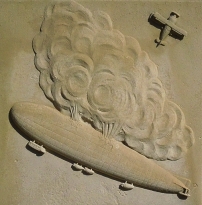
A memorial, less original in design than that of Anderson, also caught my attention with its bas-relief depicting an old-fashioned biplane heading away from a large flying zeppelin from which clouds of smoke are billowing. The grave marks the resting place of Flight-Sub-Lieutenant Reginald Alexander John Warneford (1891-1915). The stone bears the words:

“Accidentally killed 17 June 1915”

Given the year he died and his rank, it was hard to imagine what kind of accident caused him to die during a war when most fatalities were not described as ‘accidents’.

Warneford was born in Darjeeling (India), son of an engineer working for the railways in British India (https://en.wikipedia.org/wiki/Reginald_Warneford). He was educated first in England and then in Simla, back in India. His father:

“…taught him the law of the jungle; to read the moon and stars across the wide Indian night skies; to be able to study cloud formations. Rex rode on the footplates of the service engines, rode the work elephants and hunted tigers.” (http://kes1914.net/the-boys/reginald-rex-warneford-vc/ – a highly informative web page)

 At the outbreak of WW1, he joined the British Army and then was soon transferred to the Royal Naval Air Service to be trained as a pilot. He was a good student even if somewhat overconfident. Soon, he became involved in hunting down and intercepting German Zeppelin airships that were being sent to attack London and other targets in the UK.

On Sunday, the 6th of June 1915, Warneford was sent in a Morane Saulnier L monoplane to intercept the heavily armed and well-powered LZ37, a 521-foot-long German zeppelin, which had just taken off from Belgium and had got lost in the fog over the English Channel. German radio signals, intercepted by the British, discovered that the airship had been ordered to return to base. Warneford was sent out to find and attack it. He reached the airship when it was 10,000 feet over Bruges. Warneford rose to 11,000 feet and dropped six bombs onto the Zeppelin, which burst into flames. The hot air from the explosion caused Warneford’s ‘plane to go into a spin and damaged its fuel line. Warneford managed to land in a field behind enemy lines. After rapidly repairing the damage, he managed to fly back to safety, not before landing to refuel at a French base en-route. On the 8th of June, he was awarded the prestigious Victoria Cross for gallantry. Just before that, he was also awarded:

“Chevalier de la Legion D’Honneur with its automatic companion, the Croix de Guerre’ that had been recommended by General Joffre.” (http://kes1914.net/the-boys/reginald-rex-warneford-vc/).

Modestly, he told a friend that in comparison to his grandfather, who had constructed railways in India:

“Bringing down the LZ37 was just routine and over in a flash. But building a railway, that was something.”

Returning to duty after his heroic activity, Warneford’s next mission was to take a new Henry Farman F27 biplane on a test flight. He took off from Paris on the 17th of June 1915 with an American reporter as a passenger. At 2000 feet, the aircraft began to disintegrate and fall downwards. It turned upside down at 700 feet and both pilot and passenger, who were not strapped in, fell to the ground. The reporter died instantly but Warneford survived. However, he died on his way to a hospital.

Had Warneford died whilst attacking a Zeppelin or during any other military encounter, his death would not have been regarded as accidental. As his death was a consequence of an unforeseen disaster, I suppose that calling it an accident is appropriate.

These graves I have described are two of many I saw that attracted my attention. I might well describe some of the others at a later date.

Utopia and Worlds End

THE AUTHOR OF “Utopia”, which was published in Latin in 1516, Sir Thomas More (1478-1535), had a house in London’s Chelsea. It was not far from Henry VIII’s manor house on what is now Cheyne Walk. The land in which More’s house was built was bounded to the north by what was, and still is, the Kings Road, to the south by the River Thames and between the still extant Milman Street and Old Church Street.

The house that was ‘L’ shaped in plan (www.british-history.ac.uk/survey-london/vol4/pt2/pp18-27) when More used it as his out-of-town dwelling between 1520 and 1535, when he was arrested there and taken to the Tower of London. His arrest was in connection with trying to upset the marriage plans of his neighbour in Chelsea, King Henry VIII. More lived at Beaufort, to which he loved to escape from London and from the Court, and to spend time with his family and to write. It was here that he entertained many friends, among whom were the scholar Erasmus and the artist Holbein.

After Thomas More’s execution and the death of Henry VIII, King Edward VI granted Beaufort House to William Pawlet, 1st Marquis of Winchester (c1484-1572). Then, it passed through the hands of the Dacre family to William Cecil, Lord Burghley (1520-1598), and next to his son, Sir Robert Cecil (1563-1612). Cecil sold it to Henry (Clinton) Fiennes, Earl of Lincoln (1539-1616). The house and its grounds continued to move through different owners until it came into the possession of the physician and founder of the British Museum, Sir Hans Sloane (1660-1753) in 1738.

Sloane demolished Beaufort House in 1740 to “…strip it for parts…”, so wrote James Delbourgo in “Collecting the World”, his recent biography of Sloane. The demolition work was executed by a Quaker, Edmund Howard (1710-1798; detailed biography: https://ahsoc.contentfiles.net/media/assets/file/Edmund_Howard_by_J_Nye_SF.pdf). He was Sloane’s gardener in Chelsea. During the demolition, he was often in dispute with Sloane over money.. Howard observed that:

“… the receiving of money was to Sir Hans Sloane more pleasing than parting with it.”

Little remains of what Sloane demolished apart from a few brick walls. However, one fine relic, an elegant neo-classical gateway designed by Inigo Jones, was sold to Richard Boyle, 3rd Earl of Burlington (1694-1753) and placed near his Chiswick House.

The northwest corner of Thomas More’s Chelsea estate is a peaceful walled garden, which can be entered from Kings Road. Some of these walls are the Tudor brickwork from More’s time at Beaufort House. The north side of the almost square plot is occupied by a line of small buildings belonging to the Moravian Church Fetter Lane Congregation (Chelsea). These buildings, which include the curate’s house, a tiny chapel, and a meeting hall, once a church, face a large square patch of lawn with four fig trees in its centre. Closer examination of the lawn reveals that it contains numerous square gravestones that lie flush with the mowed grass. This is the Moravian Burial Ground.

Protestant missionaries from Moravia (now in the Czech Republic) founded a church in Fetter Lane in the City of London in 1742. The missionaries were hoping to travel to the British colonies to carry the Gospel to people out there, notably slaves. However, they realised that there was plenty for them to do in England and worked alongside British missionaries like the Wesleyans. The church in Fetter Lane survived until WW2 when it was destroyed by bombing. In the 1960s, the congregation moved to its present site.

The burial ground was established in the former stable yard of Beaufort House and the first burial was done in 1751. About 400 people have been buried in this cemetery. Amongst them was Henry, the 73rd Count of Reuss, brother-in-law of Nicolaus Ludwig Zinzendorf (1700-1760). It was the latter who leased Lindsey House in Chelsea, built on the estate of Sir Thomas More, and used it between 1749 and 1755 as his base for missionary work in England. Zinzendorf was extremely critical of slavery (www.zinzendorf.com/).

At the south edge of the burial lawn, there is a stone pergola and an elaborately carved wooden bench backrest. Both were created by the sculptors Ernest (1874-1951) and Mary Gillick (1881-1965), who leased the site of the Moravian cemetery between 1914 and 1964 (https://londongardenstrust.org/conservation/inventory/site-record/?ID=KAC100). Mary designed the effigy of Elizabeth II used on coinage in the United Kingdom from 1953 to 1970. The long wooden bench is decorated with painted shields, showing the coats-of-arms of all the owners of Beaufort House and its estate from More to Sloane. It also has a brief history of Beaufort House carved into it.

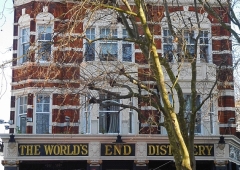
From the oasis that is the Moravian Church’s ground, it is but a short walk west along Kings Road to the large Worlds End Distillery pub, which was already present in the 17th century.  The present pub was built in 1897. It is: “… a public house in the gin-palace genre …” (https://historicengland.org.uk/listing/the-list/list-entry/1391649).

As for the name ‘Worlds End’, this might not be as apocalyptic as it first appears because ‘end’ often used to mean ‘field’ in archaic English. Regarding the ‘World’ part of the name, Edward Walford wrote in about 1880:

“In the King’s Road, near Milman Street, is an inn styled “The World’s End.” The old tavern… was a noted house of entertainment in the reign of Charles II …The house was probably called ‘The World’s End’ on account of its then considerable distance from London, and the bad and dangerous state of the roads and pathways leading to it.”

The posh ‘Sloanes’* of Chelsea might regard Worlds End as truly the end of their part of the world because west of it the shops and dwellings on Kings Road seem far less opulent than those on the stretch between the pub and Sloane Square. At Worlds End, the ‘Sloanes’’ utopian world transforms into unglamorous routine inner-city life. Should ‘Sloanes’ carelessly stray as far west as Worlds End, they would have crossed over to the ‘wrong side of the tracks’.

[* a ‘Sloane’ is a fashionable  upper middle- or upper-class, often young, person, especially one living in London and particularly in Chelsea; most definitely not Bohemian, but extremely bourgeois.]

Peter Pan and Long John Silver

COCKAYNE HATLEY IS A BIG name for a tiny rural settlement in Bedfordshire, close to the county’s borders with both Hertfordshire and Cambridgeshire. Today, it consists of a small parish church and a few buildings about one hundred and fifty yards away. Its population in 2007 was 75 souls. Over the centuries, the place has had various names: Hettenleia (10th cent.); Hatelai (11th cent.); Bury Hattele (13th-15th cent.); Hatley Port, and then from the 16th century as Cockayne Hatley. The name ‘Hatley’ is from the Old English words ‘haett’ and ‘leah’, meaning ‘woodland clearing on the hill’. The first part of the place name, Cockayne, was added to Hatley in the 15th century after John Cockayne (died 1429), Chief baron of the Exchequer, acquired the manor in 1417.

We travelled to Cockayne Hatley to see its church, built during the 13th and 14th centuries and dedicated to St John the Baptist. It was locked up and we did not have enough time to ring the person who holds the keys. However, we took a stroll around the church’s well-maintained small graveyard and found some graves and memorials of great interest.

A pinkish granite stone records the death of Margaret Lindsay (died 1941), whose husband, Lt Col WG Cooper DSO, died in 19?8. What interested me was its Indian connection. WG Cooper had served in India in ‘The Poona Horse’. He was in 34th Prince Albert Victor’s Own Poona Horse, a unit of the Bombay Presidency. His wife Margaret was born in India, the daughter of Peter Stephenson Turnbull, Surgeon General of the Government of Bombay and later, Honorary Physician to the King. William and Margaret married in Bombay Cathedral. The Poona Horse was founded in about 1820, and served in the two world wars, and after India became independent, it served in the India-Pakistan conflicts of both 1965 and 1971 (by which time Cooper was no longer living).

A white stone memorial close to Cooper’s records the death of Private Herber Saunderson in 1919. A Canadian serving in the 17th (Reserve) Battalion, Canadian Infantry (www.roll-of-honour.com/Bedfordshire/CockayneHatley.html), he was aged 40 when he died. He was born in Cockayne Hatley, and then moved to Ontario (Canada) after marriage.

A few feet away from the Canadian’s gravestone there is a black stone monument dedicated to the memory of the crew of a Liberator KN 736 aircraft, which crashed in nearby Potton Woods on the 18th of September 1945. Four men were killed and three were saved as well as a dog called Bitsa. Local people came to their rescue. None of the men who were killed were buried at Cockayne Hatley.

Apart from the graves with military connections, there is one which has many literary associations. The monument to William Ernest Henry and his family is in the art-nouveau style and is the most prominent memorial in the tiny cemetery.

William Ernest Henley (1849-1903) was, according to that font of all knowledge Wikipedia, “…an English poet, critic and editor in late Victorian England.” At the age of twelve, he began suffering from tuberculosis. This resulted in him having to have the lower part of his left leg amputated sometime between 1868 and 1869. Incidentally, Henley was looked after by the eminent Dr Joseph Lister (1827-1912), founder of surgical sterile techniques. The amputation led to an important landmark in British literature. Henley was a good friend of the Scottish writer Robert Louis Stevenson (1850-1894), author of “Treasure Island” (published 1883). It is said that Stevenson’s well-known character, the pirate Long John Silver, was inspired by his “… crippled, hearty friend” (www.britannica.com/biography/William-Ernest-Henley).

Poor old Henley fell out of a train in 1902. This accident caused a flare up of his tuberculosis, which caused his death in 1903. He was cremated at a crematorium near his home in Woking. His ashes were interred in the graveyard at Cockayne Hatley where his daughter was buried. This brings us back to fictional pirates: not Long John Silver but one with a hook instead of a hand: Captain Hook (created by JM Barrie [1860-1937]), who was an enemy of Peter Pan.

Ernest and his wife Anna (née Hannah Johnson Boyle; 1855-1925) married in 1878. They had one child, Margaret, who was born in 1888. The author of “Peter Pan”, JM Barrie, was a friend of the family during Margaret’s short life. Unable to pronounce the word ‘friend’ the small child called her friend Barrie ‘fwendy-wendy’. As a result of this, Barrie used the name ‘Wendy’ for Peter Pan’s female companion in his famous children’s book, “Peter Pan”. It was published in 1904. Margaret did not live long enough to see it; she died in 1894, aged 5. She was buried at Cockayne Hatley, the estate of her father’s friend, the politician and editor Henry John Cockayne-Cust (1861-1917). The monument to Margaret is on the back of that to Ernest and his wife.

Although our visit to Cockayne Hatley was brief, it turned out to be full of interest. If we had not visited the place, we would have been unlikely to have ever heard of William Ernest Henley and his family’s contribution to the richness of British literature. One of the many things that gives me pleasure during our forays into the English countryside is observing things that trigger my curiosity and often generate new interests for me.

A small town in South Africa

B 11 Barkly East evening BLOG


MY MOTHER AND THREE OF HER four siblings were born in King Williams Town (South Africa) in the home of their grandfather Franz Ginsberg, who became a Senator in the South African parliament in 1927. They spend the first few years of their lives in the tiny town of Barkly East in the Eastern Cape. Their father, who ran a general store, was also the town’s Mayor until he died in the early 1930s.

My mother migrated to England in 1947. Her sister, my aunt, and one of her brothers arrived in England in the 1950s. Both of them had vivid memories of their childhood in Barkly East, which they happily shared with me.

In 2003, we made a trip to South Africa in order to see places associated with my ancestors, who migrated there from Europe during the 19th century. We hired a car to travel between these scattered places. One of them was Barkly East.

Before leaving England, I discussed Barkly East with my aunt and noted what she told me. During one of these discussions, she drew a sketch map of Barkly East,  marking on it various places she recalled. I took her map to South Africa with me.

Barkly East was established in 1874. In 1885, my maternal grandfather’s uncle Sigmund Seligmann, who came to South Africa from Ichenhausen in Bavaria in about 1865. His nephew, my mother’s father, took over Seligmann’s store in the first decade of the 20th century and ran it along with Mr Blume.

Barkly East was an important commercial centre for the many sheep farmers and wool producers in the district. It began to decline greatly when the usage of motor vehicles increased and farmers were able to reach the far larger centre the town of East London.

When we arrived in Barkly East in 2003, we found a town with almost empty streets that gave little or no feeling of its once prosperous past. It looked like a place on its ‘last legs’, a bit like London is now during the Coronavirus ‘lockdown’.

On our first day we visited the office of local newspaper,  the Barkly East Reporter,  which was then run by the two Mollentze brothers. They welcomed us and told us a lot about Seligmann’s shop, a place where you could buy everything from a needle to a tractor.

I showed my aunt’s map to the brothers. Despite the fact that she had left the town on the early 1930s, they said her map was very accurate.

Using her map, we found the location of her father’s store, which burnt down in the 1960s. The firm’s wool storage warehouse still stood. It was near to the small street where my mother and her siblings spent the first few years of their lives. It stands next door to the house once owned by Mr Blume.

We were keen to see inside my mother’s childhood home. A young man, probably a teenager,  was sweeping the front porch. His name was Frikkie. We explained our interest in the house. Without hesitation, he showed us around the house despite his parents being at work in their café located near a bridge named after my mother’s father.

It made my spine tingle wandering around the building where my mother was a child. Not having seen it before I was unaware that many internal changes had been made to the building since my mother’s family sold it after my grandfather,  the Mayor of Barkly East, died at an early age.

After my mother’s family left Barkly East, their large house was used for a time as a nursing home before being reconverted to a family residence. My aunt’s two children visited Barkly East in late 2019. They found the old family home, but were unable to enter it. Currently, it houses the offices of the local branch of the African National Congress (ANC). How the tide has changed! In my mother’s childhood, the only non-Europeans who would have entered the house were domestic servants.

We also visited the tiny museum in Barkly East,  where we were welcomed by its curator. Like other curators of local museums in other small South African towns we visited, the curator in Barkly East was concerned about their future in the light of lack of both funding and footfall. She told us about the six or so Jewish families in Barkly East. The last of these, the Bortz family, to leave the town had moved elsewhere a few years before our visit.

The curator said that the Bortz family home had stood empty since they left. Then, after rummaging in a drawer,  she showed us a small metal object in the palm of her hand, and said:

“I know I shouldn’t have done it, but I prised this off the frame of the front door of their empty house long after they left. I took it for the museum. Had I left it there, it would have been taken by someone else eventually. Are you able to tell me what it is?”

It was an empty mezuza, a casing for a prayer scroll that Jewish people attach to the doorframes of their homes and sometimes also within them.

On the last day of our visit to Barkly East,  we visited its extensive cemetery, overlooked by a sad looking shanty town. The small Jewish cemetery containing 11 graves, mostly damaged but identifiable was surrounded by a fence, separated from the resting places of white skinned gentiles. Even after death, apartheid exerted its unsavoury influences. The graves of non-Europeans were in a part of the cemetery well separated from the final resting places of the Europeans.

We left Barkly East, the place where my grandparents enjoyed dinner parties, fly fishing, tennis, and golf, as the snow began to fall on the town. We met many lovely people there during our brief but moving visit to the place where my mother lived for the first decade of her life. I am only sad that she died 23 years before our visit. I would have loved to talk with her about what we saw so long after her childhood.


A surprising city

AFTER AN EXCITING DAY exploring Gopipura, an old part of Surat where my wife’s father’s family lived until over 100 years ago, we spent the following day seeing some of the better known historic sights of the city.

The castle on the bank of the River Tapi was built by the Muslim Tughlaq dynasty to defend Surat against attacks by the Bhils. It was later modified by the Mughals, the Dutch, and then the British.

Until the River Tapi silted up, Surat was an important international port city with a very active involvement in import/export activity. The silting up and the British acquisition of what became Bombay led to a decline in Surat’s prosperity. Over the years, its castle gradually fell into great disrepair.

Now, the castle is being painstakingly repaired. About half of it is currently open to visitors. The castle is being reconstructed using materials and techniques that archaeologists have discovered whilst investigating what has been left of the original structure. The result is a brand new version of what was most probably how the castle was before it began to disintegrate.

The rooms inside the castle recreate their original appearanc as deduced from archaeological examination. The rooms house a beautifully displayed collection of items portraying the history of Surat. A magnificent job has been done.

A man at the ticket booth of the castle reccomended downloading an app called “Surat Heritage Walk”, which is a very useful and well designed guide to the historical landmarks of the city.

After viewing the castle from a bridge that crosses the Tapi, which is how trading vessels would have seen it in days of yore, we visited the Christ Church (Church of North India) built in 1824. This simply decorated church has memorials to several Victorians, whi died in Surat.

We drove past the Mughal Sarai constructed in the reign of Shah Jehan. This large building was a hostel where pilgrims travelling between Surat and Mecca could be accommodated. Shah Jehan was first to encourage pilgrims going to Mecca to sail from Surat rather than travel overland or to embark on ships from Persian ports.

The Khudawan Khan Rojo, a mausoleum built in the mid 16th century, is newer than most of the medieval mosques that survive in Ahmedabad but, like them, it is rich in features adopted from Hindu and Jain temple design. The mausoleum contains the grave of its builder, Khudawan Khan, a military commander who was killed while fighting the Portuguese in about 1559/60.

The mausoleum described above is beautiful and impressive, but not ‘over the top’. The mausoleums in the Dutch, Armenian, and English cemeteries, which are close to each other and surrounded by crowded Muslim neighbourhoods, have to be seen to be believed. Many of the mausoleums are flamboyant structures with domes and details suggestive of both the art of India and the orient and also the Greek and Roman empires. These fantastic final resting places of Europeans who became rich in Surat are curiously exotic and ridiculous at the same time. The exuberance of the funerary architecture exceeds that which I have seen in European cemeteries in Calcutta and Fort Cochin. These monuments should not be missed by visitors to Surat.

As we drove between the places described above, we passed numerous old buildings, often in bad states of repair but rich in finely crafted decorative features.

After our tour, we lunched at Shukan, a restaurant that serves vegetarian thalis. As a meat eater I am not usually keen on vegetarian food, but what we were served at Shukan was much to my taste. The chef is a Rajasthani ‘mahraj’ (usually a Brahmin chef). His food was light but well flavoured. Unlike chefs cooking in the Surat traditional way, he used garlic, onions, and crushed peanuts. Yet, his dishes were not sugary as we found in other parts of Gujarat, notably in Ahmedabad and Saurashtra.

Although amongst the larger cities I have visited in Gujarat, Surat has fewer major tourist attractions than others (such as Ahmedabad, Baroda, Junagadh, and Bhuj). However, it has a visually exciting urban texture and vibrancy. The two days we allotted to our first visit to Surat was not long enough. We hope to return for longer in the future.