Artists as artworks in London’s East End

BRICK LANE IN east London has been home to immigrants from various parts of the world. Currently, many of the people who live and work in the area are of Bangladeshi heritage. In the last few years, the area has attracted the ‘trendy’ set, whose interests are mainly in the attractions north of the former Truman Brewery. Some years ago, my friend David, visiting from Atlanta (Georgia), and I paid a visit to Brick Lane and were surprised to find a bit of ‘Ye Olde England’ almost hidden amongst the predominantly Asian businesses. It was the The Pride of Spitalfields London – a real old-fashioned ‘boozer’. Stepping into it, it was difficult to imagine you were not in a country pub, but in the heart of east London. It is on Heneage Street next door to what had once been part of a brewery.
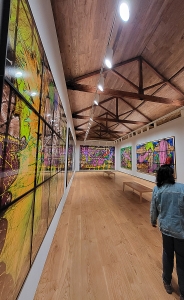
In 2015, the Trustees of the Gilbert & George Centre, a charity, acquired the building next door to the pub. On the 1st of April this year (2023), the converted buildings were opened to the public. They have been beautifully transformed by the SIRS Architects practice and they house artworks by the duo Gilbert and George (‘G&G’), who both trained at London’s St Martins School of Art. According to the G&G website (gilbertandgeorgecentre.org):

“The property was purchased with the idea to create a permanent home for works of the artist and to enrich London’s cultural offering thus further.”

G&G produce often very colourful works, all of which include the pair of creators within their images. As artists, they are also the subjects of their creations – they are almost always depicted in all their works. Their works deal imaginatively with a wide variety of things that we all face in our daily lives – some of them often considered too distasteful to be discussed or displayed. But G&G boldly bring them to our notice in a dramatic way.  As Michael Bracewell, a Trustee, wrote on the website:

“Gilbert & George maintain an ideological opposition to formalistic art theory and the reference of art to the history or theory of art. Asserting instead the power of emotion and actuality, their art addresses subjects that are culturally excluded, neglected or disowned. Their art questions social taboos and morality. By looking at difficult subjects the art and vision of Gilbert & George is intended to ‘de-shock’ rather than seeking to shock. Its aim is not the simple task of ‘shocking’ a viewer, but the difficult task of interrogating a subject and themselves … Unchanging, they have the appearance and countenance of modern sober-minded, anonymous citizens, who have embarked on the astral journey of their own Divine Comedy: purgatory, Heaven and Hell as they find it and perceive it in our world, in nature and in themselves.”

Whether or not you like the creations of G&G, the new Centre is well worth visiting, even if only to see the fine design of the buildings containing it. If the art is all too much for you, you can pop into the pub next door and seek liquid relief. And if you loved the place, which we did, you can visit the boozer to celebrate the arrival of this superb new addition to the London art scene.

An artist and a gallery in a British seaside resort

THE GREAT BRITISH artist Joseph Mallord William Turner (1775 – 1851) was accurately described by the writer John Ruskin as “… the father of Modern art …” in 1843. Turner first visited Margate when he was aged 11. After about 1820, he often stayed in the town because he thought the skies over the area were the most beautiful he had seen in Europe. Between 1827 and 1847, he stayed in the town in a guesthouse owned by Mr and Mrs Booth. When Mr Booth died in 1833, Turner became a close companion of the widowed Sophia Booth, who died in 1878. He also adopted the name ‘Booth’.

The house owned by Sophia Booth, where Turner resided, is no more. Where the guesthouse once stood is now occupied by the Turner Contemporary Gallery (‘TCG’). The gallery was designed by David Chipperfield (born 1953), and opened in April 2011. Just as Turner’s paintings were considered avant-garde and even provocative when they first appeared, the TCG is a highly adventurous contrast to the rest of the old town that neighbours it. Some buildings look better inside than outside. The TCG is a good example of this. The gallery spaces are spacious and well-lit both by natural and artificial light. They were a perfect place to view the highly colourful creations of the Brazilian born artist Beatriz Milhazes (born 1960), which are on show at the TCG until the 10th of September 2023.

I believe that the presence of the TCG has elevated Margate’s status from being a simple, unexceptional seaside resort to a place that attracts a much wider range of visitors than it did in the past. As happened in London’s Islington in the 1960s, a rather mundane place has become somewhere that people now feel they ‘must visit’. Although the usual British seaside attractions can still be found in Margate, the town is now also catering for the ‘up market’ clientele. And that cannot be a bad thing because when I lived in Kent (1982-1992), apart from Whitstable (and maybe Broadstairs), most of the seaside places in north and east Kent were in decline and rather melancholy.

The opening of the TCG has done for Margate what the art Triennale has done for another previously dreary Kent town – Folkestone. Even if Turner might have been shocked to see what now stands where he spent many happy hours with Sophia Booth, I feel sure that he would have been happy to know that it has revitalised a town which he loved.

Remembering victims of war in Sandwich, Kent

Some of the WW1 names and the Falklands victim below

IN THE HEART of Sandwich in Kent, near to the deconsecrated Church of St Peter, there is a war memorial that was erected to commemorate those from the town who died in the ‘War to End All Wars’ – the First World War (1914 – 1918). Roughly 100 names are recorded on the lists of people who died during WW1. However, they are not the only people listed on this monument because ‘The War to End All Wars’ did not live up to its name.’

The memorial lists about 15 people who were killed in WW2 (1939-1945). In addition, three of Sandwich’s population perished in the Korean War (1951), and more recently, one of the townsfolk was killed in the Falklands Conflict (1982).

I sincerely hope that no more names need to be added to this war memorial as a result of the conflict in Ukraine, or any future wars.

A Northerner’s photographic images of the American south

THE PHOTOGRAPHER BALDWIN Lee, a Chinese American, was born in Brooklyn (New York) in 1951. He studied photography at MIT and then at Yale. In 1982, he was appointed Professor of Photography at the University of Tennessee, where he established the university’s photography course. As a New Yorker born and bred, he was amazed at the contrast between living conditions in the southern states and where he had come from. He began making tours of the south, photographing members of various African Americans at home, at work, and at play. Over the years he took more than 10000 photos. All of them are in the black and white format. Apart from being fascinating glimpses of the everyday lives of low income ‘black’ Southerners, they are beautifully composed, superbly detailed images – well worth seeing, as we did recently at the David Hill Gallery in London’s Ladbroke Grove.

At his gallery, David Hill discussed Lee’s work with us. What particularly interested me was that Lee used (still uses) an old-fashioned field camera with a lens made before WW1. He chose this old lens because unlike modern lenses its glass has no coating. Also, and this is something I learned long ago, many of these older lenses were hand ground, rather than machine made. This resulted in the lens having a far better resolution than many of the best quality lenses that were available in the 1980s. The type of camera that Lee used to make his splendid photographs was not dissimilar to the kind of camera that early photographers such as Julia Margaret Cameron (1815-1879) used to create images. The lens on the simple camera that Lee used projects an image onto a ground glass screen at the back of the camera. In Victorian times, a prepared glass photographic plate used to be attached to the rear of the camera to capture the image. Lee, working more that 100 years later, captured his images on sheets of 5×4 inch high quality, fast negative monochrome film. Using these, Lee was able to create high resolution photographic images, and his subjects did not have to hold their poses for nearly as long as was the case when Cameron was creating her photographs. Because Lee’s subjects did not have to maintain their poses for more than a few seconds, his images are far clearer than Cameron’s whose subjects often had to try to remain still for many minutes. This meant that in addition to the deliberate artistic manipulations that Cameron made in her dark room, the inevitable slight movements that her subjects made added to the interestingly other-worldly images she created.

The advantage of using an old-fashioned camera and lens, such as Lee employed, was that it was a high-quality pin-hole camera. Unlike modern cameras, these present hardly anything that might alter the light entering the camera and affect the images.  I found it fascinating that apart from taking advantage of the improvements in film quality this superb photographer prefers to use a camera that would have been familiar to Julia Margaret Cameron rather than a modern one that made the light entering it take a complicated path from the outside world to the film surface.

You can read more about Cameron in my book, which is available here:

A boundary stone in a Dalston railway station

WE VISIT KINGSLAND Road in London’s Dalston district frequently for several reasons: to eat Turkish food, to watch films at the Rio Cinema, and to enjoy plays at the Arcola Theatre. Using the Overground is quite a convenient way for us to reach the area. We use trains to and from Dalston Kingsland station. The station, close to the colourful Ridley Road market, was opened in 1850 as part of The North London Railway. Today, it is a busy station on the Overground Network.

Today (20th of July 2023), whilst walking along the westbound platform, I noticed something for the first time. It was a small white object a bit like a milestone standing a few feet east of the bridge that carries Boleyn Road over the western part of the station. It bears the date 1863. And below that there are the letters:

“St M. 1”

And at the bottom of the object is the following:

“JOSEPH SURR JUNr

WILLIAM HARVEY

CHARLES SAWBRIDGE”

They are all described as “Church wardens.”

I suspect that the stone is or was a parish boundary marker. On a map surveyed in 1870, there is a line marked “Parliamentary Boundary”, rather than ‘Parish Boundary’, running through the very spot where the marker stone stands today. The “St M” might refer to the local parish Church of St Marks. Although I cannot yet be certain, it is possible that the parish and parliamentary boundaries were in the same place where the stone stands today.  Oddly, various searches of the Internet produced hardly any information about the stone except that one person, writing on Twitter, wondered if it had been moved to its present position from another place. This is unlikely because I have discovered that a boundary marker in exactly the same position as that which I saw today is marked on a detailed map surveyed in 1893-94.

The date “1863” is curious because the present Church of St Marks in Dalston was only constructed between 1864 and 1866. Maybe, there was an earlier parish church, or possibly the parish was only established in 1863. Who knows?

It is interesting that one small item, the boundary stone at Dalston Kingsland, can give rise to so many mysteries.

A sign with missing vowels in Shepherds Bush

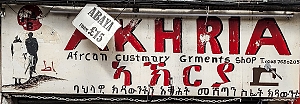
IN SHEPHERDS BUSH Market, I noticed a shop sign written in Arabic, Ethiopian and Latin scripts. The Latin script read as follows:

“Afrcan custmory grments shop”.

Was this bad spelling of English words or maybe something else? It might have been the latter as I will try to explain using two examples.

When I was a dental surgeon, I worked for a while with a wonderful assistant from Uganda. Her English was very good, but when she saw me eating potato crisps at lunch time, she used to ask me whether I was enjoying my “crisips”.  The other example concerned a couple of Italian friends who had been living together since they were both 18 years old. Just after their 40th birthdays, they married suddenly. When we asked them why, the lady said in English:

“For physical regions.”

We were surprised. It turned out that what she was trying to say in her Italian accented English was that they had married for FISCAL reasons.

Both my Ugandan assistant and our Italian friend had inserted vowels between two consecutive consonants where they did not exist in the properly pronounced versions of ‘crisps’ and ‘fiscal’. Remembering this, I wonder whether whomever had written the shop sign in Shepherd Bush Market had thought it unnecessary to put in various vowels where they should have been because they believed that readers of their sign would automatically add vowel sounds between some pairs of consonants. This kind of reader would probably read the misspelt signs as follows:

“African customary garments shop”

If this is not the case, then the signwriter needs to improve his or her spelling of English words.

A Ford Zodiac in Notting Hill and hot weather

TODAY THE TEMPERATURE in Athens (Greece) will exceed 35 degrees Celsius, and in Rome it is predicted to reach 42 degrees in two days’ time. Two years ago, a temperature of 48 degrees was recorded in Sicily. So, it seems that so-called Global Warming is happening with vigour. Meanwhile, this Sunday (16th of July 2023) in London, we enjoyed a breezy morning with temperatures not greater than a pleasant 21.

While walking along Portobello Road this Sunday, we spotted a beautifully cared for open-topped Ford Zodiac. These vehicles were manufactured between 1950 and 1972. I remember seeing them in my childhood and teenage years. In those days, I was not much interested in cars, but now when I see one that used to be common in my earlier years, I find them worthy of examination. I took several photographs of the Zodiac and then headed for the bus stop from which we were returning home.

Despite the external temperature being 21 degrees or less, it was far warmer inside the bus although its windows being open. The higher temperatures that we have been experiencing here in London and are now affecting places near the Mediterranean are commonly believed to be at least partly due to emissions produced by fossil fuels, such as petrol. As we moved homewards, a thought struck me. The beautiful Ford Zodiac, which we had just seen, is aesthetically pleasing and a souvenir of one of the great eras of automobile engineering, but it is also an ‘ancestor’ of Global Warming. Beautiful as it is, it too burns fossil fuel and makes its own contribution to what is believed to be causing dangerously high air temperatures in many parts of the world.