The house in the desert and a fighter for the independence of India

A NARROW ROAD LEADS away from the town of Mandvi (in Kachchh, a part of Gujarat) into an arid sandy area close to the seacoast. Scrubby bushes populate most of this flat terrain. After a few miles, a red building can be seen on the horizon. As you approach it, you can see that it resembles no other in the surrounding area, or, for that manner, in any other part of India. However, if you are a Londoner, it would seem familiar, although quite incongruous.
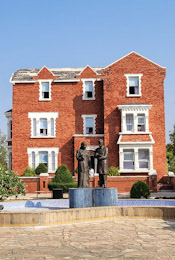
Replica of India House near Mandvi, Kachchh

The house in the desert is an accurate replica of a typical Victorian house, such as can be found in North London. In fact, it is a full-size copy of number 65 Cromwell Avenue in London’s Highgate area. The reproduction near Mandvi was built as part of a complex to commemorate Shyamji Krishnavarma (1857-1930), who was born in the centre of Mandvi.

Krishnavarma, who became a barrister and worked in various Princely States, moved to London, where he lived until about 1907. He moved to Paris, and then to Geneva, where he and his wife lived until they died.

In London, Krishnavarma lived opposite Highgate Woods. He invested wisely, and became interested in the works of English men, who had their doubts about Britain’s domination of India. He became an opponent of British rule in the Indian subcontinent. At first, his interest was mainly intellectual. However, in 1905, following the partition of Bengal, he became an activist.

One of his several activities was to purchase number 65 Cromwell Avenue. He had it adapted to become a ‘home away from home’ for Indians studying in London – they frequently had to endure the racist attitudes of English people. He named the building ‘India House’ (which should not be confused with the present Indian High Commission in London).

Apart from providing Indian food, some accommodation, and some leisure facilities, India House also hosted meetings that discussed the injustice of British rule in India. Soon, India House attracted the attention of the British police. This was because India House was becoming a nucleus or hotbed of anti-British activism. For example, some of the people who frequented the House experimented with bomb making and smuggling firearms to freedom fighters in India.

Krishnavarma left London in 1907, when he feared that he might be arrested. India House continued to be active until mid-1909 when one of its visitors assassinated an important colonial official.

Krishnavarma wrote in his will that after he was cremated, his ashes should be returned to India only after it had become independent of the British.

In the early part of this cemetery, the Chief Minister of Gujarat, then Narendra Modi, decided to bring Krishnavarma’s ashes to India – to Mandvi. Some years later, a complex to commemorate Krishnavarma was built outside Mandvi. Part if this is the replica of Highate’s former India House. The ashes of Krishnavarma and his wife are stored in urns on display in a building next to the replica.

If this story interests you and you want to know much more about India House, its replica, Krishnavarma and his fellow freedom fighters, including the currently influential VD Savarkar, you should read my, dare I say it, very informative book. I have produced two versions of it. One, the latest edition is “Indian Freedom Fighters in London 1905-1910), and is available here: https://www.amazon.co.uk/gp/aw/d/0244270716/ . The other “Ideas, Bombs, and Bullets”, which can only be delivered to addresses in India in available here: https://store.pothi.com/book/adam-yamey-ideas-bombs-and-bullets/.

She sells papers on the pavement in Ahmedabad

WE HAVE VISITED AHMEDABAD (Amdavad) at least five times since our first visit in 2018. We have always stayed at a small friendly hotel close to the House of MG. This former mill owner’s mansion is now a luxury hotel, which tries to create the kind of India that most foreigners have as an imagined preconception. It achieves that, but is rather too precious for my liking. On the road immediately outside this Disney like themed hotel is the ‘real’ rather than the sanitised India, which can be experienced within the House of MG.

Ever since we first stayed in Ahmedabad, we have seen a lady who sits on the pavement outside the compound of the House of MG. When we first met her, she used to sit beside her overweight husband. Sadly, he died during the covid19 pandemic. On our recent trip in November 2023, she could not be seen, and we were worried that she had also passed away. However, she appeared after several days of the Diwali holiday, and greeted us as old friends.

The reason for her temporary disappearance was that during the Diwali holidays newspapers are not printed. And she sits outside the House of MG for a good reason. She sells newspapers. When her husband was around she and he used to be surrounded by untidy piles of newspapers. We used to buy “The Hindu” from her every day. I noticed on our recent trip that her stock of newspapers was smaller and more tidily arranged than in the past. As “The Hindu” is no longer delivered to newspaper sellers in Ahmedabad, we have had to make do with “The Times of India”.

‘Our’ newspaper lady, the friendly autorickshaw drivers who hang around near her, the man who sells screwdrivers from his simple barrow, the faithful in the Sidi Saiyedd mosque opposite the luxury hotel, and the elderly Moslem gentleman watching the world go past his wheelchair are in my mind the real India and what makes it so endlessly fascinating for me.

By road and by rail through rural Gujarat

WE HAD DECIDED TO travel to Mandvi (in Kutch, a part of Gujarat) by taking a train to Gandidham, then going by road the 98 kilometres between there and Mandvi.

The Indore to Gandidham Express arrived 30 minutes late on Ahmedabad Junction’s platform 4. Getting on to our carriage was a veritable scrum. The problem was that people, including us, wanted to board before those alighting at Ahmedabad had reached the carriage entrance. Someone behind us shouted “Hurry up and get inside.” When a passenger who was trying to leave the train replied “We want to get off”, the irritating lout behind us shouted “You should have started getting out quicker.” We struggled along the carriage and found our window seats eventually.

We had reserved seats numbers 73 and 76. A man was sitting in seat 76. When we said it was one of ours, he said that he was occupying his alloted seat, namely seat 77. It took some considerable persuasion before he understood that seat 77 did not have the number ‘76’ above it. This incident reminded me when I used to travel by train in Italy during the 1960s.

Whenever we travelled by intercity trains in Italy long ago, my parents always reserved seats – always in the first class carriages – in advance. Invariably, our reserved seats would be occupied by passengers who should not have been in them. It was o lying after the train conductor had been summoned that the people yielded our seats to us. Moments later, these obstinate people would engage in friendly conversation with us.

Returning to the Indore to Gandidham Express, before it started, vendors selling fruit and bottled water roamed along the platform looking for customers. Meanwhile, a hot tea seller moved along the interior of the train. He and others remained on board during the journey, as did a couple of snack vendors.

Once we got going, the train sped along. There was only one intermediate station where we stopped briefly during the 4 and a 1/2 hour journey. As we traversed the flat plains of Gujarat, we saw many neatly cultivated fields and numerous industrial units of varying sizes. In the area where eastern Kutch begins, we passed vast expanses of land being used as salt pans. Every now and then, we saw conical mounds of grayish white harvested salt.

Many trains passed us, travelling in the opposite direction. Almost all of them were freight trains. The line along which were moving leads to and from the busy port of Kandla on the south coast of Kutch. What little we saw of Gandidham and its outskirts was unattractive.

The air temperature at Gandidham station was well over 30 degrees Celsius and there was little shade. To exit the station, we had to use an escalator. Once again it was a scrum trying board it. Some passengers were too frightened to step on it which made using it even more difficult.

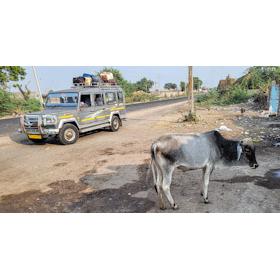
Our host in Mandvi had kindly booked us seats in a shared taxi to travel from Gandidham to Mandvi. This vehicle was like a jeep. It had a front row of seats – sofa like – and behind that there was another similar seating arrangement. Behind that, there was a far less comfortable seating space that accommodated any number of people that could be squeezed in. We were booked into the seating behind the front seats and in front of the rear ‘compartment’.

Although the middle seating had been booked for my wife and me, Lopa invited one of the three passengers who had squeezed in the front seat next to the driver to join us. He turned out to be a friendly chap. He and his friends were returning home from several days of a religious pilgrimage. Our new companion was a trader in rice, sugar, etc. He bought commodities and sold them for export. During our journey, he received a telephone call. He told us that soon after getting home, he had to go to Bombay for some urgent work. He and his business partner would have to drive for 11 hours through the night to reach Bombay from near Mandvi.

Our driver decided not use the 4 lane highway between Gandidham and Mandvi because of heavy traffic. Instead – and it made the journey far more interesting – he took us along a “short cut”, using country roads, some of them minor. This added fascination because we passed through rustic villages. At one of these, we were stopped by an elderly lady standing beside the road. She wanted to go to Mandvi, and was invited on board.

At another place, we stopped and the driver picked up a bundle tied in cloth, which he delivered to someone in another village we passed through later. After about an hour, to my great relief because my mouth was parched, we stopped for about 20 minutes at a stall where snacks and cold drinks were available.

At one point early during our journey, someone in the rear compartment asked our new companion to dial a certain number on his phone. Some conversation in Gujarati ensued. It turned out that there were some labourers travelling in the rear compartment. As they had not yet been paid by their employer, they claimed that they did not have the 300 Rupees needed to pay for the ride. Our friendly sugar trader allowed the employer to electronically transfer the required amount to his account. Our neighbour then suggested that he could electronically transfer that fare money to the driver’s account. However, the driver wanted to be paid in cash, which the trader kindly agreed to do.

Most of the way, the driver used one hand to steer, and the other to hold his mobile phone to his ear. Despite this hazardous practice, there were no scary moments along the way. We arrived at our destination safely, but somewhat cramped.

When we sat inside our host’s air-conditioned large saloon car to drive to his house, it felt as if we had moved from a stone seat into a feather bed. Never before has a modern saloon car felt so comfortable.

Despite moments of discomfort, our rail and road trip was enjoyably interesting. By the end of the journey we felt as if we had been truly travelling – a feeling that air travel often fails to provide.

She wore it a Diwali party in London

AN ARTICLE IN “The Ahmedabad Times” newspaper, dated 18th of November 2023, discussed what the British Prime Minister’s wife, Mrs Sunak, was wearing at a recent Diwali party in London. Over her tasteful blue sari she was wearing a pearl necklace, which was attached to a golden pendant.

The pendant is a Hindu mythological creature, a ganderberunda. This is a bird with two heads – a double-headed eagle. It is the symbol of the Indian State of Karnataka. It is also a national symbol of places including Albania, Serbia, and Montenegro. It was also a symbol used by the Holy Roman Empire.

I wonder if Mrs Sunak was aware that the double-headed eagle is also a national emblem of Russia, against whom Rishi Sunak and his government are providing much military assistance.

Late night shopping a the Law Garden in Ahmedabad

THE LAW GARDEN in Ahmedabad was developed into a park in about 1997. Previously, it had been a vast triangular vacant plot in the heart of an affluent residential area. Named after an adjacent college of law, it was an undeveloped, rather disreputable bit of land. In 1997, it was tidied up and turned into what is now a pleasant place for people to relax and ‘take the air’.

Market stalls can be found along the street on one side of the park. After dark, a busy night market springs to life. This existed even before the park was completed.

Many of the stalls sell clothing made using colourful traditional patterned textiles – both embroidered and printed. Several stalls were selling cloths embroidered with small mirrors – work from Kutch.

In addition to clothing, there were hawkers selling toys and balloons. Foodsellers pushed small barrows from which they sold fruit, confectionery, and soft drinks.

This lively market reminded me a little of Fashion Street in Bombay, but it is somewhat smaller and offers less variety. The Law Garden night market is well worth a visit.

Bengali art before it was affected by influences of Europe and the Far East

THE INDUSTRIALIST KASTURBHAI Lalbhai (1894-1980) filled his Ahmedabad home (built 1905) with works of art. One of his relatives had married a member of the famous Tagore family of Calcutta. When the Tagores decided to sell their fabulous collection of Indian art in the 1940s, Lalbhai purchased it and thereby saved it from being sold to buyers who did not live in India. These works are on display in the house, which is now known as the Kasturbhai Lalbhai Museum.

The Museum houses works of Indian art dating from as early as about the 4th century AD to the 1940s. Visitors to the museum are obliged to go on a prebooked informative guided tour through the rooms of the museum. Although a bit of a speedy experience, one leaves having seen an enlightening cross-section of the history of art in India. Photography in the museum is not allowed.

In the special exhibition

In the beautiful grounds of the museum, there is a recently constructed annex, where temporary exhibitions are held. We were treated to a show entitled “The Babu and The Bazaar”. It is a collaboration with the Delhi Art Gallery.

This fascinating exhibition contains a display of images created by Bengali artists, who painted in traditional styles that prevailed before art in Bengal became influenced by British art schools, Western European art, and the art of China and, especially, Japan. These external influences were most famously introduced by figures such as Rabindranath Tagore and his nephews Gagendranath and Abanendranath.

During my visits to India, I have seen plenty of paintings by Bengali artists who incorporated non-Indian artistic styles into their creations, but I cannot remember having seen such a large collection of Bengali paintings and other works in vernacular styles derived more from tradition than from outside influences. Most, but not all, of the artworks depicted Hindu religious subject matter. Many of the paintings were by artists I had never heard of, or were by unidentified painters. The well-labelled exhibits, which were beautifully displayed, were refreshing eye-openers.

Designed by a disciple of Le Corbusier but it stands disused

THE BUSTLING KHWAJA Market in the heart of old Ahmedabad (Gujarat, India) stretches from the Bhadra Fort to the three-arched Teen Darwaja – a magnificent medieval gateway. Between the two, on one side of the marketplace, there is a 20th century edifice that is hard to miss. Built in the Brutalist style, this massive concrete building is the Premabhai Hall.

Premabhai Hall in Ahmedabad

It was completed in 1972. Its architect was Le Corbusier’s disciple and collaborator, the late BV Doshi (1927 – 2023). His building – an auditorium -replaced an earlier meeting hall, which had been built during the British occupation of India.

Looking like a giant piece of moder sculpture Doshi’s building hardly clashes with the mediaeval buildings on either side of it. Sadly, because of concerns about fire hazards, the Hall ceased being used in the 1990s. Luckily, it is still standing, but when looked at closely, it is showing signs of deterioration.

I hope that one day, the Premabhai Hall will be restored to its former glory.

A war memorial in the heart of Bangalore: they died for the British Empire

ON ARMISTICE DAY (11th of November 2023), we stopped to look at the war memorial that stands in a busy part of Bangalore, where Brigade Road crosses Residency Road. Erected in about 1928, its design was somewhat influenced by Lutyens’s famous Cenotaph in London’s Whitehall. Actually, it has a greater resemblance to the memorial clock tower in London’s Golders Green, where I was brought up.

Bangalore

The four-sided memorial in Bangalore is to commemorate the members of the Pioneers, who died in WW1. However, it also records other earlier campaigns that claimed the lives of Pioneers The Pioneers, more correctly the regiments of the ‘Madras Pioneers’, were established by the British in the 18th century, and later became known as the Madras Sappers. More details are to be found in an article in the hindu.com :
“A glance at some historical documents shows that the 61st Pioneers originated in 1758 and were raised as the 1st Battalion Coast Sepoys which became the 61st Pioneers in 1901 and later became the 1st Battalion of the 1st Madras Pioneers in 1922. The 64th Pioneers also originated in 1758 as the 5th Battalion Coast Sepoys and became the 2nd Battalion of the 1st Madras Pioneers in 1922. The 81st Pioneers stood apart and originated in 1786 as the 28th Madras Battalion and later became the 10th (Training) Battalion of the 1st Madras Pioneers in 1922.”

Apart from WW1, the monument records other campaigns that were fought so that the British could consolidate their Empire. These include (to mention but a few named on the memorial): Mysore, Seringapatam, Nagpur, Afghanistan (1878-80), Burma (1885-87), and China (1900). For some of these conflicts the numbers of men lost are recorded. Numbers of English and Indian fatalities are listed separately.

When we visited the monument on Armistice Day, we saw two fresh wreaths at its base. One had a label attached, which said it had been placed by the French Consulate in Bangalore. The other had no words but it bore ribbon with the colours on the flag of Germany. There was neither an Indian nor a British wreath to be seen.

The shoe repairers and a great politician of India

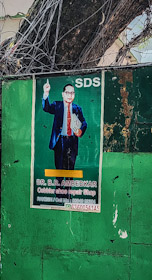
MANY SHOE REPAIRERS’ stalls in India carry at least one image depicting the politician BR Ambedkar (1891-1956). Amongst his many achievements was heading the committee that drafted the Indian Constitution. Statues often show him holding a book – the Indian Constitution.

BR Ambedkar on a cobbler’s booth

Ambedkar was born into a Marathi family in what is now the state of Madhya Pradesh. His family were outside the caste system – they were “untouchables”, also known as ”dalits” or, as Mahatma Gandhi called them, “Harijans”. One of Ambedkar’s. important ambitions was to procure political rights and social liberation for the dalits.

Traditionally, and still today, Hindu leather workers (tanners, shoemakers, leatherworkers, shoe repairers, etc) were members of dalit communities (e.g., the Chamar community). It is for this reason that images of Ambedkar, who fought for their rights, appear on shoe menders’ kiosks.

Vincent Van Gogh on a wall in India

YOU CAN SEE MURALS painted on walls throughout the Indian city of Bangalore (and in many other places in India). These paintings transform otherwise boring walls into something worth looking at.

Today, the 12th of November 2023 – Diwali, I visited Airlines Hotel in Bangalore. This place has an alfresco café and a large parking area. I saw some young people painting a mural. The design they were creating was a copy of a picture on the screen of a tablet or ipad. The building on which they were painting faces a long wall that marks the boundary of both the car park and the Airlines compound.

Since we last visited Airlines in February 2023, the boundary wall has been covered with a long painted mural. At first sight, this colourful painting brings to mind the work of the Dutch artist Vincent Van Gogh, who died long before it was made.

Though it resembles the style of the Dutch artist, on closer examination you can easily tell it is not by him. But its creator has certainly done a good job capturing the essence of Van Gogh’s style, and has livened up a hitherto unsightly, high breeze block wall. The other murals adorning the compound are visually engaging, but not as much as the Airlines “Van Gogh “