
Remembering a forgotten adventure during WW2 in German occupied France

DURING WORLD WAR II, many Indian soldiers fought with the British in North Africa and on many other battlefronts. Vast numbers of allied soldiers were taken prisoner by the Germans in North Africa, and these prisoners of war (‘POWs’) included several thousand Indians. The POWs were taken first to Italy, and then to prison camps in German occupied territory. One of the prison camps that contained many Indians was in the French town of Epinal. In May 1944, allied aircraft heavily bombed the town as part of a programme to damage French the railway system that was being used by the Germans. During this attack, the camp housing the Indians was badly damaged, and many Indian POWs escaped. At least 500 of them found their way to safety in Switzerland, and a few fought with the French resistance. This almost forgotten episode is described in “The Great Epinal Escape”, a book written by Ghee Bowman (1961-2025).
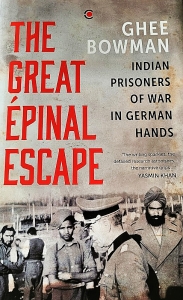
The book details how and where the Indians were taken prisoner; who they were; their journeys from Africa to Epinal; and their lives in the camps. Then, in meticulous detail, it recounts how the escapees found their way to freedom in Switzerland and the help they received from French people on their difficult journeys. This assistance was given by ordinary people, who knew that if they were discovered to be helping escaped POWs, they would face horrendous punishments, including execution.

Bowman’ scholarly but extremely readable book is the only account in English of this great escape story. Whereas the daring escapes of British POWs from German prison camps have been related in books and films, the Epinal escape, probably the greatest escape of POWs during WW2, seems to have been ignored both by British and Indian historians. The reasons for this are discussed in Bowman’s final chapter.

I bought my copy of this book about an almost forgotten episode during WW” in Bangalore (India), and I have enjoyed reading it.

A war memorial in the heart of Bangalore: they died for the British Empire

ON ARMISTICE DAY (11th of November 2023), we stopped to look at the war memorial that stands in a busy part of Bangalore, where Brigade Road crosses Residency Road. Erected in about 1928, its design was somewhat influenced by Lutyens’s famous Cenotaph in London’s Whitehall. Actually, it has a greater resemblance to the memorial clock tower in London’s Golders Green, where I was brought up.

Bangalore

The four-sided memorial in Bangalore is to commemorate the members of the Pioneers, who died in WW1. However, it also records other earlier campaigns that claimed the lives of Pioneers The Pioneers, more correctly the regiments of the ‘Madras Pioneers’, were established by the British in the 18th century, and later became known as the Madras Sappers. More details are to be found in an article in the hindu.com :
“A glance at some historical documents shows that the 61st Pioneers originated in 1758 and were raised as the 1st Battalion Coast Sepoys which became the 61st Pioneers in 1901 and later became the 1st Battalion of the 1st Madras Pioneers in 1922. The 64th Pioneers also originated in 1758 as the 5th Battalion Coast Sepoys and became the 2nd Battalion of the 1st Madras Pioneers in 1922. The 81st Pioneers stood apart and originated in 1786 as the 28th Madras Battalion and later became the 10th (Training) Battalion of the 1st Madras Pioneers in 1922.”

Apart from WW1, the monument records other campaigns that were fought so that the British could consolidate their Empire. These include (to mention but a few named on the memorial): Mysore, Seringapatam, Nagpur, Afghanistan (1878-80), Burma (1885-87), and China (1900). For some of these conflicts the numbers of men lost are recorded. Numbers of English and Indian fatalities are listed separately.

When we visited the monument on Armistice Day, we saw two fresh wreaths at its base. One had a label attached, which said it had been placed by the French Consulate in Bangalore. The other had no words but it bore ribbon with the colours on the flag of Germany. There was neither an Indian nor a British wreath to be seen.