A riverside café

SITUATED CLOSE TO the River Thames footpath between Hammersmith Bridge and Chiswick’s St Nicholas Church, in whose cemetery the artist William Hogarth is buries, is the popular Elder Press Café.

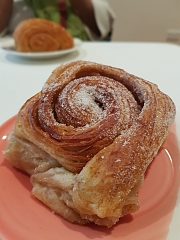
A ‘breakfast bun’ at the Elder Press Cafe

From the outside, it seems that this is a small establishment, but this is misleading. Behind the narrow shopfront facing the the Black Lion pub, the café extends a long way. It surrounds an inner courtyard with tables and chairs.

In addition to drinks and delicious patisserie items, the place offers a range of savoury dishes, which I saw being served to those on tables neighbouring ours. The food looked healthy as well as delicious. Service was attentive and friendly and prices were not exorbitant.

Eating in The Ark

THE SHED IS aptly named. It is a restaurant in a long lean-to shed amongst the more solidly built edifices on Palace Gardens Terrace in Notting Hill Gate. This ramshackle-looking wooden structure has been home to a restaurant for many decades. For most of that time, it was called ‘The Ark’. It served lovely French-influenced food including my favourite on its menu, rack of lamb. The Ark was a popular local eatery, which attracted some celebrities including Prince Charles and Ingrid Bergman in the 1960s.

On one occasion a friend, let us call him ‘X’, who had eaten at our home many times,offered to treat us at The Ark. We accepted willingly. As soon as we sat down, X ordered the restaurant’s most expensive bottle of red wine. When, during our meal, it came to an end, he ordered another of the same. When the bill arrived at the end of our dinner, X fumbled in his pockets, blushed, and then, stammering, said:

“Oh, I have left my wallet at home.”

His home was a long way from Notting Hill Gate. He continued:

“This is all I have got”,

and placed a £10 note on the table. £10 barely covered half the cost of one of the bottles of wine he had ordered. Naturally, we paid the bill, and he said he would refund us the money, which he must have forgotten to do.

The Ark closed and then re-opened as a branch of the restaurants run by the chef Jean-Christophe Novelli. It served what I considered to be rather over-priced pretentious food. On one occasion, the Novelli restaurant took part in a scheme run by the Evening Standard newspaper. For £15, restaurants in the scheme offered a full meal without drinks – a bargain. My wife rang Novelli at the old Ark and asked whether we could book a table that day and use the voucher in the newspaper for the discounted meal. She was told that the restaurant was fully booked. So, I rang about two minutes later and asked to book a table, but without mentioning the newspaper offer. The lady, who answered the ‘phone at the restaurant, told me:

“Certainly, we have plenty of tables. Come when you like.”

Novelli’s closed, and the old Ark building remained empty for a while.

In 2012, the Gladwin brothers opened The Shed restaurant in the shed that once was home to The Ark. Time Out magazine (www.timeout.com/london/restaurants/the-shed) described it well:

“Tucked away behind a curtain of tousled ivy, The Shed serves up small, resourceful dishes built with foraged and locally-grown ingredients from the countryside. Led by the Gladwin Brother trio, who have their own farm and vineyard in Nutbourne, West Sussex, as well as two additional London restaurants, their flagship Shed was quick to become a local neighbourhood favourite when it first opened in 2012.

Though the menu changes seasonally, the original plates are still the best bet. (Note: everything is served tapas-style and 2-3 dishes per person is the recommendation.)”

I have been there a couple of times and found it to be both pleasant and original from the culinary vantage point. The serving staff, which briefly included our daughter, are obliging and well-trained. When ordering, the waiter or waitress discusses the dish and its ingredients knowledgeably. Pleasant as it is, it is not as enjoyable as The Ark was in its time.

Art deco in a north London suburb

THE HAMPSTEAD GARDEN SUBURB (‘HGS’), which I mention briefly in my new book about Hampstead, “Beneath a Wide Sky: Hampstead and its Environs”, began to be built as a Utopian experiment in providing housing for all social classes in about 1904. Many of the earlier homes were built in styles that alluded to traditional vernacular architecture such as is found in East Anglia and other rural areas. Many of the older houses incorporate Arts and Craft style decorative features.

Kingsley Close

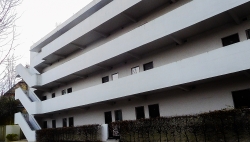
Lyttelton Road, a stretch of the A1 trunk road, passes through a part of the Suburb known as the Market Place, one of the few parts of HGS with shops. The main road separates an older part of the suburb south of it from a newer section north of it.  Close to the Market Place but south of the main road, there is a cul-de-sac, Kingsley Close, which contains houses built in 1934 in the art deco (‘moderne’) style. They have curved suntrap windows made by Crittals. The residences were designed by the architects Herbert Welch (1884–1953), Nugent Francis Cachemaille-Day (1896–1976), and Felix Lander (1890-1960). Welch did much designing in HGS and in nearby Golders Green. According to the website, http://www.encyclopedia.com/education/dictionaries-thesauruses-pictures-and-press-releases/welch-herbert-arthur, Welch:

“… also designed the handsome curved terraces of shops and apartments in Golders Green Road that demonstrate the early C20 change of style from vernacular revival to Neo-Georgian. In collaboration with Frederick Etchells (the translator of Le Corbusier’s works into English), Welch, with Nugent Francis Cachemaille-Day (1896–1976) and Felix J. Lander (1898–1960), designed the pioneering International Modern Crawford’s Office Building, High Holborn, London (1930), with long bands of windows subdivided by steel mullions, much influenced by the Weissenhofsiedlung.”

The Weissenhofsiedlung was an estate built for an exhibition in Stuttgart in 1927. Apart from influencing Herbert Welch, it also stimulated the design and construction of the Lawn Road Flats (the Isokon) in Hampstead, which is described in my new book.

“Handsome” is not how I would describe the terrace of shops mentioned in the quote. However, I feel that the houses in Kingsley Close are more pleasing to my eyes. There are other art deco homes in the HGS, which I hope to write about in the future.

Book available here: https://www.amazon.co.uk/dp/B09R2WRK92

David Hockney painted here

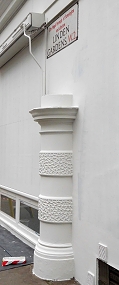
AT THE EASTERN END of Notting Hill Gate, there is a road called Linden Gardens. In the 1860s, only the eastern part of this existed and it was named Linden Grove. To the west of Linden Grove was Linden Lodge, set in extensive grounds with a large pond or lake. It was designed by the engraver, architect, and property developer Thomas Allason (1790-1852) and constructed in 1826. He lived there until about 1838. In the late 1860s, the Lodge was demolished, and houses were built around the edge of, and on, its grounds. This occurred because of the construction of the Metropolitan Railway in the mid-1860s. The gateposts of the lodge still stand, partially embedded in the buildings at the south end of Linden Gardens.

The website british-history.ac.uk noted that it was probably the peacefulness of the Grove:

“… which attracted two other artists, William Mulready, who lived in the southernmost of the eight paired houses (now demolished) from 1828 until his death in 1863, and Thomas Creswick, who lived at the still surviving No. 42 from 1838 until 1866. In the latter year this house was affected by the building of the Metropolitan Railway. Creswick therefore moved to Mulready’s now vacant house, and also, apparently, occupied the adjoining house to the north (with which it formed a pair) until his death in 1869.”

William Mulready (1786-1863) was the designer of the penny postage envelope depicting Britannia. Creswick (1811-1869) was a landscape painter and illustrator. Someone, who lived in Linden Gardens, told me that some of Queen Victoria’s children received art lessons in a studio in Linden Grove, but I have found no evidence to confirm this. However, it is certain that David Hockney painted Mr and Mrs Clark and Percy, a portrait of the dress-designer Ossie Clark (1942-1996) and his wife in their flat in Linden Gardens. The balustrades in the painting are typical of those on most of the first-floor balconies of the houses in the Gardens.

Another artist, Elsa Fraenkel (1892-1975), a German-Jewish born sculptor and Fellow of The Royal Society of Arts, who fled from the Nazis, also lived briefly in Linden Gardens, so I was informed by her daughter, who lives in Bangalore (India), where Elsa died.

Hampstead: a town on a hill

Hampstead High Street

A town on high

Home of famous artists and authors

Hampstead by name

ENJOY my new book which takes a fresh look at north London’s Hampstead: its sites, its personalities, its character, and history. “Beneath a Wide Sky: Hampstead and its Environs” is available from Amazon: https://www.amazon.co.uk/dp/B09R2WRK92

Agatha Christie lived here

HAMPSTEAD’S LAWN ROAD Flats, better known nowadays as the Isokon Flats, was built in the 1930s as an experiment in communal living. This modernistic building was home to artists, writers, architects, and others. Many of its tenants were intellectuals fleeing from Nazi Germany. Amongst its many inhabitants were Henry Moore, Agatha Christie, and Walter Gropius.  Unintentionally, it also became a centre for Soviet Russian espionage activities. You can read about this amazing place and a great deal more about Hampstead in my new book, “Beneath a Wide Sky: Hampstead and its Environs”: https://www.amazon.co.uk/BENEATH-WIDE-SKY-HAMPSTEAD-ENVIRONS/dp/B09R2WRK92/

Young Poland

WILLIAM MORRIS (1834-1896) was amongst other things a textile designer, printer, writer, and a Socialist. He was closely associated with the British Arts and Crafts Movement which lasted from the late 19th century into the early 20th. This movement can be considered part of the wider Art Nouveau/Jugendstil movements on the mainland of Europe. Morris’s Socialist leanings were embodied in his desire to make beautiful objects available to people of all social classes. His creations were not purely aesthetic but also politically motivated.

As a child, Morris lived in a grand Georgian house in northeast London’s Walthamstow district between 1848 and 1856. This became the home of the publisher Edward Lloyd (1815-1890) between 1857 and 1885. Today, this building is the home of the William Morris Gallery, which has several rooms dedicated to exhibits illustrating the achievements of Morris and his movement. It also hosts temporary exhibitions. One of these, which we visited today on its final day, the 30th of January 2022, was aptly housed in a building dedicated to such an important person in the Arts and Crafts Movement.

Between 1795 and soon after WW1, Poland did not exist as an independent country; its territories were divided amongst the Russian, Austrian, and Prussian empires. Polish language and nationalistic aspirations were suppressed. Between about 1890 and 1918, the Young Poland movement flourished. It was a wide-ranging artistic development with many similarities to what was happening in the Arts and Crafts Movement that was initiated by John Ruskin and William Morris. Just as Morris was concerned that industrialisation and mass-production might lead to the loss of beauty associated with the works of traditional craftsmen; this was also the worry expressed by members of the Young Poland movement. Like Morris and his collaborators, Young Poland was also hoping to expose all social groups to objects of beauty. As a placard in the exhibition explains:

“Like William Morris, Young Poland makers believed in cultural democracy: that everyone had a right to beauty in daily life; the spiritual benefits of handiwork; and the equal value of all the arts irrespective of materials or techniques used.”

The Young Poland movement had another motive in addition to making beauty available for all. Many of their creations illustrated and celebrated aspects of Polish tradition and national pride. It was not only an artistic movement but a fairly subtle way of expressing the desire for independence of the Polish people and Roman Catholicism during a time when more overt nationalistic expressiveness would have attracted adverse reactions from the invaders, who were then dominating the Poles.

The exhibition was large enough to be spread over several rooms. The exhibits, most of which came from collections in Poland,  are stylistically similar to what was produced in the British Arts and Crafts Movement are beautiful as well as being typically Polish in subject matter. The artists and the various subdivisions of the Young Poland movement are summarised in the gallery’s website (https://youngpolandartsandcrafts.org.uk/exhibition/).  One of the many works, which I liked and that illustrates the nationalist sentiments of Young Poland, was a painting, “Dawn at the Foot of Wawel Hill”, by Stanisław Wyspiański (1869-1907). He was, like Morris, a polymath. The picture depicts Wawel Hill in Krakow during the time when this area of the city was being used as a barracks by the Austrian occupiers. The picture is in muted drab colours except for one bright light on a lamppost. The glowing lamp represents the Poles’ eternal hope for independence, which was only achieved in 1918, 24 years after the painting was completed.

One room in the exhibition is dedicated to drawings and paintings by the playwright Maria Pawlikowska-Jasnorzewska (1891-1945), who died in Manchester (UK) having come to England from Poland in 1939. Although she would have been too young to have been a member of Young Poland, her rarely seen artworks were included, according to the gallery’s website, because:

“These bold and intimate watercolours feature fantastical and macabre elements inspired by Polish folk traditions.”

It was these traditions that also are reflected in the works by the Young Poland creators.

The exhibition was both fascinating and uplifting. I am glad we managed to see it and hope that it will be held again somewhere so that all of you reading this will not have to miss out on what was a wonderful experience.

Out of town

THE GREAT SAMUEL Johnson (1709-1784) is supposed to have said to James Boswell on the 20th of September 1777:

“Why, Sir, you find no man, at all intellectual, who is willing to leave London. No, Sir, when a man is tired of London, he is tired of life; for there is in London all that life can afford.”

Now, 245 years later in 2022, I largely agree with Dr Johnson, but not completely. Every now and then, it is wonderful to leave London in search of the open countryside, fresh air, wide expanses of sky, and a different way of life. Equally, it is satisfying to return to the city feeling refreshed and, sometimes, having been away from it, seeing familiar things in a new light. Our excursions from London have ranged from several months to several hours. The latter, shorter outings, have been invaluable during the recent period when because of covid19 travelling abroad has been difficult, to say the least.

One of our current favourite destinations for brief outings is the tiny village of Abingdon Piggots in southern Cambridgeshire. Although it is only about 90 minutes’ drive from central London, it feels as if it is almost in a different world from the metropolis. Despite being close to Baldock and Royston, the village seems as if it is in the deepest countryside. It has not more than 60 well spread-out houses, a church, and a hostelry called the Pig and Abbott.

The Pig and Abbott is run by Pat and Mick. It is a traditional country inn where one can enjoy a drink as well as eating superbly cooked, tasty food. We have visited the pub at least six times since we first discovered it in July 2020. Each time we go there, we are welcomed like old friends. I suppose we have become regarded as ‘regulars’. Mick told me that most of the regulars come from the area around the village. Of the 60 or so households on the village, only about 10 use his pub. I asked him whether we were amongst his furthest customers. He told me that we were, but one of his regulars, who lives in Alaska, always drops in when he visits Cambridge, where he has work colleagues.

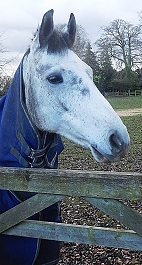
After a hearty meal at the Pig and Abbott, we always take a stroll along Church Lane to see the small church in which there are graves of members of the local Piggott family. The lane is flanked by fields in which one can watch sheep and horses grazing. There is hardly any sound to be heard except birdsong.

Pleasant as is this bucolic scene, it would not suit me to live in it for more than a day or two. I am an urban creature at heart and the humdrum of city life suits me well. My childhood was spent amongst gardens and trees in the Hampstead Garden Suburb in north London, yet I never enjoyed the place as much as central London, which I began visiting with my parents at a young age. I guess that although I enjoy my occasional forays outside London, I cannot disagree with what Johnson said to Boswell all those years ago.

The year Albania proclaimed independence

IN WARWICK, I chanced upon a fascinating book in a charity shop. It is Part 2 of “Stanley Gibbons Priced Catalogue of Stamps of Foreign Countries 1912”. When it was published, it could be purchased for as little as half a crown (2/6, which is 12.5 pence). I paid a lot more for it, but not an excessive amount.

I felt compelled to buy it because of its date and my interest in Albania. For, on the 28th of November 1912, the independence of Albania was proclaimed in the seaside town of Vlorë. Albania’s independence was formally recognised when the Treaty of London was signed in July 1913. The catalogue I bought in Warwick was published some time in 1912 and most likely before independence was proclaimed. As far as the publishers and the compilers were concerned, what is now Albania was still part of the Ottoman Empire.

The index of the catalogue contains an entry for “Albania (Italian P.O.)”.  This needs some explanation. Throughout the Ottoman Empire, there were postal services operated by foreign (i.e., not Ottoman) countries. A website (www.levantineheritage.com/foreign-post-offices.html) reveals:

“In the 18th century, foreign countries maintained courier services through their official missions in the Empire, to permit transportation of mail between those countries and Constantinople [sic] the Empire capital. Nine countries had negotiated Capitulations or treaties with the Ottomans, which granted various extraterritorial rights in exchange for trade opportunities. Such agreements permitted Russia (1720 & 1783), Austria (1739), France (1812), Great Britain (1832) and Greece (1834), as well as Germany, Italy, Poland, and Romania, to maintain post offices in the Ottoman Empire. Some of these developed into public mail services, used to transmit mail to Europe. The Ottoman Empire itself did not maintain a regular public mail service until 1840, when a service was established between Constantinople and other major cities in the country and this was slow to develop and expand. The gap in this capacity was very much filled with the various foreign post offices which continued functioning right till the beginning of WWI in 1914 …”

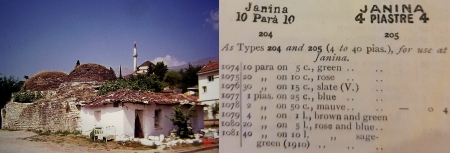
Left: Ioannina in the 1970s. Right: examples of over-printing texts

Hence, the entry in the catalogue’s table of contents. I turned to the page listed and found the section on Albania. The Italian Post Offices in the Turkish (Ottoman) Empire issued stamps, to quote the catalogue, which:

“…surcharged or over-printed for use in Italian post offices abroad.”

These stamps were the regular issues but, to quote the catalogue:

“… distinguished by the removal of some details of the design, over-printed with Type…”

Different Italian stamps were overprinted with names of places and a Type number. For example, Italian stamps were over-printed with: “ALBANIA.  10 Para 10. 201” (where ‘10 Para’ is a monetary denomination and ‘201’ is the Type number), or “Durazzo. 4 PIASTRE 4. 205”, or “Valona, or other place names. 10 Para 10. 208”. Durazzo and Valona being the Italian for the Albanian names Durres and Vlore.

Within the Albanian section of the catalogue there is also an illustration of the over-printing “JANINA. 4 Piastre 4. 205”. Janina is the name of a town now in Greece, Ioannina (Ιωάννινα).  In 1912, this town was not in what was then Greece, but in the Pashalik of Janina, part of the Turkish Empire. In February 1913, following the battle of Bizani in the First Balkan War, the town was absorbed into Greece. Many Albanians still consider that by rights Ioannina should be a part of a Greater Albania. The large Albanian population in the town was forcibly reduced by population exchanges in the early 1920s and also the pre-WW2 Greek government’s policy of strongly encouraging people of Albanian ethnicity to regard themselves as Greeks. When I visited Ioannina in the 1970s, there were the remains of Turkish buildings but many of them were in a sad condition. I do not know whether they have been restored since then.

My purchase in Warwick has proved to be of interest. It records the state of postage stamps on the eve of great changes that were about to happen in the Balkan peninsular as well as illustrating aspects of European colonialism, both political and economic.

Problems! Problems! Publishing

ALL OF MY books have been self-published. Until recently, I used a ‘print-on-demand’ website called lulu. The process involved first writing my manuscript and formatting the text and any illustrations on Microsoft’s Word software, using a template (for the size of the book) downloaded from lulu. When I was happy with what I had produced, I was able to upload it to lulu’s website. Then, the fun began. Lulu converted my Word document into a .pdf file and when that was done, I could download the .pdf to proofread and make other checks. Almost always, something was lost in translation: what appeared in the .pdf was far from what I wanted. So, endlessly I had to keep adjusting my Word file and uploading it to see whether the latest version produced what I wanted in the lulu generated .pdf. It was tedious and somewhat nerve-wracking to say the least. Then, last summer, disaster struck.

I had just completed the manuscript for a book about west London and was looking forward to uploading it to lulu. It did not take more than a couple of minutes to discover that lulu was no longer accepting manuscripts in the form of Word files. The requirement was to prepare a correctly formatted .pdf file. I was stumped. I had no idea how to do this and felt despondent because I then believed that I might not be able to publish another paperback myself.

Many months passed. Then, while I was perusing some articles on the lulu website, I discovered that one can format .pdf files using software such as Adobe’s InDesign. I investigated this and found it to be quite costly. However, soon I became aware that there is a cheaper option, Serif’s Affinity Publisher, which I bought and downloaded.

At first, Affinity looked impenetrable but there are many on-line tutorials, which I watched before tackling the software. After a few false starts, I began to get the hang of the programme’s basics. Using the relevant template downloaded from lulu, I then inserted the text from my Word manuscript into the Affinity system. After several days of moving the text about and inserting some illustrations and the page numbering, I produced something that looked acceptable. I converted the Affinity file into a .pdf file using the software’s ‘export’ function. Then, with some trepidation, I uploaded my new Affinity-generated .pdf file on to the lulu site. To my great joy, the proof that lulu produced was exactly as I wanted it. So, the Affinity software has proved to be up to the job.

Having found a method to upload to lulu without the problems caused by lulu’s conversion from Word to .pdf, I moved on to finishing and pricing the book. To my horror, I discovered that lulu has increased its prices dramatically. The book, which I created could not be sold to the public for less than £ X plus at least £3.99 postage, which in my opinion was forbiddingly excessive for a book of the size I had made.

Then, I looked at Amazon, which has a book publishing service. Using a new ISBN, I uploaded my .pdf, and after looking at the proof they generated, I looked into the pricing. To my great delight, they can sell the paperback at 58% of lulu’s price excluding postage, which does not always need to be paid. I have seen a copy of the book produced by Amazon and I am happy with its quality. Amazon have captured me from lulu when it comes to book publishing.