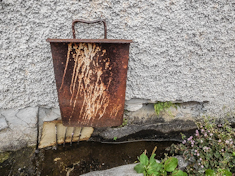
A damming plate hanging on a wall beside a stream in Funchal
WHEN WE WERE IN the Western Cape of South Africa, I noticed
streams running alongside roads in rural farming areas. Occasional small channels
led off from them and into the fields of farms. At each junction of the main stream
and a side channel, there were small plates that could be used to temporarily dam the main stream to divert water
into the channel leading to the fields.
We are staying in Funchal, Madeira. Our guesthouse is high above
the city centre and the seafront on a road that leads down an extremely steep hill. On one side of the road there is a fast flowing
stream. Every now and then, there are metal plates that can be inserted into
slots on both sides of this stream to divert water into the property beside the
water. This is just like what I saw in rural South Africa. Perhaps I should not
be surprised by the similarity of the damming system, but I cannot recall having
noticed it anywhere else I have visited.
MADEIRA IS A PORTUGUESE island in the Atlantic Ocean. Most
people, including us, arrive by air and land at the Airport of the island’s
capital, Funchal.
We flew from London to Lisbon to Funchal on the Portuguese airline. The climax of the somewhat poorly organised and unsympathetic airline‘s handling of its passengers was not entirely the fault of the airline: it was the landing at Funchal airport.
Funchal airport is hazardous to say the least. It consists
of a single short runway with sea along one side and at both ends. This short
runway, rather like that of a large naval aircraft carrier, lies almost
surrounded, not only by water, but also by nearby rocky mountains.
After flying over the empty Atlantic for about 80
minutes, the rocky island of Madeira,
partly shrouded in clouds, loomed into view.
We descended towards the short runway and almost a few seconds before we were to have touched down on the concrete, the pilot caused the ‘plane to ascend steeply. We headed back into the clouds before the pilot announced that his first attempt to land had been thwarted by an unexpected gust of crosswind and that he would make another attempt to land.
I noticed that during the second attempt, we approached the runway far slower than the first time. The few hair-raising minutes before we touched down seemed like hours, so anxious I was beginning to feel. It was a great relief to set foot on the tarmac when we left the aircraft.
The cabin crew laughed at us when we told them how scared we
were during the landing. They could have tried to be reassuring at the very
least. I was unimpressed by their reaction to our concern.
Terrifying and alarming as was the landing, Funchal is proving to be a delightful destination.
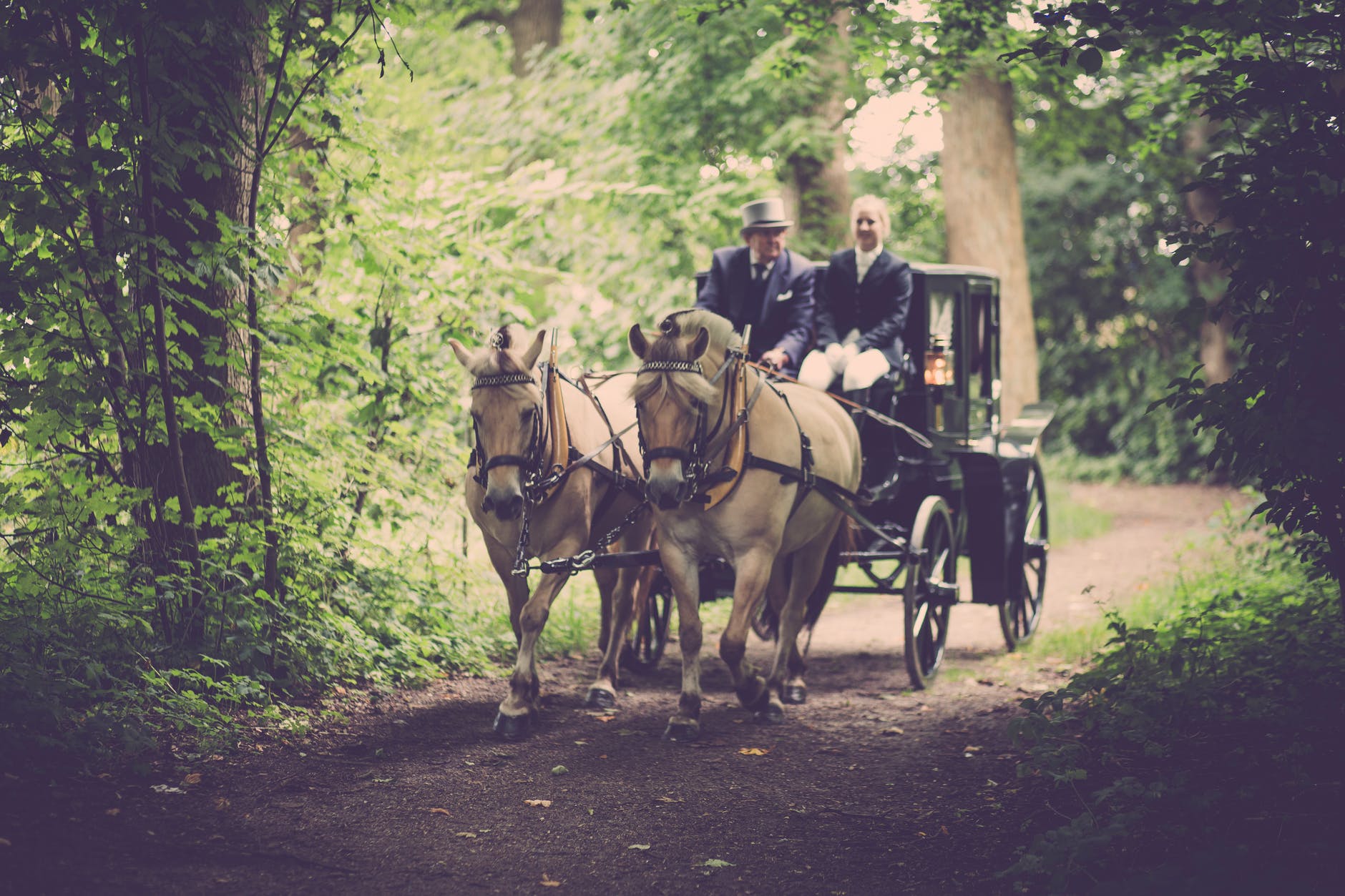
IN THE EIGHTEENTH century, travelling by road in England was not without its dangers, One of these was being robbed by highwaymen. Frequently, individual travellers and passengers in horse-drawn coaches were stopped by bandits, who were after money, jewellery, and other valuables.
Even close to London, for example between Mayfair and Hammersmith, highwaymen plied their evil trade. As an example, the diarist Samuel Pepys (1633-1703) recorded in his entry for the 19th of May 1669:
“Here news was first talked of Harry Killigrew’s being wounded in nine places last night by footmen in the highway, going from the park in a hackney coach toward Hammersmith to his house at Turnam greene [sic] …”
The punishment for highwaymen, who were captured, was often death by hanging. Many of those convicted of crimes in the countryside around London were hung at Tyburn, close to where London’s Marble Arch stands today. Ending a highwayman’s life at Tyburn was often not the end of the story as is shown in this extract from Select Trials, for Murders, Robberies, Rapes, Sodomy, Coining, Frauds, and Other Offences. At the Sessions-House in the Old-Bailey. …, (published in 1742):
“The same day that Hawkins and Simpson were hanged, their bodies were carried to Hounslow Heath, and there hanged in irons on a gibbet erected for that purpose, not far from that on which Benjamin Child was hanged in the same manner…”
Hounslow Heath was a vast area in Middlesex, now covered mostly by west London and Heathrow Airport. It was crossed by several important roads from London to the west and south west. In between the small villages that were dotted about the Heath, there was no shortage of highwaymen and the potential for stealing much of value was great on these major arteries. The quote above mentioned that the bodies of the two fellows who were hung at Tyburn were taken to Hounslow Heath to be hung in irons. Back in those times, the bodies of executed highwaymen were hung from gibbets alongside the main roads in order to deter others from being tempted to rob travellers. How effective these grim warnings were in preventing highway robberies, I do not know.
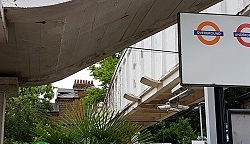
THE CONCRETE PEDESTRIAN bridge over the railway tracks at Kew Gardens Station cannot be described as attractive. In fact, it is rather ugly. However, on a recent visit to the station, I spotted a notice attached to the bridge that provides interesting information about it.
The bridge was opened in 1912. It is one of the earliest examples of the use of reinforced concrete in Britain. The technique used to construct this bridge was that pioneered by François Hennebique (1842-1921). The first building made in Britain using his method of reinforcing concrete with wrought iron beams was the Weaver Building in Swansea (in 1897). An article in Wikipedia related that between 1892 and 1902, over 2000 structures were made using Hennebique’s method. This makes me wonder why the plaque on the bridge at Kew is described as a “rare example” of this kind of structure. Maybe, what is meant is that it is a rare surviving example of his construction method. In any case, the bridge at Kew incorporates two features that were designed to protect users of the bridge from the smoke produced by steam engines that used to travel beneath it. One feature is the high wall on each side of the pathway over the bridge. The other are small projections over the railway lines, which were designed to deflect smoke from the bridge.
Kew Gardens station was opened in 1869. It is the only station on the London Underground network to have a pub attached to it. In the past, this pub, now known as The Tap on the Line, had an entrance directly from the London bound platform. In addition to the bridge described above, there is also an underground pedestrian passageway running beneath the tracks. The main reasons to use this station are to visit the National Archives and/or Kew Gardens. If you are coming from central London to visit the gardens, you will have to cross the tracks. So, why not cross them on a bridge that, although ugly, is a landmark of engineering history?
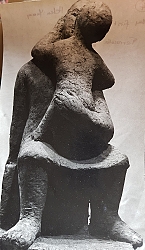
MY LATE MOTHER (Helen Yamey: 1920-1980) trained as a commercial artist in Cape Town (South Africa) before WW2. In 1948, she came to London to marry my father. In London, she painted and, according to my father, took lessons from the great Stanley Spencer (1891-1959). Around the time when I was born (1952), my mother began making sculptures. The first of these was a terracotta mother and child. Maybe, she was depicting herself with me in her arms. By the 1960s, she was working in the sculpture studios of St Martins School of Art, which was then near Foyles bookshop on Charing Cross Road. There, she was in the company of artists such as Anthony Caro, William Tucker, Philip King, and William Turnbull. At least one of these now famous artists taught my mother how to weld and solder.
My mother exhibited her works in important art galleries at least twice. In late 1961, she exhibited at the Institute of Contemporary Art in a show called “26 young Sculptors”. In 1962, she exhibited sculptures at the Grabowski Gallery, along side works by Maurice Agis and David Annesley. Although she sold a few of her creations, she did them more for pleasure than for profit.
My mother was a perfectionist. She destroyed much of what she created. However, at some time during the 1960s, she had a series of professional photographs taken of some of her mainly abstract works. These were kept in a yellow Kodak photographic paper box in a drawer in our home in Hampstead Garden Suburb. As a teenager, I used to look at them occasionally and wonder what became of some of the creations recorded in these photos.
My mother died in 1980 and my father remarried 11 years later. After remarrying, he and my stepmother moved from our home in Hampstead Garden Suburb to another house (near Primrose Hill). After the move, I used to ask him what had happened to the photographs of my mother’s sculptures and other family photos. Each time I asked, he would say that they were stored somewhere, possibly in the garage of his new home. After a while, I gave up hope of ever seeing these pictures again because it was clear to me that Dad had little or no interest in these photographs and in addition he could not imagine why anyone else would find them interesting. My father died, aged 101 and 6 months, in 2020. What with covid19 and its associated problems, we did not see his widow, my stepmother, again until recently this year (2022).
When, at last, we met her, she arrived carrying a plastic carrier bag, which she handed to me. To my great delight, it contained the box of photographs described above and another filled with family photographs taken mainly in the late 1950s. My stepmother told me that she had found them when she was sorting things in the garage of the house where she and my father had lived.
The photographs of my mother’s sculptures all bear the name of the photographer: Joseph McKenzie, ARPS (95 Blenheim Gardens, Wallington, Surrey). According to Wikipedia, Joseph McKenzie (1929-2015) is regarded as “father of modern Scottish photography”. More relevantly in the context of my mother’s works, he taught photography at the St martins School of Art.
Some of the photographs have notes written on their backs. The handwriting is my mother’s. One of the pictures, that of the mother and child has the words: “my first ever sculpture, terracotta, mother and child, 24””. Some of the other photos have information about the size and the material of the work depicted.
About 10 years before she died, my mother became disillusioned and practically gave up making sculptures. Although she made a few abstract images in pen and ink and a few carvings in alabaster, her abandonment of sculpture making as a full-time activity left a great hole in her life.
I have taken pictures of the photographs, and they can be seen on:
MY PARENTS WERE born in South Africa. They settled in England in about 1947/48. In 1955, when I was three years old, my parents took me on a visit to their native land, possibly to show me off to relatives who lived there.
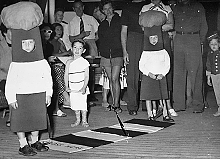
We travelled to Cape Town by sea. I remember nothing of the voyage, which must have taken about two weeks. Recently, I came across a photograph, which had remained in storage for several decades in my late father’s garage. The picture shows a little boy in a white outfit resembling a Roman toga. He is standing between two children dressed up to resemble, if your imagination is good enough, Belisha beacons such as are found at pedestrian crossings of the zebra variety.
The photograph reminded me of what my mother had told me many years ago. During our voyage to South Africa, we crossed the Equator. My mother told me that to celebrate this event, there was a fancy-dress party for the children on-board. My mother, unlike some of the other parents, had not been aware that this was going to take place. So, she had not packed a costume for me to wear. Ever resourceful and extremely creative (she was a painter and sculptor), Mom used one of the sheets from a bed in our cabin to wrap me up as if I was wearing a toga. Looking at the photograph, it appears that also she fashioned a pair of what look like Roman sandals, using some string. Thus, during my first crossing of the Equator, I was attired in a Roman toga.
Looking at this image, which includes a rug designed to look like a pedestrian crossing, made me think. There I was standing halfway across a zebra crossing whilst our liner crossed from one side of the Equator to the other.
WIMPOLE HALL IN Cambridgeshire is according to the architectural historian Nikolaus Pevsner:
“Without doubt the most spectacular country mansion in Cambridgeshire…”
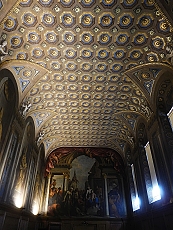
Chapel at Wimpole Hall, Cambridgeshire
Much of the mainly red brick building dates from the 17th century, although more was built in the 1740s. It contains many splendid rooms including a large library; a chapel decorated in 1724 by the painter James Thornhill (c1675-1734), who decorated the Painted Hall in Greenwich; and a large ‘salon’ created by Sir John Soane. These are a few of the wonders that can be viewed within the house, now maintained by the National Trust. The grounds of Wimpole are also superb and include a magnificent walled garden and a ‘Gothick’ folly.
Despite the visual attractions of Wimpole Hall, I was fascinated by its last owners: George and Elsie Bambridge. George Louis St Clair Bambridge (1892-1943) was a British diplomat and a soldier. In October 1924, he married Elsie Kipling (1896-1976), the second daughter of the famous writer Rudyard Kipling (1865-1936).
After living in several places outside the UK, George and Elsie came to London. Between 1933 and 1937, they lived in Hampstead. Their home in that lovely district of north London was the elegant Burgh House, which was built in 1704. In an epilogue to a biography of her father by Charles Carrington, Elsie wrote of Burgh House:
“In 1933 we returned to England, and our life in the delightful old house which we rented in Hampstead was a source of happiness to him to the end of his life.”
The person to which she was referring (i.e,, “him”) was her father, Rudyard Kipling.
On the 12th of January 1936, Rudyard and his wife (Carrie) visited George Bambridge, who was in bed at Burgh House, suffering from bronchitis. It was to be Rudyard’s last outing because on the following day he was admitted to Middlesex Hospital where he underwent hazardous surgery for a haemorrhage. He died in hospital on the 18th of January.
The Bambridges moved from Hampstead to Cambridgeshire in 1937. They rented Wimpole Hall between 1937 and 1942, when they purchased to property. George died in 1943, and his widow, Elsie, continued living in Wimpole Hall until her death. When they moved in, the place was empty of contents. They bought pictures and furniture, much of which can be seen today. After her husband’s death, Elsie used the substantial royalties from her father’s books to refurbish the house. On her death, she bequeathed the house and its vast estate to the National Trust. It is well worth visiting if you are anywhere near Royston or Cambridge and it is no more than one hour’s drive from central London.
WHEN RUDYARD KIPLING (1865-1936) died in London’s Middlesex Hospital, his body was placed in the hospital’s chapel before being taken to be cremated at the Golders Green Crematorium, Charles Carrington wrote in his biography of Kipling that just as his coffin, draped with the Union Jack flag, arrived at the crematorium:
“… the followers of Saklatvala, the Indian Communist who had been cremated just before Rudyard Kipling, were singing the Red Flag.”
Kipling was not a sympathiser of Communist ideas and ideals.
Middlesex Hospital in the Fitzrovia area of London, where Kipling breathed his last, no longer exists. Founded in 1746, it provided medical care on a square plot of land bounded one one side by Mortimer Street between 1757 and 2005. In 2008, almost all of the hospital was demolished. The only part of the complex, which was preserved, is the Fitzrovia Chapel, in which Kipling’s body reposed briefly. Between 2012 and 2016, a new development, Fitzroy Place, consisting of flats and offices, was constructed on the hospital’s site.
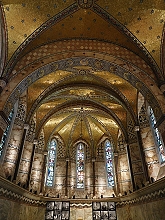
The small Fizrovia Chapel, beautifully restored, stands in a small garden in the middle of the new development, dwarfed by the buildings around it. This gem of a Victorian ecclesiastical construction was designed by the Gothic Revival architect John Loughborough Pearson (1817-1897) and was ready for use by 1892 (although the interior decoration was not fully completed until 1929). The chapel’s spectacular colourful interior must be seen to be believed. Its magnificent appearance is the result of skilful use of mosaic, marbles of different types and colours, and amazing decorative motifs inspired by early Italian, Byzantine, and Moorish architecture. Some of the metal lampshades that hang from the decorative ceiling seemed to have been influenced by the types of lamps typical of Turkish tradition.
The chapel is maintained by The Fitzrovia Chapel Foundation. It is open on most Wednesdays for public viewing as well as during the occasional exhibitions and concerts that are held within it. This charming place is also available for hire for weddings, fashion shoots, book launches, and other events.
Until we attended an exhibition in the Fitzrovia Chapel in late May 2022, we had no idea that this small architectural gem existed. Along with nearby All Saints in nearby Margaret Street, the Fitrovia, a treasure chest with its sparkling golden ceiling, should not be missed by lovers of Victorian architecture and/or fine mosaic work (as well as masterful use of inlaid stonework).



 yamey
yamey 