Hazards and memories of childhood on Hampstead Heath

DURING MY CHILDHOOD in the late 1950s and early 1960s, I used to walk on London’s Hampstead Heath with my parents. Usually, we left our home in Hampstead Garden Suburb and walked south across the manicured, grassy fields of Hampstead Heath Extension. Sometimes, we went further, crossing Wildwood Road and entering the wilder, hillier, wooded part of the Heath until we reached the Spaniards Road.

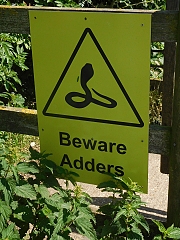
The part of the heath that extends between Wildwood and Spaniards Roads contains a few hollows in which there are bogs. Back in my childhood, there used to be signs posted within these boggy hollows. They read:

My mother, who was always a little too anxious about her children’s safety, drilled it into my sibling and me that we should never stray close to these swampy depression. She warned us that should we enter them, we would be sucked down below the surface, and lost forever, and fatally. Whenever I saw these signs, I used to want to hurry away from them.

Today, 10 June 2026, almost 60 years later, a friend of ours took us to see the swamps, which are exactly where I remember seeing them so many decades earlier. I believe that I had not seen them since the 1960s. To my great disappointment, the warning signs were no longer there. However, the bogs or swamps have become beautiful with leafy plants and trees growing in them. Seeing them after such a long interval reminded me of my childhood, but my fear of them seems to have evaporated.


Don’t fall for this trick!

THE TELEPHONE RANG this morning. I answered it and was addressed by a lady with an accent that sounded like the way Iranians often speak English. She told me that she was calling from the British Telecom (‘BT’) technical department to inform me that there was some kind of malicious interference on our broadband connection, and that a BT technician was working on our line in the street. She said that we should have received an email from BT, and could I kindly spend a few minutes with her on my computer. Quite suspicious, I simply thanked her for calling, and hung up.

Then, I checked to see whether there was an email from BT. There was. It had been sent from “ btcomms@info.bt.com” and looked pretty authentic. It even included advice about protection against scams. The email contained a PIN number, “Your PIN is ****”. I was still suspicious and used the 1471 facility to check the number of the person, who had called on our BT landline. It was a number beginning with 07, a mobile telephone number. I felt sure that BT would never call using an 07 number.

I rang BT on 0800800150 and selected the option for suspected scamming and fraud.  I explained what had happened, and an operator confirmed my suspicion that both the call and the email were dodgy. However, the email address from which the message had been sent is an official BT email address. She was relieved to hear that I had not turned on the computer and been guided by the mystery caller because she told me that what I had experienced was an attempt to gain access to the data stored in my computer.

The approach used by the lady who called and whomever she was working with was quite ingenious, and might easily have misled anyone less suspicious (or paranoid) than me.

When I was a child, before the days of internet and mobile telephones, it paid to be streetwise, to keep an eye out for people or situations that might lead to harmful consequences. It still pays to keep a wary eye, but now it is not only on the street that one needs to do so.