A shared taxi and Greeks buried in Kolkata (Calcutta)

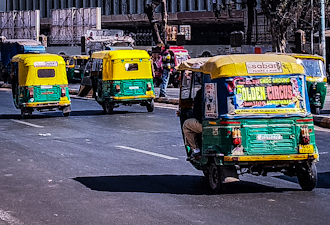
Having visited the Jewish cemetery in Kolkata, we hailed an autorickshaw to carry us to College Street. There was already one passenger in the three-wheeler that stopped for us. He moved from his seat in the rear of the vehicle to make room for us, and then sat next to the driver on his seat. After going a short distance, our driver stopped to pick up another passenger, who squeezed into the seat alongside us. She disembarked after we had driven a few blocks further, and handed the driver a few rupees. After we left the autorickshaw and paid the driver a modest fee, the other passenger continued his journey in the vehicle. Like most autorickshaws in Kolkata, the one we had just taken was a shared cab that ran on a pre-determined route.

On the way, our autorickshaw rushed past a gateway on Narkeldanga Main Road, which I noticed was marked “Greek Cemetery”. Established in 1777, it is India’s only Greek cemetery. In Henry Cotton’s encyclopaedic “Calcutta Old and New” (published in 1907), he noted that the first “eminent” Greek settler in Kolkata was Hadjee Alexios Argyree, who arrived in Bengal in 1750, and worked as an interpreter. Other Greeks in Kolkata were involved in trade and commerce. The city’s only Greek church was erected in 1780, and still stands near Kalighat on Shyama Prasad Mukherjee Road, along which we often travel between central Kolkata and Tollygunge to the south of it. The well-maintained building is neo-classical in style, and Greek Orthodox services are held there regularly.  Today, there are few if any Greeks left in Kolkata, and the cemetery in Narkeldanga, home to about 300 graves, is in a sad state of disrepair (according to a report in the online Times of India, dated March 2018).

A holy roller in Bangalore (Bengaluru)

ON THE SIXTH of February 2025, I  boarded an auto (autorickshaw,  tuk-tuk) in central Bangalore. It contained a selection of Christian religious leaflets and booklets, which passengers were invited to take. Some of them were in English,  the rest in Kannada (the main language spoken in Karnataka). The driver had adorned his auto with Christianity related stickers.


As we wove our way through the busy traffic, I wondered if I was travelling in a type of ‘Peace Auto’. The Peace Auto movement in Bangalore was started by Anil Shetty in October 2013 to improve the relationships between auto drivers and their passengers. To quote from Shetty:

“Peace Autos is an initiative to make peace between the City and auto drivers. There is a one-sided argument that all auto drivers are bad. But that’s not true. I want to make them feel responsible.” (https://www.deccanherald.com/india/karnataka/bengaluru/a-surprise-experience-peace-auto-2189174).


When I reached my destination, the driver said (in English):

“God bless you.”

I asked him if his vehicle was a Peace Auto. He replied:

“No, it is Jesus Auto”.

Hot chillies and an act of charity

MY WIFE AND I CAN tolerate and enjoy spicy Indian food. Yet, once in a while, a dish can have such an excess of hot chillies that eating it is less than pleasurable. 

Last night (4th of December 2024), our autorickshaw driver, ‘M’, recommended that we try a Muslim restaurant that is popular with ‘local people’ in Jodhpur. On arriving at the place, Beli Chicken, we were directed to one of its several rooms. It was the one where men accompanied by women plus or minus children  could dine together. It was the Family Room. Another room, the restaurant’s largest, was reserved for men only.


Lal maas

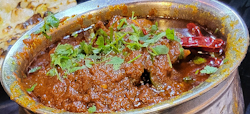
We ordered the restaurant’s speciality, fried chicken,  and Mutton lal maas (a red meat curry, a speciality of Rajasthan). The chicken was perfect. It was some of the best fried chicken I have ever eaten. The lal maas had a good flavour but contained an excessive amount of fiery red chillies. The meat was easy to enjoy, but the sauce was almost painful to eat. By mopping it up with a paratha, it became more enjoyable.  When we had eaten most of the meat  we asked the waiter to have the left overs packed up. We thought that M or his family might appreciate it.


As we set off from the restaurant, M said he needed to make a short detour to see an “uncle” (an elderly acquaintance,  rather than a blood relative). This uncle turned out to be a poor old man squatting on a low concrete divider in the middle of a busy road. In front of him, there were a few remains of kebabs and other scraps of food.  We stopped next to him, and M handed the old man our packed food. The uncle put his hand to his heart to express his gratitude.

I was touched by the charitable action of our kind autorickshaw driver.

Come with me in my Ferrari

Fort Kochi (Fort Cochin) is the picturesque, historic part of Kochi – a port on the coast of Kerala in southwest India. Occupied at various different times by the Portuguese, Dutch, and British, this small urban area at the northern tip of an island contains many buildings that recall the town’s former foreign occupiers.

Essentially, the historic town centre consists of a few short streets and some open spaces. Fort Kochi is built on flat terrain, and is a paradise for walkers even in the hot, humid weather that prevails most of the year. As a consequence, the large number of autorickshaw (‘auto’) drivers often seems to outstrip customer demand.

From dawn to after dusk, auto drivers cruise around the town in their empty vehicles, looking for customers. We usually spend at least a week in Fort Kochi every year, especially when the excellent Kochi-Muziris international art biennale is in progress. So, individual auto drivers get to know us as we stroll around. They stop and ask us if we need a ride. We tell them that we are walking. So, when they next see us, optimistically they invite us to take a ride. When we turn them down, they say to us in an understanding way:

“Walking, walking! – always walking.”

Other auto drivers, who either do not recognise us or are trying to tempt other tourists into their cabs, say:

“See my Ferrari. Come and take a ride in my Ferrari.”

This always amuses me because to describe an auto as a Ferrari is rather like describing a pigeon as an eagle.

On the subject of Ferraris, there are some in India. One of them, an eye-catchingly bright yellow, belongs to, or is driven by, a young man who is the late teenaged son of a wealthy family in Bangalore. Because this is not a type of vehicle that could be safely parked in most parts of the city, he can only use it to drive to and from the exclusive Bangalore Club, where he can park it in an area well policed by security guards. At his home, he parks it in the safe compound containing his residence. Given the density of traffic and the daring driving in Bangalore, it is amazing that he feels safe enough to flaunt his precious car on the roads between his home and the Club.

No refusal

TAXI NO RESUSAL[2493]


UBER DRIVERS IN MADRAS are, so I have been told, unaware of a customer’s desired destination when they accept a job. It might be a short ride or even an out of town destination. We discovered a consequence of this earlier this year when we were advised that the most reasonable way to make the three-hour journey from Madras to Pondicherry was to hire an Uber cab.

The first three drivers, who offered us rides, phoned us to ask where we wanted to go. When we told them, they cancelled our rides. On our fourth attempt, an Uber arrived. He was happy to drive us to Pondicherry because, as we found out three hours later, he had a friend he wanted to visit there.

In Bombay, the taxis are nicknamed ‘kali pili’, which refers to their black and yellow body paint colours. Most of the cabbies are argumentative and some of them seem reluctant to work, making complaints like “too much traffic” or “that’s too far”. Eventually, one finds a cab that is willing to carry out one’s wishes, often complaining all the way. Maybe, that is because their metered fares are so reasonable for the passenger. Driving in Bombay’s traffic cannot be too much fun, especially if one is getting paid poorly to do so.

Further south in Bangalore, popular transport for those who prefer to avoid using urban buses include Uber and Ola cabs as well as three-wheeled autorickshaws.

Bangalore’s Ubers and Olas are unreliable.  Often, they accept a ride and minutes before they are about to arrive at the pickup point, they cancel. I imagine that often they get stuck in the city’s slow moving or often static congested traffic and feel they are wasting their time trying to reach their passenger waiting beyond the traffic jam. Whatever the reason, these app-linked car services are not nearly as reliable as they are in Bombay or London.

Autorickshaws (‘tuk tuks’) are the best method for getting through the congested thoroughfares of Bangalore.  Their plucky drivers can take risks with their small vehicles that larger cars are unable to attempt. These manoeuvres are daring and can be hair-raising for the passengers, but they get you to your destination relatively quickly. I love the drivers’ sneaky tactics, but others do not. Once, I was travelling in an autorickshaw with two American ladies on a busy main road in the centre of Bangalore. They shrieked with terror as our vehicle sped adventurously between a bus and a heavy lorry that were rapidly moving close together.

One autorickshaw driver, whose command of English was good, told me that he had been a truck driver before driving the three-wheelers to earn his living. He explained that an autorickshaw driver needs to use all of his six senses and to ‘feel the traffic’ with his body. It is my observation that most drivers of these small fragile vehicles have lightning reflexes and nerves of steel. Yet, as they weave effortlessly and excitingly through the traffic, many of them chatter away on their mobile ‘phones.

Hiring an autorickshaw in Bangalore is always an adventure. The vehicles are fitted with taximeters, which are supposed to determine the fair. They are used occasionally but not often. The driver will start by suggesingt an often outrageous fare, which is the starting point for haggling.  Or, some drivers will agree to use the meter determined fare plus some extra Rupees in addition.

Some autorickshaw drivers without much to do will offer foreigners something like:

“Come with me. I’ll take you anywhere for only 10 Rupees.”

Sounds tempting, does it not? Do not succumb to this unbelievable offer because if you do, you will soon discover the catch. The naive passenger will be invited to visit the driver’s friend’s/cousin’s/brother’s  store, where if you buy something, the driver will be rewarded with something like: school books for his children, or a kilo of rice for his starving family, or a new shirt, etc.

Some autorickshaw drivers will set off for a journey in Bangalore, and then after a few minutes, will ask the passenger whether, on the way, they want to do some shopping at a shop the driver recommends. That is, at a shop that will offer the cabbie a commission or a gift when the passenger makes a purchase. A determined refusal is required to ensure that your journey will not include an unwanted, time-wasting detour for shopping.

On the whole, autorickshaws are a great way of getting around Bangalore.

Calcutta is filled with rugged but battered yellow Ambassador taxis. These are slowly being replaced by newer vehicles with blue and white body paint. One thing they share is the wording “No Refusal” painted on the exterior of their doors. The cab driver, who stops to pick up a passenger, is not supposed to refuse to take you wherever you want. Most of the drivers comply with this.

Black Cab taxi drivers in London and other places in the UK are, by law, required to take you anywhere within the area they can legally operate. Like the drivers in Calcutta, the British cabbie is supposed to adhere to the “No Refusal” concept, and often, but by no means always, cabbies comply.

Interesting as all this is, present conditions during the current pandemic mean that not too many cabs are being hailed at the present in London. While the ‘lockdown’ is in force, even in its present slightly diluted form, I feel sorry when I see an empty Black Cab with its ‘For Hire’ sign illuminated cruising the almost empty streets in the hope of finding a customer.

No refusal

UBER DRIVERS IN MADRAS are, so I have been told, unaware of a potential customer’s desired destination when they accept a job. It might be a short ride or even an out of town destination. We discovered a consequence of this when earlier this year we were advised that the most reasonable way to make the three hour journey from Madras to Pondicherry was to hire an Uber.

The first three drivers, who offered us rides, phoned us to ask where we wanted to go. When we told them, they cancelled our rides. On our fourth attempt, an Uber arrived. He was happy to drive us to Pondicherry because, as we found out three hours later, he had a friend he wanted to visit there.

In Bombay, the taxis are nicknamed ‘kali pili’, which refers to their black and yellow body paint colours. Most of the cabbies are argumentative and some if them seem reluctant to work, making complaints like “too much traffic” or “that’s too far”. Eventually, one finds a cab that is willing to carry out one’s wishes, often complaining all the way.

Further south in Bangalore, popular transport for those who avoid urban buses include Uber and Ola cabs as well as three-wheeled autorickshaws.

Bangalore Ubers and Olas are unreliable. Often they accept a ride and minutes before they are about to arrive at the pickup point, they cancel. I imagine that often they get stuck in the city’s slow moving or often static congested traffic and feel they are wasting their time trying to reach their passenger waiting beyond the traffic jam. Whatever the reason, these app connected car services are not nearly as reliable as they are in Bombay or London.

Autorickshaws are the best method for getting through the congested thoroughfares of Bangalore. Their plucky drivers are able to take risks with their small vehicles that larger cars are unable to attempt. These manoeuvres are daring and can be hair-raising for the passengers but they get you to your destination relatively quickly.

Hiring an autorickshaw in Bangalore is always an adventure. The vehicles are fitted with taximeters, which are supposed to determine the fair. They are used occasionally but not often. The driver will suggest an often outrageous fare, which is the starting point for haggling. Or, some drivers will agree to use the meter determined fare plus some extra Rupees in addition.

Some autorickshaw drivers without much to do will often foreigners something like:
“Come with me. I’ll take you anywhere for only 10 Rupees.”
Sounds tempting, does it not? Do not succumb to this unbelievable offer because if you do, you will soon discover the catch. The naive passenger will be invited to visit the driver’s friend’s/cousin’s/brother’s store, where if you buy something, the driver will be rewarded with something like: school books for his children, or a kilo of rice for his starving family, or a new shirt, or …

Some autorickshaw drivers will set off for a journey in Bangalore, and then after a few minutes, will ask the passenger whether, on the way, they want to do some shopping at a shop the driver recommends. A determined refusal is required to ensure that your journey will not include an unwanted detour for shopping.

On the whole, autorickshaws are a great way of getting around Bangalore.

Calcutta is filled with rugged but battered yellow Ambassador taxis. These are slowly being replaced by newer vehicles with blue and white body paint. One thing they share in common is the wording “No Refusal” printed on the exterior of their doors. The cab driver, who stop to pick up a passenger, are not supposed to refuse to take you wherever you want. Most of the drivers comply with this.

Taxi drivers in London and other places in the UK are, by law, required to take you anywhere within the area they are allowed to operate. Like the drivers in Calcutta, the British cabbie is supposed to adhere to the “No Refusal” concept, and often, cabbies, but by no means always, comply.

Interesting as all this is, present conditions during the current pandemic mean that not too many cabs are being hailed at the present.

Picture: Taxis in Calcutta

Some know, others don’t

I know it is not a good idea to make generalisations, but it is quite fun to do so occasionally. So, here goes! This time, I am going to generalise about taxi drivers’ knowledge in London, Bombay, Bangalore, and Ahmedabad.

The drivers of London’s characteristic black (usually) cabs are only allowed to work when they have “The Knowledge”. That is, they have passed an examination that requires the candidate to have a very detailed knowledge of the streets of London. A London cabbie only very rarely does not know the way.

London’s minicab and Uber drivers do not have to be tested on The Knowledge, but they are usually very adept at using GPS systems.

In Bombay, there is a huge number of yellow and black cabs. In my experience, the drivers usually know their way around the city. Some of them raise all kinds of objection s before they give in to your wish to hire them, but once aboard they will take you where you want without requiring navigational assistance.

I find the best way to get around Bangalore is to travel in an autorickshaw. Their drivers often know the way, and if they do not, they will ask fellow autorickshaw drivers, who can point them in the right direction. Uber and it’s competitor Ola exist in Bangalore, but their drivers, often from out of town, are often clueless about the city’s geography and find GPS hard to understand.

It is our experience with autorickshaw drivers in Ahmedabad that prompted me to write this blog. We have made many trips in their vehicles. An enormous proportion of the drivers will tell you that they know how to reach a place, but in reality they have no clue. They will not admit their ignorance and are often reluctant to stop and ask for directions from bystanders.

One driver in Ahmedabad, who was completely lost, got annoyed with us, his customers, and said: “Why are you going somewhere if you don’t know how to get there? I should leave you here, and you can find your own way.”

I did say that I would be generalizing. In all fairness, I must record that some of the autorickshaw drivers in Ahmedabad have been very knowledgeable about their city, but these have been in the minority.

So, when you visit the truly wonderful city of Ahmedabad, you will find it helpful to be able to access Google maps on your mobile phone while travelling around.

Disabled drivers

During our very recent stay in the Cochin/Ernakulam region of Kerala in the south of India, we encountered two drivers with disabilities.

The first was in central Ernakulam. He was the chauffeur working for a friend. His right arm was encased in surgical plaster of Paris from above his elbow to his finger tips. He drove well despite having only one functioning arm. Luckily for him, he was driving a car with automatic gear changing.

We met the second driver twice in picturesque Fort Cochin. He wore a surgical support collar around his neck. It was khaki in colour and matched his khaki autorickshaw driver’s uniform jacket.

The first time we were driven by him, we noticed his collar, but made no reference to it. The next time he stopped to pick us up, we asked him about the collar, guessing that he might have been involved in accident. We were not expecting his explanation.

The poor fellow related that when his wife had deserted him for reasons that he did not tell us, he had tried to commit suicide. Fortunately, his attempt failed because now his wife has returned to him.