There was trouble in the Indian Ocean

EVER SINCE ROMAN times (and probably before), people in Europe yearned for products from Asia. Before 1498, highly prized goods such as spices and precious stones reached Europe from India and places further east via the Indian Ocean, and then overland, passing through places in the Middle East like Egypt and Turkey, before crossing the Mediterranean. Another route used for transporting these wares between India and Europe involved the use of rivers and overland caravan trails that carried them to the Caspian and Black Seas, and thence to Europe. At many points along these routes, the goods attracted taxes, which greatly increased the prices that people in Europe had to pay to purchase them.

In 1498, the Portuguese explorer Vasco da Gama (c1460s – 1524) discovered a sea route from Portugal to India via the Cape of Good Hope. This discovery allowed Portuguese vessels to carry the highly prized goods from India to Europe by sea without having to pass through the lands where hitherto they had attracted high taxes and customs duties. Thus, the Portuguese were able to import the spices and other precious goods from the Orient at much lower prices than prior to Vasco’s discovery of the Atlantic route.

However, the Portuguese found that they were not the only traders making use of the Indian Ocean during the 16th century. Their competitors included Gujaratis, Egyptians, Arabs, Turks, and many others. It was not long before the Portuguese instituted measures to stifle competition and monopolise trade in the Indian Ocean. Naturally, this upset the merchants of other nations who traded in this sea. To stifle competition, the Portuguese resorted to harsh measures designed to make it almost impossible for their competitors to trade by sea. Over many years during the 16th century, attempts were made to oppose the monopolistic measures being forcibly imposed by the Portuguese, whose military and naval prowess was very formidable.

In 1508, a man called Khwaja Safar travelled from Egypt to begin trading in the Sultanate of Cambay (now ‘Gujarat’). Born in the south of Italy, his parents were Albanians. Having fought in armies in Europe in his youth, he was well-informed about the latest military techniques of European armies. By 1530, he began offering his services and military advice to the Sultan of Cambay. It was not long before he became involved both with negotiating with the Portuguese in India whilst simultaneously plotting against them. With the military experience he had gained as a young man in Europe, he became the commander of forces that repeatedly attacked the Portuguese, particularly in their important stronghold on the island of Diu – a place from which the Portuguese were able to watch and exert control on shipping to and from India.

My book, “An Albanian in India”, follows Khwaja from his birth in the ‘Heel of Italy’ to Egypt, then to Yemen, from there to Gujarat where he became a man of importance, and then to his untimely end during the attack on a Portuguese fortress on the coast of Gujarat. My book is available from Amazon, e.g.: https://www.amazon.co.uk/dp/B0D7HX2B8Q

Two Albanian heroes

JUST AS THE ALBANIAN Skanderbeg (Gjergj Kastrioti: c1405-1468) heroically resisted the invasion of his country by the Ottomans in the 15th century, Khwaja Safar, also an Albanian, bravely led forces opposed to the Portuguese, who were attacking his adopted country India during the 16th century. Both were forcibly converted to Islam. One remained a Muslim, and the other returned to Christianity.

Khwaja Safar was a soldier; a merchant; the treasurer of Cairo; advisor to the Sultans of Egypt and Gujarat; and the Governor of the city of Surat. His parents were Albanian, yet he is remembered by a name which is not Albanian. You can discover why this is when reading my book about his extraordinarily fascinating life. “An Albanian in India” is available both as a paperback and a Kindle (eBook) from Amazon:

An Albanian who fought the Portuguese in India during the 16th century

MY NEW BOOK IS ABOUT THE LIFE AND ADVENTURES OF AN ALBANIAN HERO WHO FOUGHT THE PORTUGUESE IN INDIA DURING THE 16TH CENTURY

AN ALBANIAN IN INDIA” is available

as a paperback and a Kindle eBook from Amazon:

ABOUT THE BOOK

The Albanian, known as ‘Khwaja Safar’, was born in southern Italy. Just as the Albanian national hero Skanderbeg fought the invaders of Albania, Khwaja Safar valiantly opposed the invaders of his adopted country – Gujarat.

After serving as a soldier in Italy, he went to sea as a trader, and was successful. While sailing in the Red Sea, he was captured by an Egyptian admiral, and taken to Cairo. He was presented to the Sultan. Khwaja rose rapidly to become the treasurer and trusted advisor ruler of Egypt’s ruler. From Egypt, he travelled to Yemen, and then to Gujarat in western India, where he became a formidable opponent of the Portuguese, who were aggressively attempting to monopolise trade in the Indian Ocean. With his knowledge and experience of the tactics of European armies, he became Portugal’s most formidable opponent in 16th century western India.

My book (also available as a Kindle eBook), “AN ALBANIAN IN INDIA”, is illustrated with pictures and maps. It describes Khwaja Safar’s extraordinarily exciting life and my visits to places where he made his mark in India.

CLICK BELOW TO REACH THE AMAZON PAGE FOR MY NEW BOOK:

Three informative, illustrated books about Albania and the Albanians

In the last few years, I have published 3 books about Albania and the Albanians:

ALBANIA ON MY MIND

This book describes Albania as I saw it when I made a trip there in 1984. Then, the country was being ruled by the isolationist, Stalinist dictator Enver Hoxha. The country was even more isolated from the rest of the world than is the case with North Korea today.

REDISCOVERING ALBANIA

This is a description of a visit I made to Albania in 2016. The book describes Albania as we found it then, and compares it with what I saw in 1984. It also contains descriptions of Albania made by other travellers at various times in the last 300 years.

FROM ALBANIA TO SICILY

This is one of the few books in English to describe the past and present of the Albanian-speaking people who migrated to Sicily in the 15th century to escape from the Ottoman armies that were invading the Balkans. It provides an in-depth study of the lives of this interesting group of people.

These three books are available as paperbacks and as Kindles from Amazon

An artist in Turkey with a famous Albanian ancestor

ALI PASHA OF TEPELENE (1740-1822) was born an Albanian in what is now Albania. He ruled the Ottoman pashalik of Yanina (Ioannina in Greek) with a large degree of autonomy. One of his descendants was Naciye Hanim. She married Lieutenant Colonel Abdurrahman Ziya Bey,

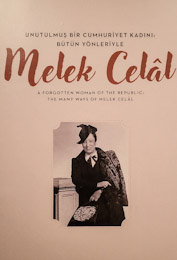
Naciye and her husband had only one child, a daughter called Melek, who was born in 1896 (in Istanbul) and died in 1976 ( in Munich, Germany). She became a renowned painter, sculptor, and writer (books and articles). I would not have heard of her had we not visited the magnificent Sakip Sabanci museum of art at the village of Emirgan on the European shore of the Bosphorus. At this place there was an excellent exhibition of Melek’s life and works. With information both in Turkish and English, it was an enlightening experience.

From an early age, Melek showed signs of artistic ability. She was brought up in an intellectual atmosphere. The Turkish poet Niğar Hanim encouraged her to take up painting. Her first lessons were with her uncle the soldier and painter Kâzim Bey. Later, she attended the Académie Julian in Paris. She also attended the School of Fine Arts for Women in Istanbul. While in Paris, Melek worked with various well-known French artists in their studios. Soon, she was recognised as an accomplished artist. This is evident from the many portraits and still-life’s on display in the exhibition.

In addition to painting and sculpting, Melek was a prolific writer of articles and books. She was also involved ed with Turkish politics during the period when the Ottoman Empire was dying and Ataturk’s modern Turkey was in its infancy. Her first book was published in 1938. In 1959, she published a book in French to introduce western readers to the delights of the Topkapi Palace complex in Istanbul. Many of her publications are on display alongside her paintings and one sculpture.

Melek married twice. First with Mr Celal in 1917. They had a son, and Celal died soon after that. In 1956, she married Dr Lampé, a physician. He died before she did. Melek died whilst being treated in a hospital in Munich.

Melek was one noteworthy descendant of Ali Paşa of Tepelene. There were others, who became famous Turkish intellectuals, including the writer Ebüzziya Tevfik(1849-1913), another writer Abdülhak Şinasi Hisar (1887-1963) and the author and poet Nâmik Kemal (1840-1888). These people of Albanian descent were not alone in shaping Turkey – both Ottoman and modern – in various ways, both peaceful and otherwise. I had heard about some of them, but Melek and her art are a wonderful discovery.

An Albanian born in Italy and buried in Gujarat

KHWAJA SAFAR SULEMANI (1500 – 1546) was born in either Otranto or Brindisi. He entered life as a Christian, named Cosa Zaffar in Italian. But later, after being converted to Islam, his first name became Khwaja Safar. I have written about him before because his most likely heritage interests me. He is most likely to have been the son of Catholic Albanian parents, who fled to Italy to escape the Ottomans who had invaded what is now Albania.

Khundhavan Khan Rojo – a detail

Khwaja was captured by an Ottoman general at sea when he was 15. The Sultan in Istanbul was impressed by him. To cut a long and complicated story short, he was put in charge of vessels to attack the ships of the Portuguese, who were trying to monopolise trade between India and Europe. The Ottomans carried goods from India to places in their Empire on the coasts of Egypt and the Arabian peninsula. From there, they were carried overland to Europe. Their competitors, the Portuguese, carried goods from India to Portugal via the Cape of Good Hope, thereby bypassing transit through lands held by the Ottomans. This proved very damaging to the economy of the Ottomans.

During the Ottoman attack on the Portuguese colony of Diu (on the south coast of Saurashtra – part of modern Gujarat state), Khwaja, whose fighting skills were highly regarded by his opponents, was killed by a cannon ball near, or in Diu. Interestingly, the Portuguese, with whom he joined forces briefly before turning against them, erected a monument in his honour. It stands in Diu, and I have seen it.

And that summarises all I knew until we visited the superb museum housed in the restored fort of Surat. There, I learned that Khwaja’s body was brought from Diu to Surat, where it was buried.

After his burial, a mausoleum was built over his grave. Probably established by his eldest son, Rajab, this lovely edifice, called the Khudhavand Khan Rojo (or Rauza), contains architectural features typical of 15th century mosques in Ahmedabad. It includes structural elements that were influenced by Hindu and Jain temples. By the way, Khwaja became known as ‘Khudhavand Khan’, the title he was given when Sultan Mahmud III made him Governor of Surat.

I entered the domed mausoleum, which contains six gravestones, all covered, as is usual, with coloured cloths. None of these is the grave of the man who was born of Albanian parents in the south of Italy. His body lies somewhere beneath the mausoleum.

As is often the case when I visit India, I come across completely unexpected things. Although I had known about Khwaja’s death in Diu, it was a delightful surprise to come across his final resting place in Surat – a city across the sea from Diu, but not too distant from it.

At first sight, it seems ironic that Khwaja’s Albanian parents fled from the Ottomans, yet their son became prominent in the Ottoman Empire. However, it is not so strange. Many Albanian boys (including Skanderbeg) were abducted, or taken as hostages, by the Ottomans, and later both served in the empire’s army, some of them becoming high officials.

A Marian mix-up and Mother Teresa

IN THE MID 1970s, I attended a series of evening lectures given by the art historian Ernst Gombrich. They were held in the Mary Ward Centre in London’s Bloomsbury.

Sign post at Loreto House School

In January 2023, we visited Sister Marilla, who works for Loreto House School and College in Middleton Row in the heart of Kolkata. My wife attended the school for several years in the 1960s. The two educational establishments are part of a larger organisation, the Loreto branch of the Institute of the Blessed Virgin Mary (‘IBVM’). When Sister Marilla told us that the IBVM was founded by Mary Ward (1585-1645), I immediately thought of the Mary Ward Centre in London, and was a bit surprised because I had always assumed that the Centre was named after a 19th century woman.

My assumption was correct. The Centre is named after the novelist Mary Augusta Ward (1851 – 1920), not the Mary Ward, founder of the IBVM.

The earlier Mary Ward (b 1585) was born in Yorkshire – Roman Catholic during the time that Roman Catholicism was outlawed in England. She felt the need to take up holy orders and instead of becoming yet another Catholic martyr, she wanted to do something worthwhile and practical. She went to Flanders where she joined the Poor Clares in St Omer.

To cut a long story short, she became, to oversimplify a lot, a female version of a Jesuit, but not a member of the Jesuit Order. After leaving St Omer, she founded the Poor Clare House for English women at Gravelines. There, and later elsewhere, she taught women about the Roman Catholic faith. In about 1609, she returned to England, where she gathered women to teach girls about the banned faith. Mary Ward suffered many hardships, including imprisonment in Germany, before succumbing to ill health in England

Leaping ahead in time, this group founded by Mary Ward, which had to surmount much criticism from the Jesuits and members of the Roman Catholic hierarchy, was the seed that germinated to become the officially recognised IBVM in 1877.

Followers of the group she had founded in 1609, established the Bar Convent in York in 1686. It was from here in 1821 that the IBVM Loreto branch was founded in Dublin by Teresa Frances Ball.

On the 12th of October 1928, 18 year old Albanian Agnes Gonxha from Skopje (now in North Macedonia) joined the IBVM at their Loreto Abbey at Rathfarnham in Ireland. She left Ireland on the 1st of December 1928, and landed at Kolkata on the 6th of January 1929. From there she travelled to Darjeeling, where on the 24th of May 1931, as a novice, she made her First Profession in Darjeeling’s Cathedral of the Immaculate Conception. In this church she made her Final Profession on the 24th of May 1937.

Next, Agnes was sent to the Loreto Convent at Entally in Kolkata. At first, she taught catechism and geography at Loreto St Mary’s Bengali School, which was on the campus of the convent. Eventually, she became the school’s headmistress.

On the 10th of September 1946, whilst travelling to a retreat in Darjeeling, she decided that her true calling was to work with the poor in the slums of Kolkata. By that time, she was known not as Agnes Gonxha but as the now much more familiar Mother Teresa. The order she founded, The Missionaries of Charity, maintained a warm relationship between it and the IBVM. Internationally famous, she died in 1997.

Had it not been for our visit to Sister Marilla and the informative booklets she gave us, it might have been a long time before I discovered the two Mary Wards and the connection that one of them had with both my wife’s school and Mother Teresa.

Seeing double at the pub

I DO NOT KNOW why there is a huge Albanian flag hanging outside The Cow pub in Notting Hill’s Westbourne Park Road. The large red flag decorated with a double-headed eagle has been fluttering outside the pub for several weeks, if not longer.

I walked into the colourfully decorated pub, for many years a local favourite both for drinkers and diners, and asked two members of staff if they knew anything about the flag. They did not have any real idea, but suggested that it might be because at least one long-serving member of the pub’s current staff is Albanian. A quick search of the internet revealed nothing.

The flag was put up long before the 28th of November, Albania’s Flag Day commemorating the founding of independent Albania in 1912, and is still flying. Maybe, one of you out there can tell me more about the reason that The Cow has an Albanian flag.

Russian music with an Albanian conductor in a London church

THE ALBANIAN CONDUCTOR Olsi Qinami, who began studying music in Tirana (Albania), lives in London. He certainly knows how to get the best out of the orchestra he helped to found, the London City Philharmonic. On Saturday the 2nd of October 2021 he conducted the orchestra in a wonderful concert of music by three Russian composers, two of them from the 19th century and the other from the 20th. The musicians performed to a large and enthusiastic audience in the church of St James in Sussex Gardens, Paddington. Many of those present were Albanian speakers and amongst them the Albanian ambassador, Qirjako Qirko.

Olsi Qinami

The church, a fine example of Victorian gothic, was built to satisfy the spiritual requirements of the rapidly growing population of 19th century Paddington. Designed by George Edmund Street (1824-1881), the building was completed in 1882 on the site of an earlier, smaller church that was built in the neo-classical style in about 1841. Apart from being a highly successful example of gothic revival, the church is notable for having been that in which the unjustly vilified writer Oscar Wilde married Constance Lloyd in 1884. Despite being a large, spacious building, the church’s acoustics coped well with the orchestral music.

The concert opened with a spirited rendering of the “Polovtsian Dances from Prince Igor” by Alexander Borodin. This piece holds a special place in my heart, as I will now explain. In the late 1950s, my parents bought or were gifted an LP entitled “Classical Music For People Who Don’t Know Anything About Classical Music”, which I played often in my childhood. Its cover has a sketch of four people in the living room of a very modern looking house, even by today’s standards. A lady, looking pleased with herself or the music or both, stands next to a gramophone player clutching a record cover (sleeve). Behind her, three people are seated in armchairs: one looks puzzled; another looks a bit bored; and the third has fallen asleep with a drinking glass resting on his armrest. One of the tracks on this LP was the “Polovtsian Dances”.

Borodin’s piece was followed by Peter Ilych Tchaikovsky’s “Romeo and Juliet Overture”, with which I am less familiar than the “Polovtsian Dances”. Although this brief piece was nicely performed, it is unlikely to enter my list of favourite works by this composer in the near future.

After the interval, we were treated to an exciting and brilliantly performed rendering of the 5th Symphony by Dmitri Shostakovich. Olsi Qinami and the orchestra handled the constant alternation of the composer’s triumphant sounding sections of the symphony with its comparatively peaceful, lyrical sections with exquisite mastery.

Shostakovitch completed his 5th Symphony in 1937, soon after having been heavily criticised by Stalin for his opera “Lady Macbeth of the Mtsensk District”, first performed in 1934. Had the Fifth Symphony not been so well received and liked by Stalin, the composer’s future might have become exceedingly grim. As Olsi Qinami pointed out in a brief speech before conducting the symphony, the piece, which was praised by the authorities, contains subtle musical messages expressing the composer’s criticism of the ruling regime. Whether or not one was able to detect these messages did not matter because the performance we heard was exciting, uplifting, and invigorating. In the last minutes of the symphony, I noticed one of the violinists breaking into a wonderful smile, no doubt because she and the rest of the orchestra had so successfully mastered this complex and difficult piece of music.

An odd thought occurred to me whilst listening to the Shostakovich piece. It was composed in 1937, when life for ordinary people in the USSR cannot have been at all easy. Although the situation here in the UK in 2021 is hardly comparable to that distant time in Russia, we are also going through times far more difficult than anyone has experienced since WW2, what with the covid 19 pandemic, Brexit-related problems, and shortages in shops and filling stations. It must have been a source of great solace for Soviet citizens to escape from their daily problems, if only for a few hours, by joining an audience at a concert of fine classical music. Well, that is how Olsi’s joyous concert felt for me as soon as he lifted his baton, and the orchestra began to play.

A lost landmark and a treasured map

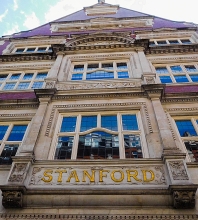
EVER SINCE I CAN REMEMBER, I have been fascinated by maps and collected them. I cannot say exactly why I enjoy them, but one reason is that I get satisfaction from aesthetic aspects of cartography. Another reason is that when I look at them, I try to imagine the reality that they represent, a form of virtual travelling. Whatever the underlying cause(s) of my fascination with maps might be, it is irrelevant to what follows because what I want to tell you is about a shop that I used to love to visit. It was Stanford in London’s Long Acre, a street not far from the old Covent Garden Market and Leicester Square.

Founded by Edward Stanford (1827-1904) in the early 1850s, his business was one of the best specialist suppliers of maps in the UK, if not the very best.  His company’s store on Long Acre opened in 1901, having moved there from Charing Cross. When I used to visit the shop to browse the lovely maps on display in the 1960s, there were two floors open to the public. The ground floor was the main showroom with maps of popular destinations that appealed to the majority of customers. The basement was less attractively arranged but far more interesting to serious travellers and map collectors such as me. There were no maps out on display down there. One had to ask a salesman to show you maps of areas that interested you. I believe it was there that I bought a nautical chart of the extremely remote French island of Kerguelen in the southern part of the Indian Ocean, a place that I had no intention of ever visiting.

In about 1966, my interest in Albania was born. I have tried to explain why this happened in my book “Albania on My Mind”, which I published in 2013, 101 years after Albania gained its independence.   In those days, not much was known in the UK about this small country in the western Balkans. Maps of Albania were not available in most shops, probably because few people visited the place, or were even remotely interested in it. So, I took the Underground from my local station, Golders Green, to Leicester Square. Stanford was a few yards from that station. At Stanford, I enquired about detailed maps of Albania, and was sent to the specialist map department in the basement.

The only detailed map of Albania available at Stanford was a 1:200,000 scale map with the information that it was made:

“Auf Grund der Oesterreichischer-Ungarische Kriegsaufnahmen und der im Auftrage der Albanische Regierung Von Dr Herbert Louis gemachten aufnahmen sowie mit Benützung italienischer und franzoesischer Karten” (i.e., ‘On the basis of the Austrian-Hungarian war recordings and the recordings made by Dr Herbert Louis on behalf of the Albanian government, as well as with the use of Italian and French maps’)

The map, which comes as two sheets, was up to date in 1925. A small map alongside the main map shows which parts of the large map were surveyed by whom and when.        Between 1916 and 1918, the surveyors were the armies of Austria-Hungary, France, and Italy. Some information collected by Baron Nopcsa between 1905 and 1909 is included in the map, as well as data collected by Dr H Louis between 1923 and 1924.

Baron Nopcsa was the Hungarian aristocrat and politician Franz Nopcsa von Felső-Szilvás (1877-1933; see: http://www.smithsonianmag.com/history/history-forgot-rogue-aristocrat-discovered-dinosaurs-died-penniless-180959504/), a founder of paleobiology and a specialist on Albanian studies. This one-time candidate for the throne of Albania created the first geological map of northern Albania. The German Dr Herbert Louis (1900-1985), whose name is prominent on the map, was no stranger to Albania. In 1923, he accompanied the Austrian geologist Ernst Nowack (1891-1946) during his research in the country, and in 1925, he was awarded a doctorate for his studies concerning Albania.

The map looked beautiful, I fell in love with it, and I knew I had to obtain a copy of it, but it was priced at 23/- (23 shillings: £1.15) for the set. That might not sound excessive today in 2021, barely the price of a small bar of chocolate or a cup of tea (in a scruffy café). But in about 1966, it was a huge sum of money for me, many times more than my weekly pocket money. I left Stanford, determined to save up for it and hoping that in the meantime the shop would not run out of copies of it. Eventually, I was able to purchase a set of these maps.

Delicately drawn, covered with contour lines, shaded representations of rocks and mountains, a variety of colours, the map shows how few roads there were in Albania in the 1920s. The tiny black dots, which represented buildings or small groups of them are often shown to be connected by tracks or footpaths, but many of them are a long way from any line of communication marked by the map makers. Most of the names on the map are in Albanian, but a few are also in Italian (e.g., Durazzo [Durres], Valona [Vlora], San Giovanni di Medua [Shengjin], and Santi Quaranta [Saranda]). Some words on the map are also in German.

I treasure this set of maps I bought at Stanford so many years ago and my memory of first being shown them in the basement of the shop. Yesterday, on the 15th of August 2021, first day of the 75th year of India’s independence, we walked along Long Acre, and discovered that although its name on the building is still there, the map shop is not. I had not realised that in 2019 this repository of records of landmarks and one of my favourite childhood haunts had moved from Long Acre to nearby Mercer Walk near The Seven Dials.