Pizza in Warsaw with a haiku on the side

Pizza Etna_500


Some years ago, we were visiting relatives in the city of Buffalo in New York State (USA). We had never met them before, which was a pity since they turned aout to be a quite delightful couple. Apart from that, they were very interesting and interested in everything. Unfortunately, one of them has passed away.

We were travelling around New York State in a rented car when we visited my relatives in Buffalo. One day, they suggested that we went for an outing. Being much younger than them, I decided that we should all travel in our rented car. They were very mysterious about our destination. They gave me directions and i followed them. About 50 miles east of Buffalo we arrived at a neatly laid out small ‘one horse town’ and parked next to a pizzeria. 

My relatives ordered one pizza. It was large enough for each of the five of us in our party to eat to our satisfaction. Of all the many pizzas I have eaten so far, this was one of the best that I can remember. I cannot rember the name of the pizzeria, but the town’s name is WARSAW.

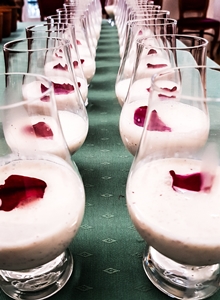
A ring of dough

A colourful topping

It’s Italian, it’s pizza


PS after lunch at Warsaw, we continued to the nearby Letchworth State Park, which well deserves its nickname ‘The Grand Canyon of the East’
Scene in a ticket office

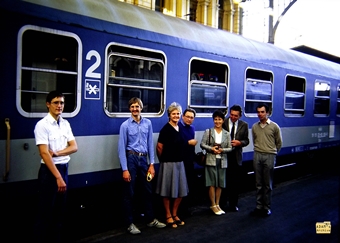
BUDAPEST KEL PU 83 Farewell 2

I used to visit Budapest in Hungary frequently in the 1980s during the Communist era. I had many good Hungarian friends there. They were very hospitable to me.

One day, I happened to visit the advanced booking office at Budapest’s grand Keleti (Eastern) Station. I have no recollection of where I was planning to go, but that is not relevant to the true story that follows. The smallish rectangular room was lined with about ten (or more) counters at each of which there was a booking office official. 

A young Soviet Russian soldier entered the room. He was in an immaculately smart uniform and looked proud. He went up to the first counter and spoke to the person behind it. After about a minute, he was instructed to go to the next counter. Once again, he spoke to the official behind the window at the counter. And, after a few minutes, he was directed to the next counter. This went on until he had visited each counter in the room and reached the last one. At the last one, the official indicated that he should leave the room as he was in the wrong room for obtaining tickets for Soviet military personnel.

You might have thought that the official at the first counter he visited would have directed him to the correct place, but no. So great was the average Hungarian’s disdain for the Soviet soldiery that was keeping their country under the thumb of the Soviet Union that the officials in the booking office conspired together to waste the young Soviet soldier’s time and humiliate him. It was a beautiful example of passive resistance.

A Dream


The first time I saw a performance of Shakespeare’s A MIDSUMMER NIGHTS DREAM was in the 1960s in north London (Big Wood in Hampstead Garden Suburb). It was performed by an amateur dramatic group in a clearing in a small wood. There were barely any props. The actors appeared and disappeared in and out of the trees growing around the clearing. It might not have been the very best of renderings of the play, but I found it highly enjoyable and magical. Whenever I think of the Dream, I remember that show in the woods, so long ago, with much fondness. 

Since that magical summer evening in the wood, I have seen several more performances of the play, but none of them managed to recapture for me the magical experience  that was created for me by my first viewing of the work.

A few days ago, I watched yet another performance of the Dream. This time it was at the lovely new Bridge Theatre next to the southern end of London’s Tower Bridge. The staging and acting was brilliant. The Director, Nicholas Hytner, had ‘tweaked’ the play slightly but successfully to make it more accessble to contemporary audiences. I hope that Shakespeare would have approved of this latest version. I feel that he might well have done. The ‘show’ was livened up with acrobats, who were not only superbly skilful but also great actors with clear diction, and much music. Despite these additions, the Bard’s original words were not sacrificed or edited in any noticeable way. It was not merely a play, but  a spectacular extravaganza.

There was one aspect of the performance that I did not like. The play was performed ‘in the round’ on an arena where there would normally be stalls seating. Many people had bought tickets to stand on the stage in order to take part in an immersive performance. The actors mingled with the crowd of spectators standing on the ‘stage’. Assistants and the actors themselves shifted the crowds around to make spaces for props and passages through which the actors could move. It was a case of, to use the Bard’s words, “All the world’s a stage…”. This seemed to be very popular with both the audience members immersed in the drama as well as the rest of us sitting in seats. I was not keen on watching a play where the actors are surrounded by swarms of spectators. I felt that the latter diluted the action and were a bit of a distraction. The immersive theatre technique disturbed me, but most of the rest of the audience approved of it.


My picture shows the actors and audience mingling together at the end of the play

Indian Independence Day 15th August 1947

HAPPY INDIAN INDEPENDENCE DAY!

yamey's avatarGUJARAT, DAMAN, and DIU

JAI HIND!
(Long live India!)
The 15th of August 1947 was the day on which India became an independent country.
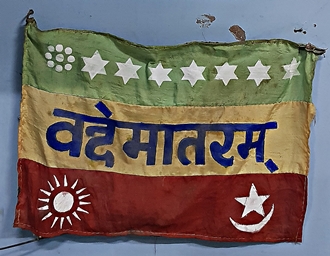
CAMA FLAG blog
This early Indian national flag was designed by the Indian Freedom fighter Madame Bhikaiji Cama at the beginning of the 20th century. This particular example of the flag is preserved in a museum in Bhavnagar (Gujarat).
READ MORE about Mme Cama and other patriots who struggled for India’s freedom long before Gandhi became prominent in the fight for Indian Independence:
A SMALL house cover

View original post

Slow down

taxi

My late mother lost two front teeth in a car crash in South Africa during the 1930s. Ever since then, she was both a nervous driver and an apprehensive passenger.

In the early 1960s, my mother was one of the first drivers in the UK to have seat belts installed in our car, which, like all other cars at the time, was sold without seat belts.

When I used to go on holidays with my parents, we used taxis wherever we were: water taxis in Venice and automobiles elsewhere. The places we visited most often were Italy and Greece. In both places, drivers manoeuvred at higher speeds than in the UK and far more adventurously. I remember one occasion in Milan (Italy) in the 1960s where our taxi driver drove along the tram lines on the wrong side of the road, so that trams headed straight towards us. And, in Athens (Greece), if a driver saw a space on the road some hundred yards ahead, he would take all kinds of risks to reach it. In all the years that I travelled with my parents in taxis we were only involved in one accident – no injuries, fortunately.

Well, all this dangerous dashing about in dare-devil taxis did not do anything positive for my mother’s nerves. Consequently, wherever we went she made sure that she knew how to say ‘slow down’ in the local language. Whenever I am being driven in India, where traffic is very exciting to say the least, I often think that had my mother experienced it, she would have died of fright. Oh, by the way, the Hindustani word for ‘slow down’ is ‘aasthe‘.

Postage stamps in Albania

TIRANA Skand Sq with House of Culture and mosque


Recently, I read a blog (Click here) written by an Australian, who has visited North Korea twice. On one of his trips, he visited a museum or exhibition of postage stamps, many of which depict important leaders of the country. Given that it is against the law to deface pictures of these people, he wondered how careful postal officials would have to be when they cancel the stamps with the rubber stamps used for franking. One false move and the great leder’s face might become defaced. In that case, the postal official would risk punishment. This story reminded me of something that I observed in an Albanian post office when I was visting Albania in 1984. In those days, Albania was even more isolated from the outside world than North Korea and it was governed by a stern, repressive regime led by the dictator Enver Hoxha.

This excerpt from my book  Albania on my Mind describes what I saw:

I wrapped my books into a number of parcels, addressed them, and then began leaving the hotel to visit Tirana’s main post office. The Australian, who was travelling with us, spotted me in the lobby and asked me what I was doing. When I told him, he askedwhether he could accompany me to the post office, as he,working as he did for the Australian postal service, was curious to see how things were done by the Albanian post…

… The clerk behind the counter in the Tirana post office offered no objection to the way that I had packed my parcels. He weighed them and then gave me numerous stamps to stick on them. I stuck them on and returned the parcels one by one. The clerk examined each of them to make sure that I had stuck the right combination of stamps on each packet.

Suddenly, he stopped, looked up at me, then at the parcel, before pointing at one of the stamps. In my haste, I had stuck it on upside down. He tore the stamp off the
parcel, and then replaced it the right way up, pointing at the portrait on it whilst saying:
Enver Hoxha.”
The Australian, who was watching this with wide-open eyes,
turned to me and said:
You know, it’s completely illegal to remove stamps from postage. It’s against all international postal rules.”

I did not know what to say, but admired the respect that even a humble postage stamp could inspire in one of Enver’s subjects.”


ALBANIA ON MY MIND 

is available

on Amazon by clicking   HERE

Picture shows Skanderbeg Square in Tirana, Albania, in 1984

Olives in London

I love olives, especially the black Kalamata and Amphissa varieties. These are imported from countries which are members of the EU (European Union), which the UK is destined to leave at the end of October 2019.

It is becoming increasingly likely that the UK will leave the EU without a trade deal. If this happens, supplies of olives may become restricted for some time. Also, the falling value of the Pound Sterling will increase the cost of those olives that make their way into the UK retail market. Gloomy as this seems, there might be light at the end of the tunnel coming from a much feared source.

The UK, like the rest of the world, is affected by climate change, which includes global warming. As I write this, I am sitting in front of a fan, something we would not have considered purchasing, even in summer, 25 to 30 years ago.

A result of global warming struck me today whilst walking in Kensington Gardens. I passed a south facing tree with greyish leaves. It was an olive tree, usually planted in gardens in the UK to provide visual contrasts. However, this particular olive tree was rich in young olives ripening in the sun (see photo above).

Seeing this richly fruited olive tree gives me hope for the future. Maybe, I will be buying British olives as well as those from southern Europe (if import duties and exchange rates do not make them unaffordable).