
Waiting at waters edge
Watching for tasty snacks
At the park’s Round Pond

Waiting at waters edge
Watching for tasty snacks
At the park’s Round Pond
Sometime in the 1980s, I was visiting Italy in order to see my sister who lives in the Emilia Romagna region. I landed at Milan and rented a car.
The SEAT vehicle which I hired was tiny and very basic and seemed to lack many items that can be found in other low-cost cars. However, I benefitted from it because it did not consume fuel at a high rate. This was lucky because in those days fuel was extremely expensive in Italy as compared with other countries in Europe. In those days, the petrol price in the UK had just exceeded £1 per GALLON (4.5 litres). In Italy, at the same time, petrol was available at about 1600 Lire per LITRE, and the exchange rate was about 1570 Lire to the Pound Sterling. Nevertheless, I ‘beetled’ around Italy visiting various friends in different places.
Driving practices in Italy differed from those in the UK. One day, I gave a lift to some Italian friends. At each village or small settlement on the Strada Statale (main road, not a motorway or highway) there were traffic signals at intersections. At one of these, I began to slow down because I could see that the signal was about to turn red. My friends said:
“What are you doing? Why are you slowing down?”
“The signal is turning red,” I replied.
“Don’t be silly, speed up. Don’t let the signal hold us up!”
I cannot remember what I did, but I have lived to tell the tale.
A day or so before I was due to meet my sister, I decided that I ought to have a haircut in order to look presentable. I stopped in a village, where I had spotted a barber shop as I was driving past.
I entered to smart looking salon, and sat amongst three or four other gentlemen awaiting the caring hands of the barber.Eventually, I was invited onto the barber’s throne. I explained what I wanted as best I could with my very rudimentary Italian. However, the barber, a true experienced professional, knew what was needed.
He began rummaging around in the mop of hair on my head, and then suddenly stepped back as if he had been confronted by a deadly poisonous snake. He raised his hands high above his head, and shouted:
“Forfora”
The other men in the salon shrank back, one or two of them hiding their heads under the newspapers that they were reading. I sat, amazed and wondering about the meaning of ‘forfora’ and why it had caused such alarm.
Then it dawned on me. The barber had discovered dandruff in my hair. He explained something to me that I worked out meant that he needed to apply a special treatment to my hair. I told him to go ahead. He rubbed some oily liquid into my hair. After a moment, I felt a strong burning sensation. It felt as if something was burrowing down the roots of my hair and into my scalp. As it worked, I thought that whatever had been applied felt as if it was strng enough to kill anything. I just prayed that my hair would not fall as a result of this terrific chemical onslaught.
After a short time, my head began to feel normal, and the barber carried out my haircut. I do not remember how much my cut cost, but I do remember having to pay an extra 5000 Lire for the special treatment.
I doubt that I will ever forget the Italian word for ‘dandruff’, but how often I will make use of this knowledge is questionable.
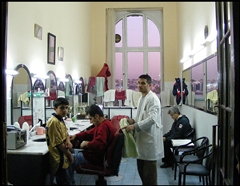
Photo: a hairdresser in Istanbul

IN THE CURRENT CORONAVIRUS OUTBREAK, infection is spread from person to person in close contact with one another. Isolation and quarantine are likely to be effective in eventually reducing the rate of infection.
At the end of the 19th century and beginning of the 20th, another deadly pandemic, the bubonic plague, spread around the world. It was then believed that separating people from each other was likely to help arrest the plague. It was not because bubonic plague is rarely contagious, but usually transmitted by a vector.
While researching the life of my great grandfather, Franz Ginsberg, sometime Mayor of King Williams Town and later a South African Senator, I needed to explore the history of bubonic plague in South Africa. While doing so, I discovered that the young Indian lawyer, Mahatma Gandhi, also entered the story. The following is extracted from my article that was published in a South African medical journal back in 2008:
INVISIBLE INVADERS
When the Boer forces, provoked by the British, started invading the Cape Colony in 1899, another invasion, covert in nature, was also beginning to threaten the area. The hidden enemy, a bacterium, lives in the blood of fleas and the rats (and other rodents) whose blood they ingest. These fleas are also partial to feeding off the blood of humans. When an infected flea feeds off the blood of a susceptible human, that person runs the risk of developing an often fatal illness known as ‘bubonic plague’. When my great-grandfather Councillor Franz Ginsberg (1862-1933) was serving on the Borough Council of King William’s Town in 1899, little was known about the transmission of the plague, even in the scientific world, except that its causativeagent was the bacterium Yersinia pestis (Y.pestis). This ‘bug’ is named after one of its discoverers Alexandre Yersin (1863-1943).
PESTILENT FLEAS
Today, much is known about the mechanism of transmission of Y. pestis. Bubonic plague is an example of a zoonosis: a disease that normally exists in other animals, but also infects humans. The danger to humans is that the bacterium is carried in the blood of certain kinds of rat, and that these rats often live in close proximity to humans. The rats serve as a mobile reservoir for this pest, but they are susceptible to its ill-effects. When a flea bites an infected rat, it ingests the blood of the rat and some of the bacteria living in it and the bacteria multiply within the flea’s digestive tract, causing considerable harm to the flea itself. If this same flea should bite a human, the human victim will receive some of the bacteria from the flea because the flea, while feeding, regurgitates some of its Yersinia-infected stomach contents into its human victim, who may then begin to exhibit the symptoms of bubonic plague. The plague can produce numbers of victims in epidemic or pandemic proportions. The Black Death, also known as ‘The Second Pandemic’, killed between one third and one half of the population of Europe and Asia between 1347 and 1351. It is thought by some to have been a pandemic of (bacterial) bubonic plague but others feel that it was a viral infection. The ‘Third Pandemic’ began in China’s Yunnan Province in 1855, and is known to have been caused by Y.pestis. Its dissemination around the world in the decades that followed was facilitated by global shipping. Rats and their fleas were frequent stowaways on ships, and as infected rats moved from port to port so did the bubonic plague.
AN UNWELCOME IMPORT
In September 1896, the bubonic plague reached India (most probably from Hong Kong) and had claimed its first of many victims in the port of Bombay. News of the plague spread faster that the plague itself. In 1896, the Natal Medical Council discussed the bubonic plague – by then well-established in India – and its relevance to Natal. The Council decided that the whole of India should be regarded as an infected area, and that all ships entering the ports on the coast of Natal should be quarantined.
In January 1897, an anti-Indian demonstration was held in Durban to protest against the landing of ‘asiatics’ on board two Indian-owned ships which arrived there in mid-December 1896. The ships had been held in quarantine for 25 days. A group of Indians in Durban, including Mohanlal K Gandhi (later to be known as ‘Mahatma Gandhi’) who had just arrived in Durban on one of these two ships, the ‘Courland’, sent a long ‘memorial’ protesting against this to the Secretary of State for the Colonies in London. Its authors shrewdly noted:
‘…that the quarantine was more a political move against the Indians than a safeguard against the introduction of the bubonic plague into the Colony’,
and they provided evidence that the measures taken to effect quarantine were done ineffectively and too late to have been of any practical use. Despite measures such as these, bubonic plague reached South Africa sometime between 1899 and 1901.
The Natal medical community had some grounds for its fears that the plague might arrive from India. At a meeting of the Borough Council of King William’s Town in February 1899,13 it was announced that the bubonic plague had arrived in Port Louis on the island of Mauritius (a place that ships sailing from India to South Africa may have visited occasionally), and the Council had received a letter from the Town Office of Port Elizabeth, asking for the support of King William’s Town in their request for the government to enforce quarantine regulations (the Transvaal and Orange Free State prohibited entry to Indians in early 1899).
My great-grandfather, Franz Ginsberg, moved that the Council of his town should cooperate with that of Port Elizabeth. Although fear of importing the dreaded plague was the cause of an anti-Indian demonstration in this port as early as about 1897, the disease only began to occur in the town in April 1901 –soon after its arrival in grand style in Cape Town in March 1900 (having possibly arrived on board a ship from plague infested Rosario in Argentina). As early as November 1900, a doctor in King William’s Town reported eight cases of bubonic plague amongst Africans, three of these leading to death. By early 1901, the inhabitants of King William’s Town had good reason to worry about the plague.
In 1994, my wife, who was pregnant, and I decided to spend a relaxing week in Wales. We filled the boot (luggage compartment) of our car with more than enough books for a week’s leisurely reading.
We drove to Bala in north Wales. We had booked a room at what seemed like a lovely guest house in a converted mill. On arrival, we were given a comfortable, well-furnished room and then enjoyed a meal prepared by the establishment.
Next morning, we entered the dining room to discover a breakfast buffet with a wide selection of food items. We chose a table, were greeted by the owner of the place, and then moved towards the buffet.
As I began emptying some cereal into a bowl, the owner, much taller than me, stood close behind me, and said in a minatory voice:
“Go easy on that. It’s very expensive, you know.”
I placed my bowl of ‘costly’ cornflakes on the table, and then headed off towards a tempting glass jug filled with orange juice. As I began pouring it, the owner appeared again, saying:
“That should be enough. Do you know the cost of orange juice?”
Just before we finished breakfast, the owner addressed us and the only other couple of guests staying in his acommodation:
“You’ll all be in for dinner this evening?”
We confirmed that we would be.
“Pork chops for dinner? Alright?”
It sounded good to us and the other couple.
We spent the day exploring the surroundings of Bala rather than embarking on the reading material we had brought from London. When we returned, we entered the dining room for dinner and found that two more guests had arrived during the day. There were six of us to be fed.
The pork chops were served. However, the pieces of meat on the plates were strange shapes. We soon realised what the mean landlord had done. He had assumed that there would only be four of us for dinner, and bought only four pork chops. With the arrival of two more guests, instead of purchasing two more chops, he had divided the four so that they could be served to six people. Such meanness and penny-pinching annoyed us so much that we told the owner that we had to leave urgently the next morning. By saving on not buying two cheap pork chops, he managed to lose the income he would have gained had we stayed the full week as we originally intended.
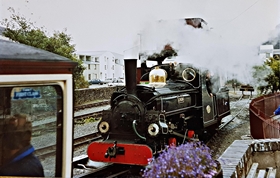
Photo taken at the Blaenau Ffestiniog railway
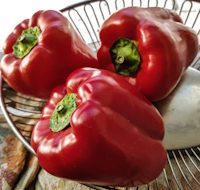
Full of goodness
Rich in sunny vitamin Cee
Clap hands for peppers
In 1967, there was a serious strike of dock workers in the United Kingdom. There were anxieties about shortages of stocks of various household goods. And one of the most worried people was my late mother. Maybe, having lived through the lean days of early post-WW2 Britain, she did not want her family to be caught short of any essential supplies.
Very soon, she filled one of our smaller bedrooms with enough toilet rolls to keep an army happy. We did not have to buy toilet paper for many years after the strike was over.
Some years after she died, my father and I looked into a large cupboard which was used mainly to store unwanted furniture and other junk. We hardly ever opened this storage area because we knew there was little inside it that we might ever want to see again. However, when we opened the cupboard sometime in the 1980s, my father and I found that its floor was packed solid with a layer of tins of canned meat: ham and so on. Sadly, this went to waste.
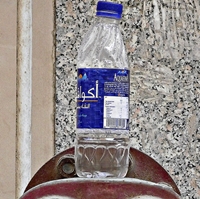
My mother worried that in addition to shortages of groceries, the strike might lead to a failure of the public water supply. To prepare for this possible tragedy, my mother bought bottled water. Today, water packaged in plastic bottles is extremely common,and many will not leave home without a bottle of water. However, in the late 1960s in the UK, bottled water was a bit of a rarity. In those days, it was de rigeur to drink only bottled water in France, but in the UK you just turned on the tap.
Given the scarcity of bottled water in the UK of 1967, it is amazing that my mother was able to find quite a few gallons of the stuff. What amazes me to this day is that all of the bottles bore labels indicating that they contained spring water bottled in Bulgaria.
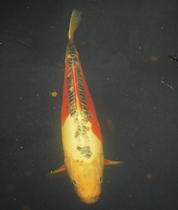
Under the still water
In a Japanese pond
Silently gliding
Kyoto Garden in London’s Holland Park

In the 1960s, as a protest against the horrendous apartheid regime in South Africa, shoppers in the UK were asked not to buy produce from South Africa. This is a stry told to me by my late mother, who was born in South Africa but was completely disgusted with the prejudice against ‘black’ and other ‘non-white’ people in the country of her birth.
My mother was in a fruit store in a north London suburb. She saw a fellow customer take some oranges to the sales counter. The customer asked the shop keeper:
“Are these oranges from South Africa?”
“Definitely not, Ma’am.”
“Oh, that’s good. I’ll take them.”
Overhearing this conversation, my mother asked the lady who had just bought the oranges:
“What’s wrong with oranges from South Africa?”
The lady replied:
“You’re not supposed to buy them because they might have been touched by coloured people.”
My mother could not believe what she had heard.
This anecdote just goes to show how a simple message can be totally misinterpreted.

When I was a young child, probably less than ten years old, we made one of our regular family holidays to Holland. My parents, having studied Afrikaans to varying degrees of competence, felt easier visiting a country like Holland where the native language, Dutch, was not too exotic for someone to comprehend with a knowledge of Afrikaans.
One Saturday afternoon, my parents decided to take us to see the tulips at Keukenhof gardens. I cannot recall anything about the flowers.
However, I do not think I will ever forget the car park at Keukenhof. We had parked our car early in the afternoon when the parking area was fairly empty. When we came to leave, the car park was very full.
Everyone wanted to leave at the same time. A disorderly tsunami of vehicles converged on the exit gates. Nobody seemed to be regulating the traffic. It took us well over an hour to escape from the motorised mayhem.
Sadly, I associate Keukenhof with traffic rather than tulips, and although I love tulips, seeing them often brings Keukenhof to mind.

Blossoms blooming
Small birds chirruping sweetly:
We should enjoy fresh air
Photo taken at Kyoto Garden in Holland Park, London

