
With wings of colour
A life so very brief
The butterfly takes rest

With wings of colour
A life so very brief
The butterfly takes rest
UNLIKE IN HOLLAND, the landscape of England is often not flat. In the 18th century, a network of canals was constructed to carry freight between different places in England and its neighbouring countries. The routes of these canals almost always involved crossing hilly terrain. When a canal encounters a hill, it can sometimes be routed around it, or it can pass through a tunnel, or it can cross the incline by means of a lock or a series of locks. A series of locks can be separated by short stretches of the canal on level terrain, in which case it is called a ‘flight of locks’. A good example of this are the six locks on the Grand Union Canal at Hanwell in Middlesex. Alternatively, one lock can lead into the next in the series without an intermediate pool or stretch of water. When one lock leads into the next, and that leads into yet another one, this is called a ‘staircase’ of locks. A good example of this is on the Leicester Line (branch) of the Grand Union Canal at Foxton in Leicestershire.

The staircase at Foxton, which we visited recently, consists of two sets of five interconnecting locks separated by a pool where boats can queue whilst the staircase is occupied with other boats. Each of the ten locks are just broad enough to accommodate one traditional narrow boat. Locks work by raising or lowering boats by being filled or emptied of water respectively. When each of the locks at Foxton is emptied to lower a boat, the water released flows via a series of valves into a side pond. The water from a side pond is reused to fill the next lock down when a boat needs to be raised. This ingenious system means that little water is required to operate the staircases.
The staircase of locks at Foxton was constructed between 1810 and 1814. On average, if there are not queues of other boats, it takes about 45 minutes to ascend or descend the whole staircase of ten locks. In 1900, an alternative to the Foxton staircase was constructed. This was known as the Foxton Inclined Plane. The way this worked was as follows. A boat sailed into a water filled container, which was made watertight. This was then hauled up rails on an inclined ramp or lowered down it if it was descending. The motive power for this boat lift was provided by a mechanism powered by a steam engine, whose housing is now an interesting canal museum. This lift reduced to traverse time from 45 minutes to about ten minutes. There were two parallel lifts, so that when one boat was being hauled upward, another could be lowered simultaneously, rather like the counterweight in a lift in a building. This ingenious mechanism was abandoned in about 1911 and dismantled in 1926. Visitors to Foxton can see what remains of the inclined plane tracks.
A visit to Foxton Locks is highly worthwhile. It is not only fascinating from the viewpoint of the history of engineering. It is also an impressive visual treat. The volunteers who work at the locks helping both users of the canal and sightseers, like us, are both friendly and well-informed.

As with opinions
It turns as the wind moves
The humble weathervane

MANY PEOPLE KNOW, but I did not, that the words of the hymn “”Faith’s Review and Expectation”, now better known as “Amazing Grace”, were written by John Newton (1725-1807), an Anglican clergyman. What fewer people know is that John Newton had once been the captain of ships that transported slaves across the Atlantic, but also a slave himself. In 1745, having fallen out with the crew on the ship he was sailing, he left his ship in what is now Sierra Leone. He was captured and enslaved and became the property of a princess of the Sherbro People, who lived in that part of Africa. He remained enslaved until 1748, when he was rescued by a sea captain, whom his father had sent to rescue him. On the voyage back to England, he received his spiritual calling.
Cutting a long story short, Newton was ordained as a priest in 1764. Soon after, he became the curate of a church in the small town of Olney in the north of Buckinghamshire. He remained in Olney until about 1779. While living in Olney, Newton struck up a friendship with the poet William Cowper (1731-1800; pronounced ‘koo-per’), who moved to the town in 1767. They collaborated on several literary projects.
From 1779 until his death, Newton was Rector of St Mary Woolnoth in the City of London. In 1788, Newton published his “Thoughts upon the Slave Trade”, a pamphlet that described to horrors on board the slave ships crossing the Atlantic. It was also a confession of his error of having been involved in such an inhumane business. He became an ally of William Wilberforce in the campaign to abolish the slave trade.
Olney is a charming little town, which we visited recently. Close to the market square, there is a large building in which William Cowper lived between 1768 and 1786. It now houses a museum dedicated to commemorating both Cowper and Newton. Behind the house, there is an attractive garden, which leads to another equally lovely garden. In the further garden, there is a small hut with white plastered walls and a tiled roof. It is just large enough for one person to sit inside it. It was here that Cowper’s friend John Newton used to sit and write. It is said that one of the hymns he wrote here in this tiny edifice was the hymn, now known by the words of its first line, “Amazing Grace”. This hymn was probably written in 1773.
DUNCHURCH IN WARWICKSHIRE is located where the old road between Oxford and Leicester crosses that between London and Holyhead. This charming village was a place where, in its heyday, up to forty carriages a day stopped to change their horses for a fresh team. This was done at the various coaching inns in the village. One of these hostelries, which is still in business today, is The Dun Cow, where we ate a good English breakfast. Some of this inn’s previous guests included the engineer George Stephenson (1781-1848) and his son, another engineer, Robert (1803-1859), who dined at the hotel on the 23rd of December 1837. Their dinner was to celebrate the completion of the Kilsby Tunnel on the Birmingham to London Railway, a project supervised by Robert.
While we were wandering around the graveyard of Dunchurch’s St Peters Church, which dates back to the 12th century, we asked a gardener working there about where one of Dunchurch’s former famous characters had once stayed. He told us that he had no idea. Half-jokingly but with some earnestness, he added: “…we could do with another one like him.”
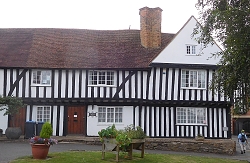
The man about whom we were asking had associates, who were staying at the village’s former inn, The Lion Inn, in the early 17th century, the year 1605 to be exact. It was in early November of that year that those waiting at The Lion in Dunchurch were wondering about their colleague who was 79 miles away in London.
The fellows at The Lion were waiting to hear whether their co-conspirator Guy (Guido) Fawkes (1570-1606) had been successful in blowing up the House of Lords in London. He was not, and the conspirators waiting in Dunchurch were arrested. Had the plot to blow up Parliament and along with it the Protestant King James I succeeded, the men at The Lion were to have travelled to nearby Combe Abbey to seize Princess Elizabeth (1596-1662), who became Queen of Bohemia. As an informative website (www.ourwarwickshire.org.uk/content/article/rugby-school-science-teaching-around-1900-2) explains:
“In 1605 the monarch was James I; the Princess Elizabeth was his eldest daughter and sister to the future Charles I. In 1605 she was nine and being educated by Lord Harington at Coombe Abbey. She wasn’t a Catholic, but the conspirators planned to convert her and use her as their figurehead … Her main importance with regard to British history is that one of her grandsons (the son of her youngest daughter Sophia of Hanover) became King George I.”
The man about whom we were chatting with the gardener was neither of the Stephensons, who dined at The Dun Cow, nor the Duke of Wellington, who also stayed in the village, nor Lord John Douglas-Montagu-Scott (1809 – 1860), whose statue stands facing The Dun Cow. He was referring to Guy Fawkes, but this time a Guy Fawkes who completes the job before being arrested!
The former inn, a lovely half-timbered edifice is now a private house, named ‘Guy Fawkes House’, even though the famous man never lived there. The rest of the village contains several old thatched cottages, a thatched bus shelter, and the old village stocks. Close to the town of Rugby, this village is well worth a visit.
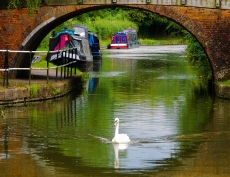
Passing the bridge
The swan swims serenely
Along the manmade channel
NO LONGER AVAILABLE !
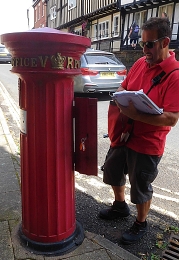
In Britain, posting boxes for letters and small packages are sometimes referred to as ‘pillar boxes’
While visiting the town of Warwick, famous for its castle, we spotted a letter box that is truly a pillar box.
This post-box (pillar box) is shaped like a classical pillar. It was made in cast-ron in 1856 and is one of two of this design in the town of Warwick. They are still in use.

UNTIL NOW I HAVE been self-publishing my books satisfactorily using a print on demand company called ‘X’. I typed the manuscript on Microsoft Word using one of X’s many templates and then uploaded it to the site. In the past, X convert the uploaded document to a .pdf file. As conversion from Word to ‘pdf always results in changes in formatting, I have always had to make modifications of my Word manuscript, often several times, before I am happy with the proofs provided by X. It was always a little time-consuming but, in the end, I produced a printed book that was, if not perfect, always satisfactory.
Now, all has changed. X will no longer accept manuscripts uploaded in Word. Instead, authors are required to submit their manuscripts in the .pdf format after fulfilling extremely detailed formatting specifications, which I must admit are beyond my technical abilities at present. I discovered that a well-known on-line trading company offers a self-publishing process, which permits authors to upload their manuscripts in the Word document format on their downloadable Word templates. I tried this, but the proofs generated by the company’s publishing system looked disastrous, to say the least. Maybe, I could have tried modifying my manuscript’s layout, but there did not appear to be a facility for doing so and, I could foresee hours if not days of frustrating work ahead.
I have spent several months writing my latest book, and even longer researching it, and now I would like people to be able to enjoy it and, I hope, comment on it. So, as many people often say in India: “What to do?”
Well, here is my current solution. I am going to upload my manuscript to one of my personal websites and make it downloadable for anyone who cares to read it. It will be downloadable free of charge because I write for pleasure rather than for profit and I value the thought that people might find what I write of interest. It is more important for me that my writing gets read rather than gets sold. Eventually, I hope to be able to produce a satisfactory paperback version of my latest work, but in the meantime, watch this space!
If anyone can offer me a simple solution to my problem, I would be grateful to see your suggestion!
ONCE A VILLAGE in Kent, Deptford is now a riverside suburb in southeast London, just west of Greenwich. We visited Deptford to see the exhibition of contemporary art, which our daughter has curated. It is being shown at ArtHub in Creek Road and finishes on Sunday, the 25th of July 2021. So, hurry if you wish to see it.
Deptford is becoming not only a trendy place to be, rather like Dalston has become, but it also attracts artists and art galleries. Maybe, Deptford’s proximity to Goldsmiths College, which educates many kinds of creators, might explain its emergence as a new artistic district of London. Whatever the reason, Deptford now has an exciting and rather edgy feel about it.
Deptford, which I plan to explore further in the future, has a long history. Its Creek was a harbour for shipping as far back as the 11th century, if not before. King Henry VIII developed an important dockyard at Deptford. Eventually, it was involved with shipbuilding. Many ‘men-of-war’ vessels were launched here. The dockyard thrived until it was closed in March 1869.
Doubtless there is much history to relate about Deptford, but I will mention only one thing and that can be seen today. Albury Street runs east from Deptford High Street and lies just north of the lovely baroque St Pauls Church designed by Thomas Archer and built between 1712 and 1730.

Originally called ‘Union Street’, Albury Street was laid out between 1705 and 1717. The south side of the street, which is paved with cobbles (or maybe setts), has been rebuilt with modern dwellings. The north side is lined by the original terraced houses built by a local bricklayer, Thomas Lucas. These brick-built dwellings are distinguished by their beautiful porches, each of which has a pair of lovely woodcarvings that support the canopies above each doorway. Many of these have been restored sensitively.
Just who lived in these houses, which would have been remarkably superior in both appearance and construction for what was then a small village outside London, is subject to some uncertainty. Famous characters such as Admiral Benbow and Horatio Nelson have been mentioned, but much doubt surrounds the likelihood that they lived in this street.
In brief, a visit to Deptford is worthwhile not only to see what remains of Albury Street but also to enjoy the vibrant atmosphere and multi-ethnic nature of this corner of London.
 yamey
yamey 