Eight bells and a bridge

BELIEVE IT OR NOT, busy Fulham in west London was a small country village in the early 19th century. Today, what was once the heart of the village, is the site of two bridges spanning the Thames. One carries the District Line railway tracks and pedestrians, and the other, an elegant stone bridge with five arches carries a road across the river. Known as Putney Bridge, the latter was completed in 1886 and designed by the prolific civil engineer Joseph Bazalgette.

Inside The Eight Bells in Fulham

Prior to the construction of the stone bridge, there was an earlier wooden bridge, known as ‘Fulham Bridge’. With roofed gatehouses at both ends and 26 arches (or openings), it was designed by Sir Jacob Acworth and completed in 1729. Its approach road was Fulham High Street. The bridge has long-since been demolished but a blind-ended, short inlet of the river, now named Swan Drawdock Nature Reserve runs right next to where the old bridge would have once begun.

The Eight Bells pub, which still serves customers, stands on Fulham High Street. Now housed in a Victorian building, it might have been first established as early as the 17th century. When the old bridge stood, it would have attracted much business from folk using the wooden crossing. Things changed when the new, current, bridge was constructed.

The approach to the new crossing, Putney Bridge, was not via Fulham High Street but by way of a new road, the present Putney Bridge Approach (the A 219), which does not pass the front of the Eight Bells. This led to a considerable loss of business for the pub, whose owners received £1000 in compensation: a great deal of money in the late 1880s.

The Eight Bells and its neighbour, a wonderful second-hand book shop, along with a few other shops near Putney Bridge station, although definitely not rural in appearance, retain a ‘villagey’ feel.

A slave trade abolitionist in Fulham

LESS FAMOUS THAN William Wilberforce (1759-1833), but equally important in helping to end Britain’s involvement in the slave trade, was Granville Sharp (1735-1813). Born in Durham, Sharp was apprenticed to a linen draper in London at the age of 15. A scholar at heart, he left his apprenticeship to become Clerk in the Ordnance Office at the Tower of London, a job that gave him more time to pursue his scholarly studies and music. One of his brothers, William Sharp (1729-1810), was a physician, who is believed to have treated King George III.

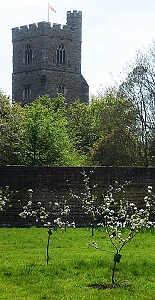
All Saints church in Fulham

One of William’s patients was Jonathon Strong (c1747-1773), a black slave from the West Indies, who had been badly beaten-up by his master, a lawyer called David Lisle. William and Granville helped tend to Strong’s injuries and paid for him to spend four months in St Bartholomew’s Hospital. Lisle instigated a number of court cases to protect his ‘possession’ of Strong. Granville was deeply involved with making sure he lost them and that Strong became a freed man. The Strong case was the beginning of his keen and active involvement in the movement to abolish slavery. His involvement with this and subsequent legal cases connected with the unjustness of the slave trade gave him the reputation of being a “protector of the Negro”.  

In 1787, Granville became one of the founder members of the Society for Effecting the Abolition of the Slave Trade. Though sometimes overshadowed today by other abolitionists such as Wilberforce and Thomas Clarkson (1760-1846) played a major role in hastening the end of the slave trade and slavery in places ruled by the British.

By the 1780s, there were approximately 15,000 ‘black’ people in Britain, many of them without employment. Ideas began to circulate that it would be a good idea to form a settlement in Africa to which the Africans could ‘return home’ and live as free individuals. One place that was suggested was Sierra Leone. Granville Sharp was consulted on this and felt that it would be an ideal location to set up a model community for the ‘blacks’. He suggested calling it ‘The Province of Freedom’. Sadly, the well-intentioned province that included a settlement called Granville Town was a failure.

Granville lived long enough to learn that the Act of Abolition received Royal Assent in 1807, but not long enough to know about the final abolition of the slave trade in the British Empire (in 1833). Granville’s brother William had a country dwelling, Fulham House, in Fulham. It was here that the ageing Granville moved after William died. He lived there with William’s widow, Catherine, and her family. It was in this house that Granville breathed his last.

Probably Fulham’s greatest resident, Granville Sharp was buried in the cemetery of Fulham’s parish church (All Saints). His funerary monument, which stands close to the boundary fence of Fulham Palace commemorates him, his brother William, and his sister Elizabeth Prowse. William’s wife Catharine (née Barwick) is also buried beneath this stone, which was restored in 2007.

Roman recycling

TOLLESBURY IN ESSEX on the Blackwater River estuary is a village just over 5 miles southeast of Tiptree, a small town close to the Wilkinson jam factory and museum. This charming village, where a good friend of ours lives, has a venerable parish church, St Mary the Virgin.

Roman bricks used to construct the arch above the south entrance of St Mary’s in Tollesbury, Essex.

In common with most of the parish churches we have visited during our extensive roamings around the English countryside, this church, whose construction had begun by the 11th century, contains a rich selection of interesting features. These are well described in a copiously illustrated booklet about the edifice published by the Friends of St Mary’s Tollesbury in early 2020. Amongst the interesting things we saw within St Mary’s, one of them particularly intrigued me: the incorporation of Roman bricks in the fabric of the church.

Archaeologists have uncovered the remains of a Romano-British cemetery near the village. They have concluded from their findings that in about 200 AD, there was a significant rural settlement located near Tollesbury at that time. Other remains are evidence that the district around the estuarine village has been the site of human activity since the Neolithic era (4000-2000 BC).

As if to prove that recycling is not simply a recent trend, the church of St Mary incorporates bricks made whilst the Romans occupied England. These can be seen clearly above the south doorway within the church. The 11th century arch above this portal is made entirely of recycled Roman bricks. Some more brickwork made with Roman bricks can be seen exposed above the gothic archway in the western wall of the nave, which is also part of the late 11th century bell tower.

Although the re-used Roman bricks have been ‘highlighted’ in St Mary’s, the structure of the parish church in the nearby village of Goldhanger also contains recycled Roman bricks. Making bricks at the time when these churches were built would have been far more laborious than making bricks using today’s industrial techniques. So, re-using bricks that had already been made would have been very sensible.

The fantastic herons

ON SUNNY EASTER Sunday (2022), we took a morning walk along the Thames Path from the Black Lion pub (and the excellent Elderpress Café facing it) to Dukes Meadows, upstream from the pub. Dodging the endless stream of mostly courteous joggers and less polite cyclists, we enjoyed splendid views of the River Thames and the many old buildings lining Chiswick Mall. Several of the buildings were covered with flowering wisteria.

The Fantastic Herons

The river was well-populated with waterfowl including swans; geese of various kinds; ducks; a pair of cormorants resting on a buoy; and several herons. The latter were either standing on the sand and mud at the waterside or in the water close to the bank. Eventually, we reached Dukes Meadows, which consists of fields formerly part of the estate of nearby Chiswick House.

Near the Hammersmith end of the Meadows, we saw a metal sculpture, ‘The Fantastic Herons’, on top of a tall pole. Created by the artist Kevin Herlihy (born 1962) along with pupils from Cavendish Primary School and unveiled in 2004, it depicts three herons standing on a nest. Like most of Herlihy’s creations which often depict animal life, it is made from recycled waste materials. Funded by Singapore Airlines, who held a series of art workshops in the school, it is an appropriate sculpture for the area as herons can often be standing by, or in, the Thames flowing past the Meadows.

Covid is over

IT WAS EASTER Saturday (2022), the sun was shining, the air was warm, and we paid a visit to the world famous, popular Portobello Road Market. For the first time after over two years of pandemic-induced suppression of London’s ‘joie-de-vivre’, the market was buzzing with activity, crowded with foreign tourists and local visitors. As it was before Covid19, the market was bustling and business at the stalls, which offer everything from artichokes to antiques and pancakes to paella, seemed to be brisk.

Portobello Road

A friend, who lives in rural France, said to me a few days ago when we were walking near Leicester Square:

“It’s hard to believe that there was ever a deadly pandemic in this city.”

And as we walked along a short street in the area, he added:

“There are more people out in this street than there are living in my hometown.”

Yet, Covid infection rates are high in the UK. Friends in India have been telling us that they are thinking twice before visiting the UK because the risk of becoming infected here is so great at the moment. Recently, I have heard that approximately between 1 in 12 and 1 and 15 people in the UK are likely to be infected with a Covid19 virus, and therefore capable of spreading it to others.

Apart from personal hygiene and wearing face coverings, good ventilation is considered to be useful for reducing the risk of spreading the viruses. So, when I boarded a bus in South Kensington recently, I opened the window closest to me – each window on London buses has a label saying “Open this window”. Immediately after following this instruction, which has been given for reasons of prevention of infection, the lady sitting behind me, who was not wearing a face covering, stood up and slammed it shut. I stood up, opened it, and told her not to touch it. She said, speaking angrily with an Eastern European accent:

“You don’t need to open it. You are wearing mask and have three vaccinations.”

How she knew my vaccination status, I do not know. My wife said to her:

“Don’t you know that one in twelve are infected?”

To which the lady replied:

“Believe what you like.”

Then to my great surprise, she added:

“Covid is over”

Buried behind Berry Brothers

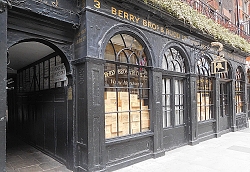
LONDON’S NOOKS AND crannies are often worth exploring. One, which I must have passed often but of whose existence I only became aware in April 2022, is Pickering Place, a narrow, covered passageway between numbers 5 and 3 St James Street, close to St James Palace.  Immediately on entering this timber lined alleyway, I noticed a metal plaque, which commemorates the short-lived Legation of the Republic of Texas to The Court of St James. The legation existed from 1842 to 1845, whilst the Republic existed from 1836 to 1846. It rented the premises from the property’s owner, Berry Brothers.

Pickering Place was in existence by 1690, when it was then known as ‘Stroud’s Court’.  Prior to that date, the site was:

“… once home to the medieval maidens’ leper colony of St James, before playing host to King Henry VIII’s royal tennis court.” (https://blog.bbr.com/2015/04/10/the-other-no-3/)

 The alleyway leads into a small open space, a courtyard that is believed to be Britain’s smallest square. The name Pickering relates to the company of Berry Brothers and Rudd (‘Berry’s’) that occupy most, if not all of the buildings around the courtyard and on the south side of the alleyway. In 1698, a widow with the surname Bourne began the business, at first a grocery shop, now known as Berry Brothers & Rudd. Her daughter, Elizabeth, married William Pickering (died 1734). They continued the business, supplying the coffee houses of St James with coffee. The company adopted the coffee mill as their symbol. The shop at number 3 St James Street and Stroud’s Court were then rebuilt by the family. William and Elizabeth’s sons, John and William Junior, continued the running of the firm. After John died in 1754, William Junior brought a relative, John Clarke, to be a partner in the business.

George Berry, John Clarke’s grandson, joined the business in 1803 and by 1810, his name became the firm’s name. George moved the firm’s activities into focussing on wine and spirits. In 1845, his sons, George Junior and Henry, took over the firm, hence the ‘Brothers’ in the company’s name. Hugh Rudd, a wine merchant with a keen interest in the wines of Bordeaux, joined the firm as a partner in 1920. His arrival in the company greatly increased its expertise in the wine trade. In 1923, the company created a new whisky which they called Cutty Sark Scotch. Its label was designed by the artist James McBey, whose studio was at the top end of Holland Park Avenue. The firm is still run by the Berry and Rudd families and flourishes.

Immediately after leaving the covered alleyway, you will see an orrery and beyond it, a carved stone portrait of a man with his head facing towards his left. Nobody we asked seemed to know whom it portrays. Various websites suggest it depicts the politician and former Prime Minister Lord Palmerston (1784-1865), who lived in Pickering Place for some time. The author Graham Greene also lived in Pickering Place for a while.

Doorways in the courtyard lead to various underground rooms including the Pickering and Suffolk Cellars. Once used to store wine and other products sold by Berry’s, parts of them are now also used as a wine school, as well as for banquets and similar gatherings. One of the cellars is named The Napoleon Cellar, after the exiled Napoleon III (1808-1873), a friend of George Berry Junior. In 1846, fearing assassination, the exiled Frenchman hid in the Berry Brother’s cellar, now named in his memory. Number 3 Pickering Place, built in the 1690s, is a well-preserved example of a William and Mary era townhouse.

Part of the tiny courtyard has outdoor tables and chairs. These can be used by patrons of the St Jacques restaurant, which occupies number 5 St James Street whose southern wall forms the northern wall of the alleyway. The southern wall of the passage is part of the wall of number 3, which houses the original Berry’s shop. This well-preserved historical shop is lined with wood-panelling and contains much of the old shop fittings.  These include old desks, shelving with old bottles, and a large hand-operated coffee grinder. Suspended from the ceiling, there is a large grocer’s weighing scales. According to Berry’s detailed company history (www.bbr.com/about/history):

“It was in the time of William Jr. and John Clarke that the famous grocer’s weighing scales began to be used to weigh the shop’s many notable customers, a fashionable pastime that continues to this day.”

Had it not been for noticing the alleyway which I have passed often without noticing it, and then spotting the portrait in the courtyard, I doubt we would have ever entered the old shop at number 3. Incidentally, if you wish to purchase wines or spirits from Berry’s, you will need to walk around the corner into Pall Mall, where the company has a newer shop … or, less interestingly, you can make purchases online.

Forbidden radio station on a ship

FROM A FIELD on my friend’s farm in Essex, I could see the mid-morning sun glistening on the water of the estuary of the River Blackwater. Moored out on the water, there was a trawler with a red hull and white superstructure. A tall aerial mast, just about visible through the heat haze, was mounted on its deck in front of the bridge housing. When my friend saw me taking a photograph of the vessel, she mentioned what it is, and this caused distant memories to surface in my mind.

When I was a child in the early 1960s, I had a Phillips radio in my bedroom. I was a keen listener and enjoyed exploring the various stations broadcasting from all over the world. It was during this period and with this radio that, for example, I was able to tune into the propaganda-rich programmes transmitted from Albania by Radio Tirana. Less exotic than this was Radio Luxembourg, which unlike the few rather straightlaced, advert-free BBC stations, pumped out a stream of non-stop ‘pop’ music, punctuated by commercials for products, which were not aimed at audiences in little Luxembourg but instead at consumers in the UK. In those days, I was not much interested in pop music, but I enjoyed the commercials. The only one that I can remember was for a particular football pool company.

Radio Luxembourg was founded in 1933, long before I became one of its listeners. Located outside the UK, it was not subject to any of the legislation that ensured the BBC had a monopoly as a broadcaster in Britain.

In 1964, the Irish businessman Ronan O’Rahilly (1940-2020) and Alan Crawford came up with the idea of broadcasting to the UK from a ship moored in international waters. This way both the restrictive laws that protected the BBC, and the record company’s control of pop music broadcasting in the UK, were overcome. Radio Caroline was born and began broadcasting non-stop pop music from beyond Great Britain’s territorial waters. Caroline was soon followed by other radio stations, such as Radio London, which all made use of the same wheeze to get around the restrictive legislation in the UK. Radio Caroline has had a long and sometimes difficult history since its formation. This is described in great detail on the company’s website (www.radiocaroline.co.uk).

Our friend in Essex told me that what I was photographing is the boat from which Radio Caroline transmitted. I was surprised because, for no good reason, I had believed that Caroline was a thing of the past. The boat moored in the Blackwater is the Ross Revenge, formerly used as a fishing trawler. It was not the first boat to house Radio Caroline; it served this purpose between 1983 and 1991. A radio station bearing the name Caroline still functions. What is important about Radio Caroline and other so-called ‘pirate’ stations is that their existence had some considerable influence in causing the BBC to commence broadcasting pop music. Radio 1, which replaced the BBC’s Light Programme, was started in 1967 in response to the popularity of the pirate stations amongst the listening public.

I am glad that we were shown around our friend’s farm and that I spotted that boat in the estuary. Although I did not often listen to Radio Caroline, seeing the vessel made me recall my early radio receiver (‘wireless’) and the joy it gave me during my early teens.

Drawn to remember: an exhibition by an Indian painter

THE PAINTER MAHESH BALIGA was born in the south Indian state of Karnataka in 1982. He studied painting at The Chamarajendra Academy of Visual Arts (CAVA) in Mysore, and then received a postgraduate qualification at the prestigious Faculty of Fine Arts, MSU, in Baroda (Vadodara in Gujarat). He has taught at various art schools in India and exhibited in several countries including India. Currently, he lives and works in Baroda. Between the 12th of April 2022 and the 28th of May 2022, some of his works are being exhibited in a solo exhibition, “Drawn to Remember”, at the David Zwirner Gallery in Grafton Street (in London’s West End).

The paintings on display were created using casein tempera. This kind of paint has a glue-like consistency, but it can be thinned with water. According to Wikipedia, artists like this kind of paint because:

“… unlike gouache, it dries to an even consistency, making it ideal for murals. Also, it can visually resemble oil painting more than most other water-based paints …”

At first glance, it is difficult to discern whether the Baliga’s paintings on display at Zwirner’s resemble water colours or oil paintings; some of them seem to look halfway between the two mediums. All of them, except one, are quite small canvases and without exception they are all attractive. The subject matter depicted in the works is varied, from studies of plants and animals to everyday scenes (often with depictions of Indian life) to the slightly unusual. An example of the latter is in the only large canvas of the show in which there is an image of a man with sticky plasters over his left eye. Another odd subject shows a man with flowers growing out of his shirt. This is appropriately named “Flowering Self”.

The small size of most of the paintings, which the artist described as ‘lap-sized’, has a reason. Many of them were executed on the journeys the artist made when commuting to and from Surat (in the south of Gujarat), where he held a teaching position for a while. Though they are not large paintings, each one of them provides a window on the artist’s experiences and and his take on them. Although the paintings are far from mundane, they are not over-dramatic or excessively visually challenging. The exhibition is well worth seeing.  I would be happy to hang any one of the works I saw at his exhibition on my walls at home.

Vanishing point

OF JAMAICAN HERITAGE, the artist Barbara Walker was born and brought up in Birmingham where she lives today. During her childhood, she was taken to see museums and galleries. She noticed that in many works (paintings and other images) of western art, Black people play a peripheral role, depicted as servants and so on, serving the ‘white’ people who play a central role in a picture. Recently (April 2022), we visited an exhibition of her works at the Cristea Roberts Gallery in London’s Pall Mall. Called Vanishing Point, this superb display contains artworks, prints, which address the issue that Barbara noted when she was younger.

At first sight, most of the framed prints appear to be large sheets of white paper with a few beautifully drawn details depicting black people or parts of their bodies. Closer examination reveals that there is more to the white spaces than first meets the eye. The white areas are embossed. The black people, who have been drawn, are surrounded by the embossed areas of the print. Together, the drawings and embossed sections of the print can be seen to be a whole picture. Walker has processed an original image to create a new one in which only Black people in the original are easily visible and the rest of the picture forms a ghostly background. Unlike the pictures she saw when a youngster, the Black people in the picture are prominent and the others are barely detectable.

I am not sure exactly how the artist achieved this interesting effect and these powerful images, but I will have a go at explaining, using my experience of having once made etchings in the past. Metal plates are first coated with a photographic material. Then images of an original painting are projected on to it and processed in some way that produces a photographic reproduction on the plate. The artist, then blocks out selected areas on the plate with an acid-resistant material to produce a pattern that includes many details of the original image, including all of the parts of it that contain depictions of Black people or the parts of their bodies in the original painting or image. The plate is then immersed in acid, which eats into all the parts of it, which have not been painted over with the blocking agent. Then, a sheet of dampened paper is placed on the plate and the two are run through a printing press. The pressure exerted by the rollers of the press force the dampened paper into the depressions on the plate caused by the action of the acid. The result is a sheet of paper with embossed indentations. When the paper has dried, the artist then draws on the flat areas, which are in fact silhouettes of the Black people (or details of them) which appeared in the original painting. The rest of the embossed area, containing details and enough outlines of the original image to make it recognisable, is left white. The result is an image in which Black people become the focus of the viewer’s attention.

Barbara Walker’s works on show at Cristea Roberts (until the 23rd of April 2022) are ingenious and extremely engaging. She has employed an interesting technique to make her statement. Rather than reinforcing the fact that Black people were often depicted as being menial as is the case in the recent display of paintings by Hogarth at the Tate Britain, she has found a way of raising their status in artworks that sought to portray them as mere subsidiaries.