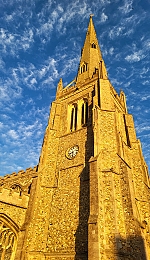
Reaching for the sky
A place for hopeful souls
The holy House of God

Reaching for the sky
A place for hopeful souls
The holy House of God
MANY YEARS AGO, a now deceased Greek friend, ‘S’, related the following story.
S was born in a small port in the Peloponnese long before WW2. It was a place that tourists disembarked from their boats to visit the Ancient Greek archaeological site of Olympia. S left school at an early age (by the age of about 12 to earn money by working on the docks of the small town. When cruise ships called in at the port, he offered services as a tourist guide to earn a few extra Drachmas.
Most of the tourists swallowed the tales that S told them as they wandered around Olympia. However, one day he met his match. An English gentleman accepted his offer to act as his guide. Soon after they reached the site and S had begun giving his customer his ‘spiel’, the Englishman stopped him, saying
“Listen, young man. It is clear that you know nothing about this site and its history. Let me tell you the correct story.”
S listened to his well-informed customer with interest and amazement. It turned out that the knowledgeable gentleman was no other than the future Prime Minister of the UK, Winston Churchill.
Many years later during one of my several visits to Olympia, I was standing in the lobby of a hotel near the site on a warm afternoon. The place was filled with members of an American tourist group. One lady asked her friend if she was going to take a tour around the famous site. The friend replied:
“Aw, no. It’s too damned hot to see more of those old rocks.”
MUSEUMS OFTEN CONTAIN interesting surprises for visitors. The small museum in Burnham on Crouch (in Essex) is no exception. It amused me to see that amongst the exhibits there were several early examples of so-called pocket calculators – too large to fit most pockets. I was given one of these (made by Casio) in about 1974, and at the time this was a wonderful gift as well as being a useful tool. I was able to replace my slide-rule with my Casio. These calculators, along with other things that were regarded as being ‘the latest thing’ in the 1960’s and ‘70s, were not what surprised me most at the museum. Hanging on the wall of one side of a staircase, there was a huge piece of cloth with advertisements printed on it. It is part of the fire safety curtain that was used in the local cinema, The Rio (see: https://adam-yamey-writes.com/2021/11/13/a-small-cinematic-survivor/) , in the 1930s.

Fire curtains are usually made of metal or heavy materials containing asbestos (or some other fire retardant). They are designed to be lowered (often automatically) should a fire break out on the stage of a theatre or cinema in order to prevent the fire spreading to the auditorium. In 1613, a cannon misfired on the stage of Shakespeare’s Globe Theatre, causing the thatch on the building’s roof to catch fire; the theatre was destroyed. There were no fire curtains in those days.
The first fire curtain (it was made of iron) to be installed in the UK was in 1794 at the Theatre Royal Drury Lane in London. A large fire at the Theatre Royal in Exeter in 1887 led to the wider use fire curtains in British theatres, and later in cinemas. However, these safety devices were not infallible. A fire that began on the stage of the Iroquois Theatre in Chicago (USA) led to the deaths of about 575 people when the fire safety curtain snagged and could not be fully lowered. This led to the invention of an improved automatic fire curtain by John Clancy a year later in 1904.
Fire curtains, which must be lowered at least once during every performance in the UK can be plain or decorated. Plain fire curtains, when lowered, can serve as screens on to which advertisements are projected. The example at the museum in Burnham has advertisements printed or painted on it. Local businesses paid the cinema to have their adverts printed on the curtain that hung in the Rio during the 1930s. The Treasurer of the museum explained that of the many Burnham firms, who placed adverts on the fire curtain, only one of them is still in business. Thus, the old fire curtain (or at least the half of it that is in the museum) not only protected Burnham’s cinemagoers from burning but also serves as a valuable record of the town as it was almost 100 years ago.
MY FATHER, BASIL Yamey (1919-2020), lived until he was over 101. Between about 1950 and 1991, he lived in our family home in Hampstead Garden Suburb. From my birth until 1982, I lived there, and afterwards I visited my then widowed father almost every weekend.
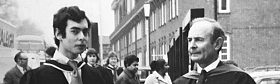
Dad was an academic, an economist, at the London School of Economics (‘LSE’). He became a senior professor long before he retired.
Although I have no knowledge of economics even at an elementary level (and this is not me being modest), I lived with an acknowledged leader in the field of microeconomics. Recently, the LSE published some of my memories of living with a professor: my late father. These memories are published on an LSE blog: https://blogs.lse.ac.uk/lsehistory/2022/07/06/at-home-with-basil-yamey-as-recalled-by-his-son/
I hope that you will enjoy these glimpses of the home life of a significant academic.

Once it steer’d a boat
Now decorating a wall
A vessel’s rudder
SADLY, THE CHARTERHOUSE was closed to the public when I walked through London’s Charterhouse Square on a Monday in July. As I walked clockwise around the grassy space in the middle of the (not so square) square, I spotted a building with a curvy brick façade with windows, many of which have both curved steel frames and glass panes.

The building, a block of flats which has Art Deco features, is called Florin Court. Although it looks recently built, it was constructed in 1936. It was designed by Guy Morgan (1903-1987) and Partners. Morgan had worked with the better-known architect Edwin Lutyens until 1927. Two years earlier, Morgan and Partners designed another block of Art Deco style flats in Highgate Village: Cholmeley Lodge. Although I was unable to enter Florin Court, I have read (on Wikipedia) that it contains 120 flats; it has a communal library, roof garden as well as a basement swimming pool. The reason that the structure looks so new is that it underwent extensive restoration work in 2013.
Florin Court has a connection with the author Agatha Christie as the following (from https://historicengland.org.uk/listing/the-list/list-entry/1390634?section=official-list-entry) related:
“Best known as ‘Whitehaven Mansions’, its exterior used as the residence of Hercule Poirot in the television adaptations of Agatha Christie’s novels.”
I have never watched this television show, but I am pleased that I stumbled upon this lovely example of Art Deco architecture in the heart of one of the older areas of the City of London.
BURNHAM-ON-CROUCH in Essex is a picturesque port on the River Crouch. Currently, it is a leisure resort and a centre for ship maintenance and boating. It was once famed for what grew in great numbers on the muddy bed under the water of the Crouch: oysters. For several centuries before the river became polluted in the 19th century, the oyster beds in the Crouch (and a few other places in Essex) were very profitable, providing much employment.
“On the shores of England the principal nurseries of oysters, not only for the English markets, but also for the foreign, are those on the coast of Essex and the estuaries adjoining: those taken there are called ‘ Natives/ Mr. Sweeting claims the name as peculiarly applicable to his fishery, as within his memory no strange oysters have ever been introduced…”
Men were required both to dredge the oyster beds and process the molluscs as well as to protect the precious creatures from thieves based in other places on the Essex coast.
Today (11th of July 2022), we visited the small but excellent museum in Burnham-on-Crouch. On the ground floor, we saw a retired mechanised oyster grading machine (made in France and capable of sorting 7000 oysters per hour) amongst the exhibits. On the upper floor of the museum, which is housed in a former boat repair building, we met the museum’s treasurer, who is a mine of interesting local history. He told us several things about Burnham’s oyster heydays. I hope that what I am about to tell you is a reasonably accurate summary of what he told us. If it is not totally accurate, I hope that he and you, dear reader, will forgive me.
For 10 years, I used to live in north Kent and often visited Whitstable to enjoy eating oysters for which this Kentish seaport is famous. The treasurer in Burnham told us that many of what are described as ‘Whitstable oysters’ were born in the mud beneath the river in Burnham-on-Crouch. From what I can recall, the young oysters, which grow in the mud beneath the Crouch, are dredged and then placed on boards to which they attach themselves. Keeping them submerged in seawater, the boards to which the young oysters are attached, were transported to Whitstable where they matured in its waters. The Burnham oysters were ‘native’, meaning that they began their lives there; they were not imported, as Thomas Campbell Eyton described in “A history of the oyster and the oyster fisheries” (published in 1858):
“On the shores of England the principal nurseries of oysters, not only for the English markets, but also for the foreign, are those on the coast of Essex and the estuaries adjoining: those taken there are called ‘Natives’. Mr. Sweeting claims the name as peculiarly applicable to his fishery, as within his memory no strange oysters have ever been introduced.”
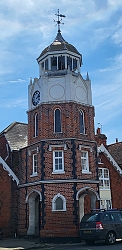
One of the exhibits in the museum is a large model of the octagonal Victorian clock tower that dominates Burnham-on-Crouch’s High Street. The tower stands next to the building that used to house the former St Mary’s School. It was erected in 1877 to honour the local philanthropist Laban Sweeting (1793-1876). So, what, you might ask, and what has he got to with what I have been writing about?
Laban Sweeting, mentioned in the quoted from Eyton’s book, was a philanthropist; a member of The Burnham River Company; and he was one of the town’s oyster merchants. The museum has amongst its exhibits a small barrow, which used to be wheeled around Burnham by a member of the Sweeting family. It would have carried baskets of oysters ready for sale to the town’s populace.
We had visited Burnham once before, and although I was impressed by the clock tower, I knew nothing of its history. Neither did I know about the town’s association with oysters, which were poor people’s food in the 19th century, when chicken was a luxury. How times have changed.
THE ESTORIC COLLECTION in London’s Highbury houses a fine permanent exhibition of modern Italian artworks, mainly creations of the so-called Futurists. In one of the galleries, I spotted the name of an artist who was born in a town, which I have visited, in the northeast of Italy: Gorizia. When the artist Anton Zoran Music (1909-2005) was born, Gorizia was part of the Austro-Hungarian empire. After WW1, the town became part of the Kingdom of Italy within the region of Venezia-Giulia. Soon after WW2, the eastern part of the region became absorbed into the Yugoslav republic of Slovenia (now an independent state). When that happened, the border between Italy and Slovenia ran through the eastern part og the town, the part in what was then Yugoslavia (a country I visited often between 1973 and 1990) became named ‘Nova Gorica’. Most of Gorizia, an attractive old town, is on the Italian side of the border.
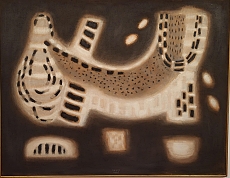
Slovenians still live on both sides of the border. Music, actually Anton Zoran Musič (pronounced mus-ich) was born into a Slovene-speaking family. Zoran, who went to schools in Maribor, studied art at the Academy of Fine Arts in Zagreb between 1930 and 1935. His first one-man exhibition (outside Yugoslavia) in Venice in 1943, where he had moved. Soon after this, he was arrested by the German Gestapo and then sent to Dachau concentration camp. After WW2, he moved to Ljubljana (in Yugoslavia), but soon shifted to Venice, where he lived (on and off) for the rest of his life. His career after the War was successful: he received several prestigious prizes for his artistic creations.
The Estorick displays five of Music’s paintings. They were created between 1951 and 1983 and illustrate his versatility as a painter. All the paintings hanging are between abstract and figurative in style, but slightly nearer the latter than the former. I had seen his paintings on previous visits to the Estorick, but until my most recent viewing of his art, I had not been aware of how many aspects of his life mesh with things that interest me.
Here is an excerpt from my new book about Hampstead in north London:

For many centuries, Hampstead has been the haunt of people involved in creative pursuits. So, it was no surprise that the former Express Dairy opposite Louis (patisserie) had at least one interesting cultural connection. In February 1916, the Bolshevik revolutionary Maxim Litvinov (1856-1951) proposed to his future wife Ivy Low in the café inside that branch of Express Dairy. Ivy, a novelist, was born, please note, in 1889 (she died in 1977). At the time he became acquainted with Ivy, Litvinov was with Lenin in London. Ivy did occasional typing for Maxim, and it was not long before they were attracted to one another. Passionate about cinema, he took her to watch films with him and one day he ‘popped the question’ in the Express Dairy. After they married, they lived in Hampstead until the outbreak of the Russian Revolution in October 1917. They did not return to Russia immediately because in January 1918 Maxim Litvinoff was made First Proletarian Envoy to the Court of St. James’s.
According to Zinovy Sheinis in his biography of Maxim first published in 1988, Maxim often went to Hampstead to meet his friends the Klyshkos, who lived on Hampstead High Street. Nikolai Klyshko (1880-1937) was a Bolshevik revolutionary of Polish parentage, who had settled in London and was a fluent Russian speaker. For a brief period, Litvinov lived in Hampstead with Klyshko and his English wife. Sheinis wrote about Maxim’s meeting with Ivy:
“They had met at a friend’s house. Then at a gathering of the Fabian Society. Litvinov was impressed by her knowledge of Tolstoy and Chekhov. Putting on weight, red-haired, of average height, well-mannered, and not very talkative, he made a big impression on the young writer. Her mother, the daughter of a colonel in the British Army, naturally wanted a different match for her daughter and certainly did not want to see her married to an insecure emigre from Russia. As for his religious background, Ivy Lowe simply never gave it a thought. She was herself from a family of Hungarian Jews who had taken part in the Kossuth uprising; in her girlhood she had been a Protestant, then had been converted to Catholicism. The choice of religion was her private affair and concerned no one else.”
After their marriage, they lived in a house, owned by Belgian refugees, in Hampstead’s South Hill Park (number 86). While there, Sheinis related:
“Friends sometimes gathered there in the evenings to discuss the political news; then an argument would flare up, developing into a fierce squabble. It always seemed to Ivy that her husband and his guests would any moment start flinging chairs at one another. At the very height of the dispute, when it was almost at boiling-point, she would leave the kitchen, go into the room, and announce that tea or coffee was ready. The disputants would calm down and drink their tea in peace.”
He also wrote that Ivy:
“… was not interested in and did not understand the political activities of her husband and his friends. To her, it was an alien world. In London, after the October Revolution, she asked her husband if he knew Lenin. Maxim replied that he had known Lenin for a long time. But she had no idea that letters from Lenin were coming to their house and that her flat was the headquarters of Bolshevik emigres.”
Later, they lived in a tiny house in West Hampstead. After that, Litvinov, having become a Soviet diplomat, moved from Hampstead. Despite not being officially accredited by the British, Sheinis noted:
“The Litvinovs were even invited to receptions. Though Soviet Russia was not yet recognised, its powerful influence reached standoffish London, Ivy Litvinova recollected.”
By 1921, the Litvinovs with their two young children, at least one of whom was born in Hampstead, settled in Moscow. Although Litvinov held high governmental posts in the Soviet Union and outside it (as a Soviet diplomat), he and Ivy, like so many other citizens in Stalin’s Russia, were constantly in fear of being arrested and/or killed.
My book about Hampstead, “BENEATH A WIDE SKY: HAMPSTEAD AND ITS ENVIRONS” is available from Amazon: https://www.amazon.co.uk/dp/B09R2WRK92
I LIVED IN A detached house (see the picture) in north London’s Hampstead Garden Suburb during the first three decades of my life. My bedroom window was that on the first floor facing the street, Hampstead Way. Externally it looks much as it did when I lived there. This is not surprising because the houses in the Suburb are all subject to strict preservation orders,which forbid alterations of the appearances of the exteriors of the Suburb’s buildings.

Although I was privileged to have lived in this part of London, it was never my favourite area of the city because during my youth, it was a dull place to be a child or even an adolescent.
By the way, although the name ‘Hampstead ‘ is part of the suburb’s name, the area is completely different from Hampstead proper: it lacks the vibrancy and vitality of old Hampstead village (or town, if you prefer). As a youngster, and still today, I have always enjoyed my visits to Hampstead Village

 yamey
yamey 
