
Huge steel hoops
Over tracks leading westwards:
Paddington rail terminus

Huge steel hoops
Over tracks leading westwards:
Paddington rail terminus

A bird flies past the Bard
No sonnet for the gull
Will thaw this statue
Statue of William Shakespeare at Leicester Square, London

When I was very young, I had a best friend called Rick (not his real name!). He lived within a short walking distance from my family home. During weekends, we spent a great deal of time in each others houses.
Both Rick and I had large collections of toy model vehicles made mainly by the Dinky Toy and Corgi Toy companies. I kept my collection in a wooden box in no particular order. In time, the model vehicles looked used, battered, and scratched.
In contrast, Rick and his younger sibling kept their vehicles much more carefully than me. Each vehicle was kept in the box in which the manufacturer supplied the toy. When we wanted to play with these toys, each vehicle was removed from its box and then we handled them very carefully. Rick’s collection was in superb condition. When we had finished playing with the vehicles, which included a fine model of a mobile rocket launcher complete with a detachable rocket, we packed each of them into their own boxes.
I lost touch with Rick when we reached our early twenties. Many years later when the Internet became commonly used, I tried to re-eastablish contact with him, but in vain. He never appeared on internet searches. Eventually, I decided to ring his parents’ telephone number, which had remained etched in my brain. To my great surprise, Rick’s mother, by now over 90 years old, replied. I asked her about Rick. She replied:
“You have just missed him, dear. He died a few months ago.”
Some time later, we visited Rick’s widow, whom I had never ever met. After feeding us lunch, I mentioned the model cars and other vehicles. Without saying anything about them, she beckoned me to follow her into another room. It was, she explained, Rick’s study while he was alive. Arranged neatly around the room on shelves was Rick’s collection of Dinky and Corgi toys, including the rocket launcher. And to my great surprise and delight, each of the toys, still in pristine condition, was sitting on top of its own box.
picture source: https://www.toyhunteruk.co.uk/
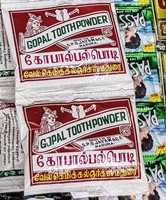
When I was a child, I brushed my teeth with toothpaste. My parents did not use paste. Instead they used Calox Tooth Powder. A small amount of this was sprinkled into the palm of one hand and then mixed into a paste using the wettened bristles of a toothbrush. The resulting gritty paste was then used to brush the teeth. I have no idea why my parents used the powder, but made us use toothpaste.
Many decades later, this year, I visited the Indian city of Pondicherry, which was a colony of France until 1954. We stopped at a tea stall that in addition to providing tea also sold small packets of paan and chewing tobacco (not very good for oral health) and packets of ‘Gopal Toothpowder’. Seeing the latter reminded my of my parents and their use of Calox. I asked the vendor how the tooth powder is used. He opened his mouth and rubbed his finger along his teeth. In his opinion, no brush is required. I bought a couple of packets, but have not yet been adventurous enough to try to use their contents.

Freezing windy rain falls
Yet flowers are blooming
Soon spring approacheth
THE HARRAPAN (or Indus Valley) civilisation existed from about 3300 to 1300 BC. Its existence overlapped with that of the ancient civilisation in Mesopotamia (existed approximately 3100 to 539 BC – the fall of Babylon).
Both civilisations used clay to seal closed vessels containing goods. They made identification marks on the clay before it set solid. To do this, they used seals that embossed identifying patterns or marks on the clay. The marks varied greatly.
It is on the ancient Mesopotamian seals that some of the earliest known examples of double-headed birds can be found. Some other Mesopotamian seals depict double-headed horses and other creatures. Whether or not the double-headed eagle of Abania is a descendant of these middle eastern double-headed creatures on sealing rings, I cannot say.
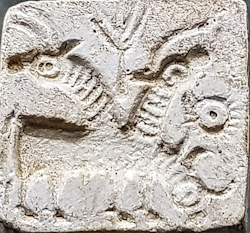
Recently, I visited the Harrapan archaeological site at Dholavira in a remote part of Gujarat close to India’s border with Pakistan. The small museum attached to the site contains several examples of the carved seals used to emboss the wet clay employed to seal close vessels. Knowing about the double-headed birds on the Mesopotamian seals, I was on the look out for similar on the seals excavated at Dholavira.
I was very excited to discove one seal that at first sight looked like a double-headed creature. It was not a bird but a four legged animal. Two heads, each on their own striped necks, faced in opposite directions just as seen in the Albanian double-headed eagle.
I showed the picture of this seal to a friend, who pointed out a third striped neck with its own head. The neck was curved downwards. If the other two heads had not been present, the creature would have resembled, say, a horse or cattle grazing.
Did the craftsman who carved this three headed animal intend it to be three headed or did he/she want to depict movement, just as can be seen on the multi limbed depictions of Hindu gods and goddesses? I cannot say, but it raises the question whether the symbolic Albanian eagle has two heads or one that moves from side to side vigilantly surveying its territory.
An afterthought.
Did Cerberus, the three or more headed dog guarding the underworld, have so many heads, or do the many heads seen in depictions of him really represent one head in frenetic motion?

Array’d on a leaf
Treats with many tastes:
A nice Indian thali
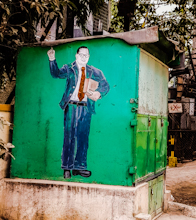
DR BR AMBEDKAR (1891-1956) was a lawyer, who drafted the Constitution of India after the country became independent. He was also a champion of the rights of dalits (‘untouchables’ or ‘harijans’ as Mahatma Gandhi called them). The dalits were excluded from the four caste Varna system of Hinduism, and considered by many Hindus as the lowest of the low, fit only for menial tasks that members of other castes would not deign to consider doing. Ambedkar campaigned actively for the ending of social discrimination against this class of people.
Mochis (cobblers/shoe repairers), who handle leather, are often dalits. The best place to find a mochi is on the pavement beside a road. Sometimes, they sit on the ground surrounded by their tools and footwear awaiting repair. In other cases, they work from little stalls that can be locked up when they are not at work. These stalls often bear images of Ambedkar in honour of the man who did much to improve the social status of the dalits.
(Image shows Ambedkar depicted on a mochi’s closed stall.)

Cross the high wall
At your own risk, boldly:
Maybe you will regret it
Some years ago, some youngsters were messing around on their motorbikes late at night on the empty Old Airport Road that passes several military compounds. When they were stopped by the police, they dismounted and scattered in all directions. One youngster leapt over a wall and into the garden of the local commander’s bungalow. When challenged by a guard, he kept running. The guard shot him dead.
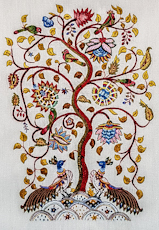 PONDICHERRY IS RICH in wonderful attractions, many of them souvenirs of its French colonial past. One of the most delightful of these is the Cluny Embroidery Centre on Rue Romain Rolland, a street named after a French writer and Nobel Prize winner who met Gandhi and was sympathetic to India and its philosophies.The Embroidery Centre is housed in an 18th century French Colonial building (a former residence, which was built by 1774) that forms part of a religious centre under the aegis of the Order of Cluny. It is believed that one of the former owners of the house donated it to help poor women in need. This must have been before 1829, when the Embroidery Centre was established. Every day except Monday and Sunday, at least twenty women of various ages arrive at the centre and take their places at tables in a large room with tall windows that open out into a verandah supported by neoclassical pillars and decorated with elaborate stucco bas-reliefs. The verandah looks out onto a courtyard surrounded on three sides by other buildings, parts of the convent, and the outer wall with a decorative entrance gate.This ensemble of buildings forms only part of a much larger complex of buildings, some of which surround another courtyard filled with a garden.After singing what sounds like a hymn, the women begin working on their elaborate embroideries. They stitch according to patterns designed by artists who work at the centre. While they work away silently with needle and thread, a simple sound system provides background music at a low volume.Dressed in white habit, Sister Agatha, who runs the convent, watches over the ladies at work and organises the sales of their labours to visitors who step into this peaceful sanctuary a few feet away from the noisy outside world.The resulting products are exquisitely beautiful. They embroider everything from coasters to handkerchiefs to napkins to pillowcases to table cloths and bedcovers. Visitors to the centre can purchase these treasures of fine needlework. Or, customers can place orders for specific items they need. The women who embroider at the centre get paid on a piecework basis. Some of them have had a history of mistreatment before joining the centre. Visiting the Cluny Embroidery Centre is a moving experience. It provides a very good example of how a religious order can work for the benefit of the ‘common’ folk.
 yamey
yamey 