Unknown's avatar

About yamey

Active author and retired dentist. You can discover my books by visiting my website www.adamyamey.co.uk .

Essential accessories


It is amazing how many things, which used to be done with two hands, are now done with only one hand. It worries me to watch a parent manoevering a child in a baby buggy off a bus or train literally single-handed, often while looking at a mobile ‘phone screen.

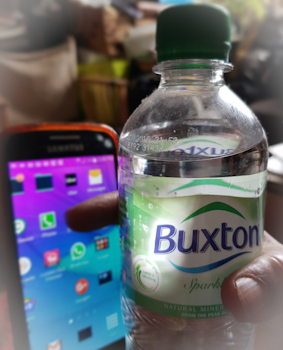
Why only one hand nowadays? The answer is simple. Many people seem incapable of going anywhere or doing anything if one hand does not hold a mobile ‘phone or maybe a bottle of water.  

Why is it necessary to be permanently attached to a ‘phone? It can be kept in a bag or pocket within easy reach thus freeing up the hand for more productive uses. 

And, what has happened to human metabolism that requires a bottle of water to be carried about? I might be old-fashioned, but several decades ago, nobody felt it essential to carry a personal water supply. Have we become more thirsty as a species, or what?

Ten places…

Big Ben_240


The Internet is full of sites listing places you must see before you die, and so on. There are also some lists of places worth missing.  All of these listings are usually subjective, as is my current list (in no particular order) of 10 or so places worth avoiding in London north of the River Thames:

1 CAMDEN TOWN

2 BRENT CROSS

3 KILBURN HIGH ROAD

4 OXFORD STREET

5 WESTFIELD AT SHEPHERDS BUSH

6 CAMDEN LOCK MARKET (OR BOROUGH MARKET)

7 PORTOBELLO ROAD ON SATURDAYS

8 COVENT GARDEN

9 KENTISH TOWN

10 WEST KENSINGTON (or KENTON)

I will not explain why any of these is on my list, and I do not expect that all of you will agree with me, but I hope that no one is offended by any of my dislikes!

Just in case this all sounds a bit negative, here is my current list (in  no particular order) of 10 or so places worth visiting in London  north of the River Thames:

1 KENWOOD HOUSE AND GARDENS

2 THE SOANE MUSEUM IN LINCOLNS INN FIELDS

3 THE VICTORIA AND ALBERT MUSEUM

4 THE BRIDGE THEATRE

5 TEMPLE CHURCH (OR ST BRIDES CHURCH)

6 LEIGHTON HOUSE

7 BRICK LANE

8 KINGS CROSS STATION CONCOURSE

9 TATE BRITAIN (but avoid eating there)

10 HIGHGATE CEMETERY (or BUNHILL FIELDS)

Poetry

Steaming_240


I have never been able to enjoy reading poetry and enjoy it. However, if it is read out aloud by someone else, I usually love what I hear.  Poetry is like music made with words.

Here is a poem that I have enjoyed ever since I was a young teenager. It is Adlestrop by Edward Thomas (1878-1917). He was killed in France during WW1. His poem captures the essence of the world that reveals itself gradually when a train stops at a small country station.


Yes. I remember Adlestrop—

The name, because one afternoon

Of heat the express-train drew up there

Unwontedly. It was late June.

The steam hissed. Someone cleared his throat.

No one left and no one came

On the bare platform. What I saw

Was Adlestrop—only the name

And willows, willow-herb, and grass,

And meadowsweet, and haycocks dry,

No whit less still and lonely fair

Than the high cloudlets in the sky.

And for that minute a blackbird sang

Close by, and round him, mistier,

Farther and farther, all the birds

Of Oxfordshire and Gloucestershire.

Do not lose it


I write a great deal on my computer. Although computers are generally reliable, they are prone to technical hiccups and even total failure. Therefore, I am in favour of following the generally accepted advice that it is a good idea, nay essential, that you save your work not only on the computer’s hard disc but also remotely from the computer.

I tend to back-up anything I don’t want to lose on USB memory sticks. However, being of a somewhat paranoid/neurotic nature, I do not place my trust in these alone. What if, for example, I lose one or one of them suddenly ceases to stop working as happened with a costly hard drive that contained almost five years of documents and photos and then suddenly ‘conked out’? To avoid this, I record everything on to two or more separate memory sticks. 

But, still I am not completely content. Although large companies like Gmail, Dropbox and Microsoft might possibly go ‘bust’ one day, this is far less likely than me losing my memory sticks or my computer giving up the ghost. So, I upload my work onto the hard-drives or ‘clouds’ of the large corporates using Dropbox, OneDrive, and various email accounts I have created, which are dedicated to storing my work.

Call me over-cautious if you like, but I don’t care. Re-writing an important letter or a several hundred page book that has been lost because it has not been securely saved is not a prospect I relish! And, nor should you!

Sounds new

Sound and science_240


Last week, I attended two concerts that showcased the works young composers studying at the Royal College of Music (‘RCM’) in Kensington, London. Most of the compositions were no longer than five minutes in duration. They were performed by musicians, vocalists and instrumentalists, also studying at the RCM.

I am not a musician, but I do enjoy classical music, both historical and contemporary. As a musically uneducated member of the audience, I was puzzled by many of the pieces that I heard. It struck me that many of the budding composers were aiming to make the performers produce extremely unusual sounds from their instruments or with their voices. It seemed to me that the compositions were written to make the performers produce the most unexpected sounds, many of them although interesting were not too pleasing to my ears and definitely atypical of the instrument making them. Tunefulness was of little or no importance in most of the pieces I heard. Many of the vocal pieces performed involved making various hissing sounds without using the vocalists’ vocal cords.  The object semmed to be to intrigue the audience rather than to please it.

Each piece, despite my misgivings, attracted generous applause. Either the audience was being kind as many in it were members of the RCM, or they really enjoyed what they heard. I could not decide which was the case.

At the end of the second concert, I wondered how the composers, whose works I had just heard, would ever be able to make a living if they continued composing such unmusical (to my ears) music as I had experienced. Well, I wish them luck.

Be reasonable

Booking

Last year, we were booking our daughter into a simple home-stay by the sea in Kerala, India. While we sat in the owner’s office, I spotted a framed certificate issued by the Booking.com website. It showed that the home-stay had earned a 9.8 out of 10 satisfaction rating. I congratulated the owner for achieving this. Sadly, he told me, the latest rating was now 9.4.

“That’s still pretty good,” I said.

“Maybe,” the owner replied, “but it keeps going down. The problem is the Indian guests who stay at my place.”

“Why?” I asked.

“When foreigners come and pay £10 per night, they know what to expect,” the owner began, “but when Indians come here they expect accomodation worth £100 even when they are only paying £10”

“The problem is,” he continued, ” that Indians arrive expecting included breakfast, a swimming pool, and other facilities, for which they would usually have to pay £100 or more. These are not available at £10 per night. So, when they write their reviews on Booking.com, they give us a low rating, which is not fair given how little they have to pay. These low ratings bring down my overall rating.”

I sympathised with the man, who then admitted:

“I would rather have no Indians staying here. I prefer the foreigners because they know what to expect of budget accommodation.”

When I stay at places that I have booked on Booking.com, I tend to be over generous with my rating unless there is something very seriously bad about the place. Also, when choosing where to stay, I am not put off by ratings of just over 6 out of 10. I have often found hotels with lowish ratings to have been under-rated because people have been over-critical about minor defects.

So, when you next rate a place you have visited, try to be fair and reasonable with your ratings.

Sailing by

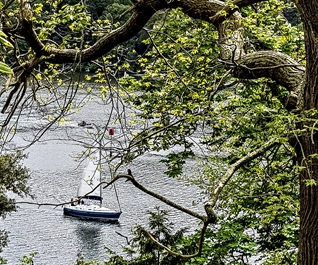
green

On the water far below

Smoothly sails a barque

View’d from up on high 


The River Dart viewed from the garden of Greenway House, which used to be the holiday retreat of author Agatha Christie from 1936 until her death in 1976.

An American in a gondola

When I was young, before I was about 17, I used to visit Venice annually with my parents. We used to stay in a pensione called ‘La Calcina’. As breakfast and one meal were included in the room price, we used to take lunch in the dining room of La Calcina. Every year, we sat with other regular visitors, whom we got to know gradually. One of them was a somewhat silent American gentleman…
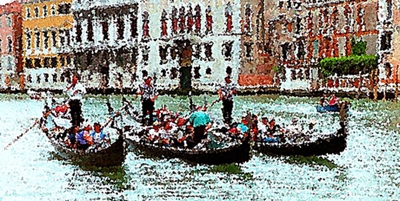
 

On the Canale Grande_500


The Calcina’s neighbour, the Pensione Il Seguso, was located on a corner where a narrow side canal met the wide Giudecca Canal. One morning, we were waiting outside the Calcina, trying to decide what to do. It was a bit later than usual, which is possibly the reason that we spotted something we had never seen before. A gondola with green upholstery and other identically coloured cloth drapes appeared from along the side canal and drew to a standstill at the corner near where we were standing. The gondolier was dressed in a livery the same colour as the upholstery and the drapes. After a short delay, the American, who used to sit silently with us at lunch, left the main entrance of the Calcina and boarded the gondola. The gondolier set his vessel in motion. His American passenger sat reading his newspaper whilst he was rowed across the Giudecca Canal. We watched them disappearing along a canal that passed through the Giudecca Island towards the wide open lagoon beyond the island. Naturally, our curiosity was aroused.

That lunch time, the American sat down in his usual place. My mother could no longer contain herself. She asked the American about what we had witnessed that morning. He explained that the gondolier was the grandson of his late mother’s personal gondolier. Whenever he visited Venice, he would hire this same grandson for the duration of his visit. Every morning, he was picked up just as we had observed, and was rowed out into the midst of the lagoon. When they arrived there, he and his gondolier exchanged roles. The American had mastered the art of rowing a gondola, and took his daily exercise by ‘gondoling’ around the lagoon for an hour or so.

The American introduced himself. My father, a knowledgable amateur historian of art, was most excited to discover that our American lunch time companion was William Milliken, a former Director of the Cleveland Museum of Art in Cleveland, Ohio, and a famous historian of mediaeval art.

Later Miss Steiner, a humourless late middle-aged Austrian who managed the Pensione Calcina, told us that Mr Milliken stayed at the Calcina every year during the month in which his mother had died. He stayed in the room that she used to occupy during her visits to the Calcina. Whilst he stayed there, Miss Steiner informed us, the room was always filled with his mother’s favourite flowers, and furnished with the very same furniture that she used to use whilst she was a guest at the pensione.


Mr Milliken died in 1978, at least ten years after I last met him. About twenty years later, I bought a second-hand copy of his book, “Unfamiliar Venice”. This wonderfully illustrated and almost poetically written book, which was published in 1967, describes the magic of Venice beautifully, but makes no mention at all of any of the things we learnt about our solitary American neighbour in the dining room of the Pensione Calcina.