Unknown's avatar

About yamey

Active author and retired dentist. You can discover my books by visiting my website www.adamyamey.co.uk .

Bachelor of Arts

booknarayan


Rasipuram Krishnaswamier (‘RK’) Iyer Narayan (1905-2001) was born in Madras (now ‘Chennai’) in southern India. He was a prolific writer of fiction and non-fiction. Many of his fictional works are set in the imaginary southern Indian town called Malgudi. Until recently when I bought a copy of “Bachelor of Arts” (first published in 1937 when India was ruled by the British), I had never read any of Narayan’s works. 

“Bachelor of Arts” is a delightful simply told tale about a young man, Chandran, whom we meet while he is completing his BA degree. We follow his life’s strangely interesting path after he graduates until he … well, I won’t give away the story. Despite the simplicity and clarity of the story telling, Narayan subtly changes the mood of the story as it progresses. I liked the way he did this. Another interesting aspect of this novel is the gentle way in which the author criticises the British imprerialistic attitude. I was also excited by the way Narayan, an Indian, portrays the ‘Indian-ness’ of his characters. As Grahame Greene wrote of Narayan in the introduction to the edition I read:

Without him I could never have known what it is like to be Indian.”

I agree wholeheartedly with what Greene wrote. I plan to read more of Narayan’s works as “Bachelor of Arts” has whetted my apetite successfully.
She sailed on a leaf

IVES


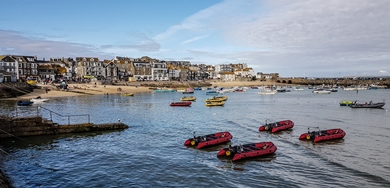
St Ives in Cornwall is one of my favourite places to visit in the UK. This charming, picturesque town straddles a shoulder of land separating two beautiful bays. One of its most endearing features is the quality of the light. The light has the same special quality as that which bathes Venice in Italy. Maybe, it is the extraordinarily light that attracted many artists to St Ives in the past and still in the present. As extraordinary as the light is, so is the story of St Ia after whom St Ives was named.

During the 5th or 6th century AD, St Ia was due to travel from Ireland to England along with several other Christian missionaries, many of whom were later to become saints. When Ia discovered that she had been left behind, she began praying and shedding tears. One of her tears fell upon a leaf floating in the sea near where she was praying. She noticed that the leaf began growing in size. It became so big that there was room for her to stand on it. Putting her trust in God, she set sail on the leaf, which carried her across the sea to Cornwall. 

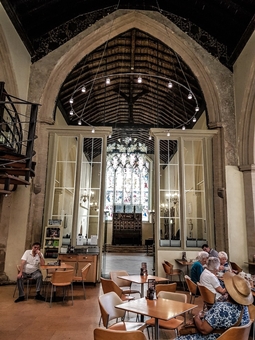
After landing in Cornwall, she set up a small oratory. Sadly, she was killed at Hayle by a local chieftain. She was buried at what is now the town of St Ives, where the main church in the town is dedicated to her memory. St Ive’s Parish Church is well worth visiting not only to contemplate St Ia but also because it is a fine example of a 15th century gothic church. The church contains many superb features including a lovely café where you can enjoy tea or coffee and home-made cakes in a peaceful environment.

Art and science

ART AND SCIENCE


From my childhood until I qualified as a dentist in 1982, aged 30, I drew and painted a great deal. Creating pictures was one of my favourite pastimes. In the late 1970s when I was already studying to become a dentist, I joined a weekly print-making class. It was held in the West Hampstead studio of my mother’s cousin, the etcher/engraver Dolf Rieser (1898-1983; see: https://dolfrieser.com/biography/ ). 

The image above is from an etching that I created in Dolf’s studio. It is a composition inspired by electron micography of intra-cellular structures. At the time I created it, I had just finished a PhD in a biological subject and was studying biology that was considered necessary to qualify as a dentist.  Interestingly, Dolf had also studied biology (genetics) in his youth, receiving a doctorate in the subject. He took to artistic pursuits after completing his studies in biology. Later in his life he wrote a book called “Art and Science” (published in 1972 by Studio Vista). Dolf was an inspiring teacher with a great understanding of compositional technique.

In 1982, I began practising as a dentist. It goes without saying that a dentist’s work involves a great deal of use of the hands and fingers. All day long, five days a week, I was doing the fiddly kind of things with my hands and fingers. Prior to qualification as a dentist, I had used my hands and fingers to create often complex images (drawings, paintings, etchings, and copper engravings). I found that my urge to create images diminished rapidly after I began practising dentistry. I suppose that the clinical activities satisfied my need to employ my manual dexterity in other ways. Sadly, now that I am retired I have not (yet) gone back to creating images. Now my fingers are kept busy at the keyboard, creating books and blog articles.

Burgers

Everyone, who eats them, can reccommend a place that serves the very best beef burgers. Naturally, most people have their own favourites. So, it would seem that there are many places that serve the ‘very best burgers’.  I havetried a few of these highly reccommended places and have with one exception (Gourmet Burger Kitchen – a chain that originated in New Zealand) been disappointed. Most ‘very best burgers’ turn out to be ok (usually) but an anti-climax (mostly).

Now, I am going to seem very conceited. That is because I believe that I make the ‘very best burgers’ myself in our home, and so should you. My recipe is dead simple. I take minced beef with a lowish fat content (10% or less), add a pinch of salt and a small spoon of oil (sunflower or olive) and, after washing my hands, mush the three ingredients together before hand shaping patties of the  sizes preferred by those who will eat them. Then, I cook them on a griddle. That’s all. No egg or breadcrumbs are added.  Try this for yourself and you will no longer be wasting your money on overpriced, mediochre burgers.


ham burger with vegetables


A patty of minced beef 

Mould-ed by hand

Enjoy burger perfection


Photo by Valeria Boltneva on Pexels.com

Memory of a great man

AMB 4


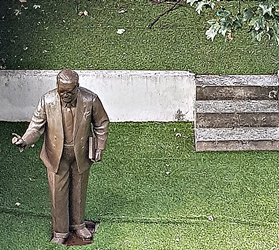
Almost wherever you go in India, you are bound to see the statue of a man wearing spectacles with round lens frames and a suit. He is always carrying a large book under his left arm. These statues depict Bhimrao Ramji Ambedkar, who was born in Mhow (now Dr Ambedkar Nagar in Madhya Pradesh) in 1891, son of an Indian army officer. He died in New Delhi in 1956. This remarkable man was a jurist, economist, politician and social reformer. He was a founding father of the Republic of India and helped formulate the Indian Constitution. He is best known for his work on promoting the rights of the ‘dalits’ (‘untouchables’) and reducing discrimination against them.

Ambedkar was awarded a doctorate by Columbia University (USA) in 1927, and another by the London School of Economics (‘LSE’) in 1922. He was called to the London Bar in 1922 as a member of Gray’s Inn. Later, he was awarded further degrees by Columbia University and Osmania University (in Hyderabad, India).

Between 1920 and 1922 while he was studying at the LSE and for the Bar, Ambedkar lived in a house at 10 King Henrys Road near Chalk Farm in north-west London. In 2015, the house was bought by the Government of Maharashtra and was then converted into a memorial to Ambedkar. It is open to the public. Visitors can learn about Ambedkar from the well-captioned photographs on the wall of the rooms that they can wander through. The upper floor contains a re-construction of Ambedkar’s bedroom including a four-poster bed, some of the great man’s books, and an old pair of spectacles, which might have belonged to him. Other rooms contain shelves of books and various memorials to Ambedkar. There is also a commemorative plaque to India’s present Prime Minister Narendra Modi, who inaugurated the memorial house in November 2015. The garden contains a typical statue of the type I have described above.

Sadly, this monument to such a great man is under threat. Some local residents have been complaining that it is annoying to have a museum amidst their overpriced bourgeois residences (see: https://www.bbc.co.uk/news/world-asia-india-49411985 ). Camden Council, in whose borough the Ambedkar house is located, are to decide on its fate at a hearing to be held in September 2019. I hope that the (racist???) objecting residents of King Henry’s Road will not be permitted to help to erase the memory of a truly great man’s stay in London.


FOR A FEW PHOTOS OF THE AMBEDKAR MEMORIAL HOUSE, CLICK HERE:

http://www.ipernity.com/doc/adam/album/1244852

Hard currency

currency

Back in 1983, I visited Bulgaria. I had been advised that it was very unwise to exchange currency in the country any other way than by using the state’s official foreign exchange desks. So, as soon as I disembarked at the railway station at Sofia, I changed some of my UK Pounds into Bulgarian Leva. Even at the official exchange rate, one Pound had a more than adequate spending power.

My friend and I took  a taxi to the city centre. When we arrived, the meter , I asked the driver how much we needed to pay. He answered:

“One Deutschmark, One Dollar, One Swiss Franc, or one Pound.”

I said that I wanted to pay in Bulgarian Leva. He said:

“Two Leva”

But, I protested:

“The meter says only one Leva”

The driver turned around and said:

“Two people: two Leva”

I repeat this true tale to emphasise how little local money was valued in comparison with so-called ‘hard currency’. Also, in a few months when the UK leaves the European Union, probably without a trade deal, the Pound, which is already sinking in value, might cease to be a hard currency. Who knows, but here in the UK we might prefer to be paid not in our own currency but in one of the harder currencies such as the US Dollar or the Euro.

A sandwich

lgbt

While looking for something to eat on the train between Cambridge and London, I spotted a sandwich in a colourful wrapping (illustrated above). It was a ‘LGBT’ sandwich containing Lettuce, Guacamole, Bacon, and Tomato. Well, the initials ‘LGBT’ usually refer to  ‘lesbian, gay, bisexual, and transgender’. The colours of the sandwich’s  wrapping are those associated with the LGBT ‘community’. 

I wondered whether M&S, the suppliers of this colourfully wrapped sandwich were:

  1. trying to appeal to LGBT customers
  2. trying to be ‘politically correct’
  3. both of the above
  4. neither 1 nor 2
  5. having a laugh at the expense of the LGBT ‘community’
  6. or, all of the above  

Who knows? I did not buy this sandwich, but selected a similar one, the BLT, which lacks guacamole.

Critics: can we trust them?

Many of us have great faith in reviews of artistic events such as film, theatre, and other performances.  Can one trust professional critics and reviewers? Do their tastes match yours? If they do not and you follow their reccommendation, you must be prepared for an anti-climax.


Auditorium_500


A rave five star review

Great expectation

Sometimes disappointment