Unknown's avatar

About yamey

Active author and retired dentist. You can discover my books by visiting my website www.adamyamey.co.uk .

Worlds apart

SOME ‘POSHER’ JEWISH people in west London tended to live around Bayswater. These prosperous members of the Jewish community arrived in Bayswater in the 19th century as the district began to be urbanised. Many of them had drifted westwards from Bloomsbury and the City (www.british-history.ac.uk/vch/middx/vol9/pp264-265). This migration placed them at an inconvenient distance from the synagogues they had been used to attending. So, in 1863, Bayswater Synagogue (at corner of Chichester Place and Harrow Road) was consecrated. This new place of worship was a branch of both the of the Great Synagogue (in the City north of Aldgate) and the New Synagogue (originally near Leadenhall Street, and then later in Great St Helens Street). Like so many Jewish buildings in mainland Europe, this synagogue was destroyed by the forces of Nazi Germany, during WW2.
New West London Synagogue

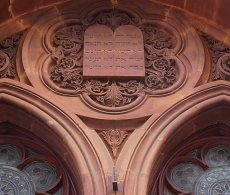
In 1879, an offshoot of the now demolished Bayswater Synagogue was consecrated in St Petersburg Place, a short distance from the main road known as Bayswater. This, The New West End Synagogue, is now one of the oldest surviving functioning synagogues in Great Britain. At first sight, you might easily be mistaken for thinking that the huge red brick building with Victorian gothic architectural features, a rose window, and twin bell towers, is a church. And maybe that was the intention of the community that commissioned the building. Upwardly mobile Jewish people in Victorian England might well have preferred not to advertise their religious beliefs too much in a society that then had many prejudices against Judaism and other non-Christian religions. The synagogue in St Petersburg Place looks no more exotic or out of place than the Church of St Matthew a few yards north on the same street. In fact, it is another building to the north of these two and within sight of them that is unashamedly exotic in appearance, Aghia Sofia, the Greek Orthodox cathedral on Moscow Road, which was consecrated only three years after the synagogue.

The desire of some Jewish people to ‘meld’ seamlessly with British ‘high society’ was not confined to England. Amos Elon writes about this in his inciteful book about the ‘emancipation’ of Jews in Germany, “The Pity of it All”, and what a dreadful fate it led to.   It is my impression that amongst the few Jewish people, mostly of British and German origin, living in Victorian South Africa, there was the belief that economic and social advancement was not hindered by being somewhat discreet about their religious beliefs. This changed during the final few decades of the 19th century when many Jewish people began arriving from parts of the former Russian Empire, many from what is now Lithuania. Often much poorer than their co-religionists, who were already well-established in South Africa, they were far less reticent about expressing their religious beliefs and critical of the ‘established’ Anglo-German Jewish community, who had, in their eyes, become rather too lax about Jewish religious observance.

Returning to Bayswater and its mainly prosperous Jewish families, we can now travel less than a mile northwest to reach the northern end of Kensington Park Road, close to Portobello Road, in nearby Notting Hill, to reach the site of another, now disused, synagogue. This building, still standing but now repurposed, was not designed to mislead the onlooker into believing it was a church.  As was the case in South Africa during the last few decades of the Victorian era, large numbers of Jewish people began arriving in London from Eastern Europe, and many of them settled in the crowded East End. In 1902, A Jewish Dispersion Committee, set up by the (Jewish) banker and philanthropist Sir Samuel Montagu (1832-1911), tried to attract some of these new arrivals to settle in areas away from the East End, like Notting Hill (www.british-history.ac.uk/vch/middx/vol1/pp149-151).

The former Notting Hill Synagogue at numbers 206/208 Kensington Park Road was opened in 1900 (www.jewishgen.org/jcr-uk/london/notting_fed/Index.htm), a little ahead of the formation of the above-mentioned committee. Presumably, it was worth opening because there must have been sufficient Jewish presence in the neighbourhood. By 1905, it had 281 members and ten years later, there were 250.  Its ritual was Ashkenazi Orthodox, the same as that at the New West End Synagogue, but the congregants were less wealthy than those who attended the latter. Many of them were market stallholders or artisans, such as tailors and shoemakers (http://www.ladbrokeassociation.info/Churchesandotherreligiousbuildings.htm#Synagogue). They lived in what were at the beginning of the 20th century far less salubrious dwellings than many of those, who worshipped in St Peterburg Place. Although I do not know for certain, I doubt there was much socialising between the Jewish communities of Bayswater and Notting Hill.

The Notting Hill Synagogue was housed in a former church hall. Its memorial stone dated the 27th of January 1900 was laid by Sir Samuel Montagu.  Although it was a discreet building externally, its interior with galleries for the women and girls was elaborate and attractive as can be seen in old photographs (www.jewishgen.org/jcr-uk/london/notting_fed/Photographs.htm). We have walked past it many times without realising it was once a place of worship until a friend told us recently about its former incarnation.

During WW2, the synagogue was severely damaged by a German bomb. It was restored and reconstructed. During the Notting Hill race riots in the late 1950’s, during the time that the fascist Oswald Mosely (1896-1980) was campaigning as a candidate in the election for the parliamentary seat of the local constituency, Kensington North, he set up his office close to the synagogue. On the 31st of January 1959, one of his supporters daubed the synagogue with the words used by the Nazis: “Juden raus”. Despite these traumatic events, the synagogue continued to thrive until the 1990s, when the size of the local Jewish population had declined.  Rabbi Pini Dunner (born 1970), who had been invited to help in performing the ritual in 1992, when the synagogue, under the leadership of its charismatic Stuart Schama, was falling into decline, wrote:

“Notting Hill Synagogue was nothing like any shul I had ever seen. The congregants consisted of a motley group of mainly octogenarian men, characters out of some East End Jewish sit-com, each with his own catchphrase, many of them not quite sure why they were there week after week.”

(https://rabbidunner.com/memories-of-stuart-schama/).

The synagogue then closed, and amalgamated with the Shepherd’s Bush, Fulham & District Synagogue. Since its closure, the synagogue has been used as a ‘health club’. Currently (March 2021), the building bears the name ‘Teresa Tarmey’, a company that supplies various treatments (www.teresatarmey.com/).

The transformation of the former synagogue into a trendy beauty salon reflects that of Notting Hill from a relatively impoverished area into a prosperous area with high property prices, which is beginning to make Bayswater seem less attractive in comparison. The synagogue in St Petersburg Place continues to thrive. One of my cousins, who lives many miles from it, told me that it was well worth travelling to because its congregation is vibrant and life-enhancing, which is good to know because the mainly residential area surrounding the synagogue is usually rather sleepy.
Hampstead, Highgate, and the Indian freedom struggle

A MOTHER OF FAMILY-planning and women’s rights, Marie Stopes (1880-1958) lived at number 14 in Hampstead’s Well Walk between 1909 and 1916. I remember seeing a plaque recording her residence in Hampstead. However, I do not recall seeing the plaque to one of her neighbours, the socialist Henry Hyndman (1842-1921) on number 14. It was only when I acquired a copy of an excellent guide to Hampstead, “Hampstead: London Hill Town” by Ian Norrie, the owner of the former Hampstead book shop, ‘High Hill Books’ and Doris Bohm that I discovered that Hyndman had lived and died in Well Walk. Hyndman, a politician, lawyer, and skilled cricketer, was initially of conservative persuasion but moved over to socialism after reading “The Communist Manifesto”, written by Karl Marx in 1848. Although anti-Semitic, he was amongst the first to promote the writings of the (Jewish) Marx in England.

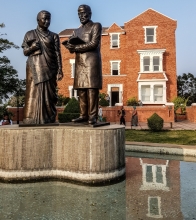
Replica of Highgate’s former India House in Mandvi, India

It is an extremely pleasant walk from Well Walk, across Hampstead Heath, Kenwood, and through Highgate village to Highgate Wood, opposite which the Indian born barrister Shyamji Krishnavarma (1857-1930) lived in self-imposed exile with his wife Banumati. Born during the year when The Indian Rebellion of 1857 (First Indian War of Independence or ‘Indian Mutiny’) commenced, it seems that it was appropriate that he was a keen promoter of India being liberated from the British Empire. Krishnavarma, in common with Hyndman, believed that it was wrong that the British should control and exploit the inhabitants of India. They corresponded and most probably met each other.

In 1905, responding to events in India such as the unpopular partition of Bengal, Krishnavarma, a wealthy man, decided it was time to do something about bringing down the British in India. He did three main things. He began publishing a virulently anti-colonial newspaper, “The Indian Sociologist”; he gave money to create scholarships for Indian graduates to study in England; he bought a large house in Cromwell Avenue, Highgate. He was also one of the founders of the Indian Home Rule Society, whose views were in stark contrast to those of the Indian National Congress, which at that time, put great faith in the supposed benevolence of the British Empire towards its Indian subjects.

The scholarships had several conditions attached. The most important of these was that the recipients had to promise that they would never ever work for, or accept posts from, the British Empire. The candidates for these scholarships were usually recommended by people in India, such as Bal Gangadhar Tilak, who were working actively to end British Rule.

Krishnavarma, recognising that many Indian students faced considerable hostility in Britain at the start of the 20th century, used the house he bought in Cromwell Avenue to create both student accommodation and a community centre, a home away from home for Indian students in England. He called the building ‘India House’, which should not be confused with the better-known India House in Aldwych, the Indian High Commission.

The grand opening of India House in Highgate was on the 1st of July 1905. The inauguration speech was given by Henry Hyndman. I do not know whether he was already living at Well Walk when he opened the student centre in Cromwell Avenue.

Soon after it opened, India House became an important centre of anti-British activity. Under Krishnavarma’s leadership, and given his anti-colonialist views, India House became of increasing interest to the British police and intelligence agencies. In 1906. Vinayak Damodar Savarkar (1883-1966), a law student and leader of a secret revolutionary society, became a recipient of one of Krishnavarma’s scholarships. He lived in India House, where he wrote a couple of anti-British books, which were banned in British India. In brief, believing in armed revolution, Savarkar became one of the most dangerously anti-British activists in Europe. When Krishnavarma and his wife shifted to Paris in 1907, Savarkar became the ‘head’ of India House. Under his watch, smuggling of arms and proscribed literature to India was carried out. He encouraged experimentation in bomb-making, and was not dismayed when one of his fellow house-mates, Madan Lal Dhingra, assassinated a top colonial official in South Kensington in 1909. The assassination led to increased police surveillance and India House, which had been opened by Hyndman, closed by 1910.

I have introduced you to this lesser-known aspect of the history of the Indian Freedom Movement for two reasons. One is to explain my delight in discovering that I must have walked many times past the house in Well Walk where Hyndman lived (and died). For me, Hyndman has assumed greater interest than his deservedly far better-known neighbour Marie Stopes. The reason for this is that about five years ago I was in the town of Mandvi in Kutch (part of India’s Gujarat State). Krishnvarma was born in Mandvi and is now commemorated there. Apart from the modest house in which he was born, there is an unexpected surprise on the edge of the town. It is a modern replica of the Victorian house in Cromwell Avenue (Highgate), which was briefly home to Krishnavarma’s India House. Seeing this extraordinary replica of the house inaugurated by Hyndman in a flat desert setting got me into researching its story. In the end, I published a book about the Indian freedom fighters in Edwardian London, “Indian Freedom Fighters in London (1905-1910)”, which explores the story I have outlined in far more detail.

[“Indian Freedom Fighters in London (1905-1910)” by Adam Yamey is available from amazon, bookdepository.com, lulu.com, and on kindle. Or specially ordered from a bookshop: ISBN 9780244270711]

Stepping on history

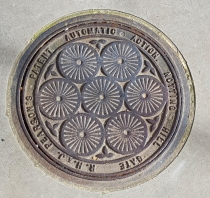
INDUSTRIAL ACTIVITY IS NOT what one would associate with present-day Notting Hill Gate in London’s Kensington district. About the only thing that is made on a large scale in the ‘Gate’ is food, which currently is only available on a take-away basis.  Yet, walking along the pavements in the area, you can see evidence that once upon a time the area was not devoid of industry. This is in the form of circular cast-iron coalhole covers. These metal discs that are almost flush with the pavement could be removed to provide an orifice through which coal could be supplied to the coal cellars beneath the pavement.  Using these holes, the coal deliverers, usually covered with coal dust, could avoid entering the house. Many stretches of pavement have been re-paved, omitting the covers, because many of the former coal cellars have been converted to usable living space. The covers that remain – and there are still plenty of them – are often covered with patterns in bas-relief and bear the names and locations of the companies that manufactured them.

I was intrigued by one company, which made many of the covers in Notting Hill Gate, ‘RH & J Pearsons’ whose covers bear the words “Automatic Action” and the information that company was in Notting Hill Gate. I wondered where their factory was in the area, which is no longer associated with trades such as casting iron coalhole covers. I thought that there would be little information about this, but I was wrong. I shall try to condense some of the sea of informative material about these metal discs, over which we walk often without noticing them.

The company Robert Henry and Jonathan Pearson, which operated between the 1840s and 1940, was located at the following places at various times:

“Nos. 141 and 143, High-street, Notting-hill, Middlesex (1871) …and 91, 95, and 97 Camden Hill Road; Iron, Steel & Metal Warehouses, 21, 22, & 23 Upper Uxbridge St.; Manufactory & Workshops, 14, Durham Place, Notting Hill Gate, W. (1879) 141, 143, 145, High Street, Notting Hill Gate, London, W. (1901)” (https://glassian.org/Prism/Pearson/index.html)

All of these places are in Notting hill Gate.

In addition to coalhole covers, the company, which described itself as ‘manufacturing and retail ironmongers’, manufactured a wide range of ironmongery for domestic use including, for example, kitchen ranges, grates, fireplaces, railings, gates. They also produced electrical fittings (for lighting and cooking) and gas fittings. In addition, they supplied a wide selection of plumbing material and sanitary appliances.

Robert Pearson lived between about 1821 and 1893. His brother Jonathan lived between about 1831 and 1898. Both died in Newcastle-on-Tyne, where they were born (https://glassian.org/Prism/Pearson/index.html). Their father, William, was a hardware manufacturer. According to the 1861 England Census, both brothers were living in Kensington. The 1871 Census entry for Robert reveals a little about the size of the firm:
“Ironmonger, Senior Partner in the firm of R. H. & J. Pearson … employing 66 men”

So, Pearson’s was a large local business.

A document published by the Royal Borough of Kensington and Chelsea gives an insight to the manufacturing of coalhole covers (‘plates’):

“Skilled artisans were employed to design and carve wooden patterns of the required shape and size. From these an endless number of moulds were produced by ramming sand around them in a box called a flask. The pattern was then removed and molten metal was poured into the cavity. Sadly many examples of Victorian cast iron work has disappeared with the exception of street furniture, in particular coal plates.”

(file:///C:/Users/adama/Downloads/07%20-%20Grouped%20Pieces%20and%20Miscellaneous.pdf).

Of Pearson’s, the document adds:

“R H & J Pearson and Sons in Notting Hill Gate was one of the largest wholesale and retail ironmongers in the area and their name appears on countless plates. Robert Henry Pearson established his business in the 1840s and by the year of his death in 1893, 200 people were employed by the firm.”

One other bit of information about Pearson’s relates to one of its employees, John Henry Mills (1880-1942), who was born in Notting Hill Gate. On the 11th of November 1895, he was ‘bound’ to Pearson’s to serve an apprenticeship for five years. By late January1899, he had already run away and enrolled with 5th Rifle Brigade (London). For committing some now unknown felony, John was discharged on the 21st of March 1899. Soon after this the Second Anglo-Boer War broke out in South Africa. John served with the Imperial Yeomanry during this conflict. After the war, his movements are unknown, but he is known to have served in WW1. After marrying in 1918, he and his wife lived in London, where by 1939, he was recorded on an official register as a “housekeeper”.  (www.bansteadhistory.com/BEECHHOLME/Beechholme%20Boer%20War/Boer_War_M.html)

Clearly, ironmongery had little appeal for young Mills.

Pearson’s made many of the coalhole covers in Notting Hill Gate, but by no means all of them. It is worth glancing occasionally at the pavement to see the variety of coalhole covers still in existence. It appears that some of these once mundane items are stolen, to be sold to collectors. Some of the stolen covers have been replaced by artistic modern covers. A good example is one with poetry on it near The Gate Cinema. Now redundant because coal is hardly used for domestic purposes in London, these metal discs are remnants of an era now fading ever further into history.

City of relief

THERE WAS ALWAYS a tin of pink coloured Isogel granules in the bathroom of my childhood home. One of my parents took a teaspoon of this daily to ensure regularity of bowel movements. An important ingredient in Isogel is psyllium husk, which is extracted from the plants Plantago ovata and Plantago psyllium. Basically, the husk is a polysaccharide gelling agent which, believe it or not, can be used to ameliorate both constipation and diarrhoea. It might also have other health promoting properties, including possible mitigation of Type 2 diabetes, and reducing cholesterol levels in the blood.

Recently, for reasons that need not be detailed here, we have taken to using psyllium husk. We did not buy Isogel, as my parents did, but a product from India called ‘Sat-Isabgol’, which my wife’s parents used in that country. This product is packed in a picturesque box that includes the company’s trademark: an old-fashioned telephone (B.G. Telephone Brand Regd.).  The box we bought recently proudly proclaims that the company is in its 80th year. According to the box, Sat-Isabgol is:

“… the upper coating of Plantago Ovata (Ispagul) which is highly purified by sieving and winnowing.”

Interesting as this is, what attracted me to the box was the fact that the Sat-Isabgol factory is in Sidhur, a place we visited in Gujarat (western India).

Sidhpur is far from being a major tourist attraction, but it is not far from the ruins of the magnificent Sun Temple at Modera, which does attract many sightseers. The main attraction in Sidhpur is a couple of streets lined with mansions decorated with ornate facades and other decorative features. These were built between the 1820s and the 1930s by a successful group of Muslim traders, members of the Dawoodi Bohra sect. The buildings incorporate many features of European neo-classical styles. Many of the houses bear their owners’ monograms in Latin lettering. The streets in this rural provincial town have a surprisingly un-Indian look about them and if it were not for cows and other animals roaming about them, it might be easy to imagine that one was not in India. While I was roaming around taking pictures, local people were extremely friendly to me. I got the impression that few Europeans visit Sidhpur. One exception was at the sad ruins of a Hindu temple, the Rudra Mahalaya, where the security guards were most unenthusiastic about seeing me with a camera. I was unable to photograph it. Constructed between 943 AD and 1140 AD, this temple is was in extremely poor condition when we saw it about two years ago. If it should ever be restored, it would make Sidhpur a fine excursion for tourists staying in Ahmedabad. I liked what I saw during our brief visit to Sidhpur, but was completely unaware that the town is home to the factory which has been producing something that has brought so much relief to people all over the world, since 1940.

He lost his head but left a river

A GROUP OF AGITATED SWANS were on a stream beneath an iron bridge. A wire mesh stretched from one bank of the waterway to the other was the cause of their frustration because some of the birds were on one side of the barrier and the rest on the other, and they had not yet discovered a way to pass the obstruction. It was distressing to watch a swan on one side pecking at the mesh trying to reach the beak of another doing the same thing on its side. The purpose of the mesh was not clear to me.

The water beneath this bridge at the northwest corner of the Waterhouse Plantation in London’s Bushy Park is flowing along the man-made Longford River. It runs from the River Colne at Longford, which is on the western edge of Heathrow Airport, to the River Thames. After being diverted into several separate channels, its waters flow into the Thames at three points near Hampton Court and Bushy Park.  On reaching the northern edge of Bushy Park it flows under the bridge where I saw the frustrated swans and then through woodland until it reaches a large triangular pool, the Waterhouse Pond. From there, its waters flow through outlets controlled by sluices into a maze of streams, which water the grounds of parts of Bushy Park. The river and the Waterhouse Pond are elevated several feet above the surrounding terrain. This allows water to escape from the river via small channels and from the pond through the sluices, which have mechanical devices with taps to control the flow. Near the Waterhouse Pond there is a tall wooden totem pole, which was designed by Norman Tait and constructed in 1992. The pole was:

“Installed to mark the connection between Canada and Bushy Park, which housed a large Canadian camp during World War l.” (www.royalparks.org.uk/media-centre/factsheets-on-the-royal-parks/monuments/monuments-in-bushy-park)

The Waterhouse Pond was a noisy place when we visited it early one morning recently. Most of the noise was being made by pairs of Canada Geese, which was rather appropriate given that they were in sight of the totem pole. The geese were craning their long necks forward and cackling loudly, their reddish tongues very visible. Nearby, occasional Egyptian Geese with their characteristic ‘eye make-up’ colouring, were furiously proclaiming something that seemed most important to them. Elsewhere in the vicinity, there was a veritable symphony of bird calls including plenty produced by green parakeets which were perched on camellia bushes, some of them pecking away at the flowers, dislodging petals one by one as they searched for something tasty. It was pleasant to be in a place that humans were completely outnumbered by birds … and squirrels.

The Longford River that supplies the water lovely features in Bushy Park did not exist prior to 1638. In that year, in accordance with the wishes of the ill-fated King Charles I, the river (really, a canal) was constructed to bring water to Hampton Court and its neighbour Bushy Park. Twelve miles in length, it took only nine months to complete. Before the twentieth century, when it acquired its present name, the waterway was known variously as: the ‘New River’, the ‘King’s River’, the ‘Queen’s River’, the ‘Cardinal’s River’, the ‘Hampton Court Cut’, and the ‘Hampton Court Canal’ (https://en.wikipedia.org/wiki/Longford_River). There is another New River in Greater London, which, like the Longford, is man-made. The other New River, which retains its original name, was built in 1613   to carry drinking water from the River Lea at Ware in Hertfordshire to reservoirs in Islington.

The part of the Longford River, which I have been describing, runs through and irrigates the Waterhouse Plantation. This and its neighbour, another plantation, the Woodland Garden, where swamp cypresses with their curious aerial outcrops may be seen, were originally planted in the early 19th century (https://historicengland.org.uk/listing/the-list/list-entry/1000281). Both areas are surrounded by fences to prevent the ingress of deer that reside in Bushy Park. They were redeveloped extensively between 1948 and 1949, and now look well-established.

After having been introduced to it by friends, who live not far away from it in Richmond, we have visited Bushy Park several times and enjoyed its variety and wildlife every time. If you are planning a visit – something I recommend highly – try to reach it early, prefer well before 10am so that you will have no difficulty parking and because at that early hour the park is reasonably empty of other visitors, many of them are dogs, which are excluded from the plantations, with their owners; joggers in expensive gear; and ‘yummy mummies’ with infants in tow or in and out of upmarket push chairs.

It was unfortunate that Charles the First lost his head, but fortunate for us that he created a waterway that makes Bushy Park so delightful today.

A quiet street in London

IT IS WONDERFUL how easy it is to escape from bustling activity on London’s main thoroughfares. Seymour Walk, a cul-de-sac leading north from London’s busy Fulham Road, is one of many such peaceful havens. In the 1860s, Seymour Walk was called ‘Seymour Terrace’. In those days it was bordered on its west side by market gardens and on its east by a line of buildings. Today, it has buildings on both sides and is entirely surrounded by land that has been built on. It is worth leaving the main road to enjoy a bit of quiet in this picturesque short street.

The small lane was built-up during the period between the 1790s and 1820s and is included in an area called Little Chelsea. Most of the terraces of houses along it appear to be from that era, but there are one or two newer constructions. The large house on the western side of the part of Seymour Walk nearest to Fulham Road is older than the other buildings. This larger house or a predecessor on the same spot might have existed as early as 1664 (www.british-history.ac.uk/survey-london/vol41/pp162-194#h2-0008). Its earliest occupant was a Dr John Whitaker, who lived there from 1666 to about 1670.  The elegant house, number 1 Seymour Walk, as we see it today looks as if it was largely built in the 18th century. Amongst its various occupants there was one, Mary Moser (1744-1819), the Royal Academician and flower painter (https://www.royalacademy.org.uk/art-artists/name/mary-moser-ra). The house became a school or academy from about 1831 to 1939.

Socially, the population of Seymour Walk was very mixed during the 19th century. Its inhabitants ranged from ‘poor’ and ‘very poor’ to the ‘better off’ amongst whom were The Reverend Elias Huelin; a jeweller; an architect; a lady doctor; and various artists.

Huelin (1786-1870), who owned several properties, was murdered in one of his homes along with his house-keeper Ann Boss. It has been recorded that:

“The murders were only discovered when a box was found in the kitchen of Reverend Huelin’s unlocked house, sitting in a pool of blood. It contained the body of the housekeeper. The police then began searching for the clergyman. He was eventually found buried in the backyard of the house he had rented to Walter Millar.” (https://www.royalparks.org.uk/parks/brompton-cemetery/explore-brompton-cemetery/elias-huelin)

Huelin was murdered by Millar during a robbery, when he was living in Paulton Square in Chelsea, but still owned property in Seymour Walk.  

Other buildings in Seymour Walk are pleasant aesthetically, but not notable architecturally or from a historical point of view. A curve near the beginning of the Walk effectively insulates most of it from the busy thoroughfare into which it leads. It was only because the road looked so attractive from Fulham Road that I decided to wander along it. It is small peaceful enclaves such as Seymour Walk that help to make London a pleasant city to live in and visit.

A grand old house in north London

THE OLD WELLS AND CAMPDEN Wash Houses stand on an elevated section of Hampstead’s Flask Walk and overlook a distinguished-looking detached house standing in its grounds surrounded by walls at the eastern end of Flask Walk. Entered through an unusual double set of wrought iron gates, this is Gardnor House, which was built in 1736. The doubling of the gates has happened since the 1960s, during which time it was a single gate (see image at: https://images.historicenglandservices.org.uk/historic-images/1960-present-day/gardnor-house-hampstead-aa071908-1339539.html)

The house was built for the successful upholsterer Thomas Gardnor (c1685-1775) opposite the stocks that were used for punishment until 1831 (Barratt, T: “The Annals of Hampstead). He and his family were responsible for the development of several streets and buildings in Hampstead (www.british-history.ac.uk/vch/middx/vol9/pp15-33). Thomas was responsible for building terraces of houses in Flask Walk and homes in what is now Gardnor’s Place. His family also:

“…enlarged their property holdings in the area to include Flask Walk, Streatley Place and parts of Heath Street, High Street and New End. The family also owned houses in Church Row on the site of Gardnor Mansions.” (https://en.wikipedia.org/wiki/Thomas_Gardnor).

In addition to his property interests, Thomas was made a trustee of the Hampstead Wells Charity, which aided the local poor, in 1761 (Barratt, T). Gardnor is believed to have died of smallpox (https://historicengland.org.uk/listing/the-list/list-entry/1067366) and was buried in the graveyard of Hampstead Parish Church, where his tomb may still be seen.

During the mid-19th century, Gardnor House was owned by a dealer in chinaware. Later that century, by which time most of the area around Flask Walk was inhabited by poor people, the grand Gardnor House was the home of an architect. Moving forward 100 years, we find that Gardnor House was the home of the authors Kingsley Amis (1922-1995) and Elizabeth Jane Howard (1923-2014). By the time they moved in, their marriage was crumbling as Joseph Conolly, owner of the former Flask Bookshop in Flask Walk, recalled (https://thecritic.co.uk/issues/november-2020/very-amis-very-hampstead/):

“…by the time they were settled in Gardnor House in Flask Walk — also Georgian, though rather smaller and with a modest garden — the gilt was beginning to chip away from the golden couple, and that deterioration was about to accelerate rather rapidly.”

 When they separated, the house was sold in 1981. On the 14th of October 2020, the house, which contains five bedrooms, five reception rooms, and four bathrooms, was sold for £11,000,000 (www.rightmove.co.uk/house-prices/detailMatching.html?prop=66871156&sale=11118685&country=england). GW Potter, a local historian,  also once lived in Gardnor House, but I do not know when that was.

The house that Thomas Gardnor built for himself is one of the larger residences within the bounds of old Hampstead. It is either evidence of his success as an upholsterer and/or as a property developer. Luckily, the house seems to be well-maintained. Many of us, who spent our childhood in or near Hampstead, bemoan it having become a more upmarket area than it used to be, but with its property values rising, the condition of many historic buildings is being well-maintained.

Accidentally killed

BROMPTON CEMETERY IS in west London. Richly populated with memorials to the dead, it is a remarkably lively place on a sunny day, being filled with walkers, cyclists, and picnickers. The bodies of people from all walks of life and from many nations lie at rest beneath the many stones in the cemetery, which was first opened in 1840. During our recent visit, I spotted two memorials to men with a military career. Each of them was particularly eye-catching.

The first of these is a pink granite slab resting on stone cannon balls made of grey granite. A pile of similar canon balls is arranged like a pyramid on top of the stone. I felt that it is a particularly fitting design for a soldier’s gravestone. One of the cannon balls is carved with the word ‘BEYROUT’ and another with ‘PORTUGAL’. This is the memorial to General Alexander Anderson (1807-1877), of the Royal Marine Light Infantry. The monument was restored in about 2016. A document relating to its restoration (https://www.rbkc.gov.uk/idoxWAM/doc/Other-1833173.pdf?extension=.pdf&id=1833173&location=Volume2&contentType=application/pdf&pageCount=1) informs that three of the cannon balls are engraved “Syria”, “Beyrout” (i.e. Beirut), and “Gaze” (i.e. Gaza). However, I photographed one bearing the word “Portugal”, which is not mentioned in the document. The monument was erected by Anderson’s friend Richard Eustace, MD, who lived from 1833 to 1908 (www.bmj.com/content/2/2490/865.2). Eustace entered the Royal Navy as a surgeon in 1854.

Anderson became a Companion of the Order of the Bath in June 1869 (www.thegazette.co.uk/London/issue/23503/page/3179/data.pdf).  His obituary in the London “Morning Post”, which shows why he was awarded this high honour, includes mention of Portugal:

“He obtained his first commission as second lieutenant in the Royal Marine Forces in May, 1823, and had during half a century seen much active service. He served with the army of occupation in Portugal, and was for some time quartered at Fort St. Julian. He served at the battle of Navarino in 1827, and at the commencement of the action boarded with his men one of the Turkish ships and captured the flag. … He served throughout the campaign on the coast of Syria in 1840-41 … was at the attack and capture of Beyrout; the bombardment and surrender of St. Jean d’Acre; the surrender of Jaffa, and was a volunteer in the expedition against Gaza. … He had received the war medal with two clasps, also the Turkish silver medal from the Sultan, and when a colonel, received the good-service pension. He became colonel-commandant in November, 1859; major-general in March, I860; lieutenant-general in November, 1866 ; and general in April, 1870.” (www.newspapers.com/newspage/396245337/)

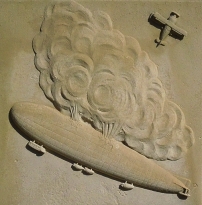
A memorial, less original in design than that of Anderson, also caught my attention with its bas-relief depicting an old-fashioned biplane heading away from a large flying zeppelin from which clouds of smoke are billowing. The grave marks the resting place of Flight-Sub-Lieutenant Reginald Alexander John Warneford (1891-1915). The stone bears the words:

“Accidentally killed 17 June 1915”

Given the year he died and his rank, it was hard to imagine what kind of accident caused him to die during a war when most fatalities were not described as ‘accidents’.

Warneford was born in Darjeeling (India), son of an engineer working for the railways in British India (https://en.wikipedia.org/wiki/Reginald_Warneford). He was educated first in England and then in Simla, back in India. His father:

“…taught him the law of the jungle; to read the moon and stars across the wide Indian night skies; to be able to study cloud formations. Rex rode on the footplates of the service engines, rode the work elephants and hunted tigers.” (http://kes1914.net/the-boys/reginald-rex-warneford-vc/ – a highly informative web page)

 At the outbreak of WW1, he joined the British Army and then was soon transferred to the Royal Naval Air Service to be trained as a pilot. He was a good student even if somewhat overconfident. Soon, he became involved in hunting down and intercepting German Zeppelin airships that were being sent to attack London and other targets in the UK.

On Sunday, the 6th of June 1915, Warneford was sent in a Morane Saulnier L monoplane to intercept the heavily armed and well-powered LZ37, a 521-foot-long German zeppelin, which had just taken off from Belgium and had got lost in the fog over the English Channel. German radio signals, intercepted by the British, discovered that the airship had been ordered to return to base. Warneford was sent out to find and attack it. He reached the airship when it was 10,000 feet over Bruges. Warneford rose to 11,000 feet and dropped six bombs onto the Zeppelin, which burst into flames. The hot air from the explosion caused Warneford’s ‘plane to go into a spin and damaged its fuel line. Warneford managed to land in a field behind enemy lines. After rapidly repairing the damage, he managed to fly back to safety, not before landing to refuel at a French base en-route. On the 8th of June, he was awarded the prestigious Victoria Cross for gallantry. Just before that, he was also awarded:

“Chevalier de la Legion D’Honneur with its automatic companion, the Croix de Guerre’ that had been recommended by General Joffre.” (http://kes1914.net/the-boys/reginald-rex-warneford-vc/).

Modestly, he told a friend that in comparison to his grandfather, who had constructed railways in India:

“Bringing down the LZ37 was just routine and over in a flash. But building a railway, that was something.”

Returning to duty after his heroic activity, Warneford’s next mission was to take a new Henry Farman F27 biplane on a test flight. He took off from Paris on the 17th of June 1915 with an American reporter as a passenger. At 2000 feet, the aircraft began to disintegrate and fall downwards. It turned upside down at 700 feet and both pilot and passenger, who were not strapped in, fell to the ground. The reporter died instantly but Warneford survived. However, he died on his way to a hospital.

Had Warneford died whilst attacking a Zeppelin or during any other military encounter, his death would not have been regarded as accidental. As his death was a consequence of an unforeseen disaster, I suppose that calling it an accident is appropriate.

These graves I have described are two of many I saw that attracted my attention. I might well describe some of the others at a later date.

Hotel Oslo

A BAR OF SOAP reminded me of our first visit to Portugal. I am looking at a small, round piece of soap sealed in a transparent package labelled “Hotel Oslo”, which we would never have acquired had I not been a victim of pick pocketers on a tram in Lisbon. We had only been in Portugal for about four hours when we took a ride on a picturesque old-fashioned tram (route 28) in the Portuguese capital. I was on the point of taking a picture of a sign that told passengers to beware of pick pocket thieves when I became one of their victims. Amongst the valuables that were stolen from me was my driving licence.

Losing the licence was a disaster as we were planning to hire a car to visit several country places in Portugal. Without the licence, the car hire company was unwilling and unable to lend me a vehicle, but it was good about refunding the money we had paid. We decided that we would attempt to carry out our plans using public transport.   

The first place on our itinerary was to have been a farmhouse in small rural place, whose name I do not remember, east of Coimbra. We travelled by train from Lisbon to Coimbra, which has two railway stations in the centre of the city. We discovered that there was a railway line from Coimbra to a spot near our planned destination. When I say “near”, it was really about half an hour’s taxi drive from where we were to stay. After lugging our baggage through the rain about 1000 yards from the station, where the Lisbon train arrived, to the other station from which we were about to depart, we ‘phoned the accommodation to which we were heading. They told us that they did not provide food, not even breakfast, and that the nearest restaurant was about half an hour’s drive from them. As we had no car and were planning to spend three days there, we began to worry how we would survive so far away from any supply of food.

Our next train was not due to depart for another two hours. I decided to walk back to the centre of Coimbra to see whether there was a hotel where we could stay instead of heading out into the ‘wild’. I rushed through the rain and found the Hotel Oslo, which had space for us and did not seem unreasonably priced. After reserving a room, I dashed back through the rain to the rest of the family, who were waiting on the platform. These were the days before we had more than one mobile ‘phone in the family, so I had to reach them to tell them about the Oslo instead of phoning them. Using our one ‘phone, we rang the rural accommodation and explained our plight. They were helpful in that they cancelled our booking gracefully and without cost.

Although not a de-luxe hotel, the Hotel Oslo was solidly built and extremely comfortable. It was located close to most of the sights in Coimbra, a place that had not been on our original itinerary. We spent four pleasant days in this delightful university city, and we were fortunate that, by chance, we were in the city at the time when the university students were starting a new academic year. By day and by night, we encountered groups of boisterous, happy students wandering about the city dressed in traditional  capes.

Had my driving licence not been stolen, I know that we would never have stayed in Coimbra and that we would have missed seeing one of the loveliest places that we have so far visited in Portugal.  As people say, every cloud has a silver lining. Although I was deprived of a lot of cash, I gained the pleasure of spending time in a wonderful place and witnessing some age-old traditions that added to our fondness of a country that we have grown to love.

The Hotel Oslo was, when we visited it, an old-fashioned style of hotel even though the 20th century building that housed it did not look archaic. Some years after staying there, we spent a couple of nights in the Hotel Mandovi in Panjim, Goa (India). This hotel had been built in 1952 by the Portuguese while they ruled Goa as a colony. It was built to coincide with the Pope’s visit to the Tenth Exposition of the relics of St Francis Xavier, which are kept in Goa. They are ceremoniously displayed once every ten years, subject to the discretion of the authorities who keep them in the Basilica of Bom Jesus in Old Goa. Although the Mandovi looks much older than the Oslo, they both have high standards of service and comfort that are old-fashioned in the best sense of the term. I am not sure whether we have kept any soap from the Mandovi as a souvenir, but you never know, one day we might find we have one lurking about somewhere in our home.

Hidden in Hyde Park

WE OFTEN CIRCUMNAVIGATE the Serpentine. Usually, when we stroll around this large body of water shared between London’s Hyde Park and Kensington Gardens, we tend to look mainly towards the water with its busy groups of waterfowl, rather than inland away from the water. Today, in the last week of February 2021, we walked around the Serpentine yet again but this time as we rounded its westernmost end and began heading back along the northern shore, we noticed for the first time a clump of trees within which there is a group of buildings.

Sheep trough in Hyde Park

A wide path leads north from the water towards these buildings, first passing the small single storey Serpentine Lodge, which being close to the lakeshore footpath, I had noticed many times before. It was built in 1839 and was home to various officials connected with the park including the Head Park Constable Joseph Smith (1811-late 1880s), who was living there by 1871 and remained there until his death (https://ifthosewallscouldtalk.wordpress.com/2016/05/31/hidden-histories-serpentine-lodge-hyde-park-london/).  The lodge is now a private residence.  

Moving inland past the lodge, we soon reach an elegant brick-built two storey house with a triple bay on each side of the centrally located front door. This is the Ranger’s Lodge, which was built in 1831/2. It houses the park’s administrative offices. Attractive because of its age and lovely setting, it is not distinguished architecturally.  It stands next to a newer and far more elegant building, The Old Police Station. When I saw the chimney stacks which are built with layers of brick alternating with layers of white stone and the windows framed with white masonry, I was immediately reminded of the former police station and courthouse that stands on Rosslyn Hill in Hampstead. Both police stations, the one in the park (built 1900-02) and that in Hampstead (1912), were designed by the same architect, John Dixon Butler (1860-1920), who designed almost 200 police stations. Two police officers on horses told us that in the yard behind the station, there are stables for the horses of the Park Police.  The police station bears a memorial to Jack William Avery (1911-1940), a war reserve Metropolitan Police Constable, who was murdered near the station on the 5th of July 1940. He was stabbed to death by a homeless labourer named Frank Cobbett (https://en.wikipedia.org/wiki/Death_of_Jack_Avery). It was only in 2007 that the memorial plaque was placed in the park.

New Lodge, a large Victorian villa with at least three storeys, built in 1876, now a private residence, stands a few yards north of the police station. This lodge as well as others in the park, like Serpentine Lodge, can be leased from the Royal Parks as dwellings by private individuals and their families.  A footpath leads northwest from between the police station and New Lodge and soon passes a disused water pump enclosed within a square area delineated by iron railings. A few feet north of the pump, there is what looks like a large bath next to a vertical pipe that might have once provided water. The map of the park describes these two items as “old sheep trough and water pump”. The bath-like object was the trough and is marked as such on a detailed map surveyed in 1862-6. This map also marks a small “fire engine house”, which no longer exists.

Another structure that no longer stands is a few yards west of Serpentine Lodge. It is commemorated by a stone lying in the grass. The stone bears an inscription that says that it marks the spot where there once stood the ‘Receiving House of the Royal Humane Society’. It had been erected on land granted by The Crown in 1774 and was severely damaged by a bomb during WW2. Its story and that of other receiving houses is related in an interesting article I found on the Internet (https://ifthosewallscouldtalk.wordpress.com/2016/05/31/hidden-histories-serpentine-lodge-hyde-park-london/):

“In 1774 two London doctors, William Hawes and Thomas Cogan, formed the ‘Society for the Recovery of Persons Apparently Drowned’ which later grew into The Royal Humane Society. The society was founded based on the doctors’ fears that people could be mistakenly taken for dead and thereby accidentally buried alive.

To combat this, a number of Receiving Houses were built along waterways in Westminster in the early nineteenth century. The Receiving Houses were designed as places where people could be taken into if they had gotten into difficulty in the water. A Receiving House was built in 1794 on the edge of the Serpentine…”

Judging by what is marked on a detailed map surveyed in 1914, the receiving house covered a considerably larger area than its neighbour, Serpentine Lodge.

Near to the marker for the former receiving house, there is an ugly black metal drinking fountain, marked on the park map as “Lutyens drinking fountain”. This was one of several similar fountains designed in 1950 by “Messrs Lutyens & Greenwood” (http://mdfcta.co.uk/fountains_lutyens.html). As the architect of New Delhi and Hampstead Garden Suburb, Edwin Lutyens, died in 1944, I imagine that the Lutyens who designed this ugly object might well have been his son Robert Lutyens (1901-1972), who published a book with his co-author Harold Greenwood in 1948.

The ugly drinking fountain no longer works. So, if you are thirsty having searched the hidden items that were new to us as described above, help is at hand a little further west, where there is an attractive modern wood-clad café kiosk, one of several of these designed trecently by the Mizzi Studio’s architects (www.floornature.com/).