An abbey no more: slavery and sightseeing

ENTIRELY JUSTIFIABLE FURORE over recent unlawful police killings of Afro-American citizens in the USA has heightened awareness of the history of unjust treatment of ‘people of colour’ under colonialism and slavery during years long passed. It was only after enjoying an afternoon in the lovely gardens of Anglesey Abbey near the city of Cambridge that I learned that this delightful place was once owned by someone whose fortune was at least partially derived from  exploitation of India and elsewhere by the East India Company. But first some history of the house, whose gardens we enjoyed despite the rain and gloomy grey late October skies.

Between 1536 and 1541, King Henry VIII disbanded the monasteries, abbeys, and other religious institutions in England. One of these was an Augustinian priory established near Cambridge by Richard de Clare in 1212. This was originally founded as the Hospital of St Mary during the reign of Henry I (that is between 1100 and 1135). The site of this religious establishment became the property of John Hynde, an important judge, who died in 1550. The religious buildings having been largely demolished, the next owner of the place, the Fowkes family who acquired it in 1595, built a Jacobean style house where the priory used to stand. The house incorporated some of the remains of the disbanded priory and abbey.

Later, the house became the property of Thomas Hobson (1544-1631), a Cambridge carrier from whose name the expression ‘Hobson’s choice’ is derived. Hobson maintained a profitable livery stable in Cambridge as well as arranging the carriage of mail between London and Cambridge. ‘Hobson’s choice’, a name derived after Hobson’s death is essentially the choice between ‘take it (i.e. the one thing on offer) or leave it’. Hobson’s son-in-law Thomas Parker and some of his descendants owned Anglesey Abbey (as the property became known). Later, the Member of Parliament for Malmesbury and then Cambridge, Samuel Shepheard (1677-1748), became owner from 1739. We will return to him later.

In 1848, the Reverend John Hailstone (1759-1847), an important geologist, a member of the Linnean Society as well as the Royal Society, bought Anglesey Abbey. He carried out many restorations and planted many trees in the Abbey’s extensive gardens, which we can enjoy today. Jumping ahead, in 1926, two brothers, Urban Huttleston Broughton (later ‘1st Baron Fairhaven’) and Henry Rogers Broughton, bought the property. They made improvements to the house, enhanced their collections of artworks, and developed the gardens. Henry moved out in 1932, leaving Anglesey Abbey to his older brother Urban, then Lord Fairhaven. Urban built a library to store his ever-growing collections of art works and books and restored the working Lode Mill on his property. When Lord Fairhaven died in 1966, the property was bequeathed to the National Trust. Sadly, because of the current covid19 crisis, we were not allowed to enter the lovely house to view his collection.

Between 1717 and 1720, Samuel Shepheard, an early owner of Anglesey Abbey, was involved with the East India Company (founded 1600 during the reign of Queen Elizabeth I). He was elected a director in 1718. His father, Samuel Shepheard (c1648-1719), was one of the so-called ‘interlopers’ who used political connections set up The New East India Company in 1691. So, not much has changed in connection with the overlap of political influence and commercial interests since then! The ‘New’ company thrived alongside the older one for a few years before the two companies merged (https://www.nber.org/system/files/working_papers/w21536/w21536.pdf). Samuel’s father tried to involve his son in the promotion of the New East India Company and is alleged to have been involved in irregularities connected with his son’s political advancement (www.historyofparliamentonline.org/volume/1690-1715/member/shepheard-samuel-ii-1677-1748). The on-line History of Parliament website includes the following about Samuel (junior):

“Concern for trade, and in particular his father’s commercial interests, suggest that he, rather than James Sheppard, twice acted as teller in that session: in favour of engrossing a bill to open up commerce with Africa; and in support of the second reading of a clause for a bill to encourage the tobacco trade.”

As for the former owner of Anglesey Abbey’s connection with India:

“Although serving as a director of the East India Company under George I, he did not seek advancement in the City, preferring the lifestyle of the country gentleman. The establishment of a residence at Exning probably reflected his association with the Cotton family, who were lords of the manor there.”

He became extremely wealthy:

“Dying ‘vastly rich’, he left the bulk of his estate to his natural daughter, who was celebrated as ‘the greatest fortune in England’, and subsequently married Charles Ingram, the future 9th Viscount Irvine.”

Exning is about six and a half miles north-east of Anglesey Abbey. Although Shepheard owned the Abbey, it is unlikely that he resided there as much as in Exning.

Samuel Shepheard was, as already mentioned, a director of the East India Company between 1718 (possibly 1717) and 1720. During that time, the company appears to have been, if not actually involved in, certainly interested in transporting slaves from Madagascar to North America in 1720 (“The William and Mary Quarterly”, Vol. 26, No. 4, pp. 548-577). To what extent Samuel Shepheard and his father were involved in the slave trade remains unclear. The National Trust are also somewhat opaque on this subject as their report (https://nt.global.ssl.fastly.net/documents/colionialism-and-historic-slavery-report.pdf) reveals:

“Shepheard was a wealthy merchant and Cambridgeshire Member of Parliament (MP) who served as director of the new East India Company and headed the South Sea Company. His father, Samuel Shepheard senior (c.1648–1719), was also an MP and merchant, building the family fortune on overseas trade. He was a founder member of the new East India Company and the South Sea Company, where he held the office of deputy-governor from 1713.”

Does the term ‘overseas trade’ include slavery? While we can not be certain whether or not either Samuel Junior or his father were involved in the slave trade, there is little doubt that the East India Company was not averse to it and might well have profited from it (see, for example: www.journals.uchicago.edu/doi/abs/10.2307/2715359?journalCode=jnh and https://aquila.usm.edu/cgi/viewcontent.cgi?article=1153&context=slisconnecting ), certainly in Africa and maybe also in the Indian subcontinent.

Should we let our enjoyment of Anglesey Abbey be disturbed by the knowledge that for a brief period of its existence it was owned by someone, who was involved in a company that ‘plundered’ India and was involved in the slave trade? By stating that Shepheard “… built the family fortune on overseas trade” to quote the National Trust in its report, which was triggered by the recent formation of the ‘Black Lives Matter’ movement, we can get no closer to ascertaining whether we should have a bad conscience about visiting the lovely gardens of Anglesey Abbey or should simply enjoy the experience without being concerned with an ill-defined unsavoury part of its history. After all, as far as we know, neither of the Shepheards, father and son, can yet be tarred with the same brush as, for example, the disgraced Bristol slave-trader Edward Colston (1636-1721), whose lifespan overlapped those of the two Samuel Shepheards. And, furthermore, unlike some other stately homes whose fame is largely due to fortunes made by persons involved in slavery, Anglesey Abbey is not one of them. If anything, the glory and splendour of this house and gardens in Cambridgeshire is due mainly to the efforts of men who owned it many, many years after Samuel Shepheard Junior died.

With the Mormons

IN JANUARY1995, we drove from Phoenix (Arizona) to San Diego (California) via Yuma (Arizona). Between Yuma and our destination, we traversed the Anza-Borrego Desert east of San Diego. We made a detour to see Box Canyon in that area. After we had finally arrived in San Diego, we had an interesting experience.

Box Canyon

On our way to San Diego, we stopped in the desert at a couple of roadside information signs placed overlooking a rough track in a chasm beneath the road along which we were driving. This was part of the road along which migrants from the eastern part of the USA made their way by foot, on horseback, or in wagons, to the ‘promised’ land of California. According to the sign beside the road, in 1825 Lieutenant Santiago Arguello of the San Diego Presidio (1791-1862), a Spaniard, discovered this pass through the mountains whilst chasing horse thieves. Later, the American frontiersman Kit Carson (1809-1868), the US General Kearny (1794-1848), and gold-seekers, travelled along the route Arguello had discovered. By 1847, a road suitable for wagons had been built through the chasm by members of The Mormon Battalion. Commanded by Lieutenant-Colonel Philip St George Cooke (1809-1895), these hardy men used hand tools to prepare the thoroughfare.

The Mormon Battalion, which existed in the 1840s, was the only US battalion ever to consist solely of members of one particular religious group. All the members were volunteers and they helped to open up the Southwest of what was to become part of the USA. Apart from being involved in various battles, they also constructed the road, whose remnants we saw on our way to San Diego.

Soon after our arrival in San Diego, we stumbled upon a building related to what we had seen at Box Canyon. It was The San Diego Mormon Battalion Historic Site. Having just seen the result of Battalion’s heroic feat of labour, we felt compelled to enter the building. We were greeted amicably and warmly by an Elder, who was immaculately dressed in formal attire. Politely, he asked us if we would like to see the diorama that explained the history of the battalion and its role in opening up the west. We wanted to see this and were led into a room with chairs set out as in an auditorium in front of a large diorama.

The lights were dimmed and then our host explained what was depicted in the diorama as different parts of it were illuminated one after another. He told us the history, the details of which I cannot recall. After the ‘show’ was over, the lights went up and the Elder asked us politely whether we would like to see something else, rather special. We were game for that and he led us into a neighbouring room.

Our host invited us to sit in comfortable chairs in front of a large pair of curtains just like those hiding a theatre’s stage. Then, he pressed a button on the wall and the curtains began to part slowly and silently. They opened to reveal a huge painting in pale shades depicting a religious scene showing Jesus in heaven surrounded by pink clouds and light-skinned angels. Proudly, he informed us:

“This is a genu-wine oil painting all the way from Salt Lake City.”

After we had made politely appreciative remarks, he said to us:

“Now, if you have a moment, I would like to show you something else.”

My wife was against this, but my curiosity was fired up. He led us to another room, which contained glass display cases. They contained metal plates covered with illegible writing. Our host explained:

“Here are the tablets that our founder Joseph Smith discovered back in 1823”

Joseph Smith (1805-1844) was the founder of the Mormon religion. In 1823, so the Mormons believe, an angel directed Smith to a spot where he discovered the gold plates on which the texts of The Book of Mormon were inscribed. Our guide in San Diego was quick to explain that (unlike the oil painting we had just seen) these plates in San Diego were faithful copies of the originals, which after Smith had transcribed them, were re-buried and never seen again.

When I expressed my genuine interest in what we had been shown, the Elder offered to show us even more but my wife, who was beginning to worry that I might be about to be converted to Mormonism, said that we had to leave as we were running out of time. There was no fear of my adopting a new religion, but I was interested to know what further delights were on offer. Our host asked us where we were from, and we told him: London. He said:

“Leave me your address and I can arrange for someone to get in touch with you at home in London.”

My wife said:

“Thank you, give us your address and we can contact you.”

And with that, we exchanged polite farewells with our Elder.

My apparent interest in what we had been shown reminded my wife of her father, whom I grew to know well. Like me, he was interested in a variety of things. Once, he and I attended a trade exhibition in Bangalore (India), where he lived. We approached a stall promoting the sale of concrete beams used for constructing large buildings. Daddy engaged the representatives in conversation, asking many of the sensible questions that builders might well ask. The ‘reps’ answered enthusiastically and informatively. As this proceeded, I began to get worried that Daddy was about to buy a concrete beam for which he had no need at all. Just when he reached the point that both the reps and I expected him to write out a cheque, he shook their hands and thanked them politely before moving on to another stall.  

When we were in San Diego, I had not yet got to know of Daddy’s behaviour as described above and wondered why my wife had become so concerned at the Mormon institution. After years of accompanying my delightful father-in-law to many trade fairs and exhibitions, I now understand the cause for her concern.

Burgers and the Parthenon

THE HARD ROCK CAFÉ at 150 Old Park Lane in central London opened its doors to customers in June 1971. It has been a popular eatery and tourist attraction ever since then. Often, a queue of hungry customers can be seen at its doors. I ate an enjoyable meal there once soon after it opened. I was then an undergraduate at University College London. Since then, I have not entered this place again. Some years ago, when the Hard Rock Café opened a branch in what had been the Tract and Bible Society bookstore in St Marks Road in Bangalore (India) in 2007, we had an indifferent meal there under the watchful eyes of a huge poster portrait of the singer Tina Turner.

Few of the customers of the Old Park Lane branch of this American-style diner in Old Park Lane are likely to have raised their heads to see what is above the eatery. It is worth doing so to see the:

“Bracketed cornice over 5th floor, shaped gable end to attic storeys finished off by giant broken segmental pediment with green brick banding and figure sculpture crowned by ornamental obelisk-finial.” (https://historicengland.org.uk/listing/the-list/list-entry/1266274).

This green (and white brick) banding gives the building an eye-catching appearance. There is a crest between the two large bow windows on the fourth (American fifth) floor. This shield with three chevrons and ten circles bears the date ‘1907’.

The building, 149-150 Old Park Lane, was built in 1904 to the designs of the architects Thomas Edward Colcutt (1840-1924) and Stanley Hamp (1877-1968), who worked together as a partnership.  So far, so good, but what was the building used for when it was built and why did it deserve such an elaborate and unusual pediment? Various descriptions of its architecture describe that it consists of ‘flats and chambers’ above ‘a former showroom, now restaurant’. One source (www.foodepedia.co.uk/restaurant-reviews/2010/nov/hard_rock_cafe.htm) states that the Hard Rock is situated inside a former Rolls Royce showroom. This is confirmed by Anthony Knight, who wrote (on a restaurant development website):

“Two shaggy-haired Americans living in London were fed up with the fact they couldn’t find US-style burgers in the capital so they started a small burger joint in a Rolls-Royce dealership. In 1973 they hosted their first live gig, with the singer none other than Paul McCartney” (www.elliottsagency.com/opinion/greateststories/).

The brand name ‘Rolls Royce’ has been used since 1906. The building at 150 Old Park Lane was constructed two years earlier. I have not been able to ascertain when the luxury car company first opened their show room in the current premises of Hard Rock Café.

Looking up at the pediment, there is a sculpture of a kneeling muscular man supporting a sort of obelisk on which there are interlinked letters, which look like ‘D’, ‘J’, and lower-case ‘l’. What this stands for remains a mystery to me. However, the crest mentioned above, is identical to that on the coat-of-arms of the city of Gloucester (www.british-history.ac.uk/vch/glos/vol4/pp368-371). This is appropriate as the building is known as ‘Gloucester House’.

The building housing the Hard Rock Café is not the first edifice on this plot to have been named ‘Gloucester House’. According to the authoritative book edited by Ben Weinreb and Christopher Hibbert, “The London Encyclopaedia”, the first Gloucester House, which like the present burger joint was located on the west corner of Old Park Lane and Piccadilly, was constructed in the early years of the reign of King George III (he was on the throne from 1760 to 1820). It was in this building that Lord Elgin (1766-1841) first exhibited the marble fragments that he had removed from the Parthenon in Athens. They were displayed here, where today burgers and milkshakes are consumed, before he sold the marbles to the nation in 1816. That year, Gloucester House was purchased by William Frederick, Duke of Gloucester (1776-1834), who despite being nicknamed ‘Silly Billy’ became Chancellor of Cambridge University. The last owner of the house was George, 2nd Duke of Cambridge, who died in 1904. Soon after his death, the old house was demolished. It seems that its successor, the present Gloucester House, was built almost as soon as the old one was demolished.

In 1850, when the old Gloucester House was still in existence, Peter Cunningham wrote in his “Handbook of London” (published in 1850):

“At the Duchess of Gloucester’s, at the corner of Park-Lane, once Lord Elgin’s, and where the Elgin Marbles were placed on their first arrival in this country, is a very beautiful carpet in sixty squares, worked by sixty of the principal ladies among the aristocracy.”

At that time, William Frederick’s widow, Princess Mary, Duchess of Gloucester and Edinburgh (1776-1857), who was born in Buckingham Palace, was residing at the house. After her death, the house was sold to its last owner.

It occurred to me that quite accidentally the Hard Rock Café with its main entrance on Piccadilly is aptly named given that it is located where some ‘rocks’ that occasionally give the British Government a hard time, The Elgin Marbles, were once housed.  What gives the precious ancient marbles a sort of hardness is that from time to time the Greek Government wants to have them back in Athens. So, next time you bite into a burger at Hard Rock in Gloucester House, spare a thought for the Greeks who have lost their marbles.

Almost but not quite nude

IN THE EARLY 1980s, I travelled to the island of Mljet, which is off the Dalmatian coast of what was then Yugoslavia. It was notable for at least two features. One was that most of the island was out of bounds to motorised traffic. The other was that nudism was both tolerated and encouraged.

I had been introduced to nude bathing a year or two earlier when I visited Dubrovnik with some friends from Belgrade. We used to take a ferry from the city to the nearby island of Lokrum. At the island’s ferry station there was a sign. One arrow pointed to the ‘nudismo’ beach and the other to the ‘ne nudismo’ beach. The first time we headed for the nudismo beach, I expressed concern about my modesty. One of my Yugoslav friends told me:

“Don’t worry, there’s always someone on the beach who looks worse than you.”

Surprisingly, these words reassured me.

Our party on Mljet included four people from the British Isles, including me, and three Yugoslavs. One of us Brits and the Yugoslavs were well-versed in nude bathing, but two of us ‘Brits’, including me. were relative novices.

Recently, my wife and I visited the gardens of Anglesey Abbey in Cambridgeshire. This lovely place is home to several outdoor sculptures. One of these is a naked youth carved in white stone. Someone, most probably a visitor, had placed a pair of sunglasses on the sculpture, rendering the youth no longer fully nude. Seeing this reminded me of our holiday in Mljet.

My friend from London and I joined in the nudity that was expected on Mljet, maybe a little anxiously at first but we soon got to enjoy it. After a few days on the island, one of my Yugoslav friends pointed out that unlike the rest of our party, neither of us ‘novices’ were ever completely nude. Either we wore only a sun hat, or a wristwatch, or even just a pair of sunglasses like the statue at Anglesey Abbey.

It is odd what can trigger far-off memories. That statue with the sunglasses did manage to remind me of the wonderful times I spent in Yugoslavia, a country that no longer exists.

Melting moments

IN THE EARLY 1990s, I was invited to a wedding in central Italy. Although I could have flown or driven to Italy, I decided to travel by train and ferry (the Channel Tunnel had not yet been opened for use). In my bachelor days, I was not a careful packer. I used to stuff my clothes and other belongings into a rucksack in a disorderly way. I was puzzled about what to do with my smart suit that I planned to wear at the marriage ceremony. I was concerned that it would become badly creased whilst stuffed in my rucksack. I consulted one of my female colleagues at the dental practice in Kent, where I was working at the time. She gave me some useful advice that did not include asking the hotel to iron it for me.

Photo by Pixabay on Pexels.com

On my way to Italy I stopped for a few days to visit some good friends who lived in Basel in Switzerland. They lived near to the terminus of a tram line that ran from the French Border, close to my friends’ flat, across the Swiss city to the German border. Although they no longer live in Basel, we now have other friends who live at the end of the same tram line, but close to the German border. Getting back to the early 1990s, I spent an enjoyable time in Basel. Before leaving, I bought an immoderate number of large bars of Swiss chocolate. My rather unhealthy plan was to take this chocolate to Italy and then after the wedding festivities were over, I would spend many happy hours eating obscene amounts of Swiss chocolate on the train while travelling back to the French coast. It seemed like a splendid plan at the time.

I arrived at the hotel in the Italian city where the wedding was to take place. As I was not yet trained to hang my clothes in wardrobes, I left my full rucksack on the floor for the duration of my stay.  Following my colleague’s advice, I extracted my creased jacket and trousers from my ruck sack, put them on hangers, and hung them in the room’s attached bathroom. Following the instructions I had been given in Kent, I turned on the hot water and closed the bathroom door so that the bathroom filled with steam from the hot water, and then I went out for some hours. On my return, the suit looked respectable enough to wear after its steaming.

The wedding festivities stretched enjoyably over three days. On each day, I attended meals in restaurants and the marriage ceremony in a municipal office. We all ate well and drunk fine Italian wines. As the saying goes, ‘a good time was had by all’.

At the end of my stay, I crammed everything into the rucksack lying on the floor of the hotel room, and then made my way to the city’s station. I boarded a train heading north through Italy towards Switzerland and then Paris, where I had to travel between the Gare de l’Est and the Gare du Nord, from where trains to Calais departed.

As my train headed across the plain of the River Po south of Milan, I began to feel the urge to make inroads into my stash of Swiss chocolate bars, which at that moment I treasured as if they were bars of gold. I opened my rucksack in which they had been stored while I was staying in the hotel in Italy, my heart sunk, and I was filled with gloom. No, they had not been stolen. Far worse, they were still there but completely and utterly inedible. Each bar of chocolate had melted and then re-solidified. However, when they had been in a molten state, they had been distorted in such a way that the silver foil in which they had been wrapped by the manufacturers had become intimately intermingled with the chocolate. After it had cooled down and solidified, all of my chocolates were welded to the silver foil in such a way that it was impossible to separate what was potentially edible from the inedible distorted strata of foil running through the chocolate. What had happened, you might well wonder. Well, there had not been a heatwave during my stay in the Italian city. What I had not realised when I was staying in the hotel was that my hotel room had under floor heating and it was this that had been warming my rucksack filled with chocolate that had been lying on the warm floor for several days.

Looking back on this after so many years, it was probably a good thing that I had not been able to consume a huge amount of chocolate all in one binge, but this is not what went through my mind at the time.

Brighton and the Alps

‘PIERRE’ IS A FRIEND of my father.  He and his American wife Bobbie lived on the outskirts of Paris with their lively intelligent children. I went to stay with them over Christmas when I was about 16. After a rough crossing of the English Channel and a long train journey, I arrived at the station near where they lived. Pierre met me there and whilst driving me home told me that he had a high temperature. He disappeared leaving me at the front door, where the family’s unruly dog wrapped his jaws around one of my wrists.

Bobbie greeted me, and then took me into the kitchen. I was tired and completely unprepared for what I was to experience. The work surfaces in Bobbie’s kitchen were higher than my shoulders. I felt as if I had shrunk. I wondered whether the rough sea voyage had affected me in some strange way. But this was not the case. Bobbie, who was tall, explained to me that she had had the kitchen constructed in such a way that she would not need to bend her back whilst working in it. My hands could hardly reach the work surfaces, but her energetic children had no difficulty; they climbed up onto them and ran along them with great agility. As Bobbie showed me around the rest of the house, we passed a bedroom where Pierre was shivering feverishly in bed under his sheets and blankets. I wondered whether he was going to be fit enough to embark on the trip to the French Alps that we were supposed to be making on the next day.

On the day after I arrived, Pierre was still extremely unwell. A doctor visited him that morning and gave him some medicine. At 3 pm that late December day, we decided to set off on our more than 400-mile journey. The journey began badly. After driving a few miles along an autoroute, Pierre realised that we were on the wrong motorway. We drove in reverse at hair-raising speed back along the way we had come until we reached the motorway junction where we had chosen the incorrect road, and then we joined the correct highway. At about midnight, we stopped for dinner at a motorway restaurant near to Bourg-en-Bresse. Then, we drove upwards into the Alps.

After passing through Albertville at about 2 am, we drew near to our destination Méribel-les-Allues. Then, we lost our way. The place to which we were heading was one of several settlements that made up the locality known as Méribel. By now, Pierre, who was driving and still unwell, was becoming exhausted. He and Bobbie began arguing. The children were fast asleep. As we drove around aimlessly along the dark winding snow lined alpine roads, I realised that we were going around in circles. However, I did not want to risk my hosts’ ire by suggesting this. After a little thought, I volunteered as tactfully as possible:

I believe that when we go around this bend, we will pass the Hotel de La Poste again.”

And, sure enough, we did. My hosts realised that we were in fact going around and around the same roads, and soon after that, we reached our destination at last. It was a holiday colony owned by the ministry for which Pierre worked.

I was accommodated in a dormitory for young men and my friends shared a family room. The place where we were staying was for the exclusive use of employees of the ministry and their close families. So, soon after I arrived, some of the others in my dormitory asked me why I spoke English rather than French and also why the woman with whom I dined and spent time spoke ‘American’.  Atypically for me, I rapidly improvised an answer that seemed to satisfy them. I told them that Bobbie was my aunt from Canada and that she spoke both French and ‘American’.

Some years later, Bobbie came to visit us in my parents’ home in London. It was a hot summer’s evening. She was expected to join us for dinner at a particular time but arrived about an hour and a half late. When my mother went to open the front door for her, we all heard a long sigh and then we could hear Bobbie asking whether she could use my parents’ bedroom before joining us. When she arrived at the table, she presented my mother with a gift from Paris. It was a box of instant soup powder. The sachet containing the powder had been torn open.  Bobbie explained that she had opened it to check whether it contained exactly what she wanted to give us. Then, she apologised to my mother for losing the other gift that she had brought for her.

She told us that to avoid injuring her bad back by carrying heavy baggage she had worn all of the clothes that she was going to need for her short stay in England, wearing layer upon layer. While she was travelling on the Underground to reach our home, she had begun to feel unbearably hot. So, she un-wrapped my mother’s other present, a bottle of perfume spray with a bulb for pumping it. At this point I must tell you that, at the time, London was the target of many IRA bombs, and the public had been told to be vigilant. So, when the passengers sitting near to Bobbie saw what looked a bit like a hand grenade, the squeezable bulb attached to the perfume bottle, they moved away from her. She told us that seeing this, she panicked and threw the perfume spray away from her, and it had broken on the floor.

After dinner that evening, she and I set off in a car, which she had been lent. It belonged to a man whom she had asked us to invite for dinner with her that evening. He drove us to where he lived in London and left us his car. Then, Bobbie began driving the two of us towards Brighton, where the rest of her family were staying in a borrowed house. As soon as we got onto the motorway just south of London, we were engulfed in dense fog. It was then that Bobbie admitted that she was wearing the wrong glasses for driving. It was after midnight and I had not yet learnt to drive. So, I was unable to take over the driving. She asked me to keep an eye out for the line on the left side of the carriageway, and to tell her whenever we began to stray from it. Fortunately, when we reached Brighton, the fog had lifted, and we arrived at our destination intact.

I have lost touch with Bobbie and her family, whose identity I hope has been disguised adequately, but I still remember them fondly and should they recognise themselves, I hope that they will not mind me relating these memories of the many good times I enjoyed with them.

Sun and snow in Arizona

BEFORE WE DEPARTED for the USA in January 1995, three months before the expected due date of the baby, who was in my wife’s womb, we consulted our obstetrician. We wanted to know whether it would be safe for my wife, Lopa, to travel at this point in the pregnancy. Our obstetrician saw no reason why we should not make the trip but warned us:

“Make sure you have good travel insurance because a premature birth in the States will bankrupt you.”

We spent much of January 1995 driving around California and neighbouring Arizona. What we had not expected was the weather. We had wanted to visit Death Valley but were advised against it, not because of the heat but because of the bad winter weather there. On arriving at Yosemite National Park, we were turned away in order to buy snow chains for the tires of our hired car. Returning with the chains we ventured into the snowy wilderness that Yosemite had become.

Later in the trip we crossed a so-called desert, probably the Mojave, the first I had ever seen. It rained nonstop and instead of sand there was plenty of green vegetation. I was disappointed as it did not match my preconceptions of desert appearances. We were travelling east towards Arizona, a state that until that trip I had associated with heat and deserts.

One of our destinations was the south side of the Grand Canyon. We were really glad that we had the snow chains with us because without them it would have been impossible to reach our rented cabin close to the edge of the canyon.

We were adequately dressed for the cold but Lopa was terrified that she might slip in the snow and fall, possibly risking the health of our unborn child. We found her a tall, stout branch and she walked in the snow, looking rather like  Mahatma Gandhi on a march as depicted in many statues in India, but dressed in padded clothing.

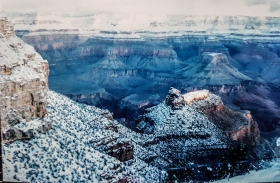
We arrived at the Canyon after nightfall. The next day, the sun was shining, and the sky was blue. The snow still lay thickly on the ground, on the trees, and in the canyon.

This was my first visit to the Grand Canyon and the snowfall enhanced my enjoyment of this spectacular place. The snow had fallen in such a way that it had only landed on the upward facing surfaces of the many strata that make up the walls of the canyon. This exaggerated their appearance in a positively aesthetic fashion. The Grand Canyon under snow made our visit memorable and exceeded all my expectations of the famous site.

From the Canyon, we drove south to Sedona, which is famous for its vortices that some people. including me, claim to be able to feel. Though not far south from the Canyon, the weather had improved considerably.

When we reached Phoenix, a city south of Sedona, winter had become summer. Whereas the temperature at the Canyon had been below freezing point, at Phoenix it was at least 80 degrees Fahrenheit.

From Phoenix, we drove west towards Yuma and San Diego in south California. On the way, we traversed a stretch of land that confirmed my preconceptions of what a desert should look like. It was neither soaked with rain nor lacking in sand dunes. On the contrary, it was hot, deserted, and sandy. And we saw occasional cacti. At last, at the age of almost 42 I had seen my first ‘real’ desert.  Since then, I have seen a few other sandy deserts including the vast wastes of Kutch in western India.

Although our obstetrician in London was unconcerned about our journey, everyone we met in the USA on that trip was horrified that we had undertaken it. Our holiday in the USA was a great success and our baby daughter arrived intact and healthy in early April. I cannot say for sure whether her in-utero journey across the Atlantic and around parts of California and Arizona is in any way responsible for her love of travelling, but there is a possibility that it was.

A walk in the West End

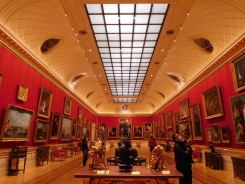
The largest gallery in the Wallace Collection

BRAVING THE INCLEMENT weather, we walked from Kensington to the Wallace Collection in London’s West End. After walking along the north side of Hyde Park, we crossed Bayswater Road (actually ‘Hyde Park Place’) and walked along the short Albion Street. The novelist William Makepeace Thackeray (1811-1863), who was born in India (Calcutta) and the author of “Vanity Fair” lived at number 18. His home was close to the still extant Tyburn Convent (located near the famous spot where criminals were hanged). He wrote of the area where he lived (‘Tyburnia’):

“The elegant, the prosperous, the polite Tyburnia, the most respectable district of the habitable globe.” (www.stjohns-hydepark.com/moreaboutus/2016/4/21/history-of-st-johns)

From Albion Street, we turned right to walk east along Connaught Street, named after George III’s nephew and son-in-law Prince William Frederick, Earl of Connaught (d. 1834), and laid out in the King’s reign (1760-1820). Archery Close leads off the street to a cobbled mews. It is so named because it was next to the former cemetery (now a housing estate called ‘St George’s Fields’) of St George’s Church in Hannover Square, which used to be used as a practice ground for archers. A few yards east of the close, we reach Connaught Square.

The square, whose brick-built elegant terraced houses surround a private garden, began to be developed in 1821. Near to the north east corner of the square, number 14 was home to the Italian ballet dancer Marie Taglioni, Comtesse de Voisins (1804 –1884), who was born the daughter of an Italian choreographer, Filippo Taglioni and his Swedish wife the ballerina Sophie Karsten, in Stockholm. In England, Marie taught social dancing to society ladies and children. The former British Prime Minister, Tony Blair, has also owned a house in this pleasant square.

Number 1 Connaught Street, which is on the corner of Edgware Road is now a branch of the Maroush Lebanese Restaurant chain. It is housed in an attractive building whose facades are topped with balustrades. On a map surveyed in the 1930s, which also shows St Georges Fields still as a disused cemetery, marks this building as a bank (Westminster Bank).  After traversing the busy Edgware Road, formerly the Roman Watling Street, the continuation of Connaught Street becomes Upper Berkeley Street, named after Henry William Berkeley (1709-1761), who was part of the Portman family who developed the area.

Number 33 Upper Berkeley Street has a distinctive neo-Byzantine frontage and looks like the entrance to a religious building. It is an entrance to the West London Synagogue whose main entrance is nearby on Seymour Street. This synagogue was established on its present site in 1870. Its congregation is allied to Reform Judaism. Its architects were Messrs Davis and Emmanuel (https://archiseek.com/2013/the-new-west-london-synagogue/). Rabbis, who have served at this synagogue have included a Holocaust survivor, Hugo Gryn, and Julia Neuburger.

Number 20 Upper Berkely Street was home to the first British woman to qualify as a medical practitioner, Elizabeth Garrett Anderson (1836-1917). She lived (and practised briefly) at number 20 from 1860 to 1874. She established her practice around the corner at 69 Seymour Place, which opened as the ‘St Mary’s Dispensary for Women and Children’. Nearby at number 24 (‘Henry’s Townhouse’), we reach the house where the banker and clergyman, Henry Thomas Austen (1771-1850), brother of the novelist Jane Austen, lived between 1800 and 1804 (http://jasna.org/persuasions/printed/number20/caplan.pdf).

After passing Great Cumberland Place and Wallenberg Place (created in the 1780s and badly damaged during WW2), an elegant crescent on the east side of the road, we pass Montagu Street that leads north to Montagu Square where my father’s colleague and co-author, the Hungarian born Peter Bauer (1915-2002), used to live.  Further east, Upper Berkeley reaches the northwest corner of Portman Square.

Opposite this corner is Home House, once the home of the Courtauld Institute (for history of art), now the home of a private club. It was built in 1773-76 for Elizabeth, Countess of Home (c1703-1784), a Jamaican born English slave-owner, and designed mainly by Robert Adam, who also created its beautifully decorated interiors and a fantastic helical staircase. A block of flats called ‘Fifteen’ with art deco front doors is next door to Home House and opposite an entrance to the square’s private gardens. This gate, normally locked, happened to be open. So, we snuck into the garden to take a brief look. As we emerged, and slammed shut the gate, a man emerging from Fifteen, noticed us and told us that it was good that we had closed the gate, because he said:

“It’s good to keep the riff-raff out of our square.”

I replied:

“We are the riff-raff.”

He laughed and we began conversing. He lives in Fifteen, which was built in the 1930s, and told us that its interior is decorated like the original ‘Queen Mary’ liner, in art deco style. He confirmed my memory that the store front that houses Air Algerie  and the National Bank of Kuwait on the east side of the square used to be part of the shop front of the Daniel Neal children’s clothing store, which closed in 1977. My late mother always pointed it out when we drove past it in the 1960s, but I cannot recall ever having entered it.

Continuing east from the square along Fitzhardinge Street, we pass Seymour Mews. A plaque on the corner of these two roads commemorates the site of the birthplace of Captain Thomas Riversdale Cloyes-Fergusson who was awarded a Victoria Cross medal posthumously after dying, aged 21, at the Battle of Paschendaele on the 31st of July 1917 during WW1. His medal is currently on display at Ightham Mote in Kent, the former home of his parents. Incidentally, the well-preserved Tudor Ightham Mote house is a lovely place to visit.

Walking another 200 feet eastwards brings us to our destination Manchester Square. Before describing its main attraction, let us look at number 14, now called ‘Milner House’. This was the home of Alfred Milner (1854-1925), who was an important colonial official in southern Africa. He was Governor of the Cape Colony from 1897 to 1901, a period that included the 2nd Anglo-Boer War. Then, he was successively Administrator of the Transvaal and Orange River Colony (1901-1902), Governor of the Transvaal and Orange River Colony (1902-1905), and then Secretary of State for the Colonies (1919-1921). Milner was in no little way responsible for the outbreak of the conflict between the British and the Boers that began in 1899, one of whose aims was to establish an unbroken British corridor that ran from Cairo to The Cape. Another of its aims was to have the gold mines of the Rand and other parts of the Transvaal under British rule.

One of Milner’s neighbours on the square was Sir Richard Wallace (1818-1890), who, unlike his neighbour Milner, did much good for mankind. He was the illegitimate son of the 4th Marquess of Hertford and educated in Paris, where he also worked. In 1870, when his father died, Richard inherited his collection of European art. Wallace added greatly to the collection, often purchasing fine works of art. During the Siege of Paris (September 1870-January 1871), Wallace, who was living in the city, performed many acts of charity including contributing much money to the needy of Paris and organising two ambulances. In 1872, he paid for the erection of fifty public drinking fountains, which are now known as ‘Wallace Fountains’ and can be found all over Paris. One of these distinctive fountains stands outside the entrance to Hertford House, his London home on Manchester Square where his art collection is now housed in what is called ‘The Wallace Collection’.

From the outside, Hertford House is imposing rather than attractive. It was built between 1776 and 1778 for the 4th Duke of Manchester. In 1797, the 2nd Marquess of Hertford acquired the building and modified it considerably. Richard Wallace and his wife, Julie Amélie Charlotte (daughter of Bernard Castelnau, a French officer), lived there whenever they were in London from 1870 onwards. The Wallace Collection contains over 5500 works of art collected by the first four Marquesses of Hertford and Richard Wallace. These include more than 6 paintings by Rembrandt, and others by great names including Vermeer, Bols, Poussin, Frans Hals, Canaletto, Velasquez, Boucher, Watteau, Fragonard, Lawrence, Hobbema, Cuyp, Maes, and many others equally well-known.  Richard’s widow bequeathed it to the nation in 1897.

I first visited the Wallace Collection with my father when I was less than ten years old. I remember being extremely bored by the huge numbers of Paintings on display but fascinated by the large collection of weapons and armour that occupies several rooms. Now, many years later, I am thrilled by the wealth of paintings that can be enjoyed in the beautifully decorated rooms of the house. The splendour of the interior décor of the rooms contrasts greatly with the exterior of the building that gives no hint of the treasures within.  Along with the collection of artworks at Kenwood House in Highgate, the Wallace Collection is one of the finest (formerly) private art collections open to the public in London.

After seeing the collection and having coffee in Hertford House’s vast covered internal courtyard, we retraced our steps by walking back to Kensington. We felt satisfied that we had had a good walk along streets and through parkland after having enjoyed an enriching artistic experience at the Wallace Collection.

At home with Adam

IN CASE YOU ARE WONDERING, this piece is not all about me, Adam Robert Yamey. My father, a well-known economist, was all for calling me ‘Adam Smith Yamey’, in honour of the famous Scottish economist and author of “The Wealth of Nations”, Adam Smith (1723-1790), but my mother was against this. My ‘Robert’ might have been chosen because my mother had a brother called Robert, but maybe they chose the name because they knew about a more celebrated Robert, the Scottish  architect and Adam Smith’s contemporary, Robert Adam (1728-1792). Lately, we have visited two buildings whose appearances owe much to Adam the architect. One is Osterley House, west of London, and the other Kenwood House in north London.

Ceiling of Etruscan Room at Osterley

According to a mine of information, “Handbook to the Environs of London” by James Thorne (published in 1876), the manor of ‘Osterlee’ belonged to John de Osterlee in the reign of Edward I (lived 1239-1307). Through the years it moved through the hands of men such as John Somerseth (died 1454), Henry Marquis of Exeter (1498-1538), Edward Seymour (Protector Somerset 1500-1552), Augustin Thaier, and then Sir Thomas Gresham (1519-1579).

Gresham was, according to Thorne, was “… the prince of merchants”. An able financier, he worked on behalf of King Edward VI, Queen Mary I, and Queen Elizabeth I, and was also the founder of the Royal Exchange in London. In 1857, the economist Henry Dunning Macleod, used Thomas’s surname to name a law of economics, namely ‘bad money drives out good’.  By 1577, Gresham enclosed Osterley Park and constructed a magnificent mansion. Although there are no surviving images of this building, its architectural style can be imagined by looking at the Tudor stable block (c1560) that stands next to the present Osterley House.

After Gresham’s death, the building began to decline even while his widow, Anne (née Ferneley), continued to dwell in it. After her death in 1596 at the age of 75, Osterley House and its grounds were owned by a series of people until about 1713, when the banker Sir Francis Child (1642-1713) bought the property.

Sir Francis left the place to his sons Robert (1674-1721), Francis (1684-1740), and Samuel (1693- 1752). It was the latter’s son, the third Francis Child (1735-1763), who engaged the fashionable architect Robert Adam to make improvements to Osterley House. His was employed in the 1760s to modernise Gresham’s house. The most obvious of Adam’s works can be seen before you enter the house, the neo-classical portico supported by two rows of six Ionic columns that evokes memories of the Propylaeum of the Parthenon in Athens, which Adam might well have known about after his Grand Tour of Europe undertaken between 1755 and 1757, which, incidentally, included a visit to the ruins at Split (now in Croatia). The portico joins two wings of the building that Child inherited.

In addition to the magnificent portico that contrasts with the Tudor brickwork of the rest of the building,  Adam redesigned the entire interior of the building, creating a series of beautifully decorated rooms, most of which have eye-catching ornate ceilings. One room, which does not have a decorated ceiling is the Long Gallery which was used to house some of the large collection of paintings that used to hang in the Child’s London home, which they sold in 1767. Most of these artworks were removed from the house when Lord Jersey gifted the house to the National Trust in 1949, and then lost in a fire. They have been replaced by other fine paintings. Many of the chairs and sofas and other furnishings in the Long Gallery (and other rooms) were designed by Robert Adam, who took great interest in every detail of what he created. The absence of ceiling decorations, it was explained to us, was intentional; the ceiling was left unadorned so that viewers of the paintings were not distracted by decorative features above them. In the other rooms, the ceilings rival other aspects for the viewer’s attention.  From the grand entrance hall onwards, the visitor is faced with a series of rooms that compete for his or her admiration. Amongst these marvels of interior decoration, I was particularly impressed by the Drawing Room that drew inspiration from the Temple of the Sun at Palmyra (destroyed by ISIS in 2009), the Tapestry Room, and the delicately decorated Etruscan Dressing Room. I have singled out these rooms, but the others are also magnificent. Adam’s creations make a visit to Osterley Park a breath-takingly exciting visual experience.

As the crow flies, Kenwood House is ten miles northeast of Osterley House, or about 15 miles by road. Osterley House was completely remodelled by Robert Adam. Beneath his modifications, its structure is basically the Tudor mansion that the Child family purchased. The situation is different at Kenwood.

In 1755, the lawyer and politician William Murray (1705-1793), who was to become First Earl of Mansfield, bought Kenwood House. In 1764, he commissioned Robert Adam to remodel the house, giving him freedom to do it however he wished. Adam did the following (as quoted in www.english-heritage.org.uk/visit/places/kenwood/history-stories-kenwood/history/):

“… addition of a new entrance on the north front in 1764, which created the existing full-height giant pedimented portico … modernised the existing interiors, notably the entrance hall (1773), Great Stairs and antechamber, and built a new ‘Great Room’ or library (1767–9) for entertaining. The ground-floor rooms on the south front all received Adam’s new decorative schemes. These social spaces for the family included a drawing room, parlour and ‘My Lord’s Dressing Room’ … designed the south front elevation in 1764, but changed it in 1768 in order to insert attic-storey bedrooms.”

So, he added to the existing building rather than working within its original ‘footprint’. The ‘pièce de résistance’ of Adam’s work at Kenwood is without doubt the Library. It must be seen to be believed. Reluctantly, because I was really impressed by his creations at Osterley, this library exceeds the splendour of all the rooms at Osterley.  The South façade of Kenwood is also a successful modification of the building, more effective aesthetically than the portico added to the north side of the house.

Seeing Adam’s Library at Kenwood House is just one of the good reasons to visit the place. The other attractions include the wonderful gardens and the collection of masterpieces of British and European painters that are on display. Including works by Vermeer, Rembrandt, Bols, Turner, Guardi, Reynolds, and many more celebrated artists, the paintings are part of the collection of the Irish businessman and philanthropist, Edward Cecil Guinness, 1st Earl of Iveagh (1847-1927), which he left to the nation following his death.

Those enamoured by the works of Robert Adam must visit the two houses already described, which are open to the public. There is another place in London, Home House in Portman Square, once the home of Sir Anthony Blunt and the Courtauld Institute and now a private members’ club (Home House Club), whose Adam interiors, which I have seen, are also spectacular examples of his creative powers. If you are not fortunate enough to know a member of this club, you will have to satisfy yourself by visiting Kenwood and Osterley Houses, but you will not be disappointed.

In the shadow of the Hilton Hotel

BBC RADIO ONE began broadcasting on the 30th of September 1967. Before then, if you wanted to listen to popular music on the radio in the UK, you would have to tune your radio to pick up Radio Luxembourg, whose broadcasts from Luxembourg came over the airwaves loud and clear. Some of its presenters, for example Dave Cash, Noel Edmonds, and Kenny Everett, later hosted programmes on the new radio stations that began to broadcast after Radio One and various new commercial stations began transmitting. Unlike the BBC, Radio Luxembourg was commercial and broadcast advertisements relevant to British listeners. Several programmes were sponsored by two football pools companies, Littlewoods and Vernons. The station continued transmitting for UK audiences until December 1992.

I had not thought about Radio Luxembourg much until mid-September 2020 when we were walking along Hertford Street in a part of London’s Mayfair under the shadow of the tall Hilton Hotel on Park Lane. This short street runs east from Park Lane (just next to the Hilton) for about 630 feet and then makes a right angle turn and heads north through Shepherd Market and ends up at Curzon Street, which I have written about elsewhere (https://londonadam.travellerspoint.com/20/). Next to the front door of number 38 Hertford Street, a tall narrow house built in the 18th century (or not much later), a commemorative plaque informs:

“This was the HQ of Radio Luxembourg, Broadcasting from the Grand Duchy 1933-1991”

This building was not only the headquarters of the extra-territorial radio station but also contained recording studios where seemingly ‘live’ programmes could be recorded for broadcasting later from Luxembourg. Listeners were not informed where programmes had been recorded and were left with the impression that everything was being produced in the Grand Duchy.

Number 10 Hertford Street is just across the road from the former Radio Luxembourg HQ. This elegant terraced building, whose front entrance is flanked by two metal lampstands complete with inverted cones for extinguishing flaming torches, was home to two famous people, as recorded by plaques affixed to the house.  One of its former occupants was General John Burgoyne (1722-1792), who lived and died here and Richard Brinsley Sheridan (1751-1816), who lived here from 1795-1802. Prior to these celebrated occupants, the house was occupied by John Montagu, 4th  Earl of Sandwich (1718-1792), who was famous for his musical parties (www.british-history.ac.uk/old-new-london/vol4/pp345-359) and for giving his name to a popular food item.

General Burgoyne was, according to Wikipedia:

“… a British army officer, dramatist and politician who sat in the House of Commons from 1761 to 1792.”

His military achievements during the American War of Independence were dismal. His attempt to disrupt the American forces came to nought and ended with him surrendering his army of over 6000 men in October 1777 at Saratoga. His dramatic works were popular and included “The Maid of the Oaks” (1774) and “The Heiress” (1786). He assisted in the writing and production of “The Camp: A musical Entertainment” (1778), principally written by another occupant of Number 10 Hertford Street, Richard Sheridan. The General also worked on the libretti of several operas. Had he stuck to the stage, and kept away from the battlefield, Burgoyne might have been remembered as a dramatist rather than a failed military man. Politically, he began by supporting the Tories, but later switched to the Whigs. Near the end of his political career, he was involved in Parliament’s attempted impeachment of Warren Hastings at the end of the 18th century. Hastings, the first Governor General of Bengal had been accused of misconduct in Calcutta but was eventually acquitted.

Another occupant of number 10 was also involved in the theatre but to a greater extent than Burgoyne. Richard Sheridan, born in Dublin, was a playwright and poet as well as being the owner of the London Theatre Royal in Drury Lane.  He is best known for his still popular plays “School for Scandal” (1777) and “The Rivals” (1775).What I did not know until I began writing this was that Sheridan had been a Member of Parliament (a Whig supporter). In 1777 during a Parliamentary session, he had demanded the impeachment of Warren Hastings. His speech on the subject made on the 7th of February 1787 lasted five and three-quarters hours. His oration:

“… commanded the most profound attention and admiration of the House. His matchless oration united the most solid argument with the most persuasive eloquence. His sound reasoning giving additional  energy to truth, and his logical perspicuity, and unerring judgment, throwing a light upon, and pervading the obscurity, of the most involved and complicated subject.” (https://quod.lib.umich.edu/e/ecco/004858403.0001.000/1:3?rgn=div1;view=fulltext).

Clearly, Sheridan was eloquent both in life and creatively on the stage.

This home of playwrights was built between 1768 and 1770 by the builder Henry Holland the elder (1745-1806). On arrival at this address in 1769, Burgoyne commissioned his friend, the architect Robert Adam (1728-1792), to design and execute some of the interior decoration (http://collections.soane.org/SCHEME1106).  After the General’s death in 1792, Sheridan purchased it.

Moving on, we enter the short Down Street that leads south from Hertford Street to Piccadilly. Although the street slopes downwards to Piccadilly, I am not sure that this is the reason for its name. “The London Encyclopaedia” (edited by B Weinreb and C Hibbert) noted that it was was laid out in the 1720s by the bricklayer John Downes, who was involved in much building work in Westminster (www.british-history.ac.uk/survey-london/vols29-30/pt1/pp77-83). Maybe, that is the origin of its name.

Two buildings caught my attention on Down Street. Nearer Hertford Street, on the corner of Brick and Down Streets, stands a Victorian gothic church, Christ Church Mayfair. Constructed in 1865, this protestant church was designed by F & H Francis (they were brothers) and enlarged in 1868. After a fire in 1906, it was rebuilt considerably. It was closed when we passed it, but I have read that it contains some art nouveau features.

South of the church on the west side of Down Street, there is a terracotta coloured tiled façade that looks like a typical Underground station, which is what it was between 1907 and 1932, when it was closed. This now disused station was ‘Down Street’ station on the Piccadilly Line. It lies between Hyde Park Corner and Green Park Stations, no more than about 500 yards from each of them. It was closed because it was never busy enough to keep open. Most of the inhabitants around it were and still are wealthy enough not to need or use public transport. During WW2, it was used as a bunker by Winston Churchill and his staff before the Cabinet War Rooms were ready for use.

By retracing our steps, we can return to Shepherds Market for refreshment, be it a drink or something more substantial. After passing the former Radio Luxembourg HQ and entering the section of Hertford Street that runs towards Curzon Street, you will come face to face with a pub (currently closed) called ‘Shepherds Tavern’. This hostelry was first built in 1735 as part of the development of the area by the developer and architect Edward Shepherd (died 1747). Its customers are said to have included the actress Elizabeth Taylor and Antony Armstrong Jones, who was once married to Princess Margaret.  The actress Wendy Richard (1943-2009) lived in the pub from 1948 to 1953, when her parents were its publicans.

As you enjoy a pint of beer or a glass of sherry or maybe a cortado or a ‘latte’ in Shepherds Market, you can marvel at how much history is packed into two short streets overshadowed by the 331 foot high, 28 storey Hilton Hotel on Park Lane, which first opened in 1963. And fully refreshed, you can resume exploring Mayfair sure in the knowledge that you will be treading in the steps of many now famous people who have haunted the area since it was laid out in the early 18th century.