HUMANS HAVE BEEN weaving textiles for many centuries, for at least 12000 years, if not longer.
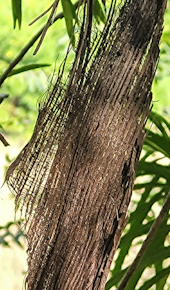
Today, while walking in the extensive grounds of a country house in Kachchh (Kutch) in Gujarat, we noticed something interesting about the decaying fronds that had fallen from palm trees. The fronds have long tapering stems that support the photosynthesising leaves of the tree. The stems are widest where they attach to the tree and taper as the distance from the trunk increases. The tree discards mature fronds to make way for new ones.
Woven by nature: detail of a drying, fallen palm frond
What interested us was that the drying fronds that have fallen from the trees shed or lose part of their external cuticle to reveal lattices of fibres that resemble woven textile. These lattices of drying palm fibres look just like sheets of sacking cloth. Nature achieves this natural weaving without requiring looms.
Palm trees have been around since long before Homo sapiens. Therefore, this natural form of weaving antedates human weaving activities. I wonder whether when our ancestors saw what we noticed today that they conceived the idea of weaving.
THERE HAVE BEEN events that have caused people to flee from one part of the Indian subcontinent to another, traversing national boundaries. The best known of these events was the Partition of India in 1947. Another event was the Bangladesh War of 1971, which resulted in Bangladesh (formerly East Pakistan) becoming independent, no longer united with West Pakistan.
Until I visited an exhibition, “Shifting Identities”, at Arthshila, an art institution in Ahmedabad, I was unaware of India’s temporary occupation of a part of West Pakistan in 1971. In order to deflect some of West Pakistan’s army from their activities in East Pakistan, India staged an attack on Sindh, a province in West Pakistan. As a result of this, India temporarily annexed a part of Sindh close to Kacchch (Kutch). This annexation was reversed by treaty in 1972. However, this resulted in a flow of refugees from Pakistan into border areas of Gujarat and Rajasthan. Likewise, during the liberation struggle in what was East Pakistan, refugees flowed from what was to become Bangladesh into Indian West Bengal.
Amongst the migrants who sought refuge in India, there were many who were skilled in traditional crafts, notably textile manufacturing.
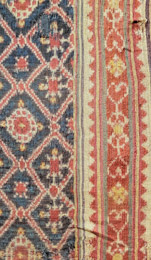
The splendid exhibition at Arthshila contains beautiful examples of textiles made by refugees both from Sindh and the former East Pakistan. The exhibition also includes documents and photograph albums that belonged to these people who felt it necessary to flee their former homes. The photographs in the albums were those sent to the migrants by family and friends they had left behind.
The show at Arthshila is both attractive and very moving. The exhibits are well labelled with much information. It showcases the skills that were the only riches that the refugees were able to carry with them when forces beyond their control made them feel it was necessary to leave the land that had been their home for innumerable generations.
AJIT KUMAR DAS was born in 1957, son of a laundry man (washer man). From an early age, he became fascinated with the wonderful colours of the textiles that his father washed. He became involved with traditional fabric printing and design. Today, Das is recognised as one of India’s foremost natural dye painters.
Das paints on cloth using natural dyes, rather than artificially created colours. He uses dyes derived ed from sources such as, for example, pomegranate rind, turmeric, fermented iron solution, indigo, and madder. He applies them using bamboo brushes and handmade quills. The colours are fixed using alum as mordant. With decades of experience and experimentation, he is able to use the natural dyes to produce interesting colourful effects.
At his exhibition held in a magnificent gallery in the Kolkata Centre for Creativity, we were able to view more than 20 of his paintings. All of them feature closely observed natural objects, such as foliage, birds, and fish, all arranged in patterns on the textiles. Some of these compositions are naturalistic. In others, Das has arranged the details from nature to produce lovely patterns.
We were fortunate to have been at the inauguration of the exhibition, during which the soft-spoken Das discussed his works with a panel of invited guests. From what I could gather, the panellists were more interested in the current state of natural dye crafts than the artist’s works on display. I am pleased that we made the journey from central Kolkata to the outlying district of Anandapur to see the exhibition and to learn a little about the use of natural dyes in traditional methods of textile making.
KENIA ALMARAZ MURILLO was born in Bolivia in 1994. She moved to Paris in France at the age of 11 years. Until the 30th of January 2025, there is an exhibition of her work at the Waddington Custot Gallery in London’s Cork Street.
All of the exhibits contain woven textiles. Many of them also have objects added to them, making them like three-dimensional collages. The objects she has added were salvaged from Parisian scrapyards whilst the yarns she has used are indigenous South American in origin. The resulting artworks are both beautiful and exciting.
I can strongly recommend seeing this well-displayed show in a gallery a few yards away from the northernentrance to Burlington.
ONE OF THE THINGS that struck me when I first visited India in January 1994 was how everyone was wearing clothing far more colourful than anywhere else I had been before. Wherever I have been in the country, there is a feast of colourful clothing to be seen. Whether the colourful garments are worn purely for aesthetic reasons and/or for ceremonial or group identity reasons, everywhere there is much to please the eye.
I am not alone in noticing the Indian penchant for wearing bright colours. In 1956, the famous style ‘diva’ Diana Vreeland noted in British Vogue magazine: “… pink is the navy blue of India …”. Following from this, an article in India’s “Economic Times” of January 2022, pointed out that “Red is the Indian beige and yellow is the Indian grey…”. In other words, that the exuberant colours worn by Indians contrast dramatically with the much more drab colours currently worn in the West. Actually, as my wife pointed out, long ago in Europe (eg the 18th century and before) clothes – especially those worn by the wealthy and the aristocracy – were far more colourful than now.
On the 23rd of December 2023, we were fortunate to get admission to an exhibition of sarees on its last day. Intriguingly entitled “Red Lilies, Water Birds”, the show was hosted by The Registry of Sarees in a house on Hayes Road in Bangalore. The Registry (established in 2016) is a trust set up by the Mysore Saree Udyog (founded in 1932). Its purpose is to promote the study, design, and conservation of handspun and handwoven textiles.
The nine rooms of the exhibition contained about 84 examples from the Registry’s much larger collection. Each room concentrated on either a particular region of India, or a specific method of creating the textiles. Every room was filled with sarees, which filled the viewer’s eyes with richly coloured, intricately patterned delights.
Many of the visitors to the exhibition, and the staff looking after, and explaining, the show were wearing clothing that demonstrated what I mentioned at the outset – namely, the preference of many Indians to dress colourfully.
THE LAW GARDEN in Ahmedabad was developed into a park in about 1997. Previously, it had been a vast triangular vacant plot in the heart of an affluent residential area. Named after an adjacent college of law, it was an undeveloped, rather disreputable bit of land. In 1997, it was tidied up and turned into what is now a pleasant place for people to relax and ‘take the air’.
Market stalls can be found along the street on one side of the park. After dark, a busy night market springs to life. This existed even before the park was completed.
Many of the stalls sell clothing made using colourful traditional patterned textiles – both embroidered and printed. Several stalls were selling cloths embroidered with small mirrors – work from Kutch.
In addition to clothing, there were hawkers selling toys and balloons. Foodsellers pushed small barrows from which they sold fruit, confectionery, and soft drinks.
This lively market reminded me a little of Fashion Street in Bombay, but it is somewhat smaller and offers less variety. The Law Garden night market is well worth a visit.
A FEW WEEKS AGO, we viewed a wonderful exhibition of contemporary quilt making at Swiss Cottage Library (see: https://adam-yamey-writes.com/2023/07/15/quilts-in-a-wonderfully-designed-library/ ). These quilts were made with both recycled bits of material and/or textiles specially bought for use in their manufacture. Although some of the works on display could be used as rugs or coverings, many of them were designed as non-functional artworks for display. Today (1st of August 2023), we visited the Brunei Gallery in London’s Bloomsbury. Our intention was to see an exhibition of paintings and drawings from the south of India. However, when we entered the place, we discovered that in addition to what we had come to see, there was another exhibition, which we did not know about. This is the rather intriguingly named “Japanese Aesthetics of Recycling”, which is on until the 23rd of September 2023. With a name like that, we could not resist taking a look at what was on show.
The exhibition has a fine collection of exhibits demonstrating the Japanese tradition of recycling old materials to create new objects. In a country where raw materials were highly valued, it made a lot of sense not to waste them, but to re-use them. We saw many examples of ‘Boro’ textiles. These are items made by fashioning worn clothing and waste fabrics to create another usable textile. Often, a large piece of used material with damage (e.g., holes) was made usable by patching it with scraps of waste material. Both quilting and Boro involve sewing pieces of material together. Unlike quilting, which uses scraps of material to create a brand-new entity, Boro uses scraps to restore worn textiles to make them usable again. There were also examples of ‘Washi’ on display. This is handmade paper concocted from already used sheets of paper (for example from discarded account books). The Washi was made waterproof by painting it with persimmon paste. Washi paper was used for many purposes including wrapping valuable clothing, floor coverings, room dividers, making bags, and more. For example, there was a conical hat made in leather and lined with waxed recycled Washi paper. In addition to these recycling techniques, there were several others. One which caught my attention was ‘Sakiori’, which in many ways resembles the North American and European rag weaving technique.
The exhibition was not only fascinating because of the range of recycling techniques exemplified, but also because many of the items made from the recycled materials were aesthetically pleasing. The exhibits are beautifully displayed, and the accompanying labels are interesting and informative. Whether you are interested in Japan or recycling or both, it is well worth visiting the Brunei Gallery to see this show.
LONG AGO PEOPLE in the Andes did not write. Instead, as Chilean artist Cecilia Vicuña (born 1948) explained in a note on the Tate Gallery website:
“… they wove meaning into textiles and knotted cords. Five thousand years ago they created the quipu (knot), a poem in space, a way to remember…”
After the Europeans conquered South America, they abolished and burnt the quipus. However, as the artist explained:
“… the quipu did not die, its symbolic dimension and vision of interconnectivity endures in Andean culture today.”
Cecilia has created two large sculptures which are hanging from the tall ceiling of the Tate Modern’s Turbine Hall until the 16th of April 2023. Each of these artworks consist of knotted strands of different materials, each of which is 27 metres long. They hang from circular metal structures looking to me rather like shredded laundry. Though they are undoubtedly deeply meaningful and attract the attention of many viewers, I felt the history underlying them was more interesting than their aesthetic qualities.
Abakanowicz
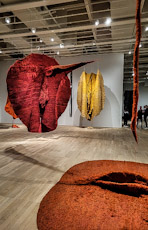
Elsewhere in the Tate Modern, we viewed an exhibition of the works of an artist, who knew how to write, but was creating during a time when the use of words had to chosen carefully to avoid being punished by the government. That artist Magdalena Abakanowicz (1930-2017), was born in Poland, where she created most of her art. After WW2, she studied painting and weaving the Academy of Plastic Arts in Warsaw. Her early works were created during a period when the Soviet-supported Stalinist regime in Poland imposed great restrictions on creative endeavours. During that harsh period, artists had to express any criticisms of the regime in a coded way in order to evade censorship. To some extent, this was necessary until Communist rule ended in Poland. In the mid-1950s, restrictions on art eased up a bit and experimentation became possible.
Magdalena moved from creating flattish conventional woven pieces to innovative three-dimensional artworks – woven sculptures of great originality. Photographs cannot do justice to these amazing creations. Videos can help the viewer appreciate the amazing way that these tapestries both fill and engulf space. However, the best way to see these works is to see them with your own eyes, which you can do at the Tate Modern until the 21st of May 2023. Included in the exhibitions are photographs of the lovely sculptures the artist created in later life and some videos of the artist talking about her work. There is also a film made in 1970 in which her tapestries are displayed on the sandy dunes of Poland’s Baltic coast. The artworks are suspended from poles and move gently in the sea breeze. It is clear from this film, which included scenes showing the fabric sculptures in galleries, that the artist seemed keen to have viewers explore them by touch as well as by vision. Sadly, and probably sensibly, the Tate forbids visitors from touching the lovely artworks.
Both the Vicuña and the Abakanowicz artworks use knotting and weaving to communicate ideas with the viewer. A window in one of the Abakanowicz exhibition rooms overlooks one of the quipu artworks. It intrigued me to see the juxtaposition of the works of the two fabric artists. Seeing these two exhibitions, one immediately after the other, made for a fascinating visit to the Tate Modern.
WHILE WANDERING THROUGH the large rambling bazaar in Mandvi, which is in the former Kingdom of Kutch (now part of Gujarat), we came across a workshop where bandhani textiles for clothing were being made.
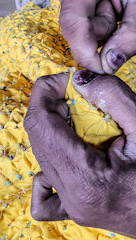
Making a knot for bandhani dyeing
Bandhani is a method of producing patterned dyed silks and cotton. Put simply, a piece of cloth, already dyed one colour or not at all, is prepared as follows. Parts of the cloth are gathered up to form tight bundles fastened by fine threads. The bundles, which look like small pimples are distributed to form patterns. The tied cloth is then dyed. The dye reaches all parts of the cloth except those enclosed in the tiny bundles. When the bundles are untied the patches of the cloth that had been shielded from the dye remain the original colour. This process can be repeated several times using different dyes to create an interesting pattern.
The shop the looked at, Khatri Ibrahim Siddik & Co, is the oldest bandhani workshop in Mandvi. It has been run by the same family for fifteen generations .
During our recent visit (January 2023), we have come across several businesses that have passed from generation to generation. In Bhuj, the Shivam Daining (sic) restaurant is run by chefs whose great grandfathers, grandfathers, and fathers, have all been cooks to the Maharaos of Kutch. Likewise, there is a bakery in Bhuj with an ancient wood fired stove. This business has passed through at least four generations. Nearby, there is a knife, scissors, and sword maker, who is the fourth or fifth generation of a family, which has been in this trade for over more than a century.
I am certain that there are plenty more examples of families in Kutch specialising in skills that have been passed from one generation to the next. I wonder whether these skills are in the genes, or simply taught by one generation to the next, and so on.
HAD IT NOT BEEN FILLED WITH parked cars, Market Square in Lavenham (Suffolk in East Anglia) would probably be recognisable to those who lived in the town several hundred years ago. The square is surrounded by old buildings, many of which are half-timbered. The most impressive of these is the Guildhall that was built in 1529. This large building attests the former wealth of the town, when it was an important centre of the wool trade in East Anglia. In its heyday, cloth from Lavenham was sent all over Britain and exported to Holland and Spain via the port of Ipswich. During the reign of Henry VIII (1509-1547), Lavenham was the fourteenth richest town in England.
Lavenham boasts a 16th century market cross. Market crosses were erected to indicate that an area had been designated as being a market square by a bishop, or a baron, or the monarch. Lavenham’s market cross is made of stone. A three stepped pyramid supports a slender column surmounted by a stone sphere. A metal plate informs the visitor that:
“The market cross was erected in 1501in accordance with the will of William Jacob”.
So, who was William Jacob?
Jacob was one of Lavenham’s wealthy clothiers, involved in the wool textile trade. Despite his surname, it was highly unlikely that he was Jewish because most Jews had been expelled from England in the 13th century (and it was not until the mid-17th century that Jewish people began returning). According to text on the website deverehouse.co.uk:
“William Jacob was the tenth wealthiest clothier and businessman in England, making an annual profit of 67 marks and with a gross turnover of 223 whole cloths (a gross turnover of £12m in today’s money, around 400 marks). On his death he paid for the erection of the market cross that is still there 520 years later. He did not branch into “straites” or “narrow cloths” and within 25 years of his death the cheaper narrow cloth was dominating the market and Jacob’s family were seeking other work.”
In his will, dated 1500, he wrote:
“I will have a cross made of my perpetual cost that shall be set upon the market hill in the village of Lavenham.”
The cross that was erected in Lavenham in 1501 was a copy of the market cross already present in the city of Cambridge. The Cambridge market cross has long-since disappeared. The stepped base is all that remains of the cross paid for by Jacob’s estate. The slender shaft that now stands on it was put up in 1725. It is interesting to note that far away in Florence (Italy) Michelangelo was beginning work on his famous statue of David in 1501. That sculpture was completed in 1504. Although many visitors come to Lavenham, many more visit Florence.
Suffolk was the most important clothmaking county in 15th/16th century England. William Jacob was one of the county’s 100 clothiers in business between 1480 and 1500. Other counties had far fewer members of this trade. Although William Jacob was the tenth most wealthy, the wealthiest was Thomas Spring III (c1474-1523) of Lavenham. By 1500, Suffolk was the most industrialised and urbanised county in Britain, but by 1700, the county had become a rural backwater. Suffolk and much of the rest of East Anglia might be regarded as a bit of a backwater nowadays, but it is a largely picturesque one with wonderful landscapes and a great architectural legacy due to its past prosperity during the golden age of the wool trade.