Tagore and the oppression of women in traditional families in Bengal

THE BENGALI POLYMATH Rabindranath Tagore (1861-1941) is modern India’s most important cultural figure. In 1913, he was awarded the Nobel Prize for literature, and in 1915 he was honoured with a knighthood by King George V. Following the massacre at Jallianwala Bagh in 1919, which was instigated by a British military commander, he renounced the knighthood. Five years before this, Tagore, who did not tolerate injustice, wrote “Streer Patra” (‘A Wife’s Letter’), a short story that highlighted and questioned the domination of women by men in 19th and early 20th century families. Kolkata’s leading English language actress and two colleagues have created a play “I am Mrinal”, which is based on Tagore’s short story.

Piali Ray on stage

On the 9th of September 2025, I watched a performance of this play at London’s Nehru Centre. Piali Ray skilfully and convincingly acted all the roles in the play. These were: Mrinal, the wife of the second eldest son in the family; Bindu, an orphaned child, related to one of Mrinal’s in-laws; Mrinal’s brother-in-law’s wife; and Mrinal’s husband. Against everyone except Mrinal’s wishes, Bindu was accepted into the household.  Mrinal’s husband disapproves of Bindu’s presence in the joint family home, but childless Mrinal treasures this young girl’s presence. Mrinal’s husband is keen to evict Bindu, and eventually decides to marry her off to an insane man. In desperation, Bindu sets herself alight, and she dies. Then, Mrinal flees from Kolkata to Puri, where, at the end of the play, she writes a letter to her husband, explaining that she will never return to the domestic bondage that she had to endure for 15 years as his wife. Tagore’s story vividly illustrates the oppression of women in conventional Bengali families, and his feeling that this injustice needed to be combatted. It was written in 1914, the year the First World War commenced. It might not have been “the war to end all wars”, but after it was over, women in many parts of the world began to question their roles in society, and to improve their status.

During Piali’s performance, she switched roles effortlessly, and one was never in doubt as to whom she was portraying at any given moment. Even when she was playing the role of the husband, one forgot that she was not actually a man playing this part. She used a different tone of voice and set of gestures for each of the characters. Throughout the performance, there was music playing in the background. It impressed me that Piali’s movements on stage seemed to harmonize with the music. Her performance was not simply dramatic but also balletic.

It was fascinating watching this play not only because it gave an insight into the oppressive conditions experienced by women in traditional bourgeois Bengali joint families in the early 20th century, but also because it gave me a chance to watch a skilled actress conveying the story so beautifully.

Adam Yamey is the author of “88 Days in India: A Journey of Memory and Discovery” [https://www.amazon.co.uk/dp/B0FKTFBFM2],  and several other books about Indian topics.

Bengali art before it was affected by influences of Europe and the Far East

THE INDUSTRIALIST KASTURBHAI Lalbhai (1894-1980) filled his Ahmedabad home (built 1905) with works of art. One of his relatives had married a member of the famous Tagore family of Calcutta. When the Tagores decided to sell their fabulous collection of Indian art in the 1940s, Lalbhai purchased it and thereby saved it from being sold to buyers who did not live in India. These works are on display in the house, which is now known as the Kasturbhai Lalbhai Museum.

The Museum houses works of Indian art dating from as early as about the 4th century AD to the 1940s. Visitors to the museum are obliged to go on a prebooked informative guided tour through the rooms of the museum. Although a bit of a speedy experience, one leaves having seen an enlightening cross-section of the history of art in India. Photography in the museum is not allowed.

In the special exhibition

In the beautiful grounds of the museum, there is a recently constructed annex, where temporary exhibitions are held. We were treated to a show entitled “The Babu and The Bazaar”. It is a collaboration with the Delhi Art Gallery.

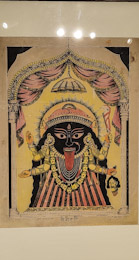
This fascinating exhibition contains a display of images created by Bengali artists, who painted in traditional styles that prevailed before art in Bengal became influenced by British art schools, Western European art, and the art of China and, especially, Japan. These external influences were most famously introduced by figures such as Rabindranath Tagore and his nephews Gagendranath and Abanendranath.

During my visits to India, I have seen plenty of paintings by Bengali artists who incorporated non-Indian artistic styles into their creations, but I cannot remember having seen such a large collection of Bengali paintings and other works in vernacular styles derived more from tradition than from outside influences. Most, but not all, of the artworks depicted Hindu religious subject matter. Many of the paintings were by artists I had never heard of, or were by unidentified painters. The well-labelled exhibits, which were beautifully displayed, were refreshing eye-openers.

Cross cultural fertilisation between India and Europe at Milton Keynes

THE ARTIST REMBRANDT (1606-1669) produced a set of 23 drawings based on Mughal miniature paintings that were created in India in the early 1600s. In her article (see: https://mapacademy.io/what-rembrandt-learned-from-mughal-miniatures/), Shrey Maurya wrote:

“Perhaps the original Mughal miniatures arrived from the Dutch trading post in India. It’s also possible that he encountered the paintings in the collections of wealthy traders and various Dutch East India Company officials, who were his friends and often his clients.”

Shrey added:

“These drawings are remarkable for they allow us to understand the incredible global network established by trade ships which allowed an exchange of cultures to take place on a global scale.”

Recently, we visited an excellent exhibition at the MK Gallery in Milton Keynes: “Beyond the Page. South Asian Miniatures and Britain 1600 to now.” Amongst the many beautiful and intriguing exhibits, there were a few that illustrated the influence of Mughal painting on Western European artists. Although none of the above-mentioned Rembrandt drawings were on display, what I saw interested me greatly. I have been long aware of the influence of western artistic trends on the works of artists from the Subcontinent, but not the other way around.

An artist, Willem Schellinks (1623-1678), one of Rembrandt’s contemporaries is represented in the MK Gallery’s exhibition. He, like Rembrandt, is believed to have studied an album of Mughal paintings, which was thought to have been in the possession of the English art collector Alethea Howard (1585-1654), Countess of Arundel, who lived in Amsterdam from 1641 until her death. Incidentally, her portrait was painted by Peter Paul Rubens (1577-1640). In addition to sketches, Schellinks is known to have painted at least six paintings that contain Indian imagery (see the detail above). One of these and a sketch are on display at the MK Gallery.

In the same room as the Schellincks works, there is a painting by William Rothenstein (1872-1945). Drawing inspiration from traditional Mughal miniature paintings in the India Office Collection (in London), he created his “Sir Thomas Roe’s embassy to the court of Jahangir”, which was completed in 1924.

Before seeing the exhibition at Milton Keynes, I knew that Rothenstein had an interest in Indian culture. For example, he helped Rabindranath Tagore (1861-1941) to find accommodation in Hampstead’s Vale of Health in 1911-1912, but the well-produced exhibition catalogue provided me with information that was new to me. For example, Rothenstein had visited India and was a collector of Rajput paintings and drawings. In addition, in 1910 he was a co-founder of the India Society of London, whose aim was to bring Indian Art, in its many forms, to the attention of audiences in Britain and the world. So, it is maybe unsurprising that he chose to paint his picture of Sir Thomas Roe (c1581-1644) meeting with Emperor Jahangir (1569-1627) in a style that was influenced by the painters who would have around at the time of that historic rendezvous, sometime between 1616 and 1619.

Close to Rothenstein’s painting, there is an image by Abanindranath Tagore (1871-1951), who was a nephew of Rabindranath Tagore. This chromolithograph, “The Last Moments of Shah Jahan”, was created in 1903 in the style of traditional Mughal miniature painting. It is interesting to note that Abanindranath had never encountered Mughal paintings until he was in his twenties. He was introduced to them by another of the founders of the India Society, the art historian Ernest Binfield Havell (1861-1934). Havell had served the Madras School of Art as Superintendent for a decade from 1884, and in 1896 became Superintendent of the the Government School of Art in Calcutta. According to Wikipedia:

“Havell worked with Abanindranath Tagore to redefine Indian art education. He established the Indian Society of Oriental Art, which sought to adapt British art education in India so as to reject the previous emphasis placed on European traditions in favour of revivals of native Indian styles of art, in particular the Mughal miniature tradition.”

The works by Schellincks, Rothenstein, and Abinindranath Tagore, all on display at the MK Gallery, vividly demonstrate the cross-cultural fertilization that began when Europeans first set foot on Indian soil with intentions that were far from being cultural.  I have written about only a few of the wonderful exhibits in the show, but all of the others on display are not only beautiful but are filled with a wide variety of deep meanings. Of the many exhibitions I have seen this year, the one showing at the MK Gallery until the 28th of January 2024 is by far the best.

Three Indian men in London’s Bloomsbury

MAHATMA GANDHI IS commemorated by a statue in Tavistock Square in London’s Bloomsbury. He is probably the most famous of three Indians with statues in Bloomsbury. Crafted by the sculptor Fredda Brilliant and presented by the Indian High Commission, it was unveiled by Prime Minister Harold Wilson in 1967.

The next most famous Indian represented by a sculpture in Bloomsbury is a Nobel Prize winner, the celebrated writer and polymath from Kolkata (Calcutta), Rabimdranath Tagore (1861-1941). The memorial depicts Tagore’s head. It was created by the sculptor Shenda Armery, and unveiled by the Prince of Wales, now King Charles III, on Tagore’s 150th birth anniversary year in July 2011. The bust stands in Gordon Square, close to University College London, where Tagore studied law briefly. His face looks away from the college towards the southeast. – towards India, his homeland. On one side of the plinth, there are some words written in Bengali script. On another side, there is a translation of this brief text (by Tagore) in English:
“Thou hast made me endless, such is thy pleasure. This frail vessel thou emptiest again and again, and fillest it ever with fresher life. This little flute of a reed thou hast carried over hills and dales and hast breathed through it melodies eternally new. At the immortal touch of thy hands my little heart loses its limits in a great joy and gives birth to utterance ineffable. Thy infinite gifts come to me only on these very small hands of mine. Ages pass and still thou pourest and still there is room to fill.”
This is from Tagore’s collection of poems – “Gitanjali”, translated into English from Bengali by the author in 1913. It was this collection that led to Tagore being awarded the Nobel Prize for Literature in 1913. In 1915, King George V awarded him a knighthood, but following the Jallianwala Bagh massacre of 1919, he renounced his knighthood to express his horror at the murders that had been perpetrated on innocent Indians by British troops in the Punjab.

Thiruvalluvar

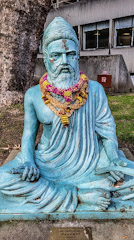
Call me ignorant but I had never heard of Thiruvalluvar, whose bust stands in a garden next to the School of Oriental and African Studies in Bloomsbury. According to a plaque next to the bust, this man was author of “Thirukkural”, which was a classic of Tamil philosophy and ethics. The bust was donated by the Governent of Tamil Nadu in 1996, and unveiled by the then Indian High Commissioner Dr ML Singhvi. Celebrated as he is in Tamil Nadu, little is known about his life. It is possible that he was born or lived in Mylapore (now a district of Chennai) in the south of India. According to Wikipedia:
“His work Tirukkuṟaḷ has been dated variously from 300 BCE to about the sixth century CE.”
As for his great work “Thirukkural”, the online version of Encyclopaedia Britannica remarked:
“…Tirukkural (“Sacred Couplets”), considered a masterpiece of human thought, compared in India and abroad to the Bible, John Milton’s Paradise Lost, and the works of Plato.”

I have described monuments to three notable men from India, but omitted one woman, whose memorial is close to those already described. The WW2 heroine Noor Inayat Khan (1914-1944) is commemorated by a bust, which, surprisingly, I have never noticed, in Gordon Square. Sculpted by Karen Newman, it was placed in the square in 2012. This artist also sculpted a bust of Violette Szabo (1921-1945), which is on the embankment of the Thames near Lambeth Palace. Both Noor and Violette worked for the British SOE, and perished in Nazi concentration camps.
Once the epicentre of the British Empire, it is not at all surprising that one comes across memorials to notable Indians whilst wandering about in London and other places in the UK.

Rabindranath Tagore in Hove and Hampstead

FROM HOVE TO HAMPSTEAD

THE NOBEL PRIZE winning Rabindranath Tagore (1861-1941) was born in Calcutta (Kolkata). Raised in a culturally rich, wealthy household, he began writing poetry when he was eight years old. His family wanted him to join many of his compatriots, who travelled to England to become barristers. By becoming barristers, many Indian men were able to begin on the pathway to wealth and/or political influence both within the British colonial system, or against it.

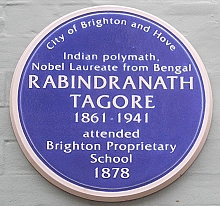
Tagore was enrolled in a school in Brighton in 1878. Whilst there, he resided in Medina Villas in Hove. His biographers, Krishna Dutta and Andrew Robinson, wrote in their book (published 1996) that one of Rabindranath’s (‘Rabi’s’) nieces:

“…retained fresh memories of Rabi Kaka (Uncle Rabi) in the family house at Medina Villas, between Brighton and Hove, where he settled for several months.”

Tagore wrote:

“Our house at Hove is near the sea. 20/25 houses stand in rows and the name of the complex is Medina Villas. When I first heard that we would be living in Medina Villas, I imagined a lot, such as there are gardens, big big trees, flowers, fruits, open space and lakes etc. After coming to my place I found houses, roads, cars, horses and no sign of Villas” (http://rabitalent.blogspot.com/2017/06/rabindranath-in-england.html).

The school that Tagore attended briefly, for about two months, was in Brighton’s Ship Street, close to the town’s famous ‘Lanes’ and a few feet from the seafront. Recently, a commemorative plaque was attached to the building which housed the school and is now part of a hotel, which used to be its neighbour. The plaque named the educational establishment “Brighton Proprietary School”.

I attended a preparatory school before moving on to a high school, but until I saw the plaque in Brighton I had never heard of proprietary schools. It seems as if they were private schools that were run as businesses, rather than not-for-profit organisations. A note on the National Archives website (https://discovery.nationalarchives.gov.uk/details/r/b1c290ea-4580-4c52-962b-10c0d281ac2a) revealed:

“The school was opened on 18 July 1859 under the title of the Brighton Proprietary Grammar and Commercial School for the Sons of Tradesmen. The proprietors … each had a share in the school and were entitled to take up places there. The education given had a Protestant bias and the first headmaster was the Rev John Griffiths, formerly of Brighton College.”

Brighton Proprietary School later became the Brighton, Hove and Sussex Grammar School (www.britishmuseum.org/collection/term/BIOG250324). Dutta and Robinson wrote:

“After spending a short time in a school in Brighton and Christmas with his family, he was taken away to London by a friend of his elder brother, who felt he was making little progress towards becoming a barrister. There he would stay during most of 1879, with a break to visit Devon, where his sister-in-law had taken a house, and, most probably, time spent with some cousins…”

Fast-forwarding to 1912, Tagore, by then a world-famous cultural figure, visited London. During his stay, he resided in Hampstead’s Vale of Health, as I recount in my book “Beneath a Wide Sky: Hampstead and its Environs” (available from  https://www.amazon.co.uk/dp/B09R2WRK92). Here is a brief extract from what I wrote:

“The only vehicular access to the Vale is a winding road leading downhill from East Heath Road. This lane is bordered by dense woodland and by luxuriant banks of stinging nettles in spring and summer. At the bottom of this thoroughfare, there are houses. Most of the expensive cars parked outside them suggest that the Vale is no longer a home for the impoverished. At the bottom end of the road, there two large Victorian buildings whose front doors are framed by gothic-style archways. They have the name ‘Villas on the Heath’. One of them bears a circular blue commemorative plaque, which has leafy creepers growing over it. It states:

“Rabindranath Tagore 1861-1941 Indian poet stayed here in 1912.”

I have visited the palatial Jorasanko where Tagore was brought up in Calcutta. The large (by London standards) ‘villa’ in the Vale is tiny in comparison. An article published in a Calcutta newspaper, The Telegraph, on the 13th of September 2009 reported with some accuracy:

‘In Hampstead, north London, regarded as a cultural “village” today for left-wing but arty champagne socialists, there is a plaque to Rabindranath Tagore at 3 Villas on Vale of Heath.’”

I have known about Tagore’s stay in Hampstead for a long time, but it was only during a recent visit to my wife’s relatives in Hove, that we first learned of the plaque commemorating Tagore’s brief educational experience in Brighton.

A hotbed of demoralisation and crime in north London

A WINDING LANE leads from Hampstead’s East Heath Road into the picturesque Vale of Health. I wrote about this isolated, small settlement surrounded by Hampstead Heath in the summer of 2017 (https://hampsteadadam.travellerspoint.com/2/) and have not revisited the place until today, the 2nd of January 2021. Little appears to have changed since then, but I have learnt a little more about the place.

As for its name, the place was not always as healthy as its name suggests. I wrote:

The land on which the Vale is situated is mentioned in the Domesday Book (1086 AD). It was then owned by the Abbots and monks of Westminster. By the 18th century this swampland in the middle of the part of the Heath, then known as part of ‘Gangmoor’, was inhabited by impoverished people and was malarial. In the 1770s, the area was known as ‘Hatches’ or ‘Hatchett’s’ Bottom, because Samuel Hatch, a harness-maker, had owned a cottage there before 1770. This unsavoury hollow was described in about 1817 as a “stagnate bottom, a pit in the heath” by the sculptor Joseph Nolleken’s wife (see: http://www.british-history.ac.uk/vch/middx/vol9/pp71-73). It was a vale, but not a healthy one.”

However, by 1801 when the land had been drained and property developers began building houses in the area, it gained the salubrious-sounding name by which it is known today.

Apart from the famous Indian artistic genius Rabindranath Tagore (1861-1941), who stayed in the Vale in 1912, the settlement was home to many other well-known people including the author Compton Mackenzie; the barrister Alfred Harmsworth; DH Lawrence; the philosopher Cyril Joad; and Stella Gibbons. Earlier notable residents included the law reformer Sir Samuel Romilly (1757-1818); the poet and essayist James Leigh Hunt (1784-1859), who entertained leading literary figures such as Hazlitt, Keats, Lord Byron and Shelley in his house in the Vale; the publisher Charles Knight (1791-1873); and, also, a Prince Eszterhazy.

During the 19th century, not only were the literati and wealthy attracted to the Vale but also it was a popular place for hoards of trippers, whose names never made it into the annals of history. The author of “The Northern Heights of London” published in 1869, William Howitt (1792-1879), describes these pleasure-seekers and what they did in some detail. He wrote that:

“This Vale of Health used, till of late years, to present a sight at once picturesque and pleasant. In front of a row of cottages, and under the shade of willows, were set out long tables for tea, where many hundreds, at a trifling cost, partook of a homely and exhilarating refreshment. There families could take their own tea and bread and butter, and have water boiled for them, and table accommodation found for them, for a few pence…”

And then, everything changed for the worse according to the puritanical-sounding Howitt:

“Recent times have seen Sunday dissipation reasserting itself, by the erection of a monster public house with a lofty tower and flag, to attract the attention of Sunday strollers on the Heath. Of all places, this raised its Tower of Babel in that formerly quiet and favourite spot, the Vale of Health … that taps and gin palaces on a Titan scale should be licensed, where people resort ostensibly for fresh air, relaxation, and exercise, is the certain mode of turning all such advantages into popular curses and converting the very bosom of nature into a hotbed of demoralisation and crime…”

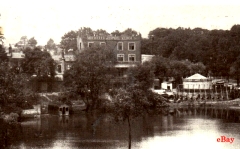
This demoniacal-sounding establishment is marked as ‘Suburban & Hampstead Heath Hotel’ on a map surveyed a year before Howitt’s book was published. On a map surveyed in 1912, it is marked simply as ‘Hotel’. Just a few houses away southwest of it, another building is marked ‘Hall’, to which I will refer shortly. According to both maps, the hotel stood where today there is a twentieth century block of flats called Spencer House. Opposite this edifice, there is a caravan park, which has been in the possession of the Abbotts family for over 160 years. Since the late 19th century, this patch of land has been fairground land. About ten members of the family live on the site in caravans, and other travelling fair workers can camp there free of charge. In exchange, members of the Abbott family, who operate travelling fairs, are allowed camp for nothing on other fairground owners’ sites when they travel around the country.

Returning to the building that upset Howitt, “A History of the County of Middlesex: Volume 9” (https://www.british-history.ac.uk/vch/middx/vol9/pp71-73) notes:

“… the Suburban hotel (also called the Vale of Health tavern) with towers and battlements and accommodation for 2,000 was built in 1863 …”

This source also notes another establishment, which was being built whilst Howitt was writing or just about to publish. This was the ‘Hampstead Heath Hotel’, which was built in 1868. This stood between two groups of ‘villas’, that is between 1-6 Heath Villas and 7-12 Heath Villas. It was the building marked as ‘Hall’ on the 1912 map. It is now occupied by a mid-twentieth century block of flats, smaller than Spencer House, named ‘Athenaeum’.

The Hampstead Heath Hotel closed in 1877, when it passed into the ownership of Henry Braun. His great grandson, Frances Francis wrote (www.francisfrith.com/uk/hampstead/vale-of-health-hotel_memory-7431):

“My great grandfather Henry Braun owned the Vale of Health Hotel … overlooking the lake, from 1877 until the early 1900’s. The hotel was used as an Anglo German club called the Athenaeum and by 1908 had 1200 members – 500 English, 700 German, including many political radicals. The hotel became a factory during World War I and then remained derelict for some years. The hotel was eventually pulled down in 1958, when I was 15 and I remember with sadness watching ‘luxury’ flats being erected in its place.”

The club closed in 1914 and then became used as a factory until it was demolished and replaced by the present building in 1958.

According to the County History to which I have already referred, The Athenaeum club’s larger neighbour, the hostelry that Howitt detested was:

“The large Vale of Health tavern, originally intended as a hotel and sanatorium, was sold in 1876, became associated with the fair, was let as flats, and c. 1900 became a hotel again on a smaller scale, with the upper rooms let as studios … Spencer House (flats) replaced the Vale of Health hotel in 1964.”

Howitt would have been even more dismayed to have learnt that there was a third hotel built in the Vale of Health in the 1880s. It stood next to the Athenaeum on the site now occupied by Byron Villas. It was at number 1 Byron Villas that the writer DH Lawrence lived in 1915.

Today, Howitt would most probably be happier with the Vale of Health than he was in 1869. The hotels have gone, and there is not even the tiniest of stalls where refreshments may be obtained. He might disapprove of the parked cars and the caravan site opposite Spencer House, but there would be hardly anything that he could find to decry.  By the edge of its large pond, one of the sources of the River Fleet, the Vale of Health remains a quiet oasis in the heart of north London.

Around London’s Euston Station

AFTER EATING DELICIOUS KEBABS and a wonderful mutton biryani at Raavi Kebab, a Pakistani restaurant in Drummond Street close to Euston Station, we took a short post-prandial stroll around the area, a part of London that is home to University College London (‘UCL’), where my wife and I did our first degrees and we first met.

BLOG TAGORE

The west part of Drummond Street has become a desolate building site because of the works being undertaken to construct the HS2 railway. A building covered in tiles the colour of clotted blood stands in the midst of the building works. It looks like some of the entrances to older London Underground stations. It is located on the corner of Drummond and Melton Streets. It was the original entrance (opened between 1907 and 1914) to Euston station of the Charing Cross, Euston and Hampstead Railway, now part of the Northern Line, which is now accessed from within Euston railway station. The latter was built in the 1960s on the site of the demolished Euston Station (with its impressive Doric arch) built in the 19th century.

When the old Euston Station existed, Drummond Street stretched further east than it does today. It ran past the southern façade of the 19th century station and across the present Eversholt Street, ending at Churchway (not far from the current British Library).

All that remains of what must have been a splendid old station is a statue of the railway engineer Robert Stephenson (1803-1859) and two pavilions on Euston Road. These formed part of the entrance to the old station’s forecourt. Built of Portland stone in about 1870, they were designed by JB Stansby. The corners of these two buildings bear the names of the stations that were served by trains from Euston Station. Interestingly, these include cities such as Cork and Dublin, which are no longer within the United Kingdom. When the pavilions were constructed, the whole of Ireland was under British rule.

Strolling along Gordon Street, we passed the Ingold Chemistry building, part of UCL, where my wife and I spent many happy hours trying to synthesize various organic compounds, often ending up with tiny granules of non-descript materials, which might have been bits of broken glass rather than the desired product. Across the street, where there had once been an open-air entrance to the main campus of UCL there is a new building, glass-fronted at street level. Through the glass, we could see the mummified, clothed remains of the philosopher Jeremy Bentham (1748-1832) in a glass container, instead of the old wooden one in which he used to be housed. Bentham was strongly associated with the foundation of UCL in 1826.

As I stared at Bentham, an opponent of slavery, through the windows of the new building, I wondered what his views were, if any, on colonialism in India. Some of Bentham’s followers, such as John Stuart Mill, had been employees of the East India Company. Mill and Bentham, were not opponents of British colonialism, but did criticise it.

It was almost dark when we walked into the garden of Gordon Square, a place overlooked by the homes of some members of the famous Bloomsbury Group, a set of British intellectuals and artists, which thrived during the first half of the 20th century. We discovered something that had not been present when we last visited the square some years ago. This is a bust of the Bengali genius Rabindranath Tagore (1861-1941). Created by Shenda Amery, it was unveiled by the Prince of Wales in July 2011, seventy years after Tagore’s death and one hundred and fifty years after his birth.

Tagore coined the name ‘Mahatma’ for the Indian Nationalist and freedom fighter MK Gandhi and also composed (in 1911) both the words and music of the Indian national anthem, “Jana Gana Mana”. The eminent historian Ramchandra Guha explains in his “Makers of Modern India” that:

“Tagore was a patriot without quite being a nationalist. He was no apologist for colonial rule… he was dismayed by the xenophobic tendencies of the populist edge of the Indian nationalist movement. He thought that India had much to learn from other cultures, including (but not restricted to) the West.”

Following the horrendous massacre of innocent Indians by soldiers under the command of the British at Jallianwala Bagh in 1919, he returned his knighthood to King George V.

Tagore was sceptical about ‘non-cooperation’ as advocated, for example by Gandhi. He was also worried about the concept of nationalism as applied to India. In his book “Nationalism”, published in 1917, he wrote:

“When our nationalists talk about ideals they forget that the basis of nationalism is wanting. The very people who are upholding these ideals are themselves the most conservative in their social practice. Nationalists say, for example, look at Switzerland where, in spite of race differences, the peoples have solidified into a nation. Yet, remember that in Switzerland the races can mingle, they can intermarry, because they are of the same blood. In India there is no common birthright. And when we talk of Western Nationality we forget that the nations there do not have that physical repulsion, one for the other, that we have between different castes. Have we an instance in the whole world where a people who are not allowed to mingle their blood shed their blood for one another except by coercion or for mercenary purposes? And can we ever hope that these moral barriers against our race amalgamation will not stand in the way of our political unity?”

Tagore’s views on Indian independence were not as clear cut as many of the other advocates of freeing India from British rule, such as Gandhi, Jawaharlal Nehru, Subhas Chandra Bose, and Vinayak Savarkar. He was essentially in favour of it but as Radha Chakravarty wrote in “The Essential Tagore”:

“For Tagore, the view of nationalism and patriotism that the movement was taking on was too narrow. He disengaged with the movement but remained expressive on the issue of independence through his art and writings … Fundamental to his belief was that nationalism could not rise above humanity…”

We left Tagore as his bust began to become less visible in the deepening gloaming and walked along Torrington Place past Waterstones bookshop that is housed in the pinnacle-rich building that once housed Dillons, the university bookshop. Almost opposite the north eastern corner of the bookshop, a private roadway leads into the UCL campus and under a circular archway. This was a familiar landmark for us when we were undergraduate students because it allows the roadway to pass beneath the building that housed ‘our’ Department of Physiology. Being August and in the midst of both the university holidays and the coronavirus pandemic, this normally busy roadway was empty.

We walked north along the east side of Gower Street passing a door marked ‘Anatomy’. This used to be an entrance to the Physiology Department, where I spent six years studying. During the last three of these, I used to have a key to the door so that I could let myself in whenever I wanted to do laboratory work on my PhD project. In those far-off days, security was far laxer than it is nowadays.

After passing the main entrance to UCL, we reached the corner of Gower Street and Gower Place. This building, now a part of UCL, used to house the medical bookshop, HK Lewis & Co Ltd. This, according to a plaque on the wall, was founded in 1844 in Gower Street, soon after UCL’s medical school was established in 1834. HK Lewis had a useful second-hand department, where I bought a few of my textbooks at prices not much lower than they would have been if they had been new.

We returned to our car parked in Drummond Street. Our favourite Asian grocery and Ambala’s sweet shop were already closed for the day. Raavi Kebab, a haven for carnivores, and its neighbour, the long-established Diwana Bhel Poori House, a haven for vegetarians, were still serving diners. These restaurants and several others in the street serving foods from the Indian subcontinent are run by folk whose ancestors were subjects of the British Empire prior to 1947. The street is a fine example of the idea suggested by the French colonial writer Frantz Fanon (1925-1961), namely, that eventually the colonial chickens come home to roost. And, thank goodness they have because they help to give London the vibrancy that makes it such a great city.

A narrow escape

IN AUGUST 2011, MY WIFE was invited to attend a Loreto House school reunion in Calcutta (Kolkata). As I had never been to the city before, I accompanied her. While my wife took part in the daily activities with some of her former schoolmates, I explored and fell in love with Calcutta.

Throughout our five day visit to the city, the monsoon rain fell heavily and incessantly. I walked around Calcutta, often wading through filthy water that submerged my feet and lapped around my ankles. This hardly affected my enjoyment of the delightful decaying city, in some respects India’s own distinctive version of old Havana in Cuba.

One day, I visited Jorasanko, the palatial residence of the Tagore family, whose members included not only the Nobel Prize winner Rabindranath but also artists such as Abanindranath and Gaganendranath.

After seeing around the fascinating rooms of Jorasanko, I sploshed through the flooded streets towards the Hooghly River. On my way, I walked along a busy street lined with shops and filled with crowds of people. A steady stream of rickshaws pulled by thin sinewy men and each laden with two or three passengers made its way through the busy throng. The huge wheels of these vehicles keep the passengers high above the water flooding the streets.

I noticed that some shops, often clothes and textile merchants, were giving hot food to some passersby. At one of these shops, I asked about the food distribution. It was explained to me that during Ramadan, it was considered to be a virtuous thing to feed the poor.

Eventually, after crossing a wide road clogged with slow moving heavy traffic, I stepped onto the Howrah Bridge, a gigantic steel bridge, a Meccano lovers dream, which traverses the River Hooghly. It was constructed between 1935 and early 1943.

At first, the bridge crosses over a large market that runs along the riverbank. Then, after a few yards, it is over the water. I walked along the downstream facing pedestrian walkway, dodging many porters carrying heavy and bulky loads on their heads. I took numerous photographs until I was two thirds of the way across the bridge and met a policeman with an ancient rifle slung over his back. Politely, he informed me that photography was forbidden on the bridge. By then, I had sufficient images stored in the memory of my camera.

Once over the river, I headed through the streaming rain and thick crowds to a boat station close to the Howrah railway terminus. My plan was to travel on a river bus downstream to a landing stage not far from Park Street.

I bought a ticket which was printed on very poor quality paper, that had to be kept dry to avoid it falling to pieces. I asked someone on the floating platform at the water’s edge if the boat that was approaching was heading for my planned destination. I received what I believed was an affirmative reply, and then boarded a relatively empty boat with plenty of free seats. We set off.

To my surprise, the boat headed upstream rather than downstream. Soon, we passed beneath the Howrah Bridge. We sailed a long way upstream away from the city centre. The banks of the river were lined with unattractive industrial buildings and these were punctuated by occasional bathing ghats.

I disembarked at the boat’s first stop. Had it not been raining so heavily, I would have exited the boat station to take a look around the area. Instead, I bought another flimsy ticket to return to Howrah. This time, I asked several people at which of the two floating embarkation pontoons I should board the downstream boat. I waited close to the water while a large crowd of fellow passengers gathered behind me. I wanted to be sure of embarking first.

The boat approached where we were all standing. I could see from afar that it was packed to the gills with people. When the boat was about 18 inches away from the pontoon, I felt a great push from behind me and I was catapulted across the water towards the approaching vessel. Luckily, I was able to grab something on the boat and this saved me from falling into the water and being crushed between the boat and the pontoon.

The boat was stuffed with people. I am sure that sardines are less tightly packed in tins. I wanted to try to take a photograph to capture an image of this crowd, but I could not because so great was the pressure exerted by those around me that I was unable to raise my hands from beside my body.

I looked around and noticed there were few life saving flotation items. Had our boat sunk, few on board would have survived.

It was a great relief to disembark at Howrah. I was drenched, somewhat shaken, and hungry. I decided to take a taxi to Flurys in Park Street, a European style tea room that served what I was yearning at that moment: toasted club sandwiches.

I boarded a battered yellow Ambassador taxi in a car park near the railway station. We moved forward into a mass of other similar taxis. The crowded taxis were so close to each other that it felt that they were all welded together. It took almost an hour for my driver to skilfully manoeuvre his taxi a couple of hundred yards on to the bridge.

At last, we arrived at Park Street, where, slightly drier because of sitting for ages in the taxi, I settled down at a table in Flurys. I ordered my sandwich and savoured the peaceful atmosphere in the tea room.

On my third visit to Calcutta at the end of 2019, we visited Flurys but, sadly, we were disappointed to find that its food and service was no longer as good as before. Fortunately, the scruffy Nizams at New Market, which serves parathas stuffed with meat and omelettes, remains as good as it was in 2011 and many years before.

Despite my near escape from severe injury or worse, my enthusiasm for Calcutta and its people continues to grow and grow.