Shifted to Somerset from London

EVERY YEAR SINCE 2000, excepting 2020, The Serpentine Gallery in London’s Kensington Gardens has erected a temporary summer pavilion. Each pavilion is designed by a different architect or group of architects. What they have in common is that their pavilion is the first of their designs to be constructed in London, or maybe the UK. They stand in front of the Serpentine Gallery during the summer months and into early autumn. They are always fascinating visually and always contain a café with seating. Over the years some of them have been used as event spaces.

At the end of the season, the pavilions are dismantled and are never seen again in Kensington Gardens. Some of them might be sold and others re-erected elsewhere, but until recently I have never seen one again.

A few years ago, a contemporary art gallery, Hauser and Wirth, which has a branch in London’s West End, bought a farm on the edge of Bruton in Somerset. They have used some of the farm buildings and constructed some new ones to accommodate another branch of their gallery. In addition to the exhibition spaces, there is a superb restaurant, an up-market farm shop, and a wonderful garden created by the Dutch garden designer Piet Oudolf (born 1944).

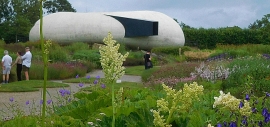
The garden slopes upwards from the gallery. At the top of the slope, there is something that at first sight looks like a giant hamburger patty or the profile of an oversized bagel. I recognised it immediately as being one of the former summer pavilions that once stood next to The Serpentine Gallery in Kensington Gardens. It is the 2014 Serpentine pavilion designed by Smiljan Radic (born 1965 in Santiago, Chile).

When I saw it in London in 2014, I was not overly impressed by it. However, seeing it at Hauser and Wirth in Somerset, it looks great. My description of it as an oversized bagel is not too far from the truth. It is, basically, an annular structure like a ring or a bagel, but it is far more interesting than that. Supported on rocks, the ring is not in one plane, but it undulates gradually. Irregularly shaped holes in its translucent skin provide intriguing views of Oudolf’s garden, which looks good in all seasons, and the surrounding hilly Somerset countryside.

A visit to Hauser and Wirth in Somerset makes a fine day out even if you have only a scant interest in contemporary art. The food served in the restaurant is of a high quality and not unreasonably priced. The buildings on the estate are lovely and the garden is hard to beat for its beauty.

Cows on the café

GUILAN IS A NEW cafe on the corner of Moscow Road and St Petersburgh Place in London’s Bayswater. I have walked past the building numerous times over the past more than 25 years, but until today I missed seeing something on the building.

Above the ground floor windows there are a number of sculpted heads of cattle. I had never noticed these before.

On looking at a map produced in the 1950s, I discovered that the building was then a dairy. An older map revealed that it was ‘The Aylesbury Dairy’. A search on the Internet informed me that this building was the head office of the company, which had another branch not far away. So,  the cattle heads are a souvenir of the building’s time as a dairy.

The new café in the former dairy is across the road from Aghia Sofia, a Greek Orthodox church. The cafe is elegant and serves good coffee and tasty pastries including a croissant flavoured with za’atar. I have no idea from which dairy the milk is supplied to Guilan, but you can be sure it is not the Aylesbury Dairy.

Packed with art in St Ives, Cornwall

THE TATE GALLERY has two branches in the picturesque fishing port of St Ives in Cornwall. The artworks displayed at Tate St Ives are contained in a building overlooking Porthmeor Beach, constructed between 1983 and 1993. It replaced a disused gasworks, but I feel that the gallery’s almost fascistic architecture neither does anything to enhance the town or to match the beauty of many of the items displayed within it. The other part of The Tate in St Ives is house and gardens of the sculptor Barbara Hepworth (1903-1975). A visit to her former home and its garden, filled with her sculptures, is a delightful experience.


Barbara Hepworth and her sculpture in the Penwith Gallery

Not far from the Tate St Ives, there is another ‘must-see’ attraction for lovers of modern and contemporary art. This is the Penwith Gallery on Back Road East. Less visited than the two Tate institutions in St Ives, the Penwith is the home of the Penwith Society of Arts, one of whose founders was Barbara Hepworth. The gallery contains one of the loveliest Hepworth sculptures that I have seen to date. Maybe I like it because it recalls the works of the Romanian born sculptor Constantin Brancusi (1876-1957), a sculptor whose works are much to my taste. To be frank, I am not a great lover of Hepworth’s sculpture and this piece in the Penwith is less typical of what I do not like about her work.

Returning to the gallery itself, its website reveals (https://penwithgallery.com/):

“The society was founded in 1949 by Barbara Hepworth,Ben Nicholson, Peter Lanyon, Bernard Leach, Sven Berlin and Wilhelmina Barns– Graham, amongst others. Later members have included Patrick Heron, Terry Frost and Henry Moore (honorary member). This association with so many progressive and influential artists has given the Penwith Society a unique place in British art history.

Today the society continues to play a central role in the thriving and vibrant St. Ives art community, exhibiting contemporary art from Cornwall and beyond.”

The gallery is housed in a former pilchard packing factory. Its ceiling is supported with roughly hewn granite pillars, painted white. Part of the ceiling is glass-covered, allowing natural light into the largest of the three main display areas. The rest of the ceiling does not transmit light.

The gallery displays an ever-changing collection of artworks, which are on sale. Created by members of the Society or artists, who have worked in the Society’s studios, they include sculptures, prints, paintings, and ceramics. Some of the works are figurative and many of them are abstract. Some are halfway between the two extremes. I have enjoyed abstract art since my childhood. This is probably because my mother, who was a sculptor who enjoyed creating abstract pieces. The lovely Hepworth piece that stands next to a fine photograph of its sculptor, and several other works, form part of the Penwith’s permanent collection. A small range of books and cards are available for visitors to purchase.

Every time I visit the Penwith, I enjoy the gallery’s spaces and the works displayed within them.  Instead of being packed with pilchards, as it was in the past, and other tourists, as are the two Tate establishments, the Penwith is comfortably packed with pleasing works of art, which you can take home if you can afford them, and some of them are not excessively costly.

King Alfred gazes over Winchester

KING ALFRED RULED the West Saxons from 871 to c886 and king of the Anglo-Saxons from c886 to 899. He was known as ‘Alfred the Great’. Amongst his many achievements was encouraging education and proposing that primary education was taught in (Old) English, rather than Latin. Winchester was Alfred’s capital and the place where he was buried there for a while. After the Norman Conquest in 1066, his remains were removed to Hyde Abbey near Winchester. This was destroyed in 1538 during the Reformation. Despite this, his grave remained intact until 1788, when the land where he was interred was redeveloped to build a jail. Since then, the whereabouts of his remains is unknown.

Despite, the disappearance of his bones, King Alfred dominates the centre of Winchester in the form of a huge statue near to the city’s cathedral, rich in gothic features, and its Guildhall, which is richly adorned by Victorian gothic features. The statue was erected in 1899. A plaque at its base reads:

“To the founder of the kingdom and nation D. October DCCCI. Winchester and the English name MDCCCI”

DCCCCI, being Roman for 901 and MDCCCCI, being Roman for 1901.

The tall bronze statue was designed by Sir William Hamo Thornycroft (1850-1925), a sculpto who might have been unknown to me had I not become aware of him whilst walking near London’s Holland Park back in 2017. He was an important figure in the New Sculpture movement, whose members’ oeuvres bridged the gap between the neo-classical tradition, popular during the 19th century, and early modernist trends at the end of the 19th century and beginning of the next.

I was roaming around Kensington taking photographs of buildings of interest prior to writing a piece about them when I spotted a plaque on a house in Melbury Road. Number 2a was Thornycroft’s studio, which was designed by his friend, the architect John Belcher (1841-1913).

Although I did not realise that they were created by Thornycroft before I wrote this today, I am familiar with two of his other creations: the statue of Oliver Cromwell outside The Houses of Parliament and “The Sower” at Kew Gardens. His Alfred statue is far larger than the other two.

I wonder what the great king would have thought if he knew that at his feet today, there is a short-term car park and that his capital’s cathedral now charges a fee for visitors to enter within it.

Reform and destruction in an English cathedral

SPLIT IN FORMER Yugoslavia, now in Croatia, is a city that developed in the ruins of a great establishment, the Roman Diocletian’s Palace. Likewise with the city of Ely in Cambridgeshire: it developed within the remains of another great establishment, the large Abbey of Ely, which was dissolved by King Henry VIII in 1539. By 1541, after having its charter renewed by the king, its then bishop, Thomas Goodrich (1494-1554), instigated an orgy of iconoclasm, to which I will return soon.

In 1975, I visited the city of Prizren in the former Yugoslavia, now in Kosovo (Kosova). I was impressed by what I saw in one of the place’s fine mediaeval churches. The caretaker showed me that the frescos on the walls inside the building were badly damaged, but only up to a certain height above the ground, Above this, they were as intact as one could hope for paintings of that age. He explained to me that many centuries ago, the Ottoman soldiers were ordered to destroy the figurative images depicted on the walls. They used the tips of their spears to do the job, but they only destroyed what they could reach from the ground (i.e., without using ladders). Sadly, the iconoclasts working under the orders of Henry VIII and Bishop Goodrich were more diligent in their destructive activities.

Under Goodrich’s orders, first the shrines to Anglo-Saxon saints were mutilated. Then, the vandals attacked all the stained glass and many of the statues in the cathedral, before getting to work on the large Lady Chapel on the north side of the body of the church.

The spacious, airy, light-filled, Lady Chapel is at first glance a magnificent example of 14th century gothic architecture, which was created in 1321. The excellent article in Wikipedia (https://en.wikipedia.org/wiki/Ely_Cathedral) describes an important and interesting aspect of the chapel:

“Below the window line, and running round three sides of the chapel is an arcade of richly decorated ‘nodding ogees’, with Purbeck marble pillars, creating scooped out seating booths. There are three arches per bay plus a grander one for each main pillar, each with a projecting pointed arch covering a subdividing column topped by a statue of a bishop or king. Above each arch is a pair of spandrels containing carved scenes which create a cycle of 93 carved relief sculptures of the life and miracles of the Virgin Mary. The carvings and sculptures would all have been painted.”

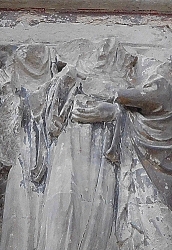
When we entered the Lady Chapel, we were in so much awe of its beauty that we did not at first notice something, which a church official soon pointed out to us. In each of the booths or alcoves lining the walls, the statues are either missing their heads or their faces have ben erased crudely. The deliberate damage to these statues was ordered by Bishop Thomas Goodrich. He also removed some of the larger statues that once adorned this fine chapel. It was seeing this destruction that reminded me of my trip to Prizren so long ago.

After looking at the Lady Chapel, we explored other parts of the cathedral, where I found other examples of statues that had lost either their faces or their heads. The iconoclasm that occurred in the so-called Reformation, which began in the 1530s, can be seen in many English churches, especially with regard to the acres of stained glass that were wantonly destroyed during that period of religious reform. Maybe, this destructive era should also be known as the ‘de-formation’. Some valuable examples of the pre-Reformation stained-glass can be seen in Ely Cathedral’s fascinating Stained-Glass Museum, which is well worth visiting. Incidentally, apart from European stained glass from across the centuries, the museum has recently acquired a fine example of stained glass from the USA, depicting a black African American.

Although I have concentrated on aspects of destruction, there is plenty of Ely Cathedral left for the visitor to enjoy, including fine gothic and pre-gothic (Norman) architecture. Many mediaeval and Tudor buildings that were once part of the abbey still exist and are now part of the daily life of modern Ely, just as some parts of Diocletian’s Palace in Split are still in use today. Some of these buildings in Ely are used by Kings School Ely, which was one of about 12 schools founded by Henry VIII. These few schools were the only part realised of a more ambitious plan to build many more schools and other new establishments.

We spent a whole day in Ely but could easily have stayed longer without being able to see all of its attractions. Prior to our departure for the city, a friend had told us that it was an unlikeable place not worth visiting. We discovered how wrong he was.

Art and memory in East Anglia

MY LATE MOTHER worked in the Sculpture Department of London’s St Martins School of Art in the days when it was located on Charing Cross Road, near Foyles bookshop. Amongst her colleagues at St Martins were Sir Antony Caro (1924-2013) and one of his pupils, Phillip King (b 1934). Both of these artists helped my mother to learn sculptural metal welding techniques in the early 1960s.

THIS SCULPTURE, which is on display in a glade within the gardens of Houghton Hall in Norfolk, reminds me of the kind of work Caro produced, but this was by his ‘disciple’ Phillip King. I like it, but cannot explain why, but it might not be seen as beautiful by everyone. My mother was mainly involved in abstract composition. This might have helped me me to become appreciative of this kind of art. .

Perched on a sculpture

KENSINGTON GARDENS CONTAINS numerous works of art, one of which is a large piece by Henry Moore (1898-1986), a sculptor who is highly regarded by many people. It is a large irregularly shaped arch made of travertine, which stands overlooking the Long Water, the part of the Serpentine lake within the confines of Kensington Gardens. Presented by the artist to the park in 1980, its shape is based on that of an animal bone. I am not wild about Moore’s works, but this piece looks wonderful in its setting on the eastern bank of the Long Water.

Today, 19th of May 2021, whilst walking in Kensington Gardens I saw a heron standing on the western bank of the Long Water almost framed by the Moore arch. After circumnavigating the lake, we reached the point on the eastern shore where the sculpture stands. Through the archway you can see the eastern façade of Kensington Palace. Along the line that connects the palace and the sculpture, you can see another sculpture, “Physical Energy” by George Frederick Watts (1817-1904). The three items on this axis form a kind of timeline: the 18th century palace, the 19th century sculpture by Watts, and the 20th century sculpture by Moore.

I have walked past the Moore sculpture too many times to count, but it was only today that I saw a heron perched on top of it. I have seen geese and pigeons perched on it in the past, but this was the first time I saw a heron using it as a doubtless superb vantage point to survey its surroundings. Apart from the fact that I find herons beautiful, its close association with the sculpture struck a certain curious chord in my mind. Maybe, it was something to do with the fact that the words ‘heron’ and ‘henry’ share so many letters in common (3 out of 5). Whatever the reason, it was pleasing to see nature and art intimately in touch with each other.

Dame Jane lies stone cold in the church

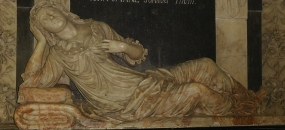
HER HEAD RESTS ON her stone-cold right hand with her elbow on a carved alabaster cushion. Her left hand is held lightly and limply against her left breast. She is a carved alabaster effigy of Dame Jane Cotton (1630-1692), widow of Sir John Cotton of Landwade (1615-1689). This sculpture of Jane Cotton lies against the north wall of the chancel of the Church of St Mary Magdalene in the village of Madingley, close to Cambridge. The church is open until 4pm most days and we got there by 3.45 pm a few days ago in April 2021. So, we were able to have a good look at the interior of this building whose construction commenced in the late 13th century (https://historicengland.org.uk/listing/the-list/list-entry/1127740).

Jane Cotton, who reclines close to the high altar, was the daughter and sole heir of Edward Hinde (c1598-1631) of the Parish of Madingley. Edward lived at Madingley Hall (www.thepeerage.com/p34969.htm#i349687), which is a few yards uphill from the church. Sir John Cotton did well by marrying Jane because by doing so, he acquired the manor of Madingley.

Sir John Hinde (or ‘Hynde’; c1480-1550; see: http://www.geni.com/people/Sir-John-Hynde-MP/6000000090158312935), Serjeant-at-Law and Member of Parliament, had been buying land at Madingley since the 1520s (www.british-history.ac.uk/vch/cambs/vol9/pp166-171). In 1544, the manor of Madingley, which had been held by several trustees for about 100 years, was bestowed on him by law. He commissioned the building of the lovely Madingley Hall, which was constructed between 1543 and 1547. Edward Hinde, Jane Cotton’s father, was a grandson of Sir John Hinde.

Sir John left Madingley to his son Francis, who left it to his son William, who married a widow, Elizabeth. When William died childless in 1606, his widow Elizabeth took over all of the Hinde estates. She remarried and leased Madingley Hall to Edward, who was son of William Hinde’s brother Edward (died 1633).

Jane’s father Edward (died 1633) settled his lands on his eldest son Anthony, who died before him, fighting in Denmark, in 1612, when Denmark was fighting Sweden for control of part of Norway. Anne, Anthony’s widow, ‘sold’ her interests in the lands to her father-in-law Edward (died 1633). Anne and Anthony had a son Edward, to whom Anthony’s father (Edward, died 1633) had left all his lands, but the grandson, Edward, died in an accident in 1631. Jane Hinde then became the heir to her father’s lands. Had Anthony and his son not pre-deceased Jane’s father, she would not have come into possession of the Hinde’s estates, and neither would have they come into the hands of Sir John Cotton. The lands at Madingley remained in the Cotton family until the beginning of the 20th century.

Sir John, husband of Jane, was buried with his ancestors at Landwade in eastern Cambridgeshire. His daughter Jane is interred in the church at Madingley. Her monument stands near the northwest corner of the nave. She is depicted kneeling with a small book in her left hand. Jane was a spinster. She died in 1707. Not far from her monument stands a lovely carved stone font. Covered with geometric decoration, this was made in the 12th century and probably stood in an earlier version of the church. Nearby, the internal walls of the bell tower are decorated with damaged sculptures made of wood. They are:

“… probably the survivors of the cherubim, perhaps on the nave roof, whose removal William Dowsing ordered in 1644.” (www.british-history.ac.uk/vch/cambs/vol9/pp173-176)

Although there is much to enjoy in the church at Madingley, it was Lady Jane Cotton’s reclining effigy that most sparked my curiosity. Looking into what is known of Jane’s heritage has revealed a little bit about the complexities faced by the ‘landed gentry’ when they considered who was to inherit their land.

The families mentioned are what some might describe, often expressing a sense of deference, as ‘old families’. What this means is that the family has sufficient documentary information to trace it back, maybe over many centuries, for many generations.  Well, if you think about it ‘old families’ are no different from other families because all of them must go back an awfully long way in history, even if the documentary evidence no longer exists.

Philosopher’s stone and UFOs

A SCULPTED STONE stands in a small garden on the north side of All Saints Church in London’s Notting Hill. We have walked past it often during the various ‘lockdowns’ and over many years before these were deemed necessary, always remarking on its satisfying appearance but without questioning its significance. Yesterday, the 8th of March 2021, we entered the garden and examined the abstract stone artwork. It stands on a circular stone base inscribed with the words we had never noticed before:

“JOHN MICHELL 1933 _ 2009 WRITER GEOMETER NATURAL PHILOSOPHER”

By chance, the church was open, and we entered. There, we met one of its clerics and asked him whether the word ‘geometer’ meant anything to him. Like us, he had no idea about that or about Mitchell. My curiosity was aroused. There is plenty about John Michell on the Internet, but to a simple-minded chap like me, it is mostly rather weird, but that will not prevent me having a stab at trying to unravel why he was worth commemorating with a stone in Notting Hill.

Michell’s early life was conventional (www.john-michell-network.org/index.php/about-john-michell): educated at Eton and Trinity College Cambridge, where studied languages but missed examinations by oversleeping; trained as a Russian interpreter for the Royal Navy; painted and exhibited his works; and worked briefly as an estate agent and chartered surveyor.  In 1966, by which time he had moved into one of the properties he managed in Notting Hill, its basement became the London Free School, an alternative community action education project (https://en.wikipedia.org/wiki/London_Free_School). Around this time, Michell began publishing works on unidentified flying objects (‘UFOs’) and many other unexplained phenomena. His first book, “The Flying Saucer Vision”, published in 1967, was probably:

“… “the catalyst and helmsman” for the growing interest in UFOs among the hippie sector of the counter-culture.” (https://en.wikipedia.org/wiki/John_Michell_(writer)).

This work introduced links between UFOs and ley lines, proposed by Alfred Watkins, (1855-1935), which some believe criss-cross the countryside and act as markers for extra-terrestrial spacecraft crewed by aliens who assisted human society early in the history of mankind. Along with two subsequent books, notably his “The View over Atlantis”, and other publications, Michell became an influential figure who believed in the:

“ “sacred geometry” of the Great Pyramid. Alfred Watkins’s ‘The Old Straight Track’ had come up with the concept of ley lines in 1925. John took it much further, believing that these alignments of traditional sites were a kind of feng shui of the landscape. They made up a sort of Druids’ transport system, he said, which harnessed a mysterious power that whisked large rocks across the countryside.” (www.theguardian.com/books/2009/may/06/john-michell-obituary)

As time went on, Michell delved deeper and deeper into phenomena like these. His knowledge of the hidden forces was used to help design the pyramid stage used at the Glastonbury Festival in 1971. It was because of him that Glastonbury an epicentre of New Age ideas and events (www.nytimes.com/2009/05/03/books/03michell.html).

Unfamiliar as many of his ideas and theories are Michell was a serious thinker:

“His approach uniquely combined the thought of Plato and of Charles Fort. Blending scholarship and deep intuition, John often returned to his favourite subjects: Platonic idealism, sacred geometry, ancient metrology, leys and alignments, megaliths, astro-archaeology, strange phenomena, simulacra, crop circles, UFOs, the Shakespeare authorship controversy, and the nature of human belief.” (www.john-michell-network.org/index.php/about-john-michell)

You have heard of Plato, but Charles Fort (1874-1932) might be less familiar. This self-taught American researcher and writer, a contrarian, specialised in discovering and considering the many examples of phenomena that defied explanation by conventional (accepted) scientific methods and theories. When Michel wrote an introduction to one of Fort’s books, “Lo!”, he remarked:

“Fort, of course, made no attempt at defining a world-view, but the evidence he uncovered gave him an ‘acceptance’ of reality as something far more magical and subtly organized than is considered proper today.” (quoted in https://en.wikipedia.org/wiki/Charles_Fort).

Not being inclined to philosophy, it would be unwise for me to attempt to explain how Michell’s ideas display the influences of both Plato and Fort.

Michell felt it necessary to question orthodoxy. His book on the identity of the true author(s) of Shakespeare’s plays, “Who Wrote Shakespeare?” examined this question thoroughly but received mixed reviews. Several of his other publications questioned the commonly accepted archaeologists’ interpretations of their findings, suggesting that their refusal to take ideas about ley lines seriously was a grave error. In the 1980s, two academic archaeologists investigated his ideas and found that he had erroneously included natural rocks and monuments that were created far later than during the prehistoric era as markers for his supposed ley lines. When the replacement of feet and inches by the Metric metre was introduced, Michell objected strongly to the abandonment of a measurement that he believed dated back to earliest times and established an Anti-Metrication Board to oppose the change.

Michell had one son, Jason Goodwin, born in 1964. His mother was the writer Jocasta Innes (1934-2013), who was married twice to Richard B Goodwin. Jason, a Byzantine scholar, is a well-known, prize-winning author, whose books my wife has enjoyed greatly.

Michell became a cult figure in Notting Hill, associated with the ‘local vibe’ and The Rolling Stones. He took members of the group to Stonehenge to scan the heavens for saucers (https://www.nytimes.com/2009/05/03/books/03michell.html). He smoked marijuana regularly, publicly encouraged the use of mind-altering drugs, and, surprisingly, his favourite newspaper was the right-wing oriented “The Telegraph”. At Notting Hill, he lived at number 11 Powis Gardens, within easy reach of All Saints Church, where the stone monument to his memory can be found. It was sculpted by John de Pauley, who explained (www.constructingtheuniverse.com/JM%20Memorial%20Sculpture.html):

“’The idea for the sculpture comes from Neolithic stone spheres. Their purpose remains a mystery. The geometrical construction is of a Platonic solid, 12 projecting tumescence making an icosahedron.”

Knowing this and a little about Michell, it seems an entirely suitable memorial to a bold and original thinker.

Finally, that word ‘geometer’: it is simply the name given to a mathematician, who studies geometry. One of Michell’s may paintings has the title “The Geometer’s Breakfast”.

A new arrival above the theatre

I HAVE NEVER SMOKED. Therefore, when smoking was banned in cinemas, I was not upset by this ruling. The Coronet cinema in Notting Hill Gate was one of the last cinemas in London to enforce the ban. Smokers sat upstairs in the circle and non-smokers sat downstairs in the stalls. Despite the smoking, it was a delight seeing films at the Coronet because the cinema was housed in what was once a theatre that first opened in 1898. The original interior décor, though in need of some restoration had been preserved.

The theatre was designed by the theatre architect William George Robert Sprague (1863 – 1933), who also designed the Novello and Aldwych theatres in London. Audiences at the Coronet were able to see famous actors such as Ellen Terry and Sarah Bernhardt on its stage. From 1923, the Coronet became used as a cinema, the screen being positioned in the theatre’s proscenium arch. In 2004, the Coronet was bought by Kensington Temple, who used it for prayer meetings. When not being used for religious purposes, films were screened there for public audiences as before.

In 2014, a fringe theatre group, The Print Room, which left its original premises in nearby Hereford Road, acquired the Coronet and began using it as a theatre once more. A new stage was constructed. It covers the area of the theatre where the stalls seats used to be. The audience sits in the steeply raked seats of the former circle seating area. Where the stalls used to be, has been converted to a quirkily decorated bar area. Because the bar is just beneath the stage, the bar is closed during performances to prevent noise from it being heard in the auditorium during a show. All of this has been done without changing what has been left of the place’s old internal décor.

The Coronet occupies a corner plot. Its exterior has neo-classical decorative features with pilasters, pediments etc. There is a dome high above the main entrance, which is located at the corner of Notting Hill Gate and Hillgate Street. For as long as I can remember (about 30 years), the lead-covered dome was unadorned.

The covid19 pandemic began closing London in about March 2020. The Print Room, like all other theatres in the country, closed. As it is close to shops that we use, we passed it regularly. During the summer, the theatre was covered with scaffolding whilst builders redecorated its exterior. By the end of summer, the scaffolding was removed.

Several weeks later, I could not believe my eyes. A statue had been placed on the top of the dome. The figure on the dome appears to be bound by ropes or cables and his or her face is covered by the sort of mask one might wear if one was a beekeeper. The figure is holding what looks like a large open book or an artist’s palette in its left hand, whilst pointing a pen or artist’s paintbrush into the distance with the right hand. Close examination of the sculpture reveals that at present the ropes are holding down a protective covering. I look forward to seeing what is being concealed.

I was curious about the sudden appearance of a statue on the dome. It turns out that when the Coronet was built, the dome did bear a statue (www.arthurlloyd.co.uk/CoronetTheatreNottingHillGate.htm). When it was taken down, I cannot discover, but it was more than 30 years ago. Planning to replace it began in September 2018 (www.rbkc.gov.uk/idoxWAM/doc/Revision%20Content-2133806.pdf?extension=.pdf&id=2133806&location=VOLUME2&contentType=application/pdf&pageCount=1). The planning document submitted by the Studio Indigo architectural practice reveals:

“Historical images and photos of the Coronet show that there was at some point a statue on top of the dome roof. The statue appeared to be of a life size human figure, the details of which were difficult to precise.

The proposals include for a life size bronze sculpture of the artist Gavin Turk as the famous English portrait artist [posing as] Sir Joshua Reynolds. The statue is based on the Alfred Drury sculpture which stands in the Anneberg Courtyard of Burlington House in the grounds of the Royal Academy, and is a design by contemporary artist Gavin Turk. The new statue celebrates the notional idea of a theatrical/cultural building which had a figure calling the people into the venue.”

Looking at old pictures of the Coronet, it seems that the new sculpture will not resemble the original. If the sculpture that now perches on the dome is by Gavin Turk, a leading British sculptor, it will be in good company. Not far away, there is an abstract sculpture by Antony Gormley on the roof of Holland Park school.  

Noticing that a statue had arrived on the dome of the Coronet hit me dramatically. I was very pleased to see it as it will enhance a theatre which is already remarkable for the high quality of its productions. Furthermore, it is heartening that the only remaining elegant edifice on Notting Hill Gate’s main thoroughfare, mostly ruined architecturally in the 1960s and 1970s, is being well-maintained and tastefully improved.