Down in Hampshire at The Vyne with the Sandys and the Chutes

THREE MILES NORTH of Basingstoke, there is a magnificent stately home, The Vyne, which is now owned by the National Trust. Set in fine grounds alongside a long, thin lake, this edifice is a wonderful mixture of architectural styles and features.

The present house began its life as a Tudor mansion built between 1500 and 1510 for William Sandys, 1st Baron Sandys, Lord Chamberlain to King Henry VIII. It remained a possession of the Sandys family for most of the time from when it was constructed until 1653, when it was sold to Chaloner Chute (died 1659), who was a lawyer and the Speaker of the House of Commons during the Commonwealth. Because he felt that the Vyne was too big for his requirements, he had much, but not all, of the Tudor mansion demolished. Fortunately, several of the beautiful rooms with elaborate wood panelling were saved, along with the Tudor chapel.

The rest of what remained of the original building was converted to a version of the Palladian Style. This included adding a neo-classical portico to the north side of the hose, facing the lake. In the eighteenth century, one of Chaloner’s descendants, John Chute, influenced by his friend Horace Walpole, redesigned the interior of the chapel, adding trompe l’oeil features and also installed a very spectacular staircase in the house. The staircase is in the neo-classical style. It must have impressed those who visited the Chutes, and it still dazzles the visitor today. Although there are many fine artefacts to be seen in the house, this staircase was, for me, the ‘star of the show’.

When John Chute died childless, The Vyne was inherited by his cousin Thomas Lobb, who then changed his surname to Chute. After that, few changes were made to the house. The house remained in the Chute family until 1958 when Charles Chute bequeathed the estate to the National Trust.  

I wondered if it was worth reading books by Charles Dickens?

WHENEVER CLASSIC BOOKS were recommended to me during my childhood, I never bothered to read them because I hated to be told what to read by people who had no idea what interested me. Therefore, until a couple of months ago I had not read anything by highly acclaimed British authors such as the Brontes, Thomas Hardy, Jane Austen, Scott, Trollope, Thackeray, and Dickens. I have read and enjoyed English translations of French authors including Balzac, Flaubert, and de Maupassant.

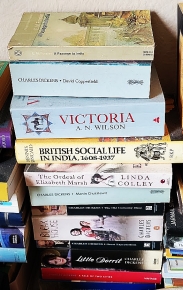
This summer (2024), we paid a visit to the delightful coastal town of Broadstairs in Kent. This place is rich in souvenirs of the author Charles Dickens (1812-1870). It was in this town that he worked on several of his novels. After our brief visit to Broadstairs, I was suddenly filled with the desire to begin reading something by Dickens to see what I have been missing for so many years, and to discover whether I ought to have followed the many recommendations I was given (during my youth) to read his work. I began with “Nicholas Nickleby” because some of it had been written in Broadstairs. After reading and enjoying this 600-page novel, I moved on to “Martin Chuzzlewit” (762 pages), which I have just finished. That I have already begun reading “Oliver Twist”, another novel by Dickens, shows that I have begun to like Dickens’s writing.

I do not find that reading Dickens is easy-going. Often, he says what could be said in a few words in many sentences, thus spinning out the story. Another problem is keeping track of the vast numbers of characters in the stories. It felt to me that every few pages, a new character is introduced. Some of them appear for a few pages and then disappear for a long time, only to reappear much later. So, when they do reappear, it is sometimes difficult to remember anything about them. As for the plots, they are complex, but fascinating. Despite the lack of conciseness, the huge number of characters, and the length of the novels, Dickens knew how to keep the reader engaged from start to finish. He had to do this because at first his stories were published as monthly episodes in magazines. If he had not kept his readers engaged one month, then they might not have bought the next episode a month later. Even though the plot acquires more and more sometimes seemingly unconnected strands, I felt instinctively that eventually they would coalesce. How Dickens kept track of what he was writing and did not ‘lose the plot’ amazes me. And how well he holds the reader’s attention is also a marvel.

Dickens’s mastery of detail amazes me. It is fascinating to read how parts of London, which I know well, were when Dickens was writing about them. His minute descriptions of aspects of daily life in early Victorian England are of great interest. His ability to portray villainous people is something else I have enjoyed. The villains and crooks are, for me, the most enjoyable of the characters in the two novels I have already read. Page after page, I realised that in the end they would receive their comeuppance, but how this happens eventually is a wonderful surprise that is revealed in the final pages of the books. Would I recommend reading Dickens? Well, I have been enjoying what I have read so far. To those who read quickly, I would strongly suggest trying Dickens. But for those who read slowly, I am not so sure. My reading habits have changed over the years. Had I attempted Dickens when I was younger, I doubt I would have read an entire novel. Now, in my retirement, I find that I am reading faster. Although Dickens should not be read too fast because of the incredibly large amount of detail he includes, I find that I can now cope with his writing and enjoy it. I am glad that I ignored the many who tried to persuade me to read Dickens when I was a child. I am pleased that at long last I have discovered how much fun it is to read his novels. I shall certainly be carrying something by Dickens to read during my next long-haul aeroplane journey.

A NEW book about Hampstead in north London

AVAILABLE FROM AMAZON WEBSITES:

e.g.: https://www.amazon.co.uk/dp/B09R2WRK92

Hampstead is one of the highest places in London. There, the heavens are vast
and wide. Beneath this expanse of sky is an area with an eventful past and a
vibrant present. This book takes a fresh look at the locality and shows that
Hampstead is richly imbued with historical memories and has been home to a
multitude of fascinating and noteworthy people. Many books have been written
about Hampstead. Doubtless, there will be more. This one is different. It looks
at Hampstead from unusual as well as familiar viewpoints and gives the reader
a richer appreciation of what makes the place both delightful and intriguing.
This volume explores a wide variety of subjects, familiar and obscure, as well as
some which have never been described in other books about the locality. Here
is a fresh and at times quirky look at this place on a hill, one of London’s
treasures: a district, which is familiar to many people, yet full of surprises.
Although the bulk of this book is about Hampstead, there are also sections
describing some of its environs.

By reading this book, you can find out why John Constable, Samuel Johnson, Boy George, Mohammed Ali Jinnah, Mahatma Gandhi, Peter Sellers, Henry Moore, Maxim Litvinov, General de Gaulle, Stanley Spencer, Thomas Masaryk, Lee Miller, Agatha Christie, Jim Henson, Ian Flemming, Ernő Goldfinger, and many others, both famous and familiar, were all connected with Hampstead.

The book has several sections:
1. a brief survey of Hampstead’s general history and geography.
2. an introduction to Hampstead’s main thoroughfares with some
reminiscences of the area as it was during my youth.
3. the largest section of the book is a collection of chapters about
various aspects of Hampstead’s past and present. Recently, a friend of mine
bemoaned the fact that Hampstead High Street and Heath Street are lined with
branches of shops and cafés that can be found all over London. He is right. So,
if you wish to capture the true character of Hampstead, you need to stray into
the side streets and explore, which is what I hope this book will stimulate you to
do.
4. The last few sections of the book deal with some places of interest near to
Hampstead: Primrose Hill, North End, Go
lders Green, and Highgate.

TABLE OF CONTENTS

PREFACE … 7
INTRODUCTION: OH NO, NOT IN HAMPSTEAD … 7
SOME GEOGRAPHY AND HISTORY … 13
HEATH AND HIGH STREETS WITH SOME MEMORIES … 25
SATURDAY STROLLS … 25
PERRINS LANE, THE EVERYMAN, AND LOUIS … 34
DISCOVERING HAMPSTEAD … 41
A HOUSE ON HEATH STREET AND THE KIT CAT CLUB … 41
A CHURCH ON HEATH STREET … 45
FLASK WALK AND THE HAMPSTEAD SPA … 46
MORE ABOUT THE SPA … 56
THE VALE OF HEALTH … 60
POETS AND THE VALE OF HEALTH … 70
FRENCH CONNECTIONS AND ST MARYS ON HOLLY WALK … 76
ARTISTS IN HAMPSTEAD: ROMNEY, CONSTABLE, AND OTHERS 84
MODERN ARTISTS AND THE ISOKON … 95
BOLSHEVISM AND HEATH STREET … 109
A SINGER AND A PHILOSOPHER ON BRANCH HILL … 114
JUDGES WALK … 118
WHITESTONE POND … 122
EAST HEATH ROAD AND SOUTH END GREEN … 126
SIR HARRY AND ROSSLYN HILL … 137
PILGRIMS LANE AND MORE ON ROSSLYN HILL … 143
NEW END, CHOLERA, AND GROVE PLACE … 150
FITZJOHNS AVENUE AND SWISS COTTAGE … 155
SHEPHERDS WELL … 171
CHURCH ROW … 174
GRACIE FIELDS, FROGNAL WAY, AND FROGNAL … 179
WEST HEATH ROAD AND PLATTS LANE … 187
WEST HAMPSTEAD … 193
SHOOT UP HILL … 198
PRIMROSE HILL … 201
NORTH END AND GOLDERS GREEN … 211
NORTH END AND GOLDERS HILL PARK … 211
POETS AND GOLDERS GREEN … 228
LIFE AND DEATH ON HOOP LANE … 232
HIGHGATE … 241
CODA … 273
SOME BOOKS CONSULTED … 275
ACKNOWLEDGEMENTS … 278
INDEX … 279

Books of choice

Beerwolf_500


I HAVE LOVED READING ever since I was first able to master this skill. During my childhood, we used to drive to Hampstead (in north London) every Saturday morning. We always used to visit the now long-since closed High Hill Bookshop on Rosslyn Hill. Our parents allowed my sister and me to choose one book each Saturday and bought them for us. Week by week, my collection of the adventures of Tintin by Hergé grew until I had all the episodes that had been published in English. There was little, if any, censorship of our choices. However, I had the distinct impression that my parents preferred that we avoided books by Enid Blyton. So, I have not yet had the pleasure of reading any of her extensive literary oeuvre.

I discovered and fell in love with “Mad” magazine, which was not available at High Hill Bookshop. I bought copies of it at a local shop, using my pocket money. My parents appeared not to approve of the magazine, but my father (not my mother) was always happy to read my copies of it when I had finished with them. “Readers Digest”, like Enid Blyton, did not fulfil my parents’ criteria of ‘good’ literature. I enjoyed leafing through this periodical and particularly remember reading and re-reading an article written by someone who was conscious during his brain surgery. I did not need to buy “Readers Digest” at full price as it was possible to buy boxes crammed full of old issues, sold as a job lots for a few pence at local jumble sales.  

There was only one book that was deemed strictly forbidden during my childhood. It was “Struwwelpeter” by Heinrich Hoffman, published in 1845 and reprinted many times since then. It is a series of moral tales about children who misbehave. For example, when Konrad disobeys his mother’s instruction not to suck his thumbs, an itinerant tailor appears and cuts off Konrad’s thumbs. Each tale is illustrated by frighteningly graphic illustrations. On afternoon, my sister and I, who had discovered this book by accident, were interrupted by my mother. She seized the book and tore it into pieces, which she stuffed into the wastepaper basket. Apart from this violent reaction to a book and the hints that Enid Blyton was to be avoided, I could read pretty much anything I wanted.

At school, books were recommended as being worth reading, especially those by famous 19th century British authors. I never read any of these. For some unknown reason, probably contrariness, if someone told me that I ought to read a particular book, this put me off even opening it. I wanted to read what I had chosen myself, not what had been chosen for me because it might be “good for you”. Similarly, if someone tells me that this or that food item is “good for you”, I do not rate that as a positive recommendation.

At Christmas 1963, we were in New York City. A friend of my parents, ‘E’, met us in the book department of FAO Schwarz, a toy store on Fifth Avenue. She wanted her son and me each to choose a book as a gift from her. E showed me a thick encyclopaedia of anthropology, which she had decided either that I would enjoy it or that it would be good for me. Well, I took one look at it and decided to check out the other books on display. I homed in on an illustrated history of the FBI. It was filled with intriguing black and white photographs, some quite gory. I took the book to E, who looked at it disapprovingly and then asked whether I was sure that I did not want the fine book on anthropology. I was sure, and a few minutes later I became the proud owner of the book about the FBI. E’s son, who was clearly more easily influenced by his mother than me, chose to buy the anthropology book. Years later, he qualified as a psychiatrist and I as a dentist. I am not sure what can be concluded from that.

My parents’ suggestion that there was something not quite right about Enid Blyton left a lingering doubt about the author in my mind. In the mid-1990s, I began visiting India regularly. There, I discovered wonderful bookshops, some of which were (and still are) much better stocked than those in London. What surprised me in those shops were the huge numbers of books by Enid Blyton on sale. Clearly, Enid was well-read and her books much purchased in India.  So, when I heard that there was going to be a lecture about Enid Blyton and India at the Nehru Centre in London, I felt that this was not to be missed. The speaker was none other than Enid Blyton’s very articulate daughter. She told us that British educators often frowned upon her mother’s works (just as my parents had done). The reason they were not keen was that it was considered that Enid’s vocabulary was not rich or varied enough. She revealed that when the texts of her mother’s books were analysed numerically, the vocabulary used I them was, in fact, no less rich or varied than that employed by other authors writing for the same age groups.  

In recent years, I have changed. Maybe, I have become a little less stubborn about book recommendations. If someone suggests a book to me, I no longer instantly reject the idea of reading it. There is a good chance that I will look it up to see what others think of it. If it is about a subject that might chime with any of my interests, there is a good chance that I will buy a copy and add it to the ever increasing pile of unopened books waiting to be read by me.  However, you will still not be able to find Dickens, the Brontes, Thomas Hardy, or titles that would “be good for me” on their spines.

Which?

oxfam BLOG


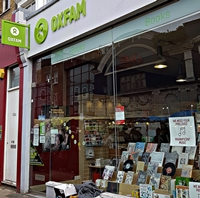
The Oxfam secondhand bookshop in London’s Portobello Road is one of my favourite haunts. It has a great stock of books on a variety of topics and the people who work there are very friendly.

Recently, I entered the shop ad headed towards the ‘History’ shelves. Near them, there was a male customer speaking with a female shop assistant. They were standing next to a cardboard box filled with dictionaries.

“Which of these dictionaries do you reccommend?” the customer asked, “the Collins or the Oxford?”

“It’s a a matter of taste. Both are good.”

“But which do you prefer?” asked the customer.

“I prefer Oxford.”

“But why?”

“I have always used Oxford. I like its approach to spelling. I used it a lot when I used to work in a publishing house,” responded the lady, edging away to escape her persistent questioner. He turned to me.

“Which do you prefer?” he asked me.

“Oxford.”

“And why do prefer that?”

“No good reason, ” I replied,”it was the first dictionary we were given at school. Maybe, that’s something to do with my preference.”

“And which authors do you think are good?” he asked me, adding, “I have just given away my television.”

I could not reccommend the books I have written, as that would be immodest and likely to prolong this conversation.

“Thomas Love Peacock,” was the first author’s name that entered my head.

“And?”

“You could also try John Buchan. You know the chap who wrote the Thirty-Nine Steps,” I suggested.

“Never heard of him.”

“Balzac is also good in translation,” I added.

“Hmm. What about this one?” the customer asked me, holding a novel by George Orwell.

“He’s also good.”

At that point, I was ‘saved by the bell’. My fellow customer’s mobile ‘phone began ringing at a very high volume. It sounded as if a fire alarm had gone off. He rushed out of the shop.

I went to the cash desk to pay for my latest purchase. When I had finished, my new acquaintance came back into the shop, and said to me:

“Sorry about that. You are real gent. It was nice talking with you.”

I left the shop and will probably not visit again for a long time as viral considerations are forcing it to close indefinitely.

One book, two titles

COVER GUJ a blog

The prices of books varies greatly from one country to another. In India, many books cost far less than their equivalents sold, for example, in Europe. Readers in India buying books that have to be imported from ‘the West’ often face high charges due to delivery from afar. I have tried to address this problem with a couple of books, which I have written. My solution is outlined after the following introduction to one of my books about India:

My wife, who is a fluent Gujarati speaker, was born in Bombay. Her father’s family originated in Gujarat and her mother’s in the former Princely State of Kutch, which became part of the State of Gujarat after India became independent.

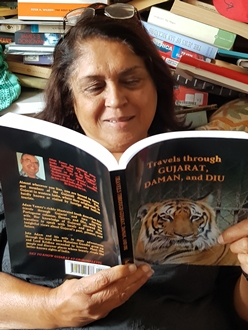
Both my wife and I have visited India regularly from our home in the UK, yet neither of us had ever been to Gujarat until early in 2018. We felt that it was high time that we visited the parts of India connected with her heritage. I have published a book that describes that first trip. We did not visit everywhere in Gujarat, but the places we saw, our experiences, and the people we met ranging from autorickshaw drivers to former royalty, and our experiences, are described my book. All of these have made us want to visit the region again and to explore it further.

I have long been fascinated with tiny enclaves. I have visited places such as Andorra, San Marino, Mahe (in Kerala), Pondicherry, and Llivia (a part of Spain surrounded by France). Gujarat contains two such places, the former Portuguese colonies of Daman and Diu, territories surrounded by Gujarat but separated from it by borders. We included them on our journey and discovered that though small in area, they are filled with interest.

Gujarat was the birthplace of many celebrated persons, including Narsinh Mehta (poet), Dayanand Saraswati (philosopher), Shyamji Krishnavarma (Sanskrit scholar and freedom fighter), and politicians such as: Mahatma Gandhi, Dadabhai Naoroji, Vallabhai Patel, Morarji Desai, and Narendra Modi. Yet, undeservedly, it is a part of India less frequented by tourists than many other places in India (e.g. Goa, Kerala, Rajasthan, and the ‘Golden Triangle’). I hope that what you will read in this travelogue will whet your appetite and encourage you to make plans to visit Gujarat.

The idea of my book is to unwrap the attractions of Gujarat to make them better known to those who have not yet visited this region of India.

What I have written above is to introduce you to a book I published in 2018 with the title “TRAVELS THROUGH GUJARAT, DAMAN, and DIU”. This book is available from on-line booksellers such as lulu.com, Amazon, and bookdepository.com. When you buy my books from these suppliers, they are produced in Europe or the USA and then shipped to the buyer. If they are bought by people living in India, their prices become very large (in comparison with average Indian book costs) because of additional postal charges. For example, TRAVELS THROUGH GUJARAT, DAMAN, and DIU can cost up to 1500 Indian Rupees (‘INR’) and another book, which I have recently published, “IDEAS, BOMBS, and BULLETS” can cost purchasers in India over 800 INR.

To make my books more affordable in India and priced at a rate closer to comparably sized books in the Indian market, I have re-published the two books mentioned above with an Indian print on demand outfit called pothi.com. The travel book has been revised and I hope improved. I have renamed it “GUJARAT UNWRAPPED”. My book about Indian patriots in early twentieth century London, “IDEAS, BOMBS, and BULLETS” retains its original name.

When ordered through pothi.com and delivered in India, GUJARAT UNWRAPPED is priced at 296 INR (plus minimal postage) and IDEAS, BOMBS, and BULLETS comes to 395 INR (plus minimal postage).

To order GUJARAT UNWRAPPED FROM POTHI.COM,

click: https://pothi.com/pothi/book/adam-yamey-gujarat-unwrapped

To order IDEAS, BOMBS, and BULLETS FROM POTHI.COM,

click: https://pothi.com/pothi/book/adam-yamey-ideas-bombs-and-bullets

IMPORTANT:

It is worth nothing that purchasers ordering the books from pothi.com BUT not having their books delivered in India, face huge postage charges.



Learning to read

The Anglican cleric Reverend Wilbert Awdry (1911-97) is best known for his series of children’s books based around the now well-known Thomas the Tank Engine. He published his series of books about railways, The Railway Series, in 42 volumes between 1945 and 2011 (two were published posthumously). Each volume was a small colourfully illustrated story about railway engines with faces and personalities. Being a lover of trains from an early age, I devoured and enjoyed these stories from the earliest day that I was able to read to myself.


engines


One of my favourite of Awdry’s books was called Eight Famous Engines. I cannot remember why I liked it, but I do remember that I mis-read the word ‘famous’. For several years, I thought that ‘famous’ was pronounced ‘farm house’. It puzzled me that the book seemed to have little or nothing to do with agriculture, but that did not stop me from liking the book and re-reading it many times from cover to cover. It was only when I had outgrown these railway books that it dawned to me that  the letters f.a.m.o.u.s spelled ‘famous’ and not ‘farm house’.

In addition to the Awdry railway books, I enjoyed leafing through a particular  well-illustrated geography book, which I used to borrow often from the local public library. One of the many photographs in this book that caught my attention was captioned “A POLISH FIELD”. You can probably guess what I will write next. Yes, for years I thought that it was a picture of a field containing plants that when harvested became shoe polish. It was a long time before it dawned on me that it was a Polish field rather than a field of polish.

Now, many decades later, you might be pleased to know that I do not make mistakes like the above when I am reading.


How far do you go?

Story line_500


There are many ways of choosing books to read. Some people go by the ‘blurb’ on the cover or the subject matter as suggested by the title, others by the first few pages, some by the last few pages, and yet others simply by the reputation of the author.

Having chosen one, how do you decide whether to read it from start to finish or to abandon it?  

If I can get through the first ten or so pages, I will continue reading it. So, I conclude from this that when I am writing a book it is very important to engage the reader from the very first page. In addition, when the book appears on sites like Amazon, the sample that becomes available for potential buyers is these first few pages.

If I am not enjoying a book by the hundredth page, I will happily stop reading the book, and then choose another. If, on the other hand, I am fully enjoying or finding a book interesting as I reach page 100, there is a very good chance that I will read the whole book.

What is your decision-making process for deciding whether or not to stick with a book?