
An unusual street name in London’s Kentish Town

WHEN VISITING KENTISH Town in north London, we parked close to a featureless cul-de-sac with an unusual name: Frideswide Place. In general, London’s street names are not invented ‘out of the blue’ but usually refer to places, such as Pretoria Road, or people, such as Gainsborough Gardens. I wondered whether Frideswide referred to a place or a person or something else.
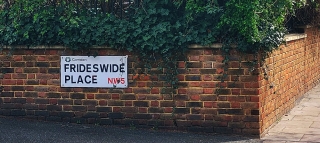
A brief search of the Internet revealed that Frideswide is the name commonly given to Frithuswith, a saint who lived from about 670 AD until 727. She was an English princess (daughter of a ruler of Mercia named Dida of Eynsham whose territory was in western Oxfordshire and the upper reaches of the River Thames) and an abbess. She founded a monastery in Oxford. She is reputed to have had great healing powers, and is remembered for this. She is now the patron saint of the City of Oxford. This is all interesting enough, but why is there a road named after her in Kentish Town?

An answer to this question can be found on a website about Kentish Town (www.kentishtowner.co.uk/2013/04/10/wednesday-picture-whats-in-a-street-name/):

“Sometimes a whole group of street names will relate to one landowner. For instance, the area to the east of The Oxford was owned by Christ Church, Oxford University. This includes Frideswide Place (which is cut off by the railway) … It turns out that St Frideswide Priory, established in 1122, was the predecessor to Christ Church [in Oxford].”

And that seems to me a reasonable answer to my question.
Which?

oxfam BLOG


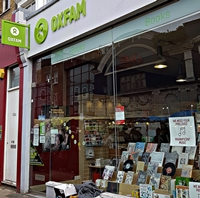
The Oxfam secondhand bookshop in London’s Portobello Road is one of my favourite haunts. It has a great stock of books on a variety of topics and the people who work there are very friendly.

Recently, I entered the shop ad headed towards the ‘History’ shelves. Near them, there was a male customer speaking with a female shop assistant. They were standing next to a cardboard box filled with dictionaries.

“Which of these dictionaries do you reccommend?” the customer asked, “the Collins or the Oxford?”

“It’s a a matter of taste. Both are good.”

“But which do you prefer?” asked the customer.

“I prefer Oxford.”

“But why?”

“I have always used Oxford. I like its approach to spelling. I used it a lot when I used to work in a publishing house,” responded the lady, edging away to escape her persistent questioner. He turned to me.

“Which do you prefer?” he asked me.

“Oxford.”

“And why do prefer that?”

“No good reason, ” I replied,”it was the first dictionary we were given at school. Maybe, that’s something to do with my preference.”

“And which authors do you think are good?” he asked me, adding, “I have just given away my television.”

I could not reccommend the books I have written, as that would be immodest and likely to prolong this conversation.

“Thomas Love Peacock,” was the first author’s name that entered my head.

“And?”

“You could also try John Buchan. You know the chap who wrote the Thirty-Nine Steps,” I suggested.

“Never heard of him.”

“Balzac is also good in translation,” I added.

“Hmm. What about this one?” the customer asked me, holding a novel by George Orwell.

“He’s also good.”

At that point, I was ‘saved by the bell’. My fellow customer’s mobile ‘phone began ringing at a very high volume. It sounded as if a fire alarm had gone off. He rushed out of the shop.

I went to the cash desk to pay for my latest purchase. When I had finished, my new acquaintance came back into the shop, and said to me:

“Sorry about that. You are real gent. It was nice talking with you.”

I left the shop and will probably not visit again for a long time as viral considerations are forcing it to close indefinitely.