Painting in the Mall

BETWEEN HAMPSTEAD AND Belsize Park, there is a narrow footpath running north from Tasker Road. One side of it is lined with a terrace of low buildings known as Mall Studios. Built in 1872 by Thomas Battersby, they were designed as artists’ studios. Each of them contained small waiting rooms; costume rooms; and a lobby. Each studio had three skylights and large north facing windows to capture the kind of light favoured by many artists. Following the advice of the artist Walter Sickert, who had lived there, the artist John Cecil Stephenson (1889-1965) settled into number 6, Mall Studios in March 1919.  It was to remain his home until he died. In 1927, Barbara Hepworth became his neighbour in number 7, and at around that time, the influential art critic and writer Herbert Read moved into number 3. Nearby, Parkhill Road became home (for various lengths of time) to other artists including Henry Moore, Ben Nicholson, Naum Gabo, Piet Mondrian, Hans Erni, and other artists who have since become famous.

By John Cecil Stephenson

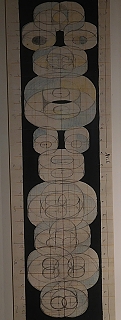
Whether it was the proximity of his artistic neighbours, who were pioneers of 20th century modernist art, or something else in his artistic evolution, Stephenson departed from his previous ‘straightforward’ portraiture and landscape painting and created works characteristic of what is now known as the ‘Modernist’ style. Although some of his works created after the late 1920s are to some extent figurative, most of his output was mainly abstract and constructivist. During WW1, Stephenson left London’s Slade School of Art temporarily to work in munition factories in Bishop Auckland (County Durham), the town where he was born. His experiences of working with industrial machinery and observing the efficiency and speed of the mechanised production processes is reflected in some of the paintings he produced later.

Stephenson, son of a grocer, was less well known than his neighbours. He produced art that bears favourable comparison to the works produced by them. Until the 18th of September 2022, there is a wonderful small exhibition of his works in a gallery within Hampstead’s charming Burgh House. The catalogue, edited by Sacha Llewellyn, Paul Liss, and George Richards, not only contains a fine collection of photographs of the exhibits but also provides a superb introduction – better than others I have seen – to the story of the pioneering role of Hampstead in the evolution of modern art in England. Burgh House, which contains several rooms comprising a museum of the history of Hampstead, also hosts excellent exhibitions such as the current survey of Stephenson’s works. Its well illuminated Peggy Jay Gallery provides a space for contemporary artists, many of them local, to display their works. Beneath the two storeys of cultural experiences, the basement of Burgh House is home to a pleasant café where anything from a cup of coffee to a wholesome meal can be obtained. And amongst the interesting range of books in the small bookshop, you can find copies of my book “Beneath a Wide Sky: Hampstead and its Environs” on sale (if they have run out, tell them to ask me for more, and then get your copy from Amazon).

The naked ceiling at Osterley Park

WHEN THE BANKER Sir Francis Child (1642-1713) acquired Osterley Park in the 18th century, its Elizabethan manor house was in a poor state of repair. His grandsons, Francis and Robert, employed the famous architect, Robert Adam (1728-1792) to give the house a major ‘makeover’ including adding a grandiose neo-classical front portico. And that is what he did on a grand scale. Adam was no ordinary architect. Not only did he plan buildings (and modifications to them), but he also designed their interiors: everything from ceilings and wall decorations to furniture and doorhandles. Osterley Park offers a magnificent display of his wide-ranging skills.

Long gallery at Osterley Park

The visitor to Osterley Park, now managed by the National Trust, usually gets to see a series of wonderful rooms on the ground floor of the house. All the rooms except one have beautifully decorated ceilings, all designed by Adam. Some of them have paintings created by Adam’s favourite painter, the Venetian Antonio Zucchi (1726-1795). Amongst my favourite ceilings are those in the Etruscan Dressing Room and the Drawing Room. The latter has a fantastic ceiling that was inspired by drawings in “The Ruins of Palmyra otherwise Tedmor in the Desert” by James Dawkin and Robert Wood (published in 1753).The ruins were those that were recently badly vandalised by the IS group. In each of the rooms, except the long gallery, the visitor’s attention is dominated by the eye-catching ceilings.

The ceiling of the long gallery is devoid of decoration. It was in this room that the Child family’s collection of fine paintings used to be displayed. The gallery’s ceiling was left plain, without decoration, deliberately, so that the viewer’s attention would be concentrated on the paintings.  Sadly, the paintings are no more. After WW2, the house’s owner, George Francis Child-Villiers, 9th Earl of Jersey (1910 -1998) gave the house and its grounds to the National Trust. He moved to Jersey, taking with him most of the paintings that had hung at Osterley. Unfortunately, many of these works were destroyed in a warehouse fire soon after he donated the house. The artworks in the gallery have since been replaced with other paintings and because the ceiling is naked, you can give them your full attention.

Constable, Turner, and a soap maker

MY GREAT GRANDFATHER Franz Ginsberg (1862-1936) was an industrialist and a politician in South Africa. One of his main industries was soapmaking. Many of his workers would have been black Africans, mostly living in poor conditions around his factory in King Williams Town (‘KWT’). While serving on the town council of KWT, he played an active role in establishing what he hoped would be a township with improved living conditions for some of the town’s black people (including his workers). Named after him, Ginsberg township, founded at the beginning of the 20th century, still exists.

A few years before my great grandfather established the township named after him, another soap maker, William Hesketh Lever (1851-1925) who was based in England, created what he hoped would be better living conditions for his workers. Far more grandiose and much more attractive than Ginsberg Township, Lever began building Port Sunlight (south of Birkenhead) in about 1887 (a year or two after Ginsberg began making soap). Lever’s model town provided his employees with salubrious dwellings in a well landscaped environment. However, they were subject to strict rules; Lever, who believed that discouraging immorality (e.g., gambling) led to a good workforce, was a benevolent paternalist.

Turner on the left, and Constable on the right

Lever and his wife were avid collectors of artworks. These are housed in the purpose-built Lady Lever Art Gallery in the centre of Port Sunlight. This gallery, contained within an impressive French neo-classical style edifice, was designed by the Warrington based architects William Owen (1846-1910) and his son Seager Owen, and opened in 1922. It contains a fine range of artworks dating from early times (pre-Christian) to the early 20th century. It contains one of the largest and most important collections of Pre-Raphaelite artists’ works. With its spacious, airy galleries and well displayed exhibits, it is amongst my top ten British galleries and museums.

In one small gallery, which contains a sculpture of a reclining nude, two paintings hang close to each other but are separated by a neo-classical fireplace (an exhibit). One of them is by JMW Turner (1775-1851) and the other by his contemporary rival J Constable (1776-1837). It is interesting to see them almost side-by-side because it allows the viewer to compare their styles and what they try to convey  in their paintings. The Turner painting depicts “The Falls of the Clyde”, and the Constable depicts “Cottage at Bergholt”. Neither of the paintings, both created in the age before photography, achieves the accuracy of, say, a photograph; both seem impressionistic, but the effects that the artists were attempting to have on the viewer are entirely different.

Turner’s paintings are often far more impressionistic than Constable’s. Although his subject matter is always at least almost discernible, I feel that Turner’s works are created to evoke both the artist’s and the viewer’s psychological and/or emotional reaction(s) to what was being depicted. In contrast, Constable’s painting techniques seem to have been designed to emphasise aspects of the scene he was painting to give the viewer the impression that he or she is looking at the very same view as that which attracted the artist. Constable regarded painting as being a branch of science. In a lecture he gave in 1836, he said:

“Painting is a science and should be pursued as an inquiry into the laws of nature. Why, may not landscape painting be considered a branch of natural philosophy, of which pictures are but the experiments?”

Turner, in his almost abstract paintings such as the one at the Lady Lever, appeared to be wanting to stimulate the viewer’s emotions. In contrast, Constable tried to convey what he saw or felt was important in his subject matter. Without resorting to the almost photographic accuracy of, for example, both Canaletto and Vermeer, the two artist whose paintings hang almost next to each other in the Lady Lever successfully achieve their aims. For me, the avoidance of detailed accuracy of representation in both Turner’s and Constable’s paintings, enhances the impression of reality in my mind, something that photography cannot do to the same extent.

Even if you do not wish to compare Turner and Constable, I can strongly recommend a visit to the soap maker’s gallery in Port Sunlight. Finally, it is a pity that my great grandfather did not invest in great works of art!

Looking at Music

THE ESTORIC COLLECTION in London’s Highbury houses a fine permanent exhibition of modern Italian artworks, mainly creations of the so-called Futurists. In one of the galleries, I spotted the name of an artist who was born in a town, which I have visited, in the northeast of Italy: Gorizia. When the artist Anton Zoran Music (1909-2005) was born, Gorizia was part of the Austro-Hungarian empire. After WW1, the town became part of the Kingdom of Italy within the region of Venezia-Giulia. Soon after WW2, the eastern part of the region became absorbed into the Yugoslav republic of Slovenia (now an independent state). When that happened, the border between Italy and Slovenia ran through the eastern part og the town, the part in what was then Yugoslavia (a country I visited often between 1973 and 1990) became named ‘Nova Gorica’. Most of Gorizia, an attractive old town, is on the Italian side of the border.

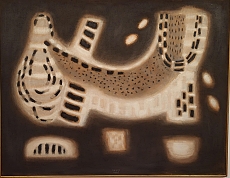
Slovenians still live on both sides of the border. Music, actually Anton Zoran Musič (pronounced mus-ich) was born into a Slovene-speaking family. Zoran, who went to schools in Maribor, studied art at the Academy of Fine Arts in Zagreb between 1930 and 1935. His first one-man exhibition (outside Yugoslavia) in Venice in 1943, where he had moved. Soon after this, he was arrested by the German Gestapo and then sent to Dachau concentration camp. After WW2, he moved to Ljubljana (in Yugoslavia), but soon shifted to Venice, where he lived (on and off) for the rest of his life. His career after the War was successful: he received several prestigious prizes for his artistic creations.

The Estorick displays five of Music’s paintings. They were created between 1951 and 1983 and illustrate his versatility as a painter. All the paintings hanging are between abstract and figurative in style, but slightly nearer the latter than the former. I had seen his paintings on previous visits to the Estorick, but until my most recent viewing of his art, I had not been aware of how many aspects of his life mesh with things that interest me.

Vanishing point

OF JAMAICAN HERITAGE, the artist Barbara Walker was born and brought up in Birmingham where she lives today. During her childhood, she was taken to see museums and galleries. She noticed that in many works (paintings and other images) of western art, Black people play a peripheral role, depicted as servants and so on, serving the ‘white’ people who play a central role in a picture. Recently (April 2022), we visited an exhibition of her works at the Cristea Roberts Gallery in London’s Pall Mall. Called Vanishing Point, this superb display contains artworks, prints, which address the issue that Barbara noted when she was younger.

At first sight, most of the framed prints appear to be large sheets of white paper with a few beautifully drawn details depicting black people or parts of their bodies. Closer examination reveals that there is more to the white spaces than first meets the eye. The white areas are embossed. The black people, who have been drawn, are surrounded by the embossed areas of the print. Together, the drawings and embossed sections of the print can be seen to be a whole picture. Walker has processed an original image to create a new one in which only Black people in the original are easily visible and the rest of the picture forms a ghostly background. Unlike the pictures she saw when a youngster, the Black people in the picture are prominent and the others are barely detectable.

I am not sure exactly how the artist achieved this interesting effect and these powerful images, but I will have a go at explaining, using my experience of having once made etchings in the past. Metal plates are first coated with a photographic material. Then images of an original painting are projected on to it and processed in some way that produces a photographic reproduction on the plate. The artist, then blocks out selected areas on the plate with an acid-resistant material to produce a pattern that includes many details of the original image, including all of the parts of it that contain depictions of Black people or the parts of their bodies in the original painting or image. The plate is then immersed in acid, which eats into all the parts of it, which have not been painted over with the blocking agent. Then, a sheet of dampened paper is placed on the plate and the two are run through a printing press. The pressure exerted by the rollers of the press force the dampened paper into the depressions on the plate caused by the action of the acid. The result is a sheet of paper with embossed indentations. When the paper has dried, the artist then draws on the flat areas, which are in fact silhouettes of the Black people (or details of them) which appeared in the original painting. The rest of the embossed area, containing details and enough outlines of the original image to make it recognisable, is left white. The result is an image in which Black people become the focus of the viewer’s attention.

Barbara Walker’s works on show at Cristea Roberts (until the 23rd of April 2022) are ingenious and extremely engaging. She has employed an interesting technique to make her statement. Rather than reinforcing the fact that Black people were often depicted as being menial as is the case in the recent display of paintings by Hogarth at the Tate Britain, she has found a way of raising their status in artworks that sought to portray them as mere subsidiaries.

A battle scene under the hammer

SRIRANGAPATNA (SERINGAPATNAM) IS A town on an island in the River Kaveri in the state of Karnataka in southern India. I have been there several times as it is near a holy spot (the ‘sangam’, where three streams meet) where ashes of deceased Hindus, including those of my parents-in-law, are ceremoniously deposited in the waters of the Kaveri. The town near the sangam was the capital of the realm ruled by Tipu Sultan (1750-1799). This former capital of a great ruler is full of impressive architectural reminders of his era. One of these, which I have visited at least twice, is a Summer Palace, the Daria Daulat Mahal (literally, ‘Wealth of the Sea Palace’) built for Tipu in 1784. This lovely, large pavilion in the middle of a formal garden is decorated with huge painted murals depicting various subjects. Some of them show scenes of battles in which Tipu was involved, often with his enemy the British East India Company. Filled with fascinating details, these are well worth visiting.

On the 30th of March 2022, a wonderful artwork was auctioned at Sotheby’s auction house in London’s New Bond Street. Created in 1784, it is a painting measuring 31.6 feet by 6.6 feet. It is one of three copies of a work commissioned by Tipu for the Daria Daulat pavilion. It depicts the Battle of Pollilur fought on the 10th of September 1780 between the British troops of the East India Company and the Mysore Army led by Haider Ali (c1720-1782) and his son Tipu Sultan. Writing for the Sotheby’s website (https://www.sothebys.com/en/buy/auction/2022/arts-of-the-islamic-world-india-including-fine-rugs-and-carpets/the-battle-of-pollilur-india-seringapatam-early), the author and historian William Dalrymple explained:

“At Pollilur, Tipu Sultan inflicted on the East India Company the most crushing defeat the Company would ever receive, and one which nearly ended British rule in India.”

He added, referring to the British:

“Out of 86 officers, 36 were killed, 34 were wounded and taken prisoner; only 16 captured were unwounded. Baillie received a back and head wound, in addition to losing a leg. Baird received two sabre cuts on the head and a pike wound in the arm. His ADC and young cousin, James Dalrymple, received a severe back wound and “two cuts in my head”. Around two hundred prisoners were taken. Most of the rest of the force of 3,800 was annihilated.”

Of the painting being auctioned at Sotheby’s, he wrote:

“The painting extends over ten large sheets of paper, nearly thirty-two feet (978.5cm) long, and focuses in on the moment when the Company’s ammunition tumbril explodes, breaking the British square, while Tipu’s cavalry advances from left and right, “like waves of an angry sea,” according to the contemporary Mughal historian Ghulam Husain Khan. The pink-cheeked and rather effeminate-looking Company troops wait fearfully for the impact of the Mysore charge, as the gallant and thickly moustachioed Mysore lancers close in for the kill. To the right, the French commander Lally peers triumphantly through his telescope; but Haidar and Tipu look on majestically and impassively at their triumph, while Tipu, with magnificent sang-froid sniffs a single red rose as if on a pleasure outing to a garden to inspect his flowers.”

As with all other items to be auctioned at Sotheby’s, the painting was put on display to the public for several days before the auction. We were lucky to have been able to view it, as we arrived only a few minutes before the public viewing period ended. One of the technicians at the auction house let us get close to the painting so that we could examine it much better than is possible when visiting the Summer Palace at Srirangapatna. I took the opportunity to take close-up photographs of details of this incredible record of late 18th century warfare. [You can view my photographs on the following website: http://www.ipernity.com/doc/adam/album/1319222] Some of them are quite gory, including decapitated heads with blood issuing from their severed necks. Many of the British can be seen being impaled by what looked like very thin, needle-like spears. I spotted one Indian soldier being struck on his head by a bayonet wielded by a Britisher. Some of the Mysore Army soldiers brandish rifles fitted with bayonets.

The British soldiers are mainly dressed in red jackets. Their opponents are depicted wearing clothes in a variety of colours. Most of the Indian soldiers have dark-coloured eyes but, as my wife spotted, some of the British have pale coloured (blue?) eyes.  Many animals appear in the picture: horses, camels, elephants, and bullocks. In addition to rifles and spears, there are other weapons in the painting including: cannon, swords of various kinds, and archery bows. Seen as a whole and in detail, the painting portrays great activity and a sense of the confusion that reigns in a battle. Whereas the British appeared to be maintaining orderly formations, their opponents can be seen making a terrifyingly massive onslaught in an apparently less organised, but ultimately successful, way.

Although words are inadequate to convey the impression made on me by this painting, I am glad that I was able to see it before it is sold. It was last exhibited for a few months in 1999 in the National Gallery of Scotland (Edinburgh), and before that for a few months in London in 1990. If it is sold to a private individual, it might not be available for public viewing again for a long time.

Doom painting

UNDOUBTEDLY THE CATHEDRAL in Salisbury (Wiltshire) is the city’s ‘star’ attraction and is worthy of many visits. However, the city has other things that should not be missed. One of these is the Parish Church of St Thomas (and St Edmund), about 370 yards north of the cathedral.

The Doom Painting

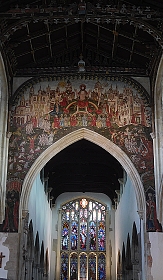
The present church was built from the 15th century onwards. Its detailed history can be found on the church’s website (https://stthomassalisbury.org.uk/wp-content/uploads/2021/06/BriefHistory.pdf). On entering the church from its western end, one cannot avoid seeing the colourful wall painting above the chancel arch. This is the Doom Painting, which depicts The Last Judgement. Images such as these used to be common in Christian Europe but are rare today. ‘Doom’ means ‘judgement’ in Anglo-Saxon. The painting in St Thomas is thought to have been created in about 1470 in the Flemish style by an English painter.

During the Reformation, the painting was covered over with whitewash in 1593. It remained hidden until 1819 when faint traces of colour began to appear when the wall was being cleaned. The painting was carefully uncovered in 1881, and then it was restored. In 1953, the image was cleaned again and retouched. Since then, it has remained untouched. Although it has been restored, it gives a good idea of how this superb fresco looked when it was first created.

While looking up at the Doom Painting, you should also examine the decorated timber ceilings above the nave and other parts of the church. These contain almost 100 wood carvings of angels. Also of interest, is a wooden panel on the wall of the south aisle. This bas-relief wood carving depicts Abraham sacrificing his son Isaac and Jacob’s Dream. It was created in about 1660 by the master Joiner Humphry Beckham (1589-1671).

There are plenty of other interesting items to see in the church, which deserves a visit. Had there not been a famous cathedral in Salisbury, this smaller church would have become one of the place’s main attractions.

Brothers in art

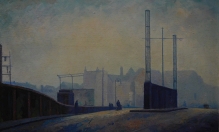
RECENTLY, WE DROVE to Southend-on-Sea in Essex to see an exhibition, “Brothers in Art”, at the town’s superb Beecroft Art Gallery. There, we enjoyed visiting a temporary exhibition of the paintings of two artists, about whom we knew nothing: the brothers Walter (1908-1997) and Harold (1911-1971) Steggles. They were members of the East London Group of artists, East End workers who created and exhibited together between 1928 and 1936. Influenced by the artists John Albert Cooper (1894-43) and Walter Sickert (1860-1942), the group produced pictures that often-depicted everyday scenes and mundane sites in a joyful way.

The Steggles were born in Ilford (east London), sons of the manager of a high-class footwear store in London’s Strand. They were not born into a family that had any history of artistic talents. At an early age, the brothers began visiting art exhibitions, including, in 1925, one at the Bethnal Green Men’s Institute Art Club at the Bethnal Green Museum. This led them to join the art classes there. Walter was 17 and Harold was 14. Unhappy with the classes at Bethnal Green, they joined the art classes conducted by John Cooper at the Bromley & Bow Institute. He encouraged the brothers to paint scenes near the institute. Soon they became members of the East London Group.

In 1928, the Group held an exhibition at the Whitechapel Art Gallery. The brothers exhibited several of their paintings at this prestigious public art venue. Many influential members of the art scene attended the show, one of them being the then director of the Tate Gallery. Several of the brothers’ paintings at the exhibition were acquired by the Tate.

The East End Group also held regular exhibitions at the Lefevre Gallery in London’s West End. The gallery, which existed from 1926 until 2002, represented leading artists including, to mention only a few, Seurat, Matisse, Degas, Picasso, Dali and Kandinski. The two brothers:

“… found themselves part of a cosmopolitan artistic milieu that included Ben Nicholson, Charles Ginner, Philip Wilson Steer, George Braque and Raoul Dufy … Before long they found themselves sought after by other galleries and Harold became a protégé of the flamboyant aesthete Eddie Marsh who lived near his office in Gray’s Inn as well as accepting a prestigious commission from Villiers David to paint the gentlemen’s clubs of St James.” (https://spitalfieldslife.com/2017/07/26/harold-walter-steggles-artists/).

Harold recalled that the first picture he sold was bought by the highly influential art dealer Sir Joseph Duveen (1869-1939) and was hung at the Tate Gallery in 1929. In 1936, Walter had one of his paintings exhibited in the Venice Biennale.

Walter and Harold sold their paintings and became prosperous enough to buy a car. This allowed them to make forays into East Anglia where they painted things they saw.  Some of these East Anglian scenes were on display at the exhibition in Southend alongside their paintings of sights in London; many of these places have disappeared since WW2.  Both Walter and Harold were commissioned by the Shell petrol company to create posters. These display places in England, beautifully depicted. Several of these were also on display.

Even though the brothers were successful as artists, they had to continue working in non-artistic jobs to gain a sufficient income. When Walter retired, he was able to concentrate fully on painting.

With the death of John Cooper in 1943, the East End Group declined and the works it had created faded from the artistic world’s limelight. What the group created was not as excitingly innovative as the art produced by the now better-known artists, some of which I mentioned above. However, the work of the Group and, in particular, of the Steggle brothers is of high quality and very pleasing aesthetically. It was well worth trekking out to Southend to see their paintings.

David Hockney painted here

AT THE EASTERN END of Notting Hill Gate, there is a road called Linden Gardens. In the 1860s, only the eastern part of this existed and it was named Linden Grove. To the west of Linden Grove was Linden Lodge, set in extensive grounds with a large pond or lake. It was designed by the engraver, architect, and property developer Thomas Allason (1790-1852) and constructed in 1826. He lived there until about 1838. In the late 1860s, the Lodge was demolished, and houses were built around the edge of, and on, its grounds. This occurred because of the construction of the Metropolitan Railway in the mid-1860s. The gateposts of the lodge still stand, partially embedded in the buildings at the south end of Linden Gardens.

The website british-history.ac.uk noted that it was probably the peacefulness of the Grove:

“… which attracted two other artists, William Mulready, who lived in the southernmost of the eight paired houses (now demolished) from 1828 until his death in 1863, and Thomas Creswick, who lived at the still surviving No. 42 from 1838 until 1866. In the latter year this house was affected by the building of the Metropolitan Railway. Creswick therefore moved to Mulready’s now vacant house, and also, apparently, occupied the adjoining house to the north (with which it formed a pair) until his death in 1869.”

William Mulready (1786-1863) was the designer of the penny postage envelope depicting Britannia. Creswick (1811-1869) was a landscape painter and illustrator. Someone, who lived in Linden Gardens, told me that some of Queen Victoria’s children received art lessons in a studio in Linden Grove, but I have found no evidence to confirm this. However, it is certain that David Hockney painted Mr and Mrs Clark and Percy, a portrait of the dress-designer Ossie Clark (1942-1996) and his wife in their flat in Linden Gardens. The balustrades in the painting are typical of those on most of the first-floor balconies of the houses in the Gardens.

Another artist, Elsa Fraenkel (1892-1975), a German-Jewish born sculptor and Fellow of The Royal Society of Arts, who fled from the Nazis, also lived briefly in Linden Gardens, so I was informed by her daughter, who lives in Bangalore (India), where Elsa died.

The first of its kind in England

THE ARCHITECT JOHN Soane (1753-1837) was skilled in designing buildings with features to permit natural light to reach parts of them that were far away from their exteriors. Good examples of this were the two homes he designed for himself, one in Lincolns Inn Fields, now the Soane Museum, and the other in Ealing, the recently restored Pitzhanger Manor. Another superb example, which we visited recently (December 2021) is the Dulwich Picture Gallery in south London. Completed and opened in 1817, it became the first picture gallery in England that was open to the public.

Light enters Soane’s galleries at Dulwich from above via overhead sky lights. These were placed in such a way that they illuminate the hanging spaces without allowing direct sunlight to hit the paintings on the walls. This system has since been adopted in many other art galleries. Newer rooms, lit entirely by artificial lighting, are used for temporary exhibitions including that of the woodcuts of the American artist Helen Frankenthaler (1928-2011), which we saw on our latest visit. Compared with Soane’s galleries, these newer ones are far less impressive, and despite the modern lighting they feel claustrophobic and rather gloomy.

The permanent collection of old masters, which is hung in Soane’s original galleries, is fabulous. Some of the paintings were parts of collections made before the 19th century. Others were supplied by the artist Sir Francis Bourgeois (1753–1811) and his business partner, the art dealer and collector, Noël Desenfans (1744–1807). Together they ran an art dealership in London and were commissioned in 1790 to purchase a collection of paintings for the then King of the Commonwealth of Poland and Lithuania, Stanisław August Poniatowski (1732-1798). It took them five years to do this but by 1795, the Commonwealth had been dissolved. The collection remained in England. After Desenfans died, Bourgeois inherited the collection and then commissioned Soane to design a gallery to house it. The superb gallery at Dulwich came into existence. Soane included within it a small circular mausoleum in which the remains of both Desenfans and Bourgeois have been placed. Rather irreverently, I felt, it was being used to screen a video about the artist Helen Frankenthaler.

In 1944, during WW2, the western façade of Soane’s gallery was badly damaged by bombing (a German V1 flying bomb) but it has been well-restored. Later, in 1999, a new café and other facilities in a modern style were built to the designs of the architect Rick Mather (1937-2013).

As for the exhibition of works by Frankenthaler, this was a delightful surprise. It is a collection of colourful abstract woodcuts that are the result of years of the artist’s complex and imaginative experimentation. Many of the works reminded me of, but were not identical to, the subtleties of Japanese ceramic glazes. Despite being displayed in galleries far less satisfactory than those designed by Soane, this as an art show well worth visiting before it ends on the 18th of April 2022.