THE EMPRESS BRANDISHES HER REVOLVER DURING A BATTLE IN ETHIOPIA

THE BRITISH MUSEUM is chock-full of exciting exhibits. To view them all would take many months, if not years. During a recent visit in March 2014, we were heading through the museum on our way to view a special exhibition of drawings and prints by four post-WW2 German and Austrian artists when we passed a painting that caught my eye. The exhibition was fascinating but not as much as the painting we passed as we were heading towards it.

The colourful painting (oil on cloth) was created in Ethiopia sometime between 1940 and 1949. So, by the British Museum’s standards it is relatively modern. The picture depicts two large armies facing each other. On the left side of the image, we can see the Ethiopian forces, and they are facing the Italians on the right side. Between the two armies, there are several dead or injured combatants. And amongst this carnage, there are two armed men on horses – they are riding towards the Italians. The faces of the Ethiopians are not all the same in appearance, whereas there is almost no variation of the faces of their Italian opponents.

Although it was painted in the 1940s, the picture illustrates the Battle of Adwa, which raged on the 1st of March 1896. The Ethiopians defeated the Italians. By the end of the 19th century, most of Africa had been invaded and occupied by various European nations. The exceptions were Liberia and Ethiopia. In 1889, Italy, having occupied to coastal territory of Eritrea, signed a treaty with King Menelik of Shewa. It was signed in Italian and translated into Amharic. The Italian version made Ethiopia a protectorate of Italy – virtually, an Italian colony. However, the Amharic version read differently – it agreed that the Ethiopians could use the ‘good offices’ of the Italians in their relations with foreign powers, if they wished.

The Italians decided to go to war with the Ethiopians to enforce the Italian version of the treaty. The Battle of Adwa put an end to the treaty with the Italians, who then recognised Ethiopia as an independent state. This situation lasted until the 1930s when Mussolini decided to invade the country.

In the painting at the British Museum, Emperor Menelik II of Ethiopia is depicted in the top left corner in his royal crown. In the bottom left of the painting, seated on a horse, and surrounded by Ethiopian soldiers, sits Empress Taitu of Ethiopia. Look carefully, and you can see that this veiled lady is holding a large revolver.

The painting is in a short corridor, which also has exhibits relating to the Copts of Egypt. As the painting fascinated me so much, I took little notice of the exhibits near to it. So, as if one needs one, yet another reason to revisit the British Museum.

An oil painting hanging on a wall in a café in Hampstead

EVERY TIME I VISIT Hampstead, I feel pleasant twinges of nostalgia not only because I was brought up in the area but also because of my associations with the place after childhood. One place, which still exists, and has done so since it first opened in 1963, is Louis Patisserie on Heath Street. Originally, its shop sign bore the words “Louis Hungarian Patisserie” because it had been established by a Hungarian called Louis Permayer.

Sometime in 1970 or maybe the following year, I took a young lady, who is now my wife, to Hampstead on our ‘first date’. We had a genteel afternoon rendezvous at Louis. My wife remembers that she had coffee, and that it had been served with a separate bowl containing freshly whipped cream. Back in those days and for many years afterwards, Louis, with its wood-panelled walls, seemed to me to have a ‘touch of class’ as well as being evocative of Central Europe. The cakes and other baked items they used to sell were all good quality versions of what you might expect to find in a ‘Konditorei’ in Vienna or a ‘Cukrászda’ in Budapest.

Today (the 26th of February 2024), it was windy and extremely cold when we got off the bus in Hampstead. For old time’s sake, we entered Louis to warm up with hot beverages. Louis has long since changed hands, but the wood-panelling and several other original features still remain. However neither the hot beverages nor the patisserie items were of the same high quality as they used to be long ago. There are now other places in Hampstead where both the coffee and the food are superior to what is available at Louis, but none of these places bring back happy memories.

High on the end wall of the sitting area within Louis, there is a large, framed painting of a pond with buildings along one side of it. These are reflected in the water. In the foreground, three figures are depicted fishing with rods. The picture is painted with muted colours, or, possibly, the colours have faded since it was completed. Despite having visited Louis on numerous occasions, I had never looked at the painting properly until today. At the lower left corner of the painting, there is the artist’s name and a date:

“DC Towner 1972”

The artist was the painter and ceramics expert Donald Chisholm Towner (1903-1985). For many years, he was a resident of Hampstead, as this biography ( www.barnebys.co.uk/auctions/lot/donald-chisholm-towner-SrpyTddupt ) explains:

“… Towner was born at Eastbourne and studied at Eastbourne and Brighton schools of art and at the Royal College of Art under William Rothenstein 1923-1927. He moved to Hampstead in 1927 where he lived until his death and produced many paintings of the area and residents. D.C. Towner showed at the RA, Burgh House, NEAC etc.”

William Rothenstein (1872-1945), mentioned above, lived in Hampstead between 1902 and 1912, but by the time he taught Towner he was living elsewhere. It is unlikely that Towner lived in Hampstead because of Rothenstein. It was more likely that he chose the area because it was already favoured by many other artists.

Although DC Towner is not one of the greatest of the artists who lived and worked in Hampstead, his family name has related to the arts in another way – possibly better known than for his paintings. When his father, Alderman John Chisholm Towner of Eastbourne, died in 1920, he left 22 paintings and £6000 for the establishment of a public art gallery. Rehoused in a new gallery opened in 2009, the Towner Gallery still exists in Eastbourne. We visited it in its beautifully designed new home in 2019.

As the picture in Louis was painted in 1972, we would not have seen it on our ‘first date’. I do not know when it was purchased or acquired by the owner of the café. Who knows, but maybe the artist used to enjoy ‘Kaffee und Kuchen’ in the place where I took my future wife out one afternoon long ago.

PS: If you wish to see another of Towner’s paintings in Hampstead, you should visit the Lady Chapel of St John’s Parish Church in Church Row. In it, you can see Towner’s depiction of Church Row, where he lived, and his self-portrait – he used a mirror image of his own face for the Christ in this painting. The picture in the church was created to commemorate the artist’s mother, Grace Towner (1862-1949), who lived in Church Row and was buried nearby in St John’s cemetery.

An interesting exhibition of painting combined with photography: doctored images

THE MUSEUM OF ART and Photography (‘MAP’) on Kasturba Road is a relatively new addition to Bangalore’s cultural scene. When it opened in February 2023, we were amongst its first visitors. Privately financed by the Poddar family, it is housed in a recently constructed edifice. I prefer the appearance of its interior to that of its exterior.

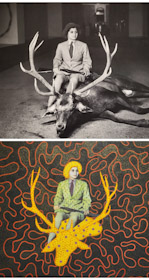
MAP describes itself as a museum of art and photography. The institution is home to a large collection of photographs created over the many years since the technique was invented. Much photography is in my opinion also art. However, the present exhibition at MAP, which is on until the 24th of March 2024, combines a traditional art form – painting – with photography. The show is called “What the camera didn’t see”.

The British born artist Alexander Gorlizki (born 1967) , who holds a higher degree from the Slade School of Art (at University College London) and now works in NYC, has teamed up with Pink City Studio – a group of miniaturist painters in Jaipur – to present historic photographs in a new light.

The exhibition at MAP consists of several old photographs from the museum’s collection and new reproductions or prints of these vintage images. Gorlizki and his colleagues have taken the reproductions and painted over them in the traditional Mughal miniature style, but leaving faces in the photographs uncovered by paint.

The resulting ‘doctored’ photographs are mostly quite whimsical and witty. The highly imaginative ideas of the artists are skilfully and beautifully superimposed on the reproductions of the old photographs. Thus, the art of the original photographers has been metamorphosed by contemporary painters in Jaipur in collaboration with their curator, Alexander Gorlizki. The results, which are on display at MAP, are both amusing and most pleasing aesthetically . This is an exhibition well worth seeing.

AT THE CLOSE OF A JOYFUL DAY HANGING IN BANGALORE AND A MYSTERY

UNTIL RECENTLY, PHOTOGRAPHY was not permitted in the Bangalore branch of the NGMA (National Gallery of Modern Art). On a recent visit in January 2024, we discovered that photography was now permissible.

I have been visiting the NGMA regularly since it first opened a few years ago (2009). Each time I have been, with one exception, I have noticed a painting by Lawrence Alma-Tadema (1836-1912). It depicts a lady leaning over a parapet beside a lake with mountains in the distance. It bears the title “At the Close of a Joyful Day”. It is currently hanging on a wall beside several portrait paintings by a Parsi artist named Pithawala. I have always wondered how this painting by Alma-Tadema has ended up as part of the collection of India’s NGMA.

According to an article published in “American Art News” (New York, 25th of April 1908), the painting had been the part of the “Coghill collection” and had sold at London’s Christie’s auction house for £966. The purchaser was not mentioned. I have not yet discovered anything relevant about the above-mentioned collection.

In connection with the sale of a painting by Alma-Tadema in 2019, the Sotheby’s auction house website mentions a letter that Alma-Tadema wrote in 1894 to the German egyptologist George Ebers. Here is an interesting excerpt from the website:

“… Alma-Tadema commented of one of his compositions, “It is a single figure girl, which has ascended to the highest point of a building to see far away out of the picture over some sort of Starnberger See, a second use of the study I painted when with you mingled with recollections… so you see my mind is still often with the dear friend at Tutzing” (letter from Alma-Tadema to Ebers, December 29, 1893, as quoted in Swanson, p. 77). While he is referring to ‘At the close of a joyful day’ (1894 …), the artist could just as easily be describing the mis-en-scene of the present work.” (That is the work in the auction.)
This essay, published to accompany an auction held in New York in February 2019, mentioned that “the current location [of ‘At the Close of a Joyful Day’] is unknown”.

Well, at least, I know where to find it.

What I would really like to know is how the painting reached India. Who owned it after it was sold in 1909, and how did it end up in the NGMA collection.

[The painting’s NGMA accession number is 02186]

Africans in a royal procession in Kutch painted in 1876

WHAT REMAINS OF the Aina Mahal Palace in Bhuj (Kutch, Gujarat) after the powerful earthquake of 2001 is now open to the public as a fascinating museum. One of its many remarkable exhibits is a painting, which is 15 metres long and 22 cm wide. Painted in 1876 by Mr Juma Ibrahin Wadha, it depicts in minute detail a Kutch State parade during the reign of Maharao Pragmalji II, who was on the throne between 1860 and 1875.

The faces in the painting are all portraits of individuals – actual depictions, not stylised images. The degree of detailing is superb – almost photographic, yet still artistic.

Amongst the many faces that can be seen on the painting are several which have unmistakably black African features. They are all soldiers dressed in armour and guarding the Maharani, the Maharao’s queen. It is possible that they might have been eunuchs, but detailed as the picture is, this cannot be ascertained by examining it!

Black Africans travelled to India (mostly as slaves) from East Africa to Gujarat and Kutch during the 14th to 17th centuries. Mainly of Bantu descent, many of them converted to Islam. Some of them rose to high positions in society. For example, one of them became a general, who founded the Sidi Saiyedd mosque in Ahmedabad. Their descendants are known as members of the Siddi community. Known as Sheedhi in Pakistan, there is apparently a significant number of them in Lowe Sindh and Karachi. Currently, there are about 50000 Siddis in India, of which about one third live not in Gujarat but in Karnataka.

There are many other interesting details on the picture of the parade, but it was the depictions of Siddi soldiers that particularly caught my attention.

Vincent Van Gogh on a wall in India

YOU CAN SEE MURALS painted on walls throughout the Indian city of Bangalore (and in many other places in India). These paintings transform otherwise boring walls into something worth looking at.

Today, the 12th of November 2023 – Diwali, I visited Airlines Hotel in Bangalore. This place has an alfresco café and a large parking area. I saw some young people painting a mural. The design they were creating was a copy of a picture on the screen of a tablet or ipad. The building on which they were painting faces a long wall that marks the boundary of both the car park and the Airlines compound.

Since we last visited Airlines in February 2023, the boundary wall has been covered with a long painted mural. At first sight, this colourful painting brings to mind the work of the Dutch artist Vincent Van Gogh, who died long before it was made.

Though it resembles the style of the Dutch artist, on closer examination you can easily tell it is not by him. But its creator has certainly done a good job capturing the essence of Van Gogh’s style, and has livened up a hitherto unsightly, high breeze block wall. The other murals adorning the compound are visually engaging, but not as much as the Airlines “Van Gogh “

An old Mughal painting in an altered format

THE PADSHAHNAMA WAS created by Abdul Hamid Lahori (and others) and completed in between 1630 and 1637. It is an illustrated history of the reign of the Mughal Emperor Shah Jahan I (1592-1666). In 1799, a copy of this valuable manuscript was sent by Saadat Ali Khan II, the Nawab of Awadh as a gift to the British King George III. This edition has been preserved in the Royal Library at Windsor. It contains 44 intricately painted Mughal miniatures. In 1997, reproductions of the paintings in this version of the Padshahnama were published in a catalogue produced to accompany the precious book as it travelled the world in an international touring exhibition. As with many publications, the illustrations in it are subject to copyright.

One of the paintings in the Windsor Padshahnama depicts the arrival of the gifts for Nadira Banu, the bride of Shah Jehan’s son, the ill-fated Dara Shikoh. They married in 1632, a year after Shah Jehan’s wife – Mumtaz Mahal – died.  The Taj Mahal was built in her honour. This painting has been lent by the Royal Collection to be displayed in a brilliant exhibition, “Beyond the Page – South Asian Miniatures and Britain, 1600 to Now”, which is being held at the M K Gallery in Milton Keynes until the 28th of January 2024. This lovely painting hangs in the first of the gallery’s five rooms.

In another room, the viewer will encounter a work by Hamra Abbas (born 1976 in Kuwait). Her artwork consists of four panels. The two central panels are enlarged copies of two pages of the catalogue of the above-mentioned exhibition. One of them is the title page of the catalogue, and to its left is the “all rights reserved” page, which warns the reader that no part of the publication may be reproduced in any way at all.  These two pages are flanked by two images (illegally) reproduced from the images of the original miniature in the catalogue, and then modified.

Ms Abbas has reproduced the part of the page in the Padshanahma which depicts the crowd of men bearing the bridegroom’s gifts to his bride. To the left of the two middle panels, we see the image of these bearers, but the gifts they were carrying have been removed from the image, leaving white spaces with the outlines of the shapes of the gifts, On the right side of the middle panels, we see the depictions of the removed gifts arranged against a white background. The artist has named this work “All Rights Reserved”. She devised it in 2004. By removing the gifts from the bearers, the artist has made her own interpretation of the removal of the Padshahnama from India in 1799.

The Padshahnama was not the only gift that Saadat Ali Khan II gave the British. He was crowned in 1798 by the British Governor General of Bengal, Sir John Shore. In gratitude, he ceded half of the Awadh (Oudh) kingdom to the British. Now that colonialism is being examined critically (at last), Ms Abbas’s intriguing artwork makes a subtle but powerful statement.

When religious art was frowned upon

WE OFTEN VISIT the Tate Britain art gallery on London’s Millbank, usually to see special temporary exhibitions. Rarely, if ever, do we spend time looking at the Tate’s permanent collection. However, today, the 6th of July 2023, we met some friends who wanted to see the recently re-hung paintings in the permanent collection. The paintings are arranged in rooms in chronological order. Each artwork has an interestingly informative label, which describes the social conditions of the era in which it was created and other points about it.

The first room of the series of galleries is dedicated to works created just before, during, and after the (Protestant) Reformation in 16th century England. I found it to be most interesting.  The radical rejection of Roman Catholic religious practices involved, amongst many other things, a profound disapproval of the artistic portrayal of religious subjects. A consequence of this was that artists switched from painting religious scenes to portraiture. Just as people love being portrayed in photographs today, those who could afford it in the 16th century were pleased to have themselves immortalised in well-executed paintings. What I had never realised before was that the Reformation unwittingly gave birth to the long tradition of British portrait painting. Maybe, most people know this already, but it was news to me.

The gallery dedicated to the Reformation era has many fine portraits, by artists both known and unknown. However, one of the paintings hanging amongst the portraits is a religious scene, “An Allegory of Man”, by an unknown artist. Painted in about 1596, it would have been a highly controversial subject given the Protestant aesthetics prevailing at that time.

Although the temporary exhibitions at the Tate Britain are usually well worth viewing, the permanent collection deserves many a visit, as we discovered today.

Survivors in Suffolk

IN 1975 I WENT to the town of Prizren in Kosovo, which was then part of the former Yugoslavia. I visited an old church in the town. Once, its internal walls had been covered with frescos. However, they had been badly defaced up to a certain height above ground level. Above that height and on the ceiling, they were intact. When the Ottoman soldiers arrived in Prizren, they used their spears to destroy the frescos, but only did so as far as they could reach. Being lazy, they did not use ladders to reach the higher parts of the church. So, the frescos beyond their reach survived.

In England, both the Dissolution of the Catholic religious establishments by Henry VIII, and later the defacement of churches by Oliver Cromwell and his followers, resulted in the destruction of many fine works of religious art. During a recent visit to Suffolk, we saw a few fine artefacts, which like the frescos in Prizren, have survived.

Bardwell

In accordance with Cromwell’s decree, many of the 15th century carved wooden angels that overlooked the nave of the parish church in Bardwell were destroyed. But, a few were left intact. Why was that? Did the workmen lose interest, or were they not paid enough? Who can say? And why was some of the 14th century stained glass left intact? Again, nobody can remember.

Over in the sleepy little town of Eye, the Parish Church contains a wooden rood screen containing beautifully painted panels that should surely have been destroyed by Cromwell’s iconoclastic vandals. Were they covered up with, say, wood panelling before the wreckers arrived, or were they removed and hidden? Luckily for us, these wonderful mediaeval paintings have survived.

Near Eye, there is a tiny church with a thatched roof in the village of Thornham Parva. It contains a rectangular wooden frame containing several mediaeval paintings that were created the 14th century. It was once the retable of an altar. Most likely, it was originally part of an altar in the Dominican Thetford Priory, which was dissolved during the reign of Henry VIII.

It is most probable that when the priory was dissolved, the retable was rescued by a Catholic family who put it in their private chapel. It passed through two other families before it was donated to the church at Thornham Parva in 1927. It is a rare surviving example of 14th century British religious painting. Interestingly, there is another series of painted panels in the Musée Cluny in Paris that resembles the Thornham Parva retable. Comparison of detailed aspects of these two sets of paintings suggests that they were both painted by the same team of artists, and were originally designed for the same location – most probably Thetford Priory.

In the space of three hours, we visited the churches at Bardwell, Eye, and Thornham Parva. All three contain artefacts of great interest and beauty which survived the religious upheavals orchestrated by Henry VIII and later by Cromwell. Once again, touring around in England has opened our eyes to its treasure house of history.

In search of WC on Madeira

IN JANUARY 1950, the famous writer, painter, and politician, Winston Spencer Churchill (‘WC’) paid a short visit to the island of Madeira with his wife and his eldest daughter. They were accompanied by various British officials.

WC arrived on the island by sea, and stayed in the luxurious Reid’s Hotel in Funchal, which continues to flourish today. He left by seaplane a few days later to attend to affairs connected with an upcoming election in the UK.

While we were visiting the excellent photographic museum in central Funchal, we saw some photographs of Churchill, which were taken during his excursion to the picturesque fishing port of Camara de Lobos, which is a few miles west of Funchal. The photographs show WC painting a picture of the lovely bay surrounded by serried rows of houses. I have yet to see the picture, which I hope still exists.

We took a local bus to Camara de Lobos and disembarked close to a small bar named after WC. This is located close to a terrace overlooking the bay and its fishing boats. It was from here that he painted. A monument records this episode.

In 2019, a new hotel opened, the Churchill Bay. Outside its entrance, there is a sculpture depicting WC with cigar held between his lips. He is shown seated at an easel. Within the hotel’s lounge and bar, there is a fascinating collection of Churchilliana – photographs; letters signed by WC; a portrait by Felix Topolski; and contemporary artworks relating to WC.

Whether or not you are a fan of the Great WC, Camara de Lobos deserves a visit. Although there are plenty of tourists there, it manages to retain the feeling of a traditional fishing village.