AT THE EXPRESSIONIST exhibition, currently showing in London’s Tate Modern until the 20th of October 2024, I was suddenly reminded of something that I did in the last three months of 1963. During those months, my father was a visiting academic in the economics department of the University of Chicago. I spent that period as a pupil in the University of Chicago’s Laboratory School. It was in that time that President John F Kennedy was assassinated.
Once a week, we had a lesson during which the teacher played us a recording of classical music – some Beethoven, for example. Each of us students were given a large sheet of white paper and some coloured crayons. While the music was playing, we could draw whatever the music inspired us to do. I cannot recall what I drew, but I do remember these lessons.
Kandinsky and his siblings
Today, the 15th of July 2024, we visited the Expressionist exhibition at the Tate Modern. In one small room, there was music by Arnold Schoenberg playing in the background. There was also a photograph (taken about 1888) of the artist Wassily Kandinsky (1866-1944) playing chamber music with his two siblings. Opposite the photograph, I saw a framed painting created by Wassily Kandinsky in 1911. It is called “Impression III (Concert)”. He painted it after hearing a concert of music by Arnold Schoenberg. This painting was his response to the music.
It was seeing this painting by Kandinsky that reminded me of our music-inspired art sessions in Chicago back in 1963.
ANYONE WHO KNOWS Calcutta well might wonder what made us stroll along Ezra Street. We had just left St Andrews Kirk (completed in 1818), where we heard the start of a Sunday service in Nepali, when I realised we were not far from Ezra Street. The Street is named after a trader David Joseph Ezra (died 1882) of Baghdadi Jewish heritage. But that is not why we visited the street.
My wife’s sister-in-law was brought up in number 48 Ezra Street in a house that my wife remembered as having been a glorious, picturesque old building. We wanted to see what, if anything, was left of the residence.
The ruined agiari
On our way along the street, we spotted a board that read “Rustomjee Cowasjee Church”. We entered the building and saw nothing that looked remotely like a Parsi fire temple (agiari). Instead, we found ourselves in a series of dimly lit chandelier and fancy lamp showrooms. We asked about the “Parsi Church”, and were shown the way to it. By the way, it seems that if a place of worship is neither a ‘mandir’ nor a ‘masjid’, then it is described by locals in Calcutta as a ‘church’ – be it a church, a synagogue, or an agiari.
The agiari behind the lamp shops is no longer in use. It is falling to pieces and unsafe to enter. It stands behind a verandah whose roof is supported by sturdy pillars with Doric capitals. It must have been magnificent in its heyday. We saw two plaques – one in English, and the other in Gujarati. Although it is in a poor condition, Kolkata Heritage has listed it as a ‘Grade 1’ monument. It was built in about 1839.
Number 48 Ezra Street has been demolished and replaced by an unattractive new building. Outside its main entrance, there is a memorial plaque in English. It records that the Russian adventurer, linguist, musician, writer, and translator, Gerasim Stepanovich Lebedev (1749-1817), opened a theatre on the site of number 37 Ezra Street, which faces number 48. His theatre was the first in Calcutta to employ Bengali actors and actresses. The first performance was in November 1795.
According to Wikipedia: “Lebedev lived in Calcutta (now Kolkata), then the capital of British India, for about ten years. During his stay, he started to learn Hindi, Sanskrit and Bengali from a local schoolteacher named Golokhnath Das. In exchange, Lebedev had to teach Das violin and European music. With the support of a Russian doctor, then practicing in Calcutta, he was soon established as a musician. Tickets for his musical programmes were priced at Rs. 12. Lebedev was the first person to use Indian tunes on Western musical instruments” The British colonial authorities became unhappy with Lebedev being in India, and expelled him in 1797. Eventually, he returned to Russia, where he was employed by the Russian Foreign Ministry. But before reaching his native land, he stopped off in London, where he published his “Grammar of the Pure and Mixed East Indian Languages”.
Although we saw nothing of the house in which my wife’s sister-in-law lived during her childhood, our stroll along Ezra Street allowed us to discover the well hidden remains of a Parsi agiari as well as introducing us to the Russian indolgist, GS Lebedev.
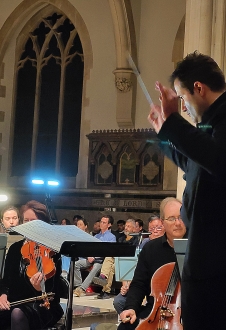
ONCE AGAIN, OLSI QINAMI has conducted the London City Philharmonic Orchestra superbly. Last night (the 28th of October 2023), they performed Rachmaninov’s Piano Concerto number 2 and Stravinsky’s “The Rite of Spring” in the Victorian gothic St James church at the Lancaster Gate end of Sussex Gardens.
Olsi Qinami was born in Albania. At the age of six, he began studying the piano. Then, he studied in Tirana’s Lycée Artistique “Jordan Misja”. Later, he studied at London’s Royal College of Music and also at both the Royal Birmingham Conservatoire and the Ecole Normale de Musique de Paris. A website with his biography (www.olsiqinami.com) noted:
“Olsi continued his studies with Paavo Jarvi at the “Jarvi Conducting Academy”, Riccardo Muti at the “Riccardo Muti Opera Academy” with Orchestra Giovanile Luigi Cherubini, “Orkney Advanced Conducting Course” with Alexander Vedernikov & Charles Peebles and “the Royal Northern College of Music Advanced Conducting Masterclasses” with Mark Heron. He also studied with, Jorma Panula, Michalis Economou, Marco Guidarini, Stefano Ranzani, Alexander Vedernikov, Daniele Rossina, Roland Çene, Petrika Afezolli, Bujar Llapaj, Howard Williams, Neil Thomson and others.”
This impressive education has certainly paid off, as we experienced last night at the concert.
Both works were played superbly. The piano soloist Angela Szu-Hsuan Wu played what seemed like a technically challenging piece by Rachmaninov with great verve and skill, and deserved the tumultuous applause that followed the performance. After a short interval, the orchestra increased in size, getting ready to tackle “The Rite of Spring”. Olsi mounted the conductor’s stand to face an enormous orchestra. Before commencing the performance, he said a few words about the many challenges that Stravinsky’s work poses the orchestra playing it. For example, he explained that within the approximately 40 minutes that the “Rite” takes to perform, there are well over 400 changes of time signature (measures of rhythm). Then, he asked a horn player to play various versions of a tune that Stravinsky had composed in various versions of his work. After that, the orchestra performed the great work. It was an exhilarating performance. Under Olsi’s direction, the orchestra had the audience spellbound. In such a complex piece of music, so much could have gone wrong, but in Olsi’s hands nothing did.
Listening to music played ‘live’ is so much more satisfying than even the best quality recorded music. The three-dimensional spatial appreciation of the sound in a concert hall, or in the case of last night, in a church, can barely be reproduced with the best of hi-fi equipment. As with live theatre, when attending live music, the audience is somehow intimately engaged with the energy and enthusiasm of the players. After a great performance, such as last night’s concert, I am left feeling both exhausted and exhilarated. Last night’s concert performed by the London City Philharmonic orchestra with Olsi Qinami was no exception to this. If you have not yet experienced Olsi conducting, then it is high time that you get to one of his concerts.
BURNHAM BEECHES IS an area of woodland not far from Slough and Windsor. Rich in beech trees, it was purchased by the Corporation of London in 1880. The German composer Felix Mendelssohn (1809-1847) visited Britain several times between 1829 and 1847. While staying in England, Felix enjoyed spending time in Burnham Beeches. It is said that there was one old beech tree under which the composer liked to sit. Legend has it that it was in the shade of this tree that he gained inspirations for some of his compositions including some of the well-known “Incidental music to ‘A Midsummer Night’s Dream’” (composed 1842). In January 1990, when the tree was about 500 years old, it fell over during a storm.
Part of the fallen tree was presented to the Barbican Horticultural Society. Like Burnham Beeches, the Barbican (a post WW2 development in the City of London) is managed by the Corporation of London. The remnant – part of the tree’s trunk – stands on a section of the elevated walkway not far from Barbican Underground Station. Next to it, there is a plaque detailing its history and its probable connection with the composer.
What I have described so far appears in many websites detailing the curiosities of London. However, not one of them mentions that there is yet another fragment of this tree within the barbican. This piece of the dead tree is smaller than that on the walkway, and can be found, somewhat hidden by vegetation, within the Barbican’s magnificent conservatory.
I wondered what had attracted Mendelssohn to Burnham Beeches. In an article by Helen J Read, published by the Buckingham Archaeological Society on its website (www.bucksas.org.uk), I learned that Felix was often a guest of Mr and Mrs Grote, who lived close to Burnham Beeches. They often entertained musical and literary figures. Amongst their many guests was the Swedish singer Jenny Lind, who first performed in London in 1847. The singer also had a favourite tree, which, like Mendelssohn’s, was destroyed in a storm.
Regarding Mendelssohn and his tree, Ms Read wrote:
“Mr and Mrs Grote also entertained the composer Felix Mendelssohn. His favourite part of the Beeches was a mossy slope between Grenville Walk and Victoria Drive, at that time covered with pollarded trees. Many maps mark this area as Mendelssohn’s slope, and it is thought that the music for Puck and Oberon from ‘A Midsummer Night’s Dream’ was inspired by this area. After Mendelssohn’s untimely death, Mrs Grote erected a headstone in his memory but the headstone was removed …
… There is no specific mention in the earlier maps or guides of any particular tree favoured by the composer, but a plaque was later erected on an old pollard tree. The tree blew over and the plaque was moved to one nearby until the storm of 1987, when this tree lost all its branches.”
Judging by what Ms Read wrote, it seems to me that there is a possibility that the fragments of tree, now commemorated at the Barbican as being Mendelssohn’s Tree, might not be remnants of the one beneath which he sat. Even if these bits of timber are not from his favourite tree, they make a charming memorial to a composer whose music gives pleasure to so many people.
JUST AS A PHOTOGRAPHER should try to capture what he or she feels about a subject, rather than attempting to copy it slavishly, I feel that good musicians should not only reproduce what is in the composer’s score but also express what they feel about it and what it means to them as they play.
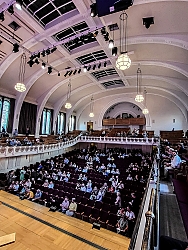
Last night, the 19th of June 2023, we attended a concert of music by Thomas Tallis (c1505 – 1585) performed by the Tallis Scholars at Cadogan Hall (see photograph) in Sloane Square. As far as I could tell, the choir sung well. But I felt for most of the concert they were concentrating on accuracy more than anything else – the result seemed sterile to me. It was only during the final piece “Spem in allium” that the performer’s music sprung to life magnificently – it was an uplifting performance of this piece.
WHEN I SET off for Venice a couple of days ago, I doubted whether I would enjoy the Biennale as much as my wife and our daughter. How wrong I was. I have been enjoying exploring the artworks housed in a number of different places around the city. Some of the shows are in pavilions specially designed for Biennale exhibitions. Others are in places adapted, mostly temporarily, for use during the art festival. For example, the Nepalese and Armenian shows are in what look like disused shop premises. Others are in far grander edifices.
Today, we visited an exhibition housed in the courtyards and rooms of a huge palace, which is home to a music conservatoire (located close to Campo S Stefano). The exhibits (sculptures, paintings, and videos) were created by members of a group of artists within the fold of the Parasol Unit art foundation. The artists in the show are: Darren Almond, Oliver Beer, Rana Begum with Hyetal, Julian Charrière, David Claerbout, Bharti Kher, Arghavan Khosravi, Teresa Margolles, Si On, Martin Puryear, and Rayyane Tabet.
The show in the conservatoire is wonderful. The building itself is a fantastic architectural sculpture with a myriad of neo-classical decorative sculptural details. The works of art, which are in total contrast to the architecture, harmonise interestingly with the environments in which they have been placed. Photographs cannot do justice to this exhibition; it has to be experienced in person.
Although this show will be amongst my favourite exhibitions in the 2022 Venice Biennale, it is not alone in being magnificent. I am glad that we have come to Venice for this artistic bonanza.
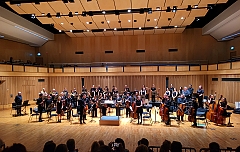
DURING AN INTERVAL of a concert given in Thaxted’s parish church, someone sitting close to us asked whether we hade ever been to a performance in what she described as the ‘superb concert hall’ in nearby Saffron Walden. We had no idea that the small Essex town had a concert hall of note. Always keen to enjoy classical music and to have an excuse to visit Essex, we booked for a concert given on the 12th of August 2022 by both the Essex Youth Orchestra and the Essex Young People’s Orchestra.
The concert hall, which has seating for audiences of over 700 people, was opened in late 2013. It is attached to Saffron Walden county high school, and was financed by a private donation of at least £10 million. This is believed to be the largest private donation to have been made to a state school. The hall is used both for school purposes and for public performances. The venue attracts ‘big names’ in both the classical and non-classical music worlds. For example, the Autumn 2022 programme includes concerts by: the Hallé Orchestra, Isata Kanneh-Mason, the London Philharmonic Orchestra, Lady Smith Black Mambazo, Courtney Pine, The Sixteen, the Pasadena Roof Orchestra, and so on. In addition to these better-known performers, there is a host of others.
The air-conditioned hall is beautiful. It is spacious, and fitted with adjustable acoustic panels and its walls are lined with birch wood. We heard a wide range of compositions beautifully performed by the two orchestras. The acoustics were fantastically good. The sound quality within the hall rivals that of the best concert halls in London. A small grumble is that the seating is not overly comfortable, but that did not detract from our enjoyment of the music performed by some of the best young musicians in Essex. Saffron Walden is not far from London, but it feels like it is much further away. If you do not mind night driving, it would be feasible to drive to and from Saffron Hall to enjoy an evening concert, but my suggestion is to spend a night somewhere near the hall and to enjoy Saffron Walden, its concert hall, and its rustic surroundings.
THE COMPOSER GUSTAV Holst (1874-1934) is best known for his orchestral suite “The Planets”, which was composed between 1914 and 1916. This work does not include the planet Pluto, which was only discovered in 1930. Son of a professional musician, Holst was born in Cheltenham (Gloucestershire). Between 1886 and 1891, he was a pupil at Cheltenham Grammar School, where at the age of 12 he composed his first piece, “Horatius” for an ensemble of strings, woodwind, brass, and percussion. From 1891, he studied counterpoint for several months with the organist of Merton College in Oxford. Next, Holst studied composition at the Royal College of Music (‘RCM’) in London’s Kensington.
After graduation at the RCM, Holst worked as a professional trombonist in the Carl Rosa Opera Company and the Scottish Orchestra. During this time, he continued composing and also became interested in translations of Sanskrit literature. Several of his compositions reflect his heartfelt interest in the “Rig Veda”, “Ramayana”, and the “Bhagavad Gita”, all of which struck a meaningful chord with him. In 1903, he accepted a teaching role at James Allen’s Girls’ School in Dulwich. Two years later, he left Dulwich to become Director of Music at St Paul’s Girls School in Hammersmith, a position he retained until his death.
Gustav Holst lived here in Barnes
Between 1908 and 1913, Holst lived not too far from the school: at Barnes in a house facing the River Thames on a road called The Terrace. His daughter Imogen Holst (1907-1984), herself a composer, wrote a biography of her father (published 1938). In it she described the house in Barnes:
“… a beautiful bow-fronted brick house overlooking the river. He had a large music room on the top floor, and in the evenings the grey, muddy river would collect all the colours of the sky and shine with a magical light …”
However:
“It was an unhealthy house to live in, for at the spring tides the river overflowed into the streets, and often the floods would come in at the front door. He never felt really well there, and was perpetually suffering from a relaxed throat …”
Before moving to Barnes, Holst began to become interested in socialism, and having read some of the writings of William Morris (1834-1896), who had been living next to the Thames near Hammersmith in Kelmscott House since 1878. Imogen Holst wrote of her father’s interest in socialism:
“… [he] began to hear about Socialism, and after reading several books by William Morris he joined the Hammersmith Socialist Club and listened to Bernard Shaw’s lectures at Kelmscott House. Here he found a new sort of comradeship, and here he became aware of other ways of searching for beauty…. His socialism was never very active, and although he admired William Morris as a man, he found that the glamour of his romantic Mediaevalism soon wore off. But he remained in the club for the sake of good companionship, and in 1897 he accepted an invitation to conduct the Socialist Choir.”
He met his wife, Isobel (née Harrison), when she joined the choir as a new soprano, and they married several years later.
Holst travelled a great deal to places where the climate was better suited to his asthma. While visiting North Africa in 1908, he heard a street musician playing a repetitive tune on a flute in a street in Algeria. This haunted him and led to his composing a lovely orchestral suite “Beni Mora”, which is amongst my favourite pieces by Holst. I first heard this when a musical friend of mine, the late Roger Apps, played a recording of it for me in his home in Rainham (Kent).
A keen walker, Gustav and Isobel went rambling in England. On one of these outings, they visited Thaxted in northern Essex, where they bought one cottage (and then moved to another), in which Gustav spent as much time as possible. I will describe his musical associations with Thaxted in far greater detail in the future. Suffice it to say that some parts of “The Planets” suite were composed there.
In 1913, St Pauls School opened a new music wing, in which Holst was given a large soundproof room for his composing work. That same year, mainly for health-related reasons, he and his family moved from the house in Barnes to a house in Brook Green close to the school.
PARR HALL IN the heart of Warrington (Cheshire) is a concert hall designed by local architect William Owen (1846-1910). It was built for the townspeople by Joseph Charlton Parr, descendant of the founder of a local bank. The benefactor was a prominent member of his family’s bank, Parr’s, and Warrington’s Mayor between 1901 and 1903. A plaque on the wall of the hall facing Palmyra Square commemorates his generosity. A much larger and newer plaque, actually a frieze, also outside the front of the hall, serves a sadder purpose.
In May 2013, a new rock band was formed in Warrington. Called Viola Beach, it had four members: Kris Leonard, River Reeves, Tomas Lowe, and Jack Dakin. Frankie Coulson and Jonny Gibson were initially members, but they left the group to concentrate on their university studies. Reading of this, I was reminded of one of my father’s students at the London School of Economics: Mick Jagger. Unlike Coulson and Gibson, he could not afford to remain a student as his band was becoming so successful. Incidentally, The Rolling Stones performed at Parr Hall in November 1963.
In June 2016, the band’s debut album, “Viola Beach”, was released. Consisting of 9 tracks, it reached the number 1 position on The UK Albums Chart in August of that year. However, the band were never to learn of their success. In February 2016, the members of the group and their manager were on tour in Sweden. In the early hours of the 13th of February, the car in which they were travelling failed to stop at the closed barriers of a bridge across the Södertälje Canal. The roadway of the bridge was lifting to allow the passage of a vessel in the canal. The car carrying the band plunged into the water 98 feet below. The driver, the band members, and its manager, were all killed. The memorial outside Parr Hall, which portrays the band members and their manager in bas-relief, was sculpted by Tom Murphy. It was unveiled in September 2021.
Had they not met their end so prematurely, I wonder whether Viola Beach formed in a town on the Mersey might have gained some of the success enjoyed by another now much more famous Merseyside band: The Beatles.
THE ESTORIC COLLECTION in London’s Highbury houses a fine permanent exhibition of modern Italian artworks, mainly creations of the so-called Futurists. In one of the galleries, I spotted the name of an artist who was born in a town, which I have visited, in the northeast of Italy: Gorizia. When the artist Anton Zoran Music (1909-2005) was born, Gorizia was part of the Austro-Hungarian empire. After WW1, the town became part of the Kingdom of Italy within the region of Venezia-Giulia. Soon after WW2, the eastern part of the region became absorbed into the Yugoslav republic of Slovenia (now an independent state). When that happened, the border between Italy and Slovenia ran through the eastern part og the town, the part in what was then Yugoslavia (a country I visited often between 1973 and 1990) became named ‘Nova Gorica’. Most of Gorizia, an attractive old town, is on the Italian side of the border.
Slovenians still live on both sides of the border. Music, actually Anton Zoran Musič (pronounced mus-ich) was born into a Slovene-speaking family. Zoran, who went to schools in Maribor, studied art at the Academy of Fine Arts in Zagreb between 1930 and 1935. His first one-man exhibition (outside Yugoslavia) in Venice in 1943, where he had moved. Soon after this, he was arrested by the German Gestapo and then sent to Dachau concentration camp. After WW2, he moved to Ljubljana (in Yugoslavia), but soon shifted to Venice, where he lived (on and off) for the rest of his life. His career after the War was successful: he received several prestigious prizes for his artistic creations.
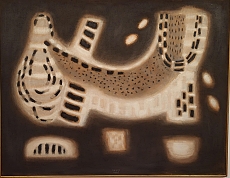
The Estorick displays five of Music’s paintings. They were created between 1951 and 1983 and illustrate his versatility as a painter. All the paintings hanging are between abstract and figurative in style, but slightly nearer the latter than the former. I had seen his paintings on previous visits to the Estorick, but until my most recent viewing of his art, I had not been aware of how many aspects of his life mesh with things that interest me.







 yamey
yamey 